
Posted on Sep 21, 2026
How to Introduce a Character: 8 Tips To Hook Readers

Savannah Cordova
Savannah is Editor-in-Chief of the Reedsy Blog. She has 8+ years of experience crafting content about how to write, edit, design, and publish your book as an independent author.
View profile →
Tom Bromley
Author, editor, tutor, and bestselling ghostwriter. Tom Bromley is the head of learning at Reedsy, where he has created their acclaimed course, 'How to Write a Novel.'
View profile →The best character introductions present characters’ personalities in unique and intriguing ways. But a strong character introduction isn’t just about the character — it also helps set the tone for the rest of the narrative.
Naturally, it’s crucial to get your introductions right. In this article, we’ve compiled eight helpful tips to introduce characters more effectively, with practical examples from successful novels.
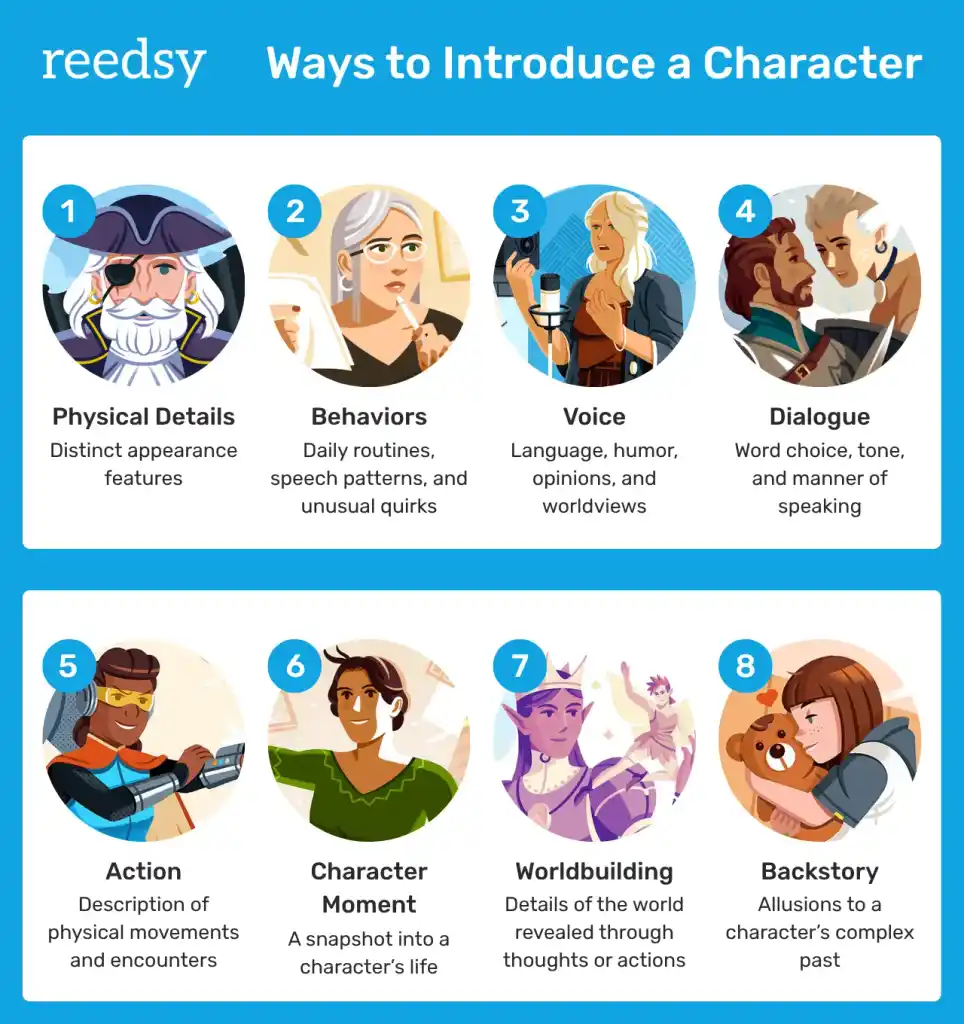
1. Open with telling physical details
In his course How to Write a Novel, author Tom Bromley explains how a character’s physical appearance is instrumental to their introduction. However, that doesn’t mean you need to lay it on thick. Instead of presenting too many details, you’re better off highlighting a few telling physical traits that’ll stick in readers’ minds.
Let’s look at an excerpt from the opening of Margaret Mitchell’s Gone with the Wind:
“Scarlett O’Hara was not beautiful, but men seldom realized it when caught by her charm as the Tarleton twins were. [...] But for all the modesty of her spreading skirts, the demureness of hair netted smoothly into a chignon and the quietness of small white hands folded in her lap, her true self was poorly concealed. The green eyes in the carefully sweet face were turbulent, willful, lusty with life, distinctly at variance with her decorous demeanor.”

Vivien Leigh as Scarlett. Credit: MGM.
Scarlett’s appearance symbolizes the disconnect between her true self and how the world perceives her. It also foreshadows conflict arising from her defiance of society’s expectations. Details like this can go a long way toward hooking readers into your characters and wider story.
Aside from distinct physical characteristics, you can also introduce a character through their behavioral quirks...
2. Reveal their unique behaviors
Unique behaviors encompass anything out of the ordinary that will stick with readers. This could include an odd ritual, an unusual speech pattern, or a weirdly intense attachment to a particular object (for example, Sebastian and his teddy bear in Brideshead Revisited).
While it may be especially evocative to “show” rather than “tell” your character’s quirks, they can also be established through direct characterization. Especially at the beginning of a story, this approach efficiently sets the stage for a character and their story.
Take the introduction of Ove from A Man Called Ove by Fredrik Backman. In the very first lines of the novel, Backman outright states Ove’s traits and behaviors:
“Ove is fifty-nine. He drives a Saab. He’s the kind of man who points at people he doesn’t like the look of, as if they were burglars and his forefinger a policeman’s flashlight.”

Rolf Lassgård as Ove. Credit: TrustNordisk.
We soon learn Ove’s pointing is just one of his many unorthodox (and oftentimes antisocial) behaviors. He also wakes up at 5:45 AM every day with no alarm. He conducts a daily inspection of his neighborhood. He argues with cats (whom he detests). His introduction fits him to a tee: no-nonsense, judgmental, a bit peculiar.
Of course, you don’t need to give your character as many peculiarities as Ove. Just one or two traits like this will help them stick in readers’ minds.
Q: What are some of the most effective character introductions in fiction, and what makes them work?
Suggested answer

Good character introductions reveal something essential—voice, want, or contradiction—directly, not in description. Take Elizabeth Bennet of Pride and Prejudice, whose sensibility and intelligence we infer from dialogue, or Katniss Everdeen in The Hunger Games, who is tough and competent before she even speaks.
They succeed because they root us in the character's internal life, not their appearance. We see choices, responses, and convictions acted out. Even awkward or introverted characters can catch us with their first few moments imparting a sense of inner conflict. A good introduction doesn't tell us who a character is—it makes us feel it.
John is available to hire on Reedsy
3. Lead with their specific voice
Another method to present a character is through their voice. Their language, humor, opinions, and worldviews all help define who they are.
To draw on a classic example, here’s the opening sentence from J.D. Salinger’s Catcher in the Rye, narrated by caustic teenager Holden Caulfield:
“If you really want to hear about it, the first thing you'll probably want to know is where I was born, and what my lousy childhood was like, and how my parents were occupied and all before they had me, and all that David Copperfield kind of crap, but I don't feel like going into it, if you want to know the truth.”
Frequent swearing, long run-on sentences, references to pop culture: these small details give us greater insight into Holden’s character. This introduction paints him as young, blunt, and abrasive, with a cynical outlook on life.
That said, some degree of relatability is key here. Your readers don’t necessarily have to see themselves in your character — but incorporating worldviews they might recognize in other, real-life people will add authenticity to your character and keep those readers engaged.
4. Present them through dialogue
Next up: dialogue. While a character’s unique narrative voice tells us how they perceive the world around them, their dialogue with others shows us how they navigate it.
Take the opening exchange between Clarice Starling and Dr. Hannibal Lecter in The Silence of the Lambs:
"Dr. Lecter, my name is Clarice Starling. May I speak with you?"
"You're one of Jack Crawford's, aren't you?" he said. "May I see your credentials?"
She handed him the credentials through the food carrier. For a second, she thought he might touch her fingers, but he didn't. He seemed to look at her, then at the card, then back at her—at her face and at her hands.
"Closer, please. Closer."
She moved closer to the bars, and as she did, she noticed his strange, maroon eyes.
"That expires in one week. You're not real FBI, are you?"
"I'm still in training at the Academy," she said.”

In this scene, Dr. Lecter’s dialogue showcases his menacing and subtly controlling nature. The way he speaks, the words he chooses, and how he treats Clarice all create an atmosphere of unease and formidability. Yet even as we begin to fear him, we’re equally compelled to learn more about his character.
Dialogue is a powerful tool to show your character’s personality, so use it wisely. Focus on how their word choice, tone, and manner of speaking reflect their inner world. Consider how your character responds to others, and how much (or how little) they reveal about themselves in conversation. Every line of dialogue is an opportunity to hint at your character’s motivations, background, and the dynamics they will bring to the story
Q: What are some techniques authors can use to introduce characters naturally through dialogue?
Suggested answer

How much or how little a character "speaks" says a lot about them. A dialect can also reveal where they are from. Broken English or a stutter can also say a lot. Dialogue is a great way to "show" and not "tell."
Melody is available to hire on Reedsy

The main thing to get across when introducing characters through dialogue is to write it so it feels natural. Constantly ask yourself if the way you're making them speak is the way regular people in those circumstances would speak. If it sounds too stilted or infodump-y, that's going to distance your reader from the character because they'll feel unreal, manufactured—just there to move the plot along.
Brett is available to hire on Reedsy
When you're going to create a character through dialogue, what you want to do is provide the reader with information about this individual without interrupting the action for exposition.
One good way to do that is to think about how actual people reveal themselves in conversation: through what they say, the cadence of their speech, and what they focus on. Instead of telling us about what a character is sure, nervous, or resentful of, you can make those qualities evident in what they say.
A certain sort of character might answer quickly or deflect, while an unsure one might lie or offer more questions than answers. You can also include context of hinting—perhaps another character does something in response to an unexpected comment, or someone uses a nickname that suggests history. This allows the dialogue not just to define who the character is, but also how they exist in relationships with the world around them. It's generally more engaging to give little hints than to tell everything.
By piling personality, background, and relationships onto conversations, you create a sense of authenticity so that readers feel they're reading about a real person rather than getting a synopsis.
John is available to hire on Reedsy
5. Jump straight into action
They say actions speak louder than words, and this old adage applies to writing great characters as well. If you wish to establish your character’s personality succinctly, introduce them through action rather than description.
Cormac McCarthy’s introduction of Anton Chigurh in No Country for Old Men is an excellent example of this. The scene below describes Chigurh’s escape from police custody (warning, it’s a violent one):
“[The deputy] was slightly bent over when Chigurh squatted and scooted his manacled hands beneath him to the back of his knees. In the same motion he sat and rocked backward and passed the chain under his feet and then stood instantly and effortlessly. If it looked like a thing he'd practiced many times, it was. He dropped his cuffed hands over the deputy's head and leaped into the air and slammed both knees against the back of the deputy's neck and hauled back on the chain. They went to the floor. The deputy was trying to get his hands inside the chain but he could not. Chigurh lay there pulling back on the bracelets with his knees between his arms and his face averted.”

Even in handcuffs, Chigurh can still calmly and ruthlessly choke the life out of the deputy. This calculated brutality speaks volumes about his character, his utter lack of remorse, and the lethal threat he poses.
By introducing Chigurh through action, McCarthy sets the tone for his role as a chilling antagonist. Similar to the Hannibal Lecter example above, this characterization simultaneously unsettles readers and compels them to keep reading — if only to see what other heinous crimes Chigurh will commit.
6. Begin with a character moment
A character moment is a snapshot into a character’s life that clearly demonstrates who they are. It should present the character in a “classic” situation for them, reacting in a way that exemplifies their personality.
For example, People We Meet on Vacation opens with main character Poppy’s idealistic thoughts about traveling: “On vacation, you can be anyone you want.” This is immediately followed by a vivid introduction to Poppy’s real life, which is somewhat less than idyllic:
“On my way out of the bathroom, I pause. Partly, this is because I’m still working on my game plan. Mostly, though, it’s because the floor is so sticky that I lose my sandal and have to hobble back for it. I love everything about this place in theory, but in practice, I think letting my bare foot touch the anonymous filth on the laminate might be a good way to contract one of those rare diseases kept in the refrigerated vials of a secret CDC facility. I dance-hop back to my shoe, slip my toes through the thin orange straps, and turn to survey the bar.”

Emily Bader as Poppy. Credit: Netflix.
Poppy’s initial internal monologue paints her as a starry-eyed optimist. But readers quickly grasp her reality — a sticky dive bar where she’s currently down a shoe and hopping backwards across the floor. This juxtaposition serves as the perfect introduction to Poppy: she’s a bit goofy, she might do something embarrassing in public, but she maintains a sense of humor and positive outlook regardless.
Not sure how to create an effective character moment for your protagonist? These 40+ character-centric writing exercises might help. Work through a few of them to better understand the ins and outs of your character — and what kind of situation would be quintessentially “them”. Or check out the character profile template below to help develop a complex character.

7. Meld worldbuilding into their introduction
You can also try introducing your character alongside a bit of worldbuilding. The trick is to not put the cart before the horse; remember, your protagonist is the emotional hook and the eyes through which your readers will experience this world. So don’t go overboard with worldbuilding until you’ve gotten readers (at least a little bit) invested in your main character.
Sarah J. Maas’s introduction of Feyre Archeron in A Court of Thorns and Roses strikes a nice balance of characterization and worldbuilding:
“Hunger had brought me farther from home than I usually risked, but winter was the hard time. The animals had pulled in, going deeper into the woods than I could follow [...] Here there were no telltale trees stripped of bark to mark the deer’s passing — they hadn’t yet moved on. They would remain until the bark ran out, then travel north past the wolves’ territory and perhaps into the faerie lands of Prythian — where no mortals would dare go, not unless they had a death wish.”
Here, Maas shows Feyre’s determination to live in her harsh reality while also establishing the existence of faeries and a dangerous magical land. By sprinkling in just a few details about Feyre’s world, Maas intrigues readers without overwhelming them — and hints at the story to come, of Feyre’s quest for survival in the faerie lands (the very place she’s always feared).
Try using your own character’s thoughts, actions, or dialogue to subtly reveal some details about their world. Weaving in information about their background, occupation, or social world may be especially fruitful. This tactic will both ground your character in the world and help readers absorb the setting organically.

FREE COURSE
How to Develop Characters
In 10 days, learn to develop complex characters readers will love.
8. Leverage their backstory
Finally, crafting an engaging backstory for your character is an excellent way to endear them to your readers.
Many writers do this through flashbacks — but as with worldbuilding, you also don’t need to provide too much information. Hints at their past can be highly effective. For example, this is how Amir begins his story in Khaled Hosseini’s The Kite Runner:
“I became what I am today at the age of twelve, on a frigid overcast day in the winter of 1975. I remember the precise moment, crouching behind a crumbling mud wall, peeking into the alley near the frozen creek. This was a long time ago, but it’s wrong what they say about the past, I’ve learned, about how you can bury it. Because the past claws its way out. Looking back now, I realize I have been peeking into that deserted alley for the last twenty-six years.”
This passage reveals small pieces of the narrator’s personality: he’s introspective and feels he’s been held back by his past. Yet his reticence also immediately raises questions that can only be answered by continuing: what happened in the alley back in 1975? Besides introspective (and potentially regretful) what kind of person has the narrator become? This kind of allusion to a character’s complex past inevitably leaves readers wanting more.
It can be tempting to gush about every little detail of your character’s history. However, try to restrict yourself only to information that will be relevant to your character’s story arc and the plot development. (And again, the same goes for worldbuilding and any other kind of exposition.)
There you have it: eight tips to help you captivate readers with an engaging character introduction. Hopefully, now you're more equipped to craft introductions that will make your characters leap off the page and into readers’ hearts.