Posted on Aug 03, 2026
11 Writing Strategies You Can Use Today

Loretta Bushell
Loretta is a translator, proofreader, and writer with 4+ years of experience in the publishing industry. She helps freelancers and authors build sustainable careers.
View profile →Writing strategies are actionable techniques or workflows that help you write better and faster. Whether you aim to speed up your writing, enhance your storytelling, or refine your editing process, here are 11 tried-and-true strategies you can use today.
Let’s start with some writing strategies to improve your efficiency, productivity, and motivation.
1. Outline what you want to say first
I can already hear the pantsers protesting — and yes, it’s true that outlining in minute detail can restrict your creativity. But writing without any plan is no better: you often get stuck or waste days going off on tangents you later have to cut. Devoting a few hours to plotting your main story beats (or argument structure) saves time in the long run.
Q: What outlining techniques can 'pantsers' use to guide their storytelling without stifling creativity?
Suggested answer
Many pantsers can be completely stifled by outlining, so the trick is to figure out what best works for you, and follow through on that plan. That said, here are some strategies to try if you known you need to stick to pantsing, but don't want to sit down and fight with writer's block in your limited writing time:
1) Try to write down the bare minimum of bullet points (I'm talking beginning, middle, end, and that's it). Even if you just have a few distant guideposts to work from, that can be a big help.
2) If you're a true pantser, just writing what's directly ahead of you, writer's block can be a particular danger. If this is you, my suggestion is to embrace daydreaming about your story. Try to carve out time where you'll be able to daydream what comes next, and it will quickly become a routine that you use particular time for 'writing' even if you're not physically writing. Whether it's while you're showering, doing the dishes, doing the laundry, riding the bus, or whatever--gearing your daydreams toward your current project can be a big help in ensuring that you know what to write when you sit down in front of the keyboard, even if you are 100% devoted to pantsing.
3) If some settings are key to your book, try sketching them out for inspiration. For instance, if 75% takes place in a particular home or workplace, sketching out and coloring in different rooms, even in the loosest/messiest form, can serve as inspiration when you're stuck and help to make sure that your setting stays consistent (because even if you don't have those drawings pinned to the wall, that blue bedroom with a shag throw-rug will be much stickier in your mind after you've drawn it vs given it a quick sentence). Thinking about setting in your downtime or taking this approach will save on revision for consistency later.
Jennifer is available to hire on Reedsy

Even having a very basic three-part/three-act overview of the story with just one page of notes per act will help you stay on course when drafting, so the finer details can emerge while you write. You want to know at least how the story ends, and then drive forward toward that ending. The ending doesn't have to be too specific, again, as details may arise while crafting the story, but knowing if it will be a tragedy or have a positive outcome at the end should help to drive the narrative forward.
Melody is available to hire on Reedsy
New York Times bestselling author and Reedsy editor Caroline Leavitt is living proof of this. “I used to be one of those people who follows their pen. I’d end up with novels that were 800 pages long and I’d have to spend another year just plowing through and figuring out what the story actually was.” For her ninth novel, Caroline tried some outlining techniques. “And lo and behold, that novel was not 800 pages long, but 400. I sold it right away and became a New York Times bestseller.”
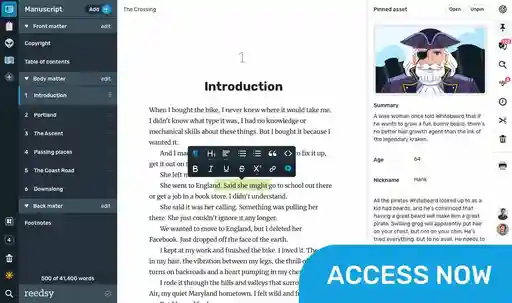
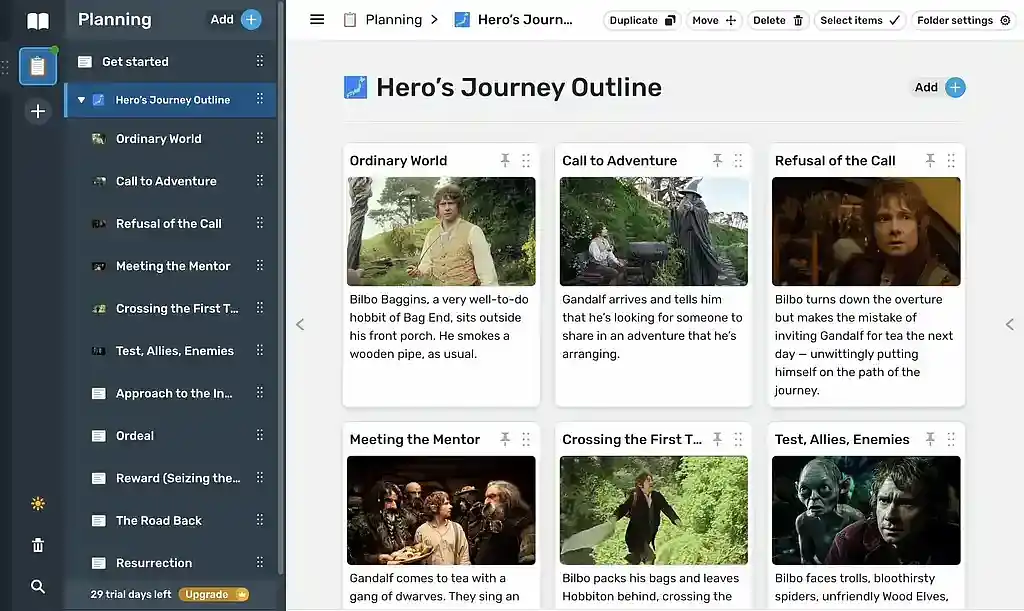
You can plot your story beats using a book outline or story structure template over on Reedsy Studio. Plotters can access hundreds of additional character and worldbuilding questions, while pantsers can stick to the basics.
2. Set small, achievable goals
It’s also worth adding structure to your time. Break your to-do list down into small, achievable word count targets, and reward yourself for meeting your goals. Every writer is different, but as a rough guide, a beginner can typically write 300–500 words per hour on a good day. Adjust this target until it’s challenging but achievable for you.
I like to reward myself with a sticker chart. Not wanting to break my streak is surprisingly motivating for me. Other writers I know reward themselves with snacks, phone games, or general relaxation.
If you want to go more extreme, you can also think up negative consequences for failure, such as no dessert or no TV!
You can monitor your progress against your daily and manuscript word count goals in Reedsy Studio.

3. Find your window of productivity
If you consistently struggle to meet simple goals, it might be because you’re writing at the wrong time of day. There’s no universal best time to write, so experiment until you find a schedule that works for you. Would you prefer to get up early like Benjamin Franklin or write into the evening like F. Scott Fitzgerald? Do you work better in small daily bursts or for several hours at once at the weekend?
4. Schedule non-negotiable writing time into your week
Once you’ve found a time that works for you, protect it with your life. Add writing sessions to your calendar and treat them like dentist appointments — commitments you honor unless there’s a genuine emergency. (And no, an overflowing laundry basket is not an emergency.)
Q: What daily writing routines can help authors maintain consistent productivity?
Suggested answer

The key to this question is one of the words in it: routines. Writing doesn't happen by accident. You need a routine and it has to be one that fits your needs. I get up at five every morning because that's when I'm awake and ready to go. I shower and eat breakfast. Then I sit at my computer in the room I use for writing. The door is closed. Everyone in the house, resident or visitor, knows the first unbreakable rule: you can knock on that door to tell me that the house is on fire and for no other reason. There is no phone in the room with me, I don't go online and I don't look at emails. I break at 10:30 for coffee: that break lasts 20 minutes and is subject to the second rule: I'm not available for conversation. Lunch at 12; the second rule still applies. Apart from those breaks, I spend the whole time writing. By 2:30 the creative juices are gone for the day. I go downstairs, I'm available for conversation. I go for a walk (I'm lucky in that regard; I don't live in a town or city and there are lots of nice places to walk). I walk at least 30 minutes, even if it's raining or snowing. If the sun is shining, that 30 minutes may become an hour. Why? Because you can't keep this kind routine up unless you are physically fit. The routine will begin again until next morning – I'm likely to read in the evening, but I won't write. That's the routine that suits me seven days a week. It would probably appall many other writers – each one of us has to find the routine most suitable to them.
John is available to hire on Reedsy

There are four things that I consider before settling in to write.
What sounds are there? The best is silence, but in a city environment this is impossible. If there are specific loud that I want to block out, I listen to drone music. This consists mostly of long, sustained notes (no melodies) and comes from the American and German post-war experimental musical traditions. The texture of the sounds is often rich which works for this purpose quite well. It has a meditative effect. Failing this, music without lyrics is also good.
What is my phone doing? Just switch it off.
Social media. Along with my phone, this is designed to distract. What I do is log out of my social media accounts. If I automatically go back in, I'm then met by the login page. This doesn't sound like much of a difference, but is just enough to nudge myself into becoming mindful of what I'm doing and what my present purpose it. And mindfulness is key.
Lastly, I take a page of Hemingway's advice: "The first draft of anything is s**t." It's ok to produce bad writing. In fact, it's totally ok; actually it's great. Why? Because my ideas are now down on the page, even if it's absolutely horrible. Nobody ever simply writes a finished product straight off the bat. I'll make it better later and that is a different process.
Don is available to hire on Reedsy

Get all domestic and admin chores out the way first, so that there is nothing else on your mind when you sit down to write. Then just stick at it for as long as possible.
Andrew is available to hire on Reedsy
5. Write without editing
Your own perfectionism can sometimes be just as much of an obstacle to writing as your endless to-do list. The trick to making speedy progress is to turn off your inner critic. Stop editing as you go, and quit worrying about the quality of your first draft. First drafts are supposed to be reworked!
Once you discard expectations, it’s much easier to get your ideas onto the page and make actual forward progress. Most writers find that editing an existing draft is easier than finishing an incomplete one.
I applied this writing strategy while writing this very post. The first draft of this section looked like this:
As well as general life getting in the way, many writers allow their own inner critics to halt their progress. If you’re a perfectionist who edits the same paragraph again and again and still isn’t happy with it, you need to break the habit. You can do so by writing without censoring or editing your work. This gets the ideas down on the page faster — with no expectation that they’ll be written well. It’s based on the principle that it’s easier to edit a complete draft than to finish one.
The rhythm and voice of this paragraph are both a little off. However, I managed to get the content down very quickly without interrupting my chain of thought, which was ultimately more efficient than agonizing over every sentence the first time round.
6. Quit while you’re ahead
If you find it especially difficult to get started during a writing session, try quitting before you run out of ideas. Next time, you can simply continue from where you left off without having to think about what to say.
Roald Dahl used to swear by this technique. “You make yourself stop and you walk away. And you can't wait to get back because you know what you want to say next.”
Q: What’s the best way to overcome writer’s block?
Suggested answer
The harsh truth is that there's no one best/true method for overcoming writer's block because writer's block is so unique to each person experiencing it. The effect of it--not being able to write--may be the same for everyone, but the causes are as varied as the writers experiencing it. That said, here are some strategies.
1) Try to figure out what's driving your writer's block. Did it start when you began considering a particular scene/character, or when some new stressor came up in your personal life? If you can figure out the source of your block, that may give you the path toward overcoming it. For instance, I worked with a writer who suddenly hit major writer's block when she was approaching a fight between characters in her Romance novel. What felt like garden-variety writer's block at first didn't resolve after a few days like it normally would for her; after weeks, she still hadn't managed to write another word. Ultimately, we talked it over and she realized it was because she'd based the characters too much off of her own relationship, and approaching the fight was causing her serious anxiety in her personal life. The solution in her case? Tweak one of the characters and the source of the fight so that she no longer felt like she was projecting fiction onto her real future.
2) Sometimes writer's block happens because a writer needs time to think. If you're stuck--especially if this isn't your first project, and the writer's block is worse than usual--take some time out to think about your project. For many writers, daydreaming is a serious part of the writing process. It may be that you need to give your project/next scene some more time to percolate before you're ready to write it. Worse comes to worse, try taking a break and writing something else or reading outside your genre, and that may give your conscious mind to catch up to your project's needs.
3) If you're midway into a project and you suddenly get blocked, consider what's just happened and what's to come. If the block is happening because you're stressed about what's about to happen in the book, your only option may be to force yourself through it (this can especially happen if what's coming up in the plot is personally triggering for you and you're planning to write it anyway). On the other hand, writer's block often happens because a writer has made a misstep in plot or character development--a plot point happened earlier than it should have, a character did something out of character, etc. Sometimes, backing up a few scenes/chapters and rethinking those last few decisions can help you realize where you went wrong, and once you back up, the writer's block will take care of itself.
Jennifer is available to hire on Reedsy

The best answer here is the most common (and maybe annoying!) one: the best way to overcome writer's block is to write.
If you're struggling to put more words on the page, the only way to truly get through that is to keep writing. Even if you need to open up a separate document to write a completely different scene with the character, the act of writing, the consistency of it is the best way to not only motivate yourself to keep writing, but also to keep the ideas and creativity flowing.
Matt is available to hire on Reedsy

I highly recommend ‘The Artist’s Way’ by Julia Cameron. It takes you through twelve weeks of exercises, daily tasks, and reflections to unlock your creativity in every aspect of your life, helping to create a more fundamental shift in how you approach creative expression.
However, if you’re looking for quicker solutions, here are a few things that have helped me and others:
- Go for a walk (try to avoid listening to anything on headphones while you do - just give your mind some space to breathe)
- Exercise
- Write in a different location than usual
- Change your method of writing (for example, if you usually type, try writing by hand)
- Do ten minutes of free writing
- If you’re stuck in a particular section of your story, skip to the next scene, or try shifting the perspective or location of that scene
- Do a writing exercise that relates to your story, but isn’t writing your story (such as writing a monologue from the perspective of one of your characters)
- Write in a different format (for example, if you usually write prose, try some poetry)
- Read an author who inspires you
- Do some research that relates to your story
- Make a mood board or playlist of your story
Emily is available to hire on Reedsy
If you’re still stuck for ideas, check out some other ways to combat writer’s block here.
Now let’s look at some writing strategies to help you plan and write more engaging narratives.
7. Show cause and effect
When planning a story, it’s important to think about causation. A weak story can be boiled down to “This happened. And then this happened. And then this happened.” But in a more memorable narrative, every action or reaction has a direct impact on what happens next, making the story’s events feel convincingly inevitable.
Reedsy editor and writing coach Tom Witcomb encourages clients to write down the main events of their story using only “therefore” and “but” between sentences. The odd “and then” can’t always be helped, but if you find yourself writing “and then” twice in a row, you know you need to strengthen that part of your plot.
Q: Which story structures give beginners the best foundation for writing engaging fiction?
Suggested answer

First, ask yourself, "Whose book is this?" If you were giving out an Academy Award, who would win Best Leading Actor? Now, ask yourself what that character wants. Maybe they want to fall in love, recover from trauma, or escape a terrible situation. And what keeps them from getting it? That's your plot. You can have many other characters and subplots, but those three questions will identify the basis of your story. I always want to know how the book ends. That sets a direction I can work toward in structuring the book.
I like to go back to Aristotle: every story needs a beginning, a middle, and an end. Act I, Act II, and Act III. Act I sets up the story. Mary and George are on the couch watching TV when… That's Act I. We introduced our characters and their lives and set a time and place. Now, something happens that changes everything. The phone rings. A knock on the door. Somebody gets sick or arrested or runs away from home. Something pushes your character or characters irrevocably into Act II. Maybe in Act I, George got arrested. In Act II, he's trying to prove his innocence, and all sorts of obstacles get in the way. Maybe somebody calls Mary and tells her George has another family she's never heard about, and she spends Act II trying to save her marriage or herself. Act III is the outcome. It's when the boy gets the girl or doesn't get the girl or gets the girl and isn't sure he wants her after all.
I'm a big fan of outlining. You're probably going to change it a lot as you get writing and get to know your characters intimately, but it gives you structure, so when you sit down to write, you know what you're going to write about. Even if you don't know precisely how you're going to break your story into scenes and chapters, it's good to know how the book ends so you're moving towards something. Before I start writing a scene, I need to know who is in it, where it takes place, what happens, and why it's in this book. Does it move the story forward? Does it give readers insight into the character? Or is it just taking up space on the page?
Joie is available to hire on Reedsy
Using a three-act story arc is the easiest way to define a story because at its core, each story has a beginning, middle, and end. A set-up to a journey, a journey, and a conclusion to this journey, will make up the three acts of every story.
Melody is available to hire on Reedsy

When I work with new writers struggling about where various story beats go, I typically refer them two The Hero's Journey by Joseph Cambell, and Save the Cat Writes a Novel by Jessica Brody. Both of these describe slightly different elements of what is included in a story.
Now, sometimes writers can get too caught up in fitting their story exactly into these story templates. But that's all they are; templates. An analogy I like to use with authors is that there are cooks, and there are chefs.
Cooks follow the recipe (story structure) exactly, never deviating, and while it can produce good dishes, there sometimes is a lack of creativity within. Chefs, on the other hand, also follow the recipe, but they also know it well enough to deviate from it. Add their own flair, flourish, and spices. By the end, the story is recognizable but their unique take on it.
You have to know the rules to break them, so for newer authors I work with, having them break down their story into the various story beats and plug them in to the two templates above can help them see where each story element fits, and maybe where a story element needs to be added or elevated.
Sean is available to hire on Reedsy
8. Skip exposition that doesn’t serve the story
Another hallmark of a weak story is info dumping. Whenever you’re tempted to explain something about your world or a character, put your strictest thinking cap on and ask yourself, “Does the reader really need to know this now?” If the information genuinely helps them understand the plot, go for it. If not, save it for a future Q&A!
As a general rule, only introduce specific details as and when they relate to the current action, per the table below.
|
Information that serves the story |
Information to keep to yourself |
|
A specific childhood memory that explains the origin of a character’s flaw or insecurity |
Details of all the schools the character went to and all their previous relationships |
|
The law your character is going to break |
All the unjust laws in society |
|
Two or three things in a room that tell us who lives there |
A wall-to-wall inventory of a room |
Q: What are effective techniques for incorporating exposition into a story without disrupting the flow or pacing?
Suggested answer
In fiction writing, I tell authors to treat your readers like they're in the CIA: everything is on a need-to-know basis.
Add expository details as they become relevant to what the POV character is experiencing right now. If the lore or backstory contributes to your readers' understanding of the current scene, those crucial details can actually speed up the pacing instead of slowing it down.
Using the CIA technique can also help you know how much exposition to add at one time--if you're debating whether a specific detail is necessary, consider whether your readers could understand the scene without it. If so, you can confidently place that exposition in a more relevant scene.
Heather is available to hire on Reedsy

The best way to get exposition in is through dialogue. The caveat, of course, is to be careful that it comes across naturally. For instance, if your characters are telling each other things they would know, the reader will know you're only doing that to get the information to the reader, which will greatly reduce their suspension of disbelief.
The second best way, in my opinion, is through thoughts. Again, though, the character needs to think things they would actually think in their situation. For instance, in a fantasy novel, if you drop a big infodump of the world's setting, or the way machines work, or how various monsters are classified, etc., it won't be believable because there's no reason for the character to think things they already know. You could show them working through various possibilities in their mind, coming to correct conclusions, that kind of thing, but the process has to appear honest. Always assume your reader is intelligent, and is capable of sensing expositional shortcuts.
Brett is available to hire on Reedsy

I see poorly integrated facts in nonfiction all the time. You'll be reading beautiful prose and all of a sudden you're hit with what reads like a copy-and-pasted section of Wikipedia. Writers need to take the facts and make them their own. That means finding ways to make them vivid and immediate to the reader and weaves them into the narrative.
Susanna is available to hire on Reedsy
9. Leave some subtext implicit
Some information that does serve the story is also better left unsaid. There’s no need to spell everything out for the reader — it’s boring and patronizing. Trust the reader to interpret a silence as awkward or a curt reply as angry.
Be wary of “because,” “which meant that,” and “[s]he felt.” Are you telling something that you’ve already shown, or could show, through dialogue or action? In fact, check yourself every time you tell the reader how a character feels. More often than not, you can evoke a stronger reaction by showing how the emotion manifests itself.
10. Use the simplest available words
This next tip goes for fiction and nonfiction writers alike. While it’s true that you don’t want to patronize readers, you also don’t want to make them work too hard. Fancy words might be rewarded at school, but in real life, they pull readers out of a story.
Unless you’re writing for a niche audience in a specialist field, pick the everyday term over the one that shows off how “educated” you are. Choose “use” over “utilize” and “until now” over “heretofore.”
In defense of this strategy, Hemingway famously said, “Poor Faulkner. Does he really think big emotions come from big words?”
On the contrary, the more unfamiliar words you use, the more distance you put between the reader and a story — and the less emotionally invested the reader becomes.
To test whether you’re using the right words, imagine saying them out loud to a group of friends. If they sound comically pretentious, rephrase them (unless they’re said by a comically pretentious character).
Q: What’s the best piece of writing advice you’ve ever received?
Suggested answer
This isn't advice I received personally, but Toni Morrison's advice is what I keep posted when I'm teaching creative writing, and the advice that I live by and suggest to other authors. She said: “If there’s a book that you want to read, but it hasn’t been written yet, then you must write it.”
Writers do their best work when telling the stories they're passionate about, and in the way they want those stories to be told. I understand the reasons for writing to market, and I'm glad to read and edit those stories, but when it comes to my creative work and my advice to other creative writers, my advice will always be to write the stories that you yourself want to read.
Jennifer is available to hire on Reedsy

One of the greatest pieces of writing advice ever imparted to me was to write badly intentionally first. It sounds a little counter-intuitive, but it freed me from perfectionism. Only trying to write a flawless first draft leads to paralysis and mid-sentence self-editing. But when I allowed myself simply to get the ideas down, unrefined and rough, the real work—shaping, refining, polishing—was something I could do. Good writing is rarely made with perfection; it's refined through revision. That second thought enabled me to enjoy the process instead of dreading the flawed beginning.
John is available to hire on Reedsy
11. Avoid unnecessary modifiers
You should also steer clear of filler words, weak modifiers, and anything else that doesn’t add meaning. Never write “very,” “quite,” or “really” without considering whether there’s a stronger adjective you can use instead — for example, “exhausted” instead of “very tired” or “unnerved” instead of “quite scared.”
The same goes for adverbs. Stephen King warned that "the road to hell is paved with adverbs.” While they are occasionally useful, you should always check that there are no suitable substitutions first. “Said excitedly” can be replaced by “gushed” and “ran quickly” can be exchanged for “sprinted” or “dashed.” The more precise and concise a phrase is, the better (as long as it doesn’t cross the line into pretentiousness or obscurity).
If you find it difficult to avoid fluff, don’t let it stop you from making progress. While keeping your writing concise is an excellent habit to get into, the most important thing in your first draft is forward momentum (see strategy 5). If the current strategy doesn’t come naturally to you, save it for the revision stage, along with these other micro-level tips to perfect your paragraph and sentence structure.
For now, worry about finishing your draft and getting the big picture right. And if you need some extra guidance, motivation, or accountability, don’t hesitate to work with a writing coach to meet your goals.





1 response
Glen Barrington says:
23/10/2018 – 14:16
Hmmm! So the survey says! Nobody knows for sure!