Posted on Aug 04, 2026
How to Write a Book in 7 Steps: Advice From a Writing Coach

Tom Witcomb
Tom Witcomb is a writing coach and editorial consultant who specializes in development projects for new authors. He has 10+ years of experience in traditional publishing, both as a London literary agent and a Big 5 commissioning editor.
View profile →A journey of a thousand miles begins with a single step. Or rather: the journey of writing a book begins with a single word. But where does that word come from?
In this post, I’ll draw on my 18 years of experience as a literary agent, commissioning editor, and writing coach to tell you how to write a book in 7 steps — from finding an idea to finishing your first draft.
In my post, I’ll mainly focus on fiction and narrative nonfiction. For how to write other nonfiction books, check out Reedsy’s post here.
1. Find your inspiration
Every story sprouts from an idea. Or better yet, let’s call it a spark — it might not be a fully formed “idea for a book” so much as a character you can’t shake or an opening chapter that grabs you by the scruff of the neck.
All that’s needed is the smallest flash of inspiration. Sometimes it takes years for that spark to reach the page, sometimes seconds. It’s a well-known fact that JK Rowling had the idea for Harry Potter on a train into London, and began writing shortly after.
Look around you for ideas
Perhaps you’ve read or watched something and thought you could do it differently — or better. Maybe you’ve seen something in the news. Maybe there’s someone you pass on your commute who looks like they could be a spy, or a vampire… or a vampire spy. I carry around a pocket-sized notebook and a pen and shove any ideas I have into it. Then, when I’m in the mood to write, I flick through the memos and pick one that sings to me.
Let’s pull one such idea from the Brainwave Book. Note that I’m not worried about the writing yet — just the plot. This idea flashed through my head when I was waiting at a train station, watching people use a luggage locker. It seemed like a good place to hide something.
The scene: Charles de Gaulle Airport. A man rolls his way over to the check-in, hoisting the case onto the belt.
“Monsieur, can you confirm these are your bags?”
“They are.”
“And can you confirm the whereabouts of your wife?”
“She’s running late — she said she’d meet me through the gate.”
[It’s quickly revealed that our protagonist isn’t going anywhere. He’s being arrested on suspicion of the murder of his wife.]
“But what do you mean? I saw her a few hours ago! She’s not dead!”
“But monsieur, she’s been with us all of this time. As you full well know.”
With that, the cop slaps down a series of photos showing an open suitcase. His suitcase. And inside, the neatly packed corpse of his wife.
Q: How can I overcome the fear that my story idea isn’t original or good enough?
Suggested answer
It's easy to walk into a bookstore, pull a finished book off the shelf, read it, and think, "Oh no. I could never write a book like this. I'm not good enough to be a writer."
This kind of thinking is a trap! As an editor, I've read hundreds of early drafts. Even the most exciting, most polished manuscripts that passed my desk needed several rounds of intense editing before they were ready for publication. And I was often seeing manuscripts after they had been through a few revisions already. It's not fair to compare your first draft to a published book that's been through many rounds of professional editing. Everyone's first draft needs work. If you expect your first draft to be on the same level as a published book, then you're going to set yourself up for a lot of self-doubt and disappointment.
However, when you pick up a book and think I could never write this, that's actually true. Not because you're a bad writer, but because your voice is uniquely and distinctively yours. You won't be the next Rick Riordan or the next Angie Thomas--but that's because you're going to be the next you!
Camille is available to hire on Reedsy

Even seasoned authors struggle with imposter syndrome and doubt themselves. That said, doing your homework is not a bad idea. Find out what books are similar to yours and find out if there is a glut in the market for that topic or if there is a need or hole in the market, and your book might fill a need.
The reality is that good books are not written; they are rewritten. That's why it is so important to work with an editor who can help you revise the book and take it to the next level, so it can become the best it can be.
Melody is available to hire on Reedsy
Imposter syndrome can kill books before they're written, so I think the first step is to realize that most authors experience it. Next, accept the fact that no story is ever 'original or good enough' when it's first conceived. That's because an idea isn't itself a book. A book takes time, patience, drafting, and revision. That process, slow as it may be, is what will ultimately make your book a success.
All that said, I think it's also helpful to remember that any number of successful projects can be based off of very similar ideas.
How many movies and romance novels are based off of woman leaving the big city for a holiday at home and finding love with someone she hated in high school, or some man who's just moved to town? Dozens! How many movies and horror novels are based off of a group of strangers somehow being forced or convinced to spend a given amount of time in a bad or haunted house? Again, the answer is dozens! But readers love those stories, and it's the writers who tell them that make them unique and interesting to readers because no two writers are going to write the exact same story.
What it comes down to is that if you get caught in the trap of over-analyzing your idea before you've begun writing, you're hamstringing yourself before you even get started. If you really want to push yourself to write a high-concept novel, then you can start with an idea and push/prod at it until you've given it enough detail in form or development that it feels unique to you, and then start writing, but don't give up on the idea before seeing where it might take you.
Worse comes to worse, if you're at a stage where you're brainstorming many different ideas, give yourself a cut-off point. Allow yourself to come up with five or ten ideas, setting a limit on that number in advance, and then choose one to push forward with. Otherwise, you'll forever be coming up with ideas, and forever judging those ideas as failures, without ever getting a book written.
Jennifer is available to hire on Reedsy
2. Pick up a pen (literal or otherwise)
So, we have our spark of inspiration. Now what?
As I often find myself saying to writers across the world: now you have to write it. But that, as we all know, is easier said than done.
The first obstacle is self-doubt. Many people think they aren’t qualified to write a book, but in truth, I know very few authors who formally studied how to write. There are only three things most writers need (and you already have one of them!):
-
An idea ✅
-
Something to write with
-
Time to do it
Now that you’re suitably reassured of your qualifications, let’s talk practicalities.
Find your writing method
There’s no one-size-fits-all approach to writing a book. I know one author who wrote their first book in the car on their lunch break, another who wrote entirely in the Notes app on their phone, and another who dictated a six-book series into a battered old dictaphone while walking their dogs.
Most people won’t have to go to such extreme lengths to get the job done. Some of you might not even have dogs to walk. Rather than kidnapping a dog, make yourself comfortable with a writing utensil or electronic device.
Since you’re going to have to type it out at some point anyway, it’s often best to go straight to the computer and open a New File. Call it by any old working title — don’t get distracted here! — and jump right in.
Q: What essential physical tools or items should writers always have on hand to help with the writing process?
Suggested answer

As an editor and a writer, the physical items I’ve carried with me have changed over the years. Back when I was a 90s teen, I always had a small notebook and pen in my car, purse, or backpack to jot down lines. I also almost always carried a physical book with me—what I was reading in school or for fun at home. Whether it was Great Expectations or The Mirror of Her Dreams, a book on the go filled the void and loneliness of the pauses in my teen life. The book I carried with me also gave me joy and energized me to do my own writing later when I was at home alone, listening to Spin Doctors or Jewel on my clunky CD-tape player.
Nowadays, a smartphone can do a lot for you and me if we let it. The Notes app on iPhones or other writing apps on Androids are great for taking down any poetic lines or other plot aha moments you might have while out with friends or coworkers or running around town getting errands done. As a mom, I often have to wait for my kids to get out of school or classes, so I read a book I’ve downloaded or an article on Substack on my phone to pass the time. (I also just scroll endlessly sometimes. Both things are totally fine!) The same can be done if you’re working nine-to-five and biding your time for a meeting to start.
If inspiration strikes, jot down what you’re thinking to get it out of your head before the bell rings or the meeting starts and life revs up again, the precious idea lost to cleaning out lunchboxes or putting out fires at your job.
If you’re having trouble using your phone as a writer’s tool, delete all your social media apps for a week, and see if it goes better. Do you find yourself writing more and scrolling less? Did you already try that and it not work? Then try to follow more writers on social media for inspiration. Even seeing writers’ day-to-day lives can be inspiring. What did they do yesterday? What shoes did they just buy? Sometimes even little things can motivate you to be in writer-mode.
Also, snacks. Never forget the snacks.
Sandra is available to hire on Reedsy

A pocket notebook and pen or pencil. You never know when an idea will come around, or you suddenly figure out a solution to a writing problem. I keep one on me all the time, even if I'm sitting at my computer, because sometimes in the time it takes to decide what app/document to open, the thought will just vanish. It also gives me a chance to think visually, which is how I often work through things: mind-maps, doodles, sketches, and other ways of expressing myself that are not always easy to pull off with a keyboard.
And they're handy for impromptu to-do or shopping lists to boot!
Marisa is available to hire on Reedsy

Your smartphone! The quickest way to make sure you don't forget an idea is to record a voice note – save yourself the scramble for a pen and paper. Snapshots of places, scenes, details, and skies that inspire you are great for reference too.
Mairi is available to hire on Reedsy
A notepad or a phone as a way of taking verbal or written notes for ideas as they arise.
Melody is available to hire on Reedsy

I'm a sucker for a good pocket notebook. You never know when inspiration will strike, and while phone are great (and another note-taking device that works wonders) I've always found that physically writing something down helps the ideas flow more.
Sean is available to hire on Reedsy

Pen and paper if you're old-school.
Laptop (or in a pinch, smartphone) if you're new-school.
Coffee if you drink coffee; tea if you drink tea.
And when the words just aren't coming, access to whiskey and rum. 😉
Brett is available to hire on Reedsy

Books, books, books. Fiction, nonfiction, contemporary writing, classics, stuff you love, stuff you hate. When I'm "stuck" as far as not knowing where to start, or my work feels like it's lacking some sort of spark, I crack open a book and read the first few lines, or I'll flip to a random page and read until something gives me pause (in a good way).
Every writer has a style. Sometimes it's short, staccato sentences. Sometimes it's long, lyrical ones that seem to take the reader on a journey, like a river slowly twisting along a valley framed by serrated mountains. Paying attention to how a writer constructs their sentences can be eye-opening.
Janet is available to hire on Reedsy
3. Choose a simple writing program
There are so many writing tools out there… so in what program should you open your New File?
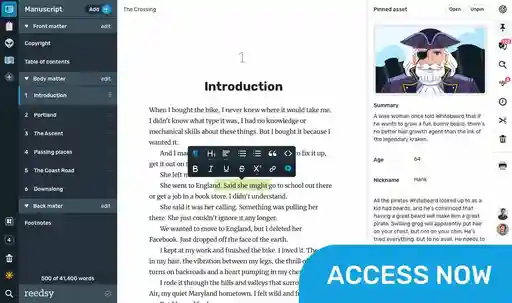
I advise clients to start with something simple — like a plain old word processor or Reedsy Studio (which is entirely online, no download required, and free). Yes, there are a bunch of flashy toys you can use to map out your timelines, subplots, character arcs, etc., but at the end of the day, the “writing” part is most important.
For the record, I’m not deeply against any particular writing apps — they've all got useful features, and everyone approaches things differently. It’s just so easy to procrastinate writing, and no matter how elegant your Chapter Structure looks, that doesn’t matter if you can’t get words on the page.
For an intuitive, free writing environment with no learning curve and no clutter, try Reedsy Studio.
FREE WRITING APP
Reedsy Studio
Set goals, track progress, and establish your writing routine in our free app.
4. Create a flexible plan
Titles and fancy chapter structures may be procrastination, but a plan is not.
Some authors are more enthusiastic about planning than others. There’s an oft-touted divide of “plotters vs pantsers” — but in my experience, most people don’t fit neatly into one category, so it’s more of a spectrum. You don’t have to know from the get-go where you sit on the Pants-Plot Spectrum™, and indeed it may change as you grow as a writer.
Personally, I find it very hard to plan things, but I also realize I go off on tangents and struggle to pull back without a solid anchor. For my fellow writers who may be more pantser-aligned, I recommend grounding yourself with a simple list of story beats you want to hit.
Space out your story beats effectively
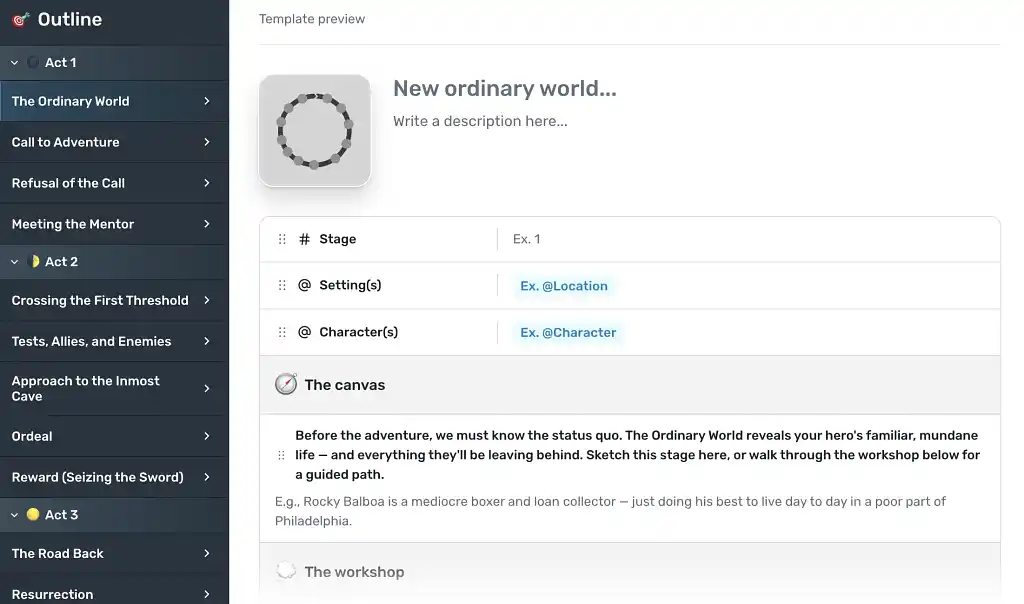
As a coach, one of the first things I do with clients is look at their raw outline and measure it against basic storytelling beats.
I just recently worked with someone whose inciting incident came way too early, before we’d firmly established a status quo, and it made the beginning of the manuscript feel rushed. We didn’t have enough time to understand who the protagonist was or where she was coming from, so I had her rewrite the beginning to unspool a little more before that inciting incident.
There are a million different books, blogs, and YouTube videos telling you the crucial story beats to hit. Beginning, middle, and end will do for now, but it’s worth reading up on The Three Act Structure, the core concept of which every other idea — Hero’s Journey, Save the Cat, Harmon’s Story Circle — is merely a variation. That Aristotle guy knew what he was talking about two and a half thousand years ago!
Make cause-and-effect chains
When plotting, I also ask clients to think about cause and effect. We never want to craft a story by simply saying, “This happened. Then this happened. Then this happened.”
Instead, a strong story uses the “therefore/but” principle: “This happened, therefore this happened, but this happened, therefore…”
Let’s apply this to my airport idea. (In our case, the inciting incident is quite early on, per genre conventions for a mystery/thriller.)
Man picks up luggage. Goes through security.
BUT his wife’s body is found in luggage.
THEREFORE he is arrested.
BUT he proclaims his innocence.
THEREFORE one small-fry policewoman believes him — and decides to investigate “off the clock.”
BUT…
Keep bullet-pointing like that until you get to the end of the story.
Man traps the real murderer on top of building. Police will be there soon.
BUT Murderer surprises Man, revealing his campaign of torment towards Man and Wife is because Man’s Father put his father behind bars — an event on which Murderer pins his own bad luck in life. This has all been vengeance for that.
THEREFORE Man offers to help him. He’ll still go to prison, but Man offers to foster the Murderer’s own son and give him a better chance.
BUT Murderer doesn’t trust him. Sees no way out.
THEREFORE Murderer throws himself off the building.
BUT… (I’m kidding — there can't really be a “but” there, unless you’re Sherlock Holmes.)
5. Flesh your story out
Consider your outline as the skeleton of your book; the next phase is putting meat on the bones. Again, everyone will have different ideas on how to do this. I like to take my outline, save a copy, and then in that copy start filling out a scene. (Note that I’m still not worrying about my prose yet.)
So we move from:
Man picks up luggage. Goes through security. Wife’s body found in luggage.
To:
Sam is waiting for his wife at a coffee shop at the airport. His wife is running late. He gets a message asking him to pick up her luggage from the locker she left it in. He gets the luggage and goes to security. There’s some confusion over his bags and he’s getting some strange looks from security staff. Someone speaks into a walkie-talkie.
And then I’ll work through the plan like that, adding bits here and there. This helps me maintain momentum; when my interest starts to wander, I can break away from it and move on to another scene, instead of forcing myself to focus on something that just isn’t coming together.
Consider characters’ actions, interactions, and reactions
Once I have some relatively stable scenes, the next stage is to bring them to life. My mantra is: Action, Interaction, Reaction. Specifically, I’ll think about:
- What exactly is my character doing?
- What are they thinking?
- How are they feeling?
- What can they smell, hear, taste?
- Who are they talking to?
- How do they feel about that person?
- What is that person saying to them?
- What does this tell us about the second person?
- Does it change how the first person feels?
And so on.
Until I end up with something that sounds more like it belongs in a book:
Sam checked his watch. The gate closed in twenty minutes. Where was she?
He drained the last sip of his espresso and fished out his phone from the front pocket of his carry-on, automatically doing his four-point check: passport, wallet, keys, phone.
> sorry! Omw. So much traffic. Can you grab the suitcase from the locker? Code is 8762. Love you xox
Sam closed his eyes, taking a deep breath. It was always the same. He got up from the table, leaving a 10-euro note underneath the saucer. There was no point keeping the currency and he had felt bad the whole trip never leaving a single tip. It felt so awkward, but Katie had assured him the reason they didn’t tip in Europe was because their servers were paid a decent wage. But the ex-barman in him struggled every time. In the end, he’d made peace with rounding up the bill a few times, but now his wife wasn’t looking, who was he hurting?
At the locker, he input the code. The door popped open with a satisfying click.
He smiled as he felt the weight of the case, filled to the brim with vacuum-sealed freezer bags of glorious French butter. Tom and Diane were going to be so jealous once they got back home.
Of course, this is just how I like to do it. You may prefer to start at the end of the story and work your way backwards. It doesn’t really matter what order you go in, as long as you’re doing something.
6. Manufacture accountability to help you finish
The key to finishing a book is to keep doing something (writing words, not perfecting your file-naming structure), even when it gets tough.
Set realistic but clear goals
It’s usually helpful to set yourself a target. It can be daily, weekly, monthly, or all three — whatever works for you.
The trick is to keep it realistic. If you’ve only got thirty minutes a day for writing, it’s unrealistic to imagine you’ll get 5,000 words down each time. Aim for 500 instead and you’ll be much more likely to consistently hit that goal. Piling on lots of small wins will boost your mood and motivation.
Q: What's your number one tip for authors dealing with burnout or writer’s block?
Suggested answer

Take a break from the project and do something relaxing that gives you pleasure, especially something physical like a long walk. Sometimes, if you stop thinking about a book, you'll find ideas pop into your head anyway. I'd also advise doing a rough plan of how you see the next part of your book progressing -- this will make the actual writing part easier and less stressful.
John is available to hire on Reedsy

Refill your creative well! Go watch TV, listen to your favorite songs, play a video game—do whatever you need to do to separate yourself from the book, even if only for a little bit. I've found that a small bit of distance can go a long way towards combating burnout/writer's block.
However, if the block is extremely pervasive (and you're not on deadline), it can also be helpful to briefly shelve a book and work on something that doesn't make you want to slam your head against the wall!
Chelsea is available to hire on Reedsy
My number-one tip to combat writer's block is to experiment.
Whatever routine you've built for yourself as a writer, try getting out of that routine and see how it affects your ability to write.
If you normally write on your desktop computer, try using a tablet or even writing longhand. Maybe the blank page is affecting you, and dictation will be something worth trying. If you normally write at night after everyone else in your family has gone to bed, try getting up early and writing then, or even snatching breaks during the day for writing time. If you write in longer chunks of time at home, try a coffee shop or restaurant, or if you like to write in coffee shops, try writing at home or in a local park. If you normally write in silence, try putting on music in the background.
Generally speaking, routine is a good thing for most writers, but some books/ideas demand a change of pace, and since we as writers change by virtue of changing as people and growing in our craft, that sometimes mean a routine will change.
Jennifer is available to hire on Reedsy
Raise the stakes
When I wanted to start running, I could never get out of bed in time to actually run. So I signed up for the London Marathon and told as many people as I could that I’d done so. Then, I wanted to get a decent enough time that I wouldn’t be embarrassed — and presto, I was lacing up my running shoes at 6am.
A similar motivational principle can be applied to writing. There are tons of local, national, and international writing competitions. Some look at sample chapters and others consider entire books — not necessarily published. Dig around online for one that suits you, sign up for it, then tell everyone you’re entering a writing competition. Yes, there’s a chance you’ll have to tell those people you didn’t win… but that’s better than telling them you never entered in the first place, right?

FREE COURSE
How to Build a Solid Writing Routine
In 10 days, learn to change your habits to support your writing.
7. Edit your completed draft for publication
Writing a book is an iterative process. Only the truly insane would get to the end of their first draft and think they were done.
Take a break first
Once you do have your first draft… go back to the beginning! But not right away. I always tell clients to put the manuscript in the bottom drawer. Take a two-week break. Read stuff that’s in a completely different genre, watch films, play board games — just whatever you do, don’t think about your book.
Hopefully, you’ll come back to your manuscript with as objective an eye as possible. When we’re deep in writing and editing, our brain bridges gaps: we know what needs to be there, so we see it there… but that doesn’t mean it always is.
To help you gain even more distance, don’t sit back down in front of your computer. Change the format. Convert the manuscript to PDF and read it on a tablet, or print it out.
Mark up your entire manuscript
As you make your way through your book, mark where you notice blips — grammar and spelling mistakes, sure, but more importantly issues with character, plot, and pacing. For example:
- Where are you telling and not showing?
- Is any of your dialogue confusing?
- Do your characters’ motivations make sense?
Don’t try to fix these areas; just mark them up and get to the end of the book. Reading it this way forces you to slow down and see what you couldn’t before.
Only when you reach the end should you reopen that New File and start the process of self-editing.
Eventually, you’ll reach the point at which you no longer know where you’re going wrong, or even if you’re going wrong. That’s when it’s time to ask for help.
Of course, you don’t have to wait until you’ve completed a draft to ask for help. If you’re stuck halfway through and need some extra guidance or accountability to finish your book, you can always hire a writing coach like myself to support you on your journey.
Initially, you can look to friends or family members to be your sounding boards. However, they may want to spare your feelings, and they may not know how to read like a writer. The crucial difference here is that readers read to be moved, but writers read to understand how the author moves them — to acknowledge the emotion (fear, sadness, happiness, arousal), and then interrogate how that emotion was evoked.
Q: How do I know when my book is "ready" for professional editing?
Suggested answer
If you've gotten as far as you can get when it comes to improving your book, and you find that you don't know what to do next, that's when you're ready to hire an editor.
That sounds pretty simple, but no matter what genre you're working in, it's the most solid advice I can offer. You could play with a book for a decade after first drafting it, tweaking characters and plot and scene or working to explain a scientific theory more clearly, but unless you're confident in what needs to happen to elevate the book, you're only postponing the process of getting feedback on what you've created.
It should be noted, though, that if you do know what needs to happen next, you're better off waiting on hiring an editor. If you know already that your book has a plot hole, or the romance needs more scenes to land on those beats which romance readers are going to expect, do that before sending your work to an editor! Otherwise, an editor is going to spend time detailing out a plot hole that you already know about, or talking about what's missing from the romance even though you already know it's missing. You'll be paying them to tell you what you already know, and they'll feel like they've wasted their time/energy when you tell them you already knew about the issue they've spent real time describing.
You might be wondering, "Is it okay to send my book off to an editor and tell them about a particular issue I'm having, so they'll know it's already on my mind?" The answer is definitely yes. When you do, just let them know whether or not you need feedback on that area.
For instance, I've had an author tell me that they already know a particular character is acting too immature for her age, but it's on their radar and they're brainstorming how to 'age up her actions'. If someone tells me that in advance, I don't have to waste time explaining how/why a character is being immature because I know the author is on the same page. I can simply focus on helping them nail down those areas that need correction and potentially give them ideas for how to fix the issue.
Similarly, I've had authors tell me they already know about a plot hole (insert plot issue here), but are struggling with how to fix it in a way that won't force a total rewrite. If they tell me that, I can spend time brainstorming on their behalf and help them figure it out, vs wasting time explaining in detail why the plot hole is a plot hole at all.
When all is said and done, though, an editor is simply there to help you find your book's full potential. When you don't know what to do next? That's when you call on them.
Jennifer is available to hire on Reedsy

You will know that your book is ready for professional editing once you have tried everything with it that you can do yourself. This means having done a first draft, sorted out serious plot or structural issues, and addressed glaring errors of consistency or weakness. You should have a feeling that the message or story is fully expressed, if not perhaps flawless. If you find yourself rephrasing sentences but no longer making noticeable improvements, that's a good sign you're ready. An editor's role is to lift your work from good to polished, not to finish half-thoughts. When you both love your manuscript and don't know how to improve it, it's time to bring in professional eyes.
John is available to hire on Reedsy
Get a professional editor
If you want your manuscript to reach the highest possible standard, you’ll need to work with a professional. Whichever publishing path you wish to follow, you can hire editors on Reedsy to help you meet your goals.
Hire a professional

Mallory B.
Professional editor of bestselling Amazon authors Seth Ring, Pedro Urvi, Rick Partlow, and more. Exhaustive experience with litRPG genre!
Request a quote
Tina B.
Meticulous editor with 15 years of experience in trad and self-pub. I will help your Sci-Fi, Fantasy, Horror shine!
Request a quote
Karin R.
Professional copy and developmental editor with over twelve years experience in political science and current affairs books.
Request a quoteThe usual approach to any manuscript — whether you're a debut author or deep into a series — is to start with an editorial assessment to get the lay of the land, redraft, and then engage in a developmental edit after another round of self-editing.
The temptation to dive straight into developmental editing is strong, but by focusing on the core elements through a lighter first pass, you can ensure your story’s engine is running smoothly and allows you to go into a developmental phase with a lean, strong narrative.
Copy editing is a technical process, reserved for just before publication when that “engine” is running smoothly. If you’re planning to publish traditionally, you don’t need to get one yourself; if you’re going to self-publish, you eventually will. Always ensure you leave any copy editing until you’ve nailed your structure, as an editorial assessment and/or developmental edit can substantially change the content of your manuscript.
Q: How do I balance getting professional editing with keeping my own voice?
Suggested answer

An editor shouldn't be rewriting your work. Your work should still sound like you, even after a heavy line edit. The reviews I really cherish from clients and writers are the ones that remark on the fact that I've retained their voice throughout the editing process, as I think that's the core purpose of an edit: giving a manuscript a glow-up rather than completely changing it.
Your best friends in choosing an editor who'll do this are (1) a detailed brief that describes the voice and tone you're aiming for and (2) sample edits. The first makes it clear what you want, while the second helps you check whether an editor will be the right fit for you. I also always make it clear to authors that my edits are suggestions, and I'm always happy to discuss why I'm suggesting a change and to provide alternatives if desired. Editors are there to support your project, not to lead it.
Claire is available to hire on Reedsy

A good editor of any kind—developmental, copyeditor, etc.—is going to honor your voice and want to help you hone it. It's good to keep in mind that your editors are not trying to make your writing less unique, they're trying to guide it to be the best it can be. With that understanding in place, make sure you're reading their feedback from a place of trust and open-mindedness. Once they've read a few hundred words of your manuscript, an editor will often have an idea of your voice and will do their best to work with your voice, not against it.
Editors will often offer an explanation for an opinion-based change, and it's important to hear their perspective. (And if your editor isn't offering an explanation for a particular change from the get-go, feel free to ask them for one.) If you find that you're declining a lot of changes in an ongoing partnership, try to afford your editor the same respect and offer an explanation as to why their changes aren't working for you. That will improve their sense of your goals for your manuscript and they can adjust their feedback accordingly. They'll probably be really excited to now be on the same page and might have some fresh new ideas!
Another thing to keep in mind is that sometimes—especially in creative writing—you may think you're doing something clever on the sentence level, and then your editor tells you they're confused by it and/or that it's wrong. As in grammatically incorrect, or conveying the wrong message, or illogical, or any number of things for which there is technically a black-and-white rule in the English language. In these instances, remember that in general the impression you want your reader to get is more important than being clever. Sometimes you may just need to be disappointed that the clever thing you thought you were doing wasn't so effective after all. And if you feel strongly about maintaining a style that's sometimes "wrong" (maybe it's important to your character building), work with your editor on how to make sure you're still being understood by the reader.
Above all, remember that your editors are on your side! They want to help your writing be its best, not be exactly like everyone else's. Your editors want to work with you. Make sure you're working with them, too!
Mira is available to hire on Reedsy
A professional editor should respect your voice and project. Honestly, it's as simple as that.
The best way to be sure that will happen is to hire an experienced editor and also ask for a sample edit, especially with line/copyedits. Seeing that sample edit and thinking about how the editor engages with your voice should tell you everything you need to know. Chances are, you won't agree with everything an editor recommends because editing is a subjective business, but if the editor is keeping in mind your particular voice and project, and if they're experienced and aligned with your vision, you should probably expect to agree with 80-90% of their recommendations.
That said, there are exceptions! I once had an author tell me she only agreed with about 40% of my copyedits, and I was horrified. I immediately told her that meant we weren't a good fit...and then she told me that she'd had three previous editors, and she'd only agreed with about 10-15% of what any of them had suggested! In fact, she was thrilled with my work! This particular author was simply extremely attached to even the smallest nuances of her language use, and had a lot of trouble working with an editor at all. I came to realize that her taking even 40% of my suggestions was actually a pretty serious compliment, odd as that may sound.
With developmental edits, things get a little trickier, but respect is still the ultimate goal. An editor shouldn't be trying to rewrite your story. Ideally, you want a developmental editor who will respect your story and help you find its full potential without injuring your vision. If they point out plot holes, they might point out different ways to address those fixes (and you can talk to them in advance about whether or not you want them to), but they won't insist on you taking any of those fixes; they'll only strongly suggest you fix the plot hole. Similarly, if you've got a 180,000 word paranormal romance on your hands, they'll be right to talk to you about the realities of publishing and how difficult it will be for you to find an agent, but they shouldn't be rewriting the book for you or lecturing you. (In a case like this, I'd personally be having a conversation with the author to talk about their publication plans, the realities of publication, and options for how to go forward, whether that would mean splitting the book into two or cutting subplots...but it would be a conversation, and not a lecture). If an editor is telling you how to rewrite your book and you didn't ask them to do so, they're not the right fit for you, and you should move on--because yes, it's a matter of respect for your project and you.
Jennifer is available to hire on Reedsy
But if you’re reading this, editing is probably still a long way off. For now, all that’s left for me to say is good luck. The path to writing a book requires tenacity and tough skin, but your persistence will ultimately pay off.


1 response
aboe says:
13/12/2019 – 15:33
thank you for helping me find a new way to write my book