Guides • Perfecting your Craft
Posted on Sep 11, 2026
100+ Romance Tropes and How to Use Them in Your Book

Martin Cavannagh
Martin Cavannagh is a publishing professional with 10+ years of experience in content strategy, editorial development, and author education within the indie publishing space.
View profile →
Loretta Bushell
Loretta is a translator, proofreader, and writer with 4+ years of experience in the publishing industry. She helps freelancers and authors build sustainable careers.
View profile →A romance trope is a plot device, theme, or motif that commonly appears in romance fiction. Many romance readers use tropes to describe their tastes, and some savvy romance authors even market their books with tropes: “Don’t miss this slow-burn, enemies-to-lovers romance with a girl next door and a bad boy hero.”
Below, we’ll look at 100+ of the genre’s best-loved tropes. While some are subsets of others, or could fall into more than one category, they cover all the different ways these tropes can be used in storytelling. Each section describes 1-2 of that group’s most popular tropes — and how they’re used (or cleverly twisted) to engage readers — then dives into other examples.
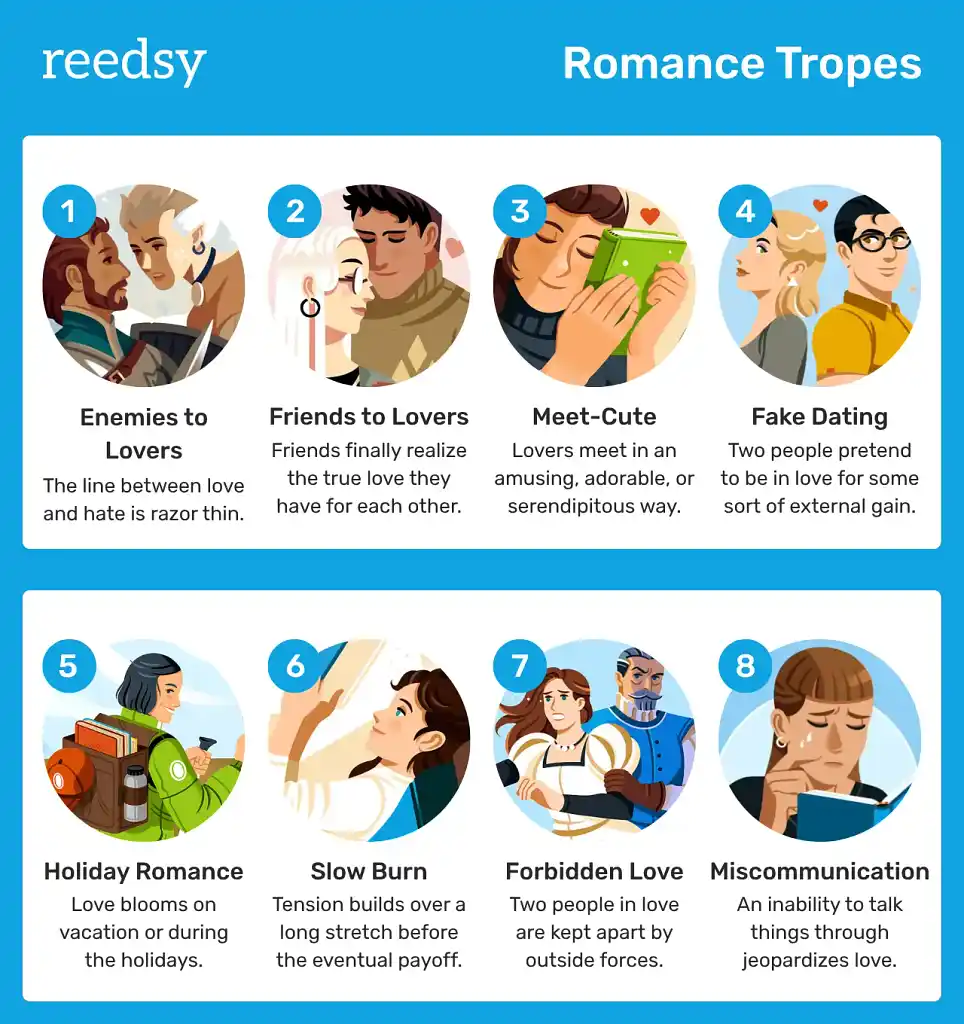
As an overview, here are some of the most popular romance tropes:
Relationship dynamic tropes
Relationship dynamic describes the way characters interact with each other. It’s shaped by the forces that affect how characters relate to, communicate with, and think about each other. Relationship arc refers to how this dynamic changes over time.
1. Enemies to lovers: two characters start out disliking each other, but eventually fall head-over-heels. Increasingly popular in the BookTok era, these lovers often ruffle each others’ feathers not because they’re so different, but because they’re similar. Maybe they’re equally competitive, or have equally high standards for something — which causes them to clash because no one else cares like they do.
A classic example is Jane Austen’s Pride and Prejudice. When Elizabeth Bennet overhears Mr. Darcy insulting her, it sparks a legendary battle of pride (and prejudice!) that slowly softens to cautious friendship and eventually love.
2. Friends to lovers: two friends finally realize romantic feelings for each other. Whether they’re childhood besties or work buddies who suddenly see each other in a new light, the progression into romance should feel authentic. The most important element here is a great story catalyst that forces one of the characters to realize how they feel about the other.
In One Day by David Nicholls, Dex and Emma meet on their graduation night and form a friendship that shapes the next twenty years of their lives. As Dex matures through (spoilers ahead) grief, divorce, and other major life changes, he finally realizes he wants to be with the one person he’s always felt drawn to. When the two eventually meet again in Paris the question on every reader’s mind is, will they or won’t they?
3. Rivals to lovers: a gentler cousin of enemies to lovers; we follow competitors for a job, a title, or a prize, and their one-upmanship curdles into chemistry. Example: The Hating Game by Sally Thorne.
4. Love/hate (frenemies): the sparks come from constant bickering between two people who love to hate each other and secretly can’t stay away from each other. Example: Much Ado About Nothing by William Shakespeare.
5. Protagonist and antagonist: the higher stakes take on enemies to lovers, where future love interests start on opposing sides of a conflict before developing feelings for each other. Example: Shatter Me series by Tahereh Mafi.
6. Friends with benefits: a no-strings arrangement that gradually grows very real strings. Example: Ugly Love by Colleen Hoover.
7. Strangers to lovers: a chance encounter between two people with no shared history, quickly building intimacy from zero. Example: When in Rome by Sarah Adams.
8. Second-chance romance: a couple who once broke up are thrown back together to decide whether they’ve grown enough to try again. Example: Persuasion by Jane Austen.
9. On-again, off-again: life often gets in the way as two people come together, break apart, and find each other over and over again. Example: Normal People by Sally Rooney.
10. Reunion/childhood sweethearts: first loves who drifted apart find their way back to each other. Example: Fake Skating by Lynn Painter.
11. The one that got away: a character who never confessed their love to someone finds out that person is about to get married to someone else or is finally single after years of one-sided pining. Example: The Enforcer by Avery Keelan.
12. Best friend’s sibling: a character falls for someone strictly off-limits by the unwritten code of friendship. Example: The Kissing Booth by Beth Reekles.
13. Best friend’s significant other: a character falls for someone strictly off-limits (and already taken) by a perhaps more strict code of friendship. Example: The Night We Met by Abby Jimenez.
14. Working with the ex: two former partners are forced back into each other’s orbit by a job, a project, or a shared obligation. Example: The Ex Talk by Rachel Lynn Solomon.
15. First love: two people experience the intense rush of falling in love for the first time. Example: Eleanor & Park by Rainbow Rowell.
16. Wrong guy first/romantic false lead: surprise! The person you thought was the main love interest was actually only in the way of finding real true love. Example: A Court of Thorns and Roses series by Sarah J. Maas.
17. Switching couples: a poorly suited couple finds true love is just around the corner in the form of another poorly suited couple, where each party just happens to be the perfect match for the individuals in the OG couple. Example: Funny Story by Emily Henry.
18. She falls first, he falls harder (or the reverse): one person falls in love before the other, but when their love interest finally catches up, the feelings that hit them are intense. Example: Romancing Mister Bridgerton by Julia Quinn.
FREE COURSE
How to Write an Irresistible Romance
10 lessons to help you plan, draft, and publish a swoon-worthy romance.
Situation and plot tropes
These are commonly seen events and circumstances that shape the plots of romance stories. Many can be classified as a type of inciting incident, the event that launches the plot of the story and, in the case of romance, prompts characters to begin building their bond.
19. Meet-cute: our lovers meet in an amusing, adorable, or serendipitous way. A meet-cute should be just that: cute, not cloying. The trick is to avoid testing the limits of believability. A well-executed meet-cute should read like a sweet (yet plausible) “how I met your mother” story.
This trope is a staple of romantic comedies, like Notting Hill where the meet-cute involves shy bookshop owner Will bumping into and spilling coffee on famous actress Anna. This huge coincidence is tempered by Will’s realistic bumbling and the genuine intimacy that springs up between them.
20. Fake dating/fake relationship: two people must pretend to be in love for some sort of external gain, but this fake dating almost always ends in our two characters falling in love for real. A lot of fake relationships center around “admin” as a story obstacle (“I need a green card/health insurance/to rent an apartment”). To that end, it may be a good exercise to think of some unique reasons for people to enter into these kooky, implausible arrangements.
In Jenny Han’s To All the Boys I’ve Loved Before, Lara Jean loses a secret love letter written to a past crush (gasp!) and salvages the situation by pretending to date someone else. The fake couple eventually find themselves stumbling around real feelings in an endearing exploration of young love.
21. Forced proximity: a snowed-in cabin, a stuck elevator, a long road trip — people experience closeness before they’re emotionally ready for it. Example: Beach Read by Emily Henry.
22. Road trip: a journey traps two people in a car (or on the road) long enough for something to spark. Example: The Road Trip by Beth O’Leary.
23. Marriage of convenience: a wedding for money, a visa, or reputational purposes — all the domestic intimacy, none of the emotional safety. Example: Purple Hearts by Tess Wakefield.
24. Arranged marriage: a match made by families or circumstance, with love expected to arrive (if at all) after the vows. Example: The Bride Test by Helen Hoang.
25. Accidental marriage/Vegas wedding: two people wake up married and have to untangle the feelings that follow. Example: Season’s Schemings by Katie Bailey.
26. Meet-ugly: the disastrous, hostile, or humiliating first meeting that somehow becomes love. Example: Red, White & Royal Blue by Casey McQuiston.
27. Love triangle: A is in love with B, who is in love with C, who is in love with A. Or sometimes A and B are both in love with C who has to choose between them. Example: The Hunger Games by Suzanne Collins.
28. Matchmaker/meddling: a well-meaning schemer determined to pair two people off (often getting it hilariously wrong and getting themselves hitched in the process). Example: Emma by Jane Austen.
29. Marriage pact: “if we’re both still single at forty…” — a deadline is due at exactly the wrong (right) moment. Example: When We're Thirty by Casey Dembowski.
30. Roommates to lovers: shared rent, shared walls, and rising tension across the hallway. Example: The Right Move by Liz Tomforde.
31. Runaway bride/groom: someone bolts from the wrong wedding and, often, straight toward the right person. Example: What I Should've Said by Max Monroe.
32. Fling to love: a one-night stand or casual affair that refuses to stay casual. Example: The Idea of You by Robinne Lee.
33. The bet: a romance that starts as a dare, a wager, or a scheme — and stops being a game once feelings enter the picture. Example: Bet Me by Jennifer Cruise.
34. Mistaken identity: love built on a misunderstanding of who someone really is. Example: Thank You for Listening by Julia Whelan.
35. Rescue romance: one character saves another from danger, and gratitude tips into something more. Example: The Witness by Nora Roberts.
36. Class divide: two people separated by money or status, love pushing against the gap between their worlds. Example: Binding 13 by Chloe Walsh.
37. Blind date: strangers are set up by a mutual acquaintance, often leading to twists (they might already know each other) and unexpected chemistry. Example: Blended (2014).
38. Wrong number: an accidental text, an email to a misspelled address, or a serendipitous butt dial introduces two strangers who form a bond without knowing who the other person is. Example: Mr. Wrong Number by Lynn Painter.
39. Hurt/comfort: people experiencing either physical or emotional pain make it through with the help of their love interest’s care, attention, and support. Example: Safe Haven by Nicholas Sparks.
40. Love spell: a fantasy trope where someone is put under a romantic enchantment (on purpose or accidentally). Example: Once Upon a Broken Heart by Stephanie Garber.
41. Rags to riches: an ordinary or overlooked character is swept into a grander world by love (and a little luck). Example: Cinderella, and every retelling since.
42. Riches to rags: a character losing their wealth and high status is the catalyst for them eventually finding love. Example: It Happened One Summer by Tessa Bailey.
Q: What are effective techniques for incorporating exposition into a story without disrupting the flow or pacing?
Suggested answer
In fiction writing, I tell authors to treat your readers like they're in the CIA: everything is on a need-to-know basis.
Add expository details as they become relevant to what the POV character is experiencing right now. If the lore or backstory contributes to your readers' understanding of the current scene, those crucial details can actually speed up the pacing instead of slowing it down.
Using the CIA technique can also help you know how much exposition to add at one time--if you're debating whether a specific detail is necessary, consider whether your readers could understand the scene without it. If so, you can confidently place that exposition in a more relevant scene.
Heather is available to hire on Reedsy

The best way to get exposition in is through dialogue. The caveat, of course, is to be careful that it comes across naturally. For instance, if your characters are telling each other things they would know, the reader will know you're only doing that to get the information to the reader, which will greatly reduce their suspension of disbelief.
The second best way, in my opinion, is through thoughts. Again, though, the character needs to think things they would actually think in their situation. For instance, in a fantasy novel, if you drop a big infodump of the world's setting, or the way machines work, or how various monsters are classified, etc., it won't be believable because there's no reason for the character to think things they already know. You could show them working through various possibilities in their mind, coming to correct conclusions, that kind of thing, but the process has to appear honest. Always assume your reader is intelligent, and is capable of sensing expositional shortcuts.
Brett is available to hire on Reedsy

I see poorly integrated facts in nonfiction all the time. You'll be reading beautiful prose and all of a sudden you're hit with what reads like a copy-and-pasted section of Wikipedia. Writers need to take the facts and make them their own. That means finding ways to make them vivid and immediate to the reader and weaves them into the narrative.
Susanna is available to hire on Reedsy
Character type tropes
Hockey players, bad boys, and billionaires, oh my. We often see similar character traits and careers amongst the leads of romance novels. Even with these commonalities between books, characters in every story should be developed with their own unique backgrounds and beliefs that have caused them to become who they are.
43. Opposites attract: two romantic leads are fundamentally different in personality, lifestyle, values, or worldview. Yet just as clashing leads to chemistry with the “enemies to lovers” trope, the same is true for “opposites attract”! The key is to ensure your characters don’t just have superficial differences, but genuinely high-stakes ones that force them to evolve.
In The Love Hypothesis by Ali Hazelwood, bubbly Olive Smith ends up fake dating the cold and intimidating Adam Carlsen. It’s unclear at first whether these differences will be their downfall, but soon, they bring out the best in each other.
44. Bad boy/good girl (and the reverse): who doesn’t love the classic story of someone cold and aloof whose heart thaws in the presence of “the one”? The key to this trope is that every “bad” person is deep down a good person who has faced personal trauma — and it’s up to their new love to reconnect them with their “sweetheart” side. Of course, when creating a “bad boy” in a romance novel, you must ensure that any behavior is still plausibly redeemable. That’s why most bad boy characters tend to be only emotionally unavailable — rather than, say, war criminals.
Mr. Rochester from Jane Eyre by Charlotte Brontë is a classic (literally) bad boy who keeps Jane at arm’s length — even leading Jane to believe he intends to marry another. Of course, he eventually succumbs to his feelings, and they live happily ever after.
45. Grumpy/sunshine: opposites attract, but with the exact dynamic where one is closed-off and cynical and the other is relentlessly kind and optimistic. The payoff is watching the grump’s walls crack. Example: Things We Never Got Over by Lucy Score.
46. Cinnamon roll hero: the soft, kind, unfailingly decent love interest, offered as an antidote to the brooding type. Sometimes also known as a golden retriever. Example: Red, White & Royal Blue by Casey McQuiston.
47. Alpha/protector: strong, capable, fiercely protective — the modern version respects boundaries while still making you feel safe. Example: Mate by Ali Hazelwood.
48. Morally gray love interest: someone who does questionable things for understandable reasons, leaving the reader unsure whether they’d forgive them. Example: From Blood and Ash by Jennifer L. Armentrout.
49. Billionaire: a love interest whose draw is their wealth and competence but still displays real depth beyond their bank balance. Example: Fifty Shades of Grey by E. L. James.
50. Single parent: instant emotional stakes, a built-in obstacle, and a love interest who has to prove they’re worth the risk. Example: All Rhodes Lead Here by Mariana Zapata.
51. Royalty/commoner: a prince, princess, or heir falls for an ordinary person, with all the culture-clash that implies. Example: The Princess Diaries by Meg Cabot.
52. Boy/girl next door: wholesome, familiar love found close to home rather than across a ballroom. Example: To All the Boys I’ve Loved Before by Jenny Han.
53. Sports romance/athlete: love on and off the field, court, or rink, with all the rivalry and pressure that comes with it. Example: Icebreaker by Hannah Grace.
54. Age gap: a meaningful difference in age (and life stage) as both the draw and the friction. Example: Heartless by Elsie Silver.
55. Widow/widower (love after loss): a bereaved character dares to open their heart again. Example: The Happy Ever After Playlist by Abby Jimenez.
56. Reformed rake/playboy: a charming serial flirt meets the one person who makes monogamy look appealing. Example: The Duke and I by Julia Quinn.
57. Celebrity/famous-meets-ordinary: a superstar and a “normal” person navigate love across a spotlight. Example: Funny You Should Ask by Elissa Sussman.
58. Tortured hero: a brooding, haunted love interest carries a dark past, softened by the right person. Example: Archer’s Voice by Mia Sheridan.
59. The nanny/hired help: love that blooms between an employer and the person looking after their home, kids, or estate. Example: The Sound of Music (1965).
60. Supernatural love interest: a regular person is introduced to a whole new world when the person they fall for is, well, not precisely a person. Example: Twilight by Stephanie Meyer.
61. “Wrong side of the tracks” love interest: issues of reputation, class, or background mean that a character isn't supposed to fall in love with them, but of course they do anyway. Example: Titanic (1997).
62. Partners in crime: embarking on a mission (not always a legal one) becomes the foundation for a love story. Couples who scheme together stay together, right? Example: Partners in Crime by Alisha Rai.
63. Cursed character: only true love can break the curse in this trope more commonly seen in the fantasy genre. Example: Beastly by Alex Flinn.
Q: How can writers use stereotypes and tropes to their benefit when creating a character?
Suggested answer

Well, stereotypes and tropes exist because they are the comfort food of readers, and should be the comfort food of writers too. Not to the extent that you write cliche stories by overusing the same old thing. But by the fact that their presence in certain story types is expected and even desired by fans of that story type, so to try and write without them can leave readers unsatisfied and the story feeling incomplete.
There are great books out there on this, John Truby in particular has a great one out. Knowing the stereotypes of a heroes journey, for example, gives you lots of options for side characters and supporting characters to help a hero on certain types of quests. The tropes are the expected encounters and obstacles that hero will encounter along the way.
If you start by mapping these out and identifying which are required (tropes most of all) and which work best for your story but are optional (stereotype characters) then you can take them and twist them in unique and interesting ways, even flip them around in timeline or approach in ways that make it clear they are there (and meet reader expectations and preferences) while still avoiding cliche expectation and creating interesting and unique characters, world, and stories that captivate readers.
Bryan thomas is available to hire on Reedsy

There is a common misconception within writing circles that "trope" = bad or cliche. While yes, certain tropes and character traits can become overused and cliche, tropes are more like reader expectations when they pick up a book from a certain genre. For instance:
- In romance, tropes are things like friends to lovers, enemies-to-lovers, he falls first, grumpy neighbor
- In YA fantasy, tropes can be things like the Chosen One, Love Triangles, or Hidden Magic
- In middle grade, tropes can be the power of friendship, magical animals, magical academies
While not all books in these genres include all of these things, and while these things can certainly be cliche if you don't put your unique take on it, they are what readers enjoy about a genre. After all, isn't that why you read a certain genre, because there are tropes and elements within that you enjoy?
The way to use these stereotypes and tropes to your benefit is to use them as a framework, understanding how they operate and why readers enjoy them. Then, sprinkle your unique author magic on them. How you describe characters, the dynamic between two characters, how certain elements show up or are utilized, all these can be unique to you and your book. You're not looking to reinvent the wheel, but rather give it a new coat of paint, your coat of paint, so that you write the story you want while delivering a satisfying reader experience.
Sean is available to hire on Reedsy

Trope = yes
Stereotype = no
A stereotype is an oversimplified view of a type of person, based on one aspect of their identity, like race or gender or hair color or where they're from. It's important to know stereotypes so you can avoid them in your writing, both so you won't be generic and so
Tropes, on the other hand, are like adding sugar to cake, rather than salt: You want to know what your audience came for, so you can give it to them!
Tropes are things with universal appeal that audiences come back for time and time again. (Not to be confused with a cliche, which is just something that has been overused until it's cringey. For instance, the villain in a YA novel being a mean blonde cheerleader is both a cliche and a stereotype. But a trope might be that the main character is an underdog who manages to win the heart of the most high-status boy in school!) Examples: enemies to lovers, amateur detective, chosen one, only one bed...
Intelligent use of proven tropes, combined in a new and unique way, are the fastest way to genre writing success!
Michelle is available to hire on Reedsy
Pace and fate tropes
Pace is the speed at which a story unfolds. In romance, this often relates to how long it takes for two characters’ relationship to develop. Our list below includes popular descriptions of romance relationship timelines as well as tropes about the outside forces that affect their development.
64. Slow burn: tension builds over a long stretch, so the eventual payoff lands like an event. Rather than feel like a drag, slow burns make a relationship all the more tantalizing. When creating a slow burn, the chemistry between characters should be palpable, even when they aren’t romantically involved, and even if the characters don’t realize it’s there themselves. Readers should have moments to grab onto that hint at the romance to come.
The Wall of Winnipeg and Me by Mariana Zapata includes two characters who (spoiler alert) don’t even kiss until near the end of the book. This marriage of convenience story is un-put-downable not because of fiery moments of passion but rather the couple’s relationship development as they evolve as people.
65. Forbidden love: two people who are desperately in love are kept apart by their families, culture, or society. (Note that this is different from unrequited love, which is generally one-sided!) Looking to write a forbidden love romance story? Try thinking of a situation in which a couple might encounter resistance, and work backwards. The resistance could be social pressure, family expectations, or legal restrictions. As long as their love is true (and consensual), then everything’s groovy.
How could we talk about forbidden romance without Romeo and Juliet? It’s an unforgettable romantic tragedy for a reason: things don’t end well for our “star-cross’d lovers,” but their names will forever be synonymous with deepest passion and forbidden love.
66. Insta-love/love at first sight: a connection that ignites on contact, then has to prove it’s real. Example: One Day in December by Josie Silver.
67. Star-crossed lovers: forbidden love with the tragic dial turned all the way up, fate itself conspiring against them. Example: Romeo and Juliet by William Shakespeare.
68. Unrequited love/one-sided pining: loving someone who doesn’t — yet, or ever — love you back. Example: The Great Gatsby by F. Scott Fitzgerald.
69. Yearning/longing: the whole story lives in the wanting, in the space between two people reaching across a gap. Example: Call Me by Your Name by André Aciman.
70. Falling in love by letter (epistolary/pen pals): correspondence — letters, emails, texts — as the medium and the meaning. Example: This Is How You Lose the Time War by Amal El-Mohtar and Max Gladstone.
71. Late-in-life romance: love arrives (or returns) for characters with decades of history behind them. Example: Our Souls at Night by Kent Haruf.
72. Belated love epiphany: realizing what someone meant to you only once you’ve lost, or nearly lost, them. Example: Wuthering Heights by Emily Brontë.
73. Soulmates/destiny: a couple who simply knows they’re meant to be, even as the universe pulls them apart. Example: The Time Traveler’s Wife by Audrey Niffenegger.
74. Fated mates: the romantasy staple in which two people are bonded by magic, biology, or destiny. Example: Fourth Wing by Rebecca Yarros.
75. Right person, wrong time: two people who are perfect for each other but keep colliding at the worst possible moments. Example: La La Land (2016).
76. Lovers in denial: a couple whose feelings are obvious to everyone but themselves, kept apart by what goes unsaid. Example: Bridget Jones’s Diary by Helen Fielding.
77. Grand gesture: the airport dash, the boombox, the public declaration that risks everything. Example: The American Roommate Experiment by Elena Armas.
78. Happily ever after (HEA)/happy for now (HFN): essentially a requirement for any story that’s not a tragedy and the romance genre’s defining promise — an ending that leaves the couple together and hopeful. Example: nearly every romance on this list!
Obstacle tropes
These tropes refer to events in a romance story that threaten to drive couples apart, and in some cases, actually do. They can arise from internal or external conflict and serve as a challenge our leading loves must overcome to show they can make it to happily ever after.
79. Miscommunication: characters’ refusal or inability to talk things through can turn misunderstandings into relationship-jeopardizing events. The key to including miscommunication in a story is to make it feel necessary to the plot. Often, these miscommunications could be resolved with a simple conversation, so there must be a plausible reason why the characters are avoiding one.
Happy Place by Emily Henry follows the story of exes Wyn and Harriet who are forced to pretend they’re still together while on a vacation with friends. Their breakup — and journey back to each other — is marred by internal struggles that deter them from open communication.
80. Amnesia: memory loss forces a couple to fall in love again — or fight to be remembered. Example: The Vow by Kim and Krickitt Carpenter.
81. Breakup-to-protect: a relationship ends when one character decides their love interest’s life will be safer and/or happier without them. Example: The Idea of You by Robinne Lee.
82. Third act separation: all seems to be working out for the couple until a catalyst (often a miscommunication or a big reveal) splits them apart in the latter half of the book. Example: Luck of the Draw by Kate Clayborn.
83. Long distance: true love can conquer anything, even hundreds of miles, weekend flights, and sleepless nights spent wondering what the other person is up to. Example: The Wedding Date by Jasmine Guillory.
Secret tropes
This list relates to tropes where something is being kept hidden, either from one person in a relationship or from the world generally. It may be that the secret coming out is a catalyst for the story to begin or it may be used as a big reveal later in the narrative.
84. Secret identity/secret royalty: what would you give up for love — fame, royalty, millions of dollars? It goes like this: a royal figure or billionaire is tired of being in the public light, so they adopt a disguise or go somewhere they won’t be recognized. This trope can be a near-endless fount of farcical comedy, as the narrative comes closer to revealing their identity. The key is striking the right balance of believability — so the unsuspecting lover doesn’t come across as foolish for not recognizing their partner earlier.
In Crazy Rich Asians by Kevin Kwan, Rachel has no idea that her boyfriend Nick belongs to one of the wealthiest families in Asia. While Nick reveals his “secret identity” close to the start of the story, there’s still surprise throughout as Rachel navigates the expectations and challenges that come with his family.
85. Secret relationship: a couple who have to hide what they are — from family, colleagues, or the public. Example: Heated Rivalry by Rachel Reid.
86. Secret admirer: an unsigned love note, a hidden crush, someone loving from the shadows. The protagonist must find who the author is. Example: Cyrano de Bergerac by Edmond Rostand.
87. Secret baby/surprise pregnancy: a pregnancy (or a child the other partner never knew about) that forces two people (back) together. Example: The Best Thing by Mariana Zapata.
Q: How can writers incorporate popular story models like The Hero's Journey and Save the Cat while maintaining originality and creativity in their writing?
Suggested answer

If you're using these outline models beat for beat to craft your outline, I think the important thing is for you to remember that an outline is only an outline. What I mean by that is that writing is itself a process of discovery, development, and revision. An outline can be a fantastic tool, regardless of the format you're comfortable with or using, but once you begin drafting, the story should be primary. If the story demands a scene you didn't outline, or a slight change from the outline, then that's what you need to do.
I'll share here that I work with one writer who's now a full-time writer, and who I've worked with for years. There was a point in his career when he transitioned over to using the Save the Cat outline, and almost immediately, his stories felt more stale and a bit less interesting/unique. It was as if he'd started writing a dumbed down version of his own style. We talked about it, and the effect the outline was having on his storytelling. On one hand, it was allowing him to write faster and revise less because he got fewer developmental notes. On the other hand, the stories just weren't of the same quality. Ultimately, he had to learn to balance his use of the outlines against his own instincts, and while he kept using them, his writing got back to original strength and he continued improving from there as he used the outline forms as more of a tool and less of a shortcut.
If you're using them for the first time, I think you have to remember that the outline structures offer a basic outline--they're meant to allow you to have room for a lot more creativity than they're necessarily demanding. If you want to avoid having an over-simplified story or having readers recognize the outline format from the word go, the key is to make sure you're developing your ideas beyond the outline's demands, and making sure you have truly rounded characters and situations. You shouldn't just be filling out the outline form and then using it beat for beat to write your book, in other words; instead, use it as a tool to guide your way while still following your own instincts and interests when it comes to storytelling.
Jennifer is available to hire on Reedsy

Story models are best used like scaffolding, not paint-by-numbers instructions.
The Hero’s Journey is basically ordinary world → challenge → trials → transformation → return. Save the Cat is a 15-beat structure that helps track emotional and plot turns from opening image to finale.
The trick is to make the beats familiar but the choices surprising. Don’t ask, “What happens in this template?” Ask, “What would my character do here that only they would do?” Originality comes from the choices only your story can make: the character’s voice, desires, fears, contradictions, world they live in, moral dilemmas, and the consequences that follow.
For example, The Hobbit follows a classic Hero’s Journey: Bilbo leaves home, faces trials, changes, and returns; But Tolkien’s Middle-earth is incredibly, richly imagined by arguably the greatest world-building author of all time, which is why the familiar quest still feels distinctive.
For Save the Cat, The Hunger Games has been mapped by Save the Cat itself as a beat-sheet example, yet it’s widely praised as brilliantly plotted, imaginative, and critically acclaimed. (If you haven't read it, do; it's much better than the movie.)
So my advice is to use structure to create momentum, but use imagination to make the story yours.
A final note: There's no law that says you have to use any story model at all. About half of the authors I've worked with are "pantsers" (versus "plotters") who simply start writing their story and let it flow wherever their imagination takes them.
Rob is available to hire on Reedsy

Saving the cat can come into play in many forms. At the end of the day, readers want to root for likable heroes. If you make your main character sympathetic in some way, that sort of ticks the "saving the cat" box off nicely.
A journey can comprise so many forms. It can be a literal journey Dorothy takes from Kansas to Oz and then back again in The Wizard of Oz, or it can be an inner journey of deciding to take charge of his life and not let others make his decisions for him, as we see with Macon Leary in the book The Accidental Tourist.
As long as your "save the cat" moment and "hero's journey" uses unique ideas that have not become cliché, you should be fine.
Melody is available to hire on Reedsy
Subgenre tropes
There are many popular romance subgenres, such as romantasy and romantic comedy. The following list of tropes includes the more specific settings and storytelling methods that provide a unique foundation for romance to bloom.
88. Fairytale retelling: classic stories are reworked with fresh characters, settings, and new points of view. Sometimes, these are close retellings that follow the same plot structure as the original tales with recognizable characters and events. Others are more loose retellings and just make use of a familiar character type or situation (see above in Plot Tropes: rags to riches, as inspired by Cinderella).
Sarah J. Maas’s A Court of Thorns and Roses follows a young woman who is held prisoner in a monster’s castle where she helps break a curse and eventually falls in love with the monster. That should sound familiar, since it’s actually a retelling of Beauty and the Beast!
89. Holiday romance: These loves bloom in the glow of Christmas trees, summer vacations, or seasonal escapes. Creating tangible settings and atmosphere is the key with a holiday romance. Whether it’s the magic of the season or the thrilling beauty of a getaway, it should feel like something in the air is making anything feel possible, even, or perhaps especially, falling in love.
The leads of The Unhoneymooners by Christina Lauren, are self-described enemies who find themselves on an all-expenses-paid trip to Maui. Set against the backdrop of beautiful Hawaiian beaches, even these two can’t help it when more loving feelings emerge.
90. Beauty and the Beast: a gruff, guarded, or literally monstrous love interest gentled by tenderness. Example: Jane Eyre by Charlotte Brontë.
91. Time-travel romance: lovers separated (or united) across centuries, fighting the clock itself. Example: Outlander by Diana Gabaldon.
92. Ugly duckling/makeover: a transformation (more often internal than external) that lets a character finally be seen. Example: The DUFF by Kody Keplinger.
93. Mafia/dark romance: love among criminals, anti-heroes, and moral grey zones — the fastest-growing corner of the “dark romance” shelf. Example: The Sweetest Oblivion by Danielle Lori.
94. Polyamory/"why choose": a love story with more than two people at its centre, where nobody has to pick just one. Example: Pucking Around by Emily Rath.
95. Cowboy romance: love set against the backdrop of ranches, small towns, and rugged landscapes, where traditional grit meets high emotional stakes. Example: Flawless by Elsie Silver.
96. Hockey romance: a popular subgenre of sports romance tracking the intense pressure, team dynamics, and high chemistry of professional or college ice hockey players. Example: The Deal by Elle Kennedy.
97. Small-town romance: a big-city heart finds love (and a slower life) in a tight-knit little place. Example: Virgin River by Robyn Carr.
98. Hometown romance: a person who moved away returns to where they grew up and finds that home really is where the heart is. Example: Cash by Jessica Peterson.
99. Military romance/in uniform: a soldier, sailor, or first responder whose duty and distance raise the stakes on love. Example: Things You Save in a Fire by Katherine Center.
100. Workplace/office romance: it turns out spending five days a week with someone can turn an office crush into something more. Example: First-Time Caller by B.K. Borison.
101. School/academy romance: love beginning within the halls of boarding schools as characters train, learn, and live together. Popular in fantasy. Example: Vampire Academy by Richelle Mead.
102. Dystopian: love becomes both a safe place and an act of rebellion in worlds defined by oppressive regimes and apocalyptic futures. Example: Divergent by Veronica Roth.
103. Dual timeline: A narrative structure that shows love stretching across years. This can highlight two different love stories or the dichotomy of one couple’s past and present. Example: The Best of Me by Nicholas Sparks.
Authors have been using romance tropes for hundreds of years, from Shakespeare to Austen to Hazelwood to Maas. And with good reason. The characters, plot devices, and storytelling techniques we find time and again in our favorite love stories make for compelling foundations for new stories to be told. Whether you feel inspired to use one of the tropes listed above or to subvert a trope with an unexpected twist, there’s no time like the present to join the ranks of all of the authors who love love.
In the next part of our swoon-worthy romance guide, we’ll show you how to write your romance novel now that you’ve got some beloved tropes in your arsenal.