Blog • Understanding Publishing
Posted on Mar 31, 2026
Reedsy vs. Spines: Which Platform Is Right for You?

Dario Villirilli
Managing Editor of the Reedsy blog, Dario is a graduate of Mälardalen University. As a freelance writer, he has written for many esteemed outlets aimed at writers. A traveler at heart, he can be found roaming the world and working from his laptop.
View profile →Authors today have more self-publishing options than ever, but not all are created equal. Reedsy and Spines both promise to get your book into the world — yet they take fundamentally different approaches.
In short: Reedsy helps you collaborate with experienced professionals to bring your manuscript to publishing standards, while giving you the tools, resources, and guidance to self-publish like a pro. Spines mainly relies on AI to fast-track your book to publication — often locking you into costly plans and subscriptions.
In this post, we'll compare Reedsy and Spines across various factors to help you decide which one is the right fit for you. Here's a quick overview:
|
Category |
Reedsy |
Spines |
|
Founded |
2014 📍(UK) |
2021 📍(Israel) |
|
Trustpilot rating |
4.7/5 (1,700+ reviews) |
4.6/5 (~790 reviews) |
|
Model |
Curated freelancer marketplace, many with former Big Five experience |
AI-powered all-in-one publishing platform |
|
Pricing model |
Variable (quote-based) + 10% buyer fee. Authors usually spend between $2,940 and $5,660 |
Plan-based ($3,300–$10,410+) |
|
Distribution |
You handle it (or hire specialists) |
Spines handles it |
|
Refund policy |
Project Protection mediation if the collaboration goes wrong |
30-day money-back guarantee |
|
Best for |
Authors who want specialist expertise and full control |
Authors who want to hand over the entire publishing process to a company |
Publishing approach
Before comparing features, it’s worth understanding the fundamentally different philosophies behind these two platforms — because they couldn’t be more opposed.
In short: Reedsy is a curated marketplace where you hire vetted professionals to help you craft a quality book on your own terms. Spines is an AI-driven pipeline designed to get your manuscript published as fast as possible, for a fixed fee. One invests in craft; the other prioritizes speed.
Reedsy (5/5)
Reedsy is a curated marketplace that connects authors with vetted freelance publishing professionals — editors, cover designers, ghostwriters, and marketers. Based on your budget and needs, you hire the people you want, with the purpose of bringing your manuscript to a professional standard so that you can pitch literary agents (if you’re going the traditional publishing route) or self-publish on retailers like Amazon or Apple Books.
Reedsy is built for authors who want to take their publishing journey into their own hands: to understand the process, collaborate with experts, and become a better writer along the way. These collaborations may take weeks or months, but the investment in craft is the whole point.
Spines (1/5)
Spines is a vanity press that offers an all-in-one publishing platform combining AI-powered tools with human services to take your manuscript from upload to distribution at a fixed price. Its main selling point is speed: your book can go live in around 30 days. The platform is aimed at authors who prioritize getting published quickly over developing their craft or learning the nuances of the publishing industry.
Q: How many drafts should I expect to go through before publishing?
Suggested answer


There is no preordained number of drafts—every writer and every book is different—but most manuscripts need more passes than expected. The first draft is for getting down the story or message. The second is where structure, clarity, and pacing happen. From there, every pass is refinement: strengthening voice, consolidating language, correcting errors. Some books feel finished after three drafts; others take five or more. What matters is not the number, but that you are open to revising until the work says exactly what you mean. Quality depends on patience, not eagerness to "done."
John is available to hire on Reedsy ⏺
Reputation and trust
A platform is only as trustworthy as its track record. When you’re entrusting someone with your manuscript — and potentially thousands of dollars — credentials matter.
In short: Reedsy has over a decade of credibility, a rigorous vetting process, and a growing catalog of verifiable success stories. Spines makes bold claims about bestsellers and global reach but offers little evidence to back them up.
Reedsy (5/5)
Founded in 2014, Reedsy has established itself as a leading authority in self-publishing. Much of its credibility comes from a rigorous vetting process: only about 3% of applicants to Reedsy’s marketplace are accepted, ensuring that every professional on the platform brings years of experience and a proven track record. Many have previously worked for Big Five publishers.
The platform has notably supported over two million authors and helped bring more than 25,000 books to market each year.
Notable success stories include authors like Fiza Saeed McLynn, who landed a six-figure deal after a Reedsy developmental edit; Christopher Parker, who sold 25,000 copies in nine months; and Brad Aronson, whose book reached the top 10 of the Wall Street Journal ebook list.

Spines (1/5)
Spines was founded in 2021. Its founders previously managed a hybrid publishing company in Israel called Niv Books and decided to go all in on AI, believing it would disrupt the way books are published. The company was originally called BooxAI.
The company claims to have published more than 10,000 books, including 1,200 bestsellers — however, there is no proof to back these claims. When The Bookseller wrote a piece on Spines and asked for evidence on the bestseller claim, the company pointed to just seven titles — of which only one had more than 70 reader ratings, with the others’ ratings ranging from seven to 22.
In other words, Spines makes bold claims, but there’s not much published online to back them up. Furthermore, the company doesn’t disclose the background or experience of the people who will work on your book. Pair that with a notable number of negative reviews on the Better Business Bureau, and it doesn’t inspire much trust.

Platform and workflow
Aside from quality, how easy is it to self-publish your book once you log into each platform?
In short: Reedsy gives you more control and visibility — you browse profiles, filter by genre, and choose who you work with. Spines' dashboard is clean and guided, which feels approachable for first-time authors, but offers less flexibility.
Reedsy (4/5)
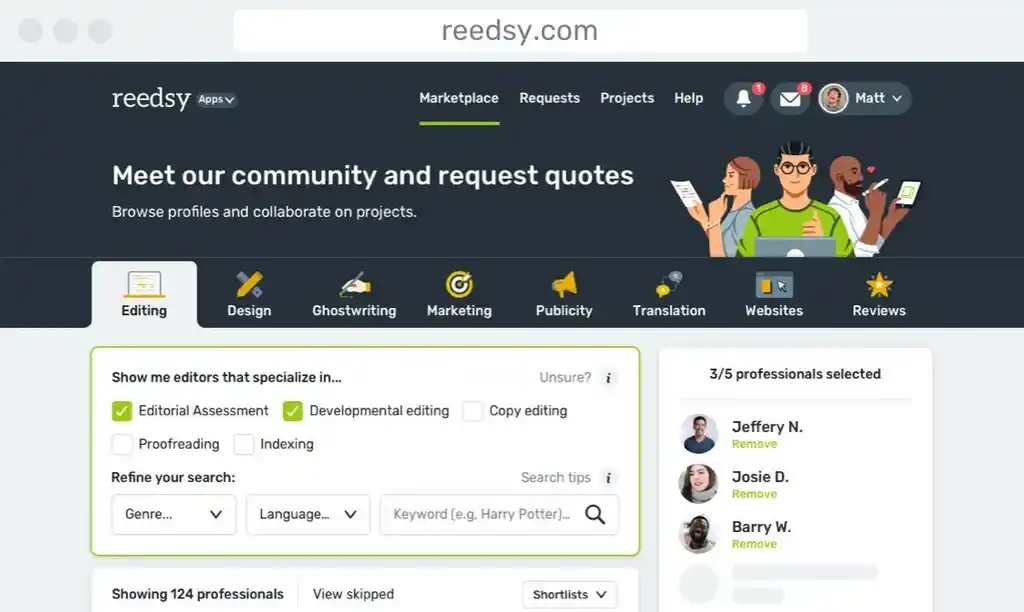
After creating a free account, you can search by service type (editing, design, marketing, ghostwriting, translation) and filter by genre and keywords. Each listing previews the professional's background, portfolio, location, and response rate.
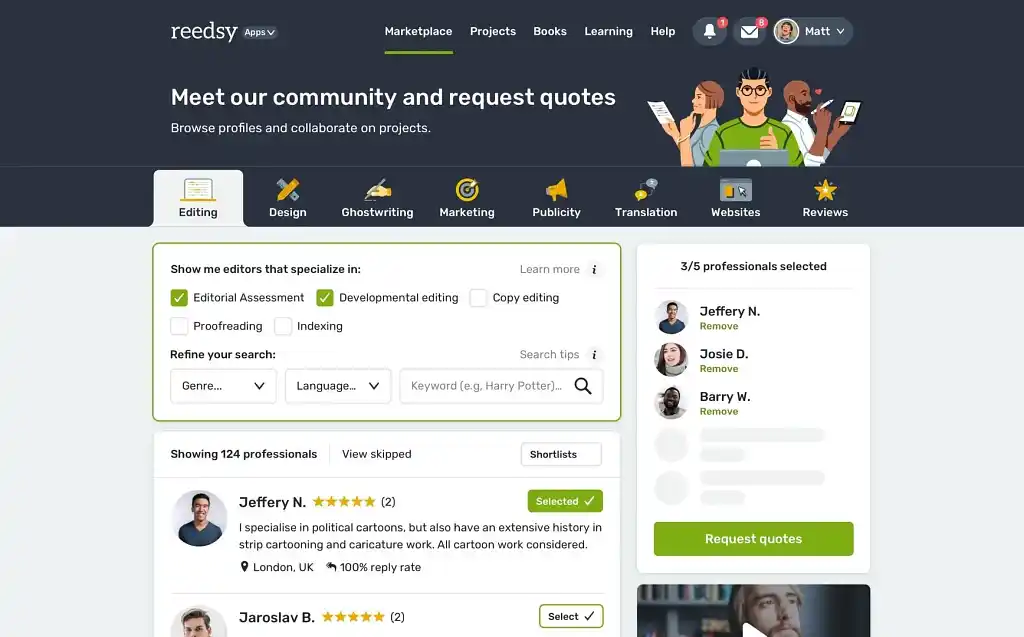
From there, you can shortlist profiles, view full portfolios and verified testimonials, and send a project brief to up to five professionals at once. Most respond within two business days with a personalized quote. You compare offers, ask follow-up questions, and decide without pressure.
How quickly and successfully your collaboration unfolds depends on a few key factors — especially how well you communicate and connect with your freelancer. Notice that they might be booked months in advance, charge more than expected, or simply not be the right fit. If you’re working to a tight deadline, this can slow things down.
Spines (3/5)
Spines works more like a SaaS product. You create a free account and the platform guides you through an automated step-by-step process.
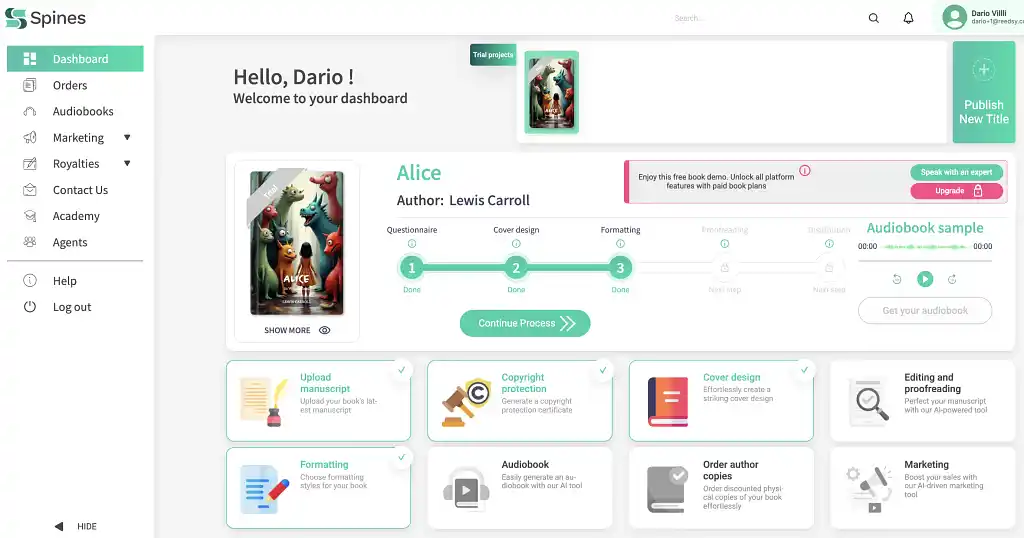
It starts with your manuscript. You choose the trim size and use AI to generate a cover design for free — three options at a time, with the option to generate more. Based on your selection, Spines auto-generates the spine and back cover. You choose from pre-made typography templates, and the platform generates your blurb (which you can edit). You can add your author photo and adjust font sizes as well.
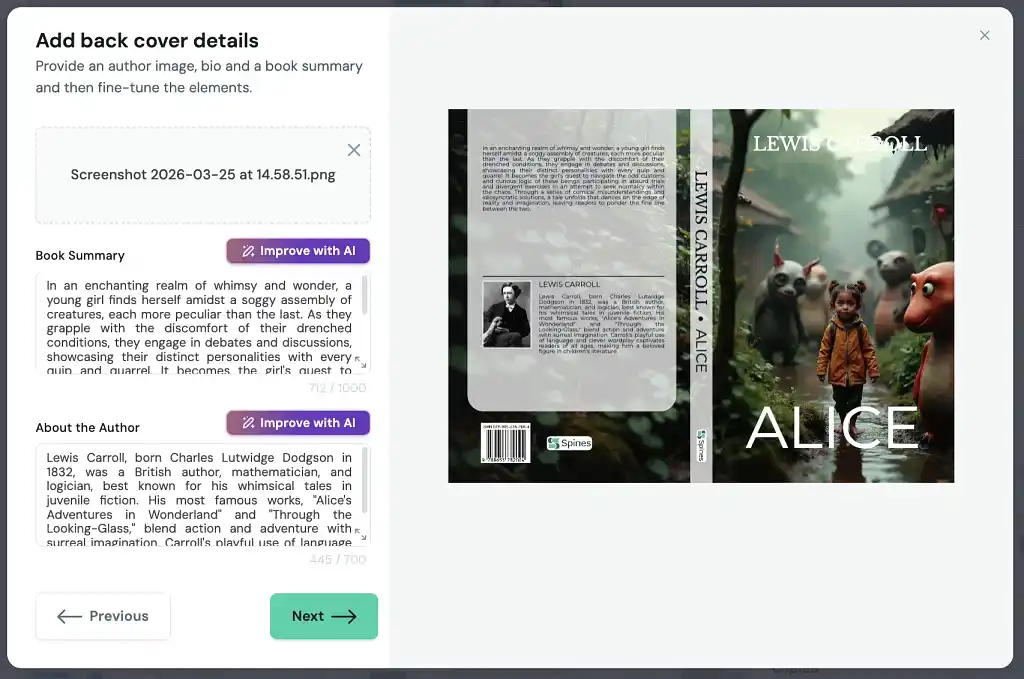
⚠️ Because Spines uses AI to generate covers, all outputs tend to look generic. Spines explicitly states in its terms of use that cover images may not be unique and that other customers may receive identical or similar images — and it disclaims responsibility for this. Yikes.
On Reedsy, each author will receive an original book cover design. Browse real examples here.
Next comes interior formatting, where you select from pre-built styles. Finally, you configure your print edition details — cover finish, ink and paper type — and Spines generates an audiobook sample. After that, a representative gets in touch to improve the book further.
This guided experience lowers the barrier for overwhelmed authors, and it's convenient to do everything in one place. But you'll need to subscribe to a paid plan to unlock the full platform and proceed to distribution.
Distribution process
Beyond the interface, what does the end-to-end journey look like — from manuscript to published book?
In short: With Reedsy, once your book is edited, designed, and formatted, you handle distribution yourself — keeping full control of your royalties. Spines handles everything, which is convenient, but they take a cut and keep you dependent on them.
Reedsy (1/5)
Reedsy doesn't handle distribution. Once your book is ready, publishing is up to you — through Amazon KDP, IngramSpark, Draft2Digital, or another distributor. You can hire a Reedsy marketer to optimize your Amazon page, but if you’d prefer to do everything on your own, the Reedsy blog is full of handy step-by-step guides.
For authors who want full control of their distribution relationships and royalty streams, this is a feature rather than a limitation.
Q: What are the most common mistakes authors make when self-publishing?
Suggested answer

Something I have seen quite a lot lately in the self-publishing world: trying to do everything by yourself. Thinking that you just need Photoshop to make a cover, spell-checking software to edit, a dictionary and a bit of knowledge to translate. Never underestimate the value of a human professional who has spent years studying and then honing their skills. There is more to translation than substituting one word with another, just as there is more to a cover than a bunch of drawings and a title.
Find the right professional for you and your project, and work closely with them; you won't regret the expense, I promise. Also, yes, some types of stories and tropes are very popular right now, and those seem like a safe bet, as far as marketing and selling go - but likely there are a lot of similar books out already. In traditional publishing, variety is sorely lacking, because a tried and tested product seems safer; let's avoid repeating that mistake. Write the story that's in your heart and then strategically find your niche audience. You'll find them starved for exactly your flavour of creativity.
Mariafelicia is available to hire on Reedsy ⏺

One of the most common mistakes I see with self-published authors is setting unrealistic timelines for their publishing journey. Many writers plan their schedule far too tightly and only reach out to professionals—whether editors, designers, or marketers—at the very last minute.
This creates unnecessary stress on both sides: the author feels rushed and overwhelmed, while the professionals either have to decline the project or take it on under less-than-ideal conditions. In the worst case, authors struggle to even find available professionals because their preferred timeline doesn’t allow for the necessary lead time. Many professionals book out months in advance, so it’s wise to plan at least four months ahead—and in many cases, even that may not be enough time.
It’s also important to remember: as self-publishers, you are free to set your own pace. Unlike in traditional publishing, there is usually no external deadline or audience impatiently waiting for the book—especially when it’s a debut. That pressure often comes only from a self-imposed timeline. Instead of rushing, it’s far wiser to take the time to do everything properly, work with professionals without stress, and then launch the book when it’s truly ready.
Publishing a professional-quality book requires space for collaboration, revisions, and creative breathing room. When timelines are compressed, the process becomes about “getting it done” rather than “getting it right,” which can ultimately compromise the quality of the finished book. A thoughtful, realistic schedule not only reduces stress but also ensures that every stage of the process—from editing to design—has the attention it deserves.
Sabrina is available to hire on Reedsy ⏺

One of the biggest traps authors fall into when self-publishing is thinking that the hard part ends once the book is written.
In reality, self-publishing is as much about production as it is about creativity, and overlooking that side can leave even the best manuscript looking unprofessional.
I’ve seen too many writers skip professional editing, try to design their own cover, or leave marketing as an afterthought, and the results are usually disappointing. But just as important, and often less discussed, are the mistakes around the actual printing and publishing process. Authors frequently go with the first printer they find rather than getting at least three quotes, which is a sure way to overpay.
Others don’t ask whether VAT will be added on top of the quoted price, only to discover the true cost later.
Perhaps the most heartbreaking mistake is not asking to see samples of the paper and materials being used; the author waits excitedly for their book to arrive, only to be handed a flimsy volume on cheap stock that feels nothing like the work they poured their heart into.
The truth is, self-publishing is about producing a product as much as sharing a story. Taking the time to ask questions, compare options, and insist on seeing exactly what you’ll be paying for can mean the difference between a book that looks like an amateur project and one you’re genuinely proud to hold in your hands and which reflects the hard work you have put in as well as the hopes, naturally enough, of your client to hold a book in their hands which is a quality item.
Edward is available to hire on Reedsy ⏺
Spines (3/5)
Spines markets an end-to-end timeline of around 30 days to get your book live across Amazon, Barnes & Noble, Apple Books, Kobo, and IngramSpark. The service covers ebooks, audiobooks, paperbacks, and hardcovers. Most books reportedly go live within 5–10 business days, and the platform includes metadata support — category selection, keyword-rich descriptions, and discoverability optimization.
On the surface, that sounds comprehensive. But there are a few important considerations.
Royalties. You keep 70% of the royalties that distribution platforms pay — but that's on top of the cut retailers already take. So you're giving away more slices of your cake.
Cancellation terms and file ownership. If you want to leave Spines, you may encounter two problems. When your agreement ends, distribution services cease — but your books may remain live on retail channels for weeks or months, and Spines disclaims responsibility for late removal. That can create issues if you want to republish elsewhere or need an urgent takedown.
Moreover, while you retain your book's rights, you don't own the files Spines produces. To use them (e.g., your formatted book or audiobook), all production and membership fees — up to six years — must be paid in full.
In other words, Spines will take care of everything, but you become completely dependent on them — and getting out costs significant time and money.
AI training and confidentiality. It's also worth noting that authors grant Spines a broad, royalty-free license to use their books in connection with its business — including for training large language models and creating AI-based promotional materials. Spines also explicitly states it does not guarantee confidentiality for any book you upload.
That's a serious red flag for anyone working with unpublished manuscripts or sensitive memoirs. If your manuscript is confidential, trade-sensitive, or simply not ready to circulate, this clause alone should give you pause.
Pricing and rights
The two platforms also take fundamentally different approaches to pricing.
In short: Reedsy lets you pay solely for the services you need. There’s no royalty split, and you retain full file ownership. Spines bundles services into tiered plans ($3,300–$10,400), then takes 30% of your net royalties in perpetuity and restricts file ownership. For many authors, Spines' "all-in" cost ends up significantly higher.
Reedsy (4/5)
Your total cost will depend on the services you hire. Let's imagine you hire a developmental edit, a copy edit, a professional cover, and a marketer to set up and optimize your Amazon page — you would end up paying around $6,500 in total. That includes the 10% marketplace fee which you pay to Reedsy (on top of the freelancer's quoted price) for maintaining its costs.
Overall, it's a fair deal. You choose which services you get based on what you need and what your budget allows, and you get to collaborate with industry experts at a fair price. If your budget, however, is smaller, you could spend less than $3,000 for a round of professional editing and a book cover, for example.
Pricing calculator
Calculate the average cost of editing services for your genre.
Editorial Assessment
Developmental Editing
Copy Editing
Proofreading
Crucially, you own your book and all the files you receive, and every dollar of royalties your book earns is yours. Reedsy's auto-generated contracts include a default clause stating that, upon receiving payment, professionals assign all rights over their deliverables to the client in perpetuity.
And if you’re not happy with the collaboration, Reedsy will act as a mediator, potentially offering full or partial refunds if work is delayed, of poor quality, or not completed.
Spines (1/5)
Spines charges upfront plan fees: ~$3,300 (Signature), $5,689 (Paramount), or $10,410 (Horizon). Each bundles AI tools, formatting, cover design, marketing, and distribution — plus a membership component that isn't transparently explained on their site. Add-ons like line editing, proofreading, and translation cost extra, so the real outlay can climb fast. These services would be performed by real editors.
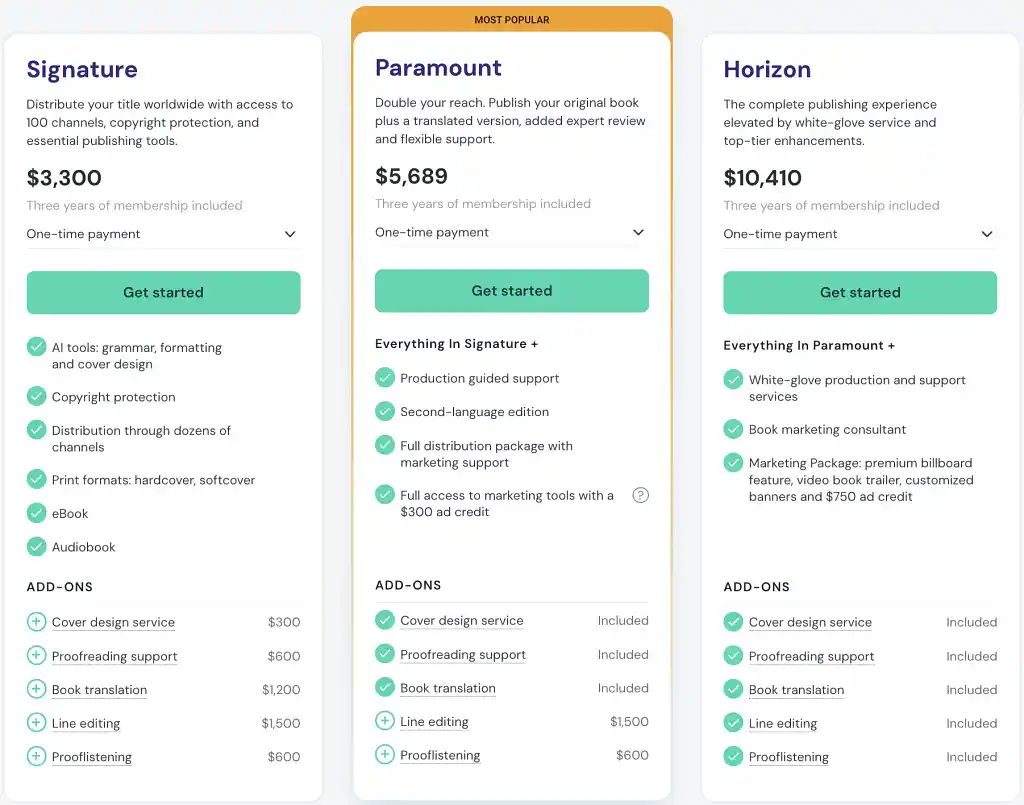
Spines offer a 30-day money-back guarantee, but they retain ownership of the assets they created or revised for you. On top of that, Spines takes 30% of your net royalties for as long as your book is distributed through the platform.
The core problem is bundling. Spines packages together services — audiobook production, translation, copyright registration, marketing tools — that most self-publishing authors don't need all at once. On Reedsy, you hire only the specialists you actually need, which usually means much better cost control.
Spines sells convenience at a premium. Reedsy lets you build a more tailored — and often more feasible — publishing budget. For most serious indie authors, $3k–$10k spent on handpicked freelance help will produce a stronger book than the same amount spent on a heavily packaged service that primarily involves AI.
Q: What type of editing is essential for self-published authors to ensure the quality and professionalism of their book?
Suggested answer

I like thinking about the different editorial processes in terms of how a house might get built. So a developmental edit is really going into the essentials: getting the foundations right, doing the electrical wiring, laying the bricks, building the house. A copy-edit would be about making the house liveable: installing the kitchen, carpets, blinds, the wallpaper. The proofread would be when everything is in place and you want to do a final deep clean, vacuum, sweep.
I think it really depends on the author and their strengths, but authors work so hard and so long on their books that I think it's almost impossible for them to do the final two stages - copy-edit and proofread - with any kind of objectivity. They've seen those words on the page so many times. A fresh pair of eyes here is invaluable.
Thalia is available to hire on Reedsy ⏺

When you’re self-publishing, developmental editing and line editing are crucial steps to consider if you want to put out a professional, high-quality book.
Developmental editing dives into the structure of your story—checking for plot consistency, pacing, character development, and overall narrative flow. It makes sure your story holds together, that characters make sense, and that everything from start to finish engages readers. Without it, even a great concept can fall flat if there are plot holes or confusing elements.
Line editing goes a level deeper, focusing on how your story is told. It improves the clarity, flow, and style of your writing. A line editor will help tighten up sentences, enhance your voice, remove repetitive wording, and make sure every sentence shines.
For self-publishing authors, at least one (preferably both) of these edits are worth the investment. It’s what transforms a good idea into a book that readers can’t put down. Skipping them risks putting out a story that might be inconsistent, awkward, or just not polished enough to compete.
Even if you can only afford one major editing service, try to follow it up with a proofread to make sure it's as polished as possible.
Eilidh is available to hire on Reedsy ⏺
The verdict: Reedsy is the safer, more transparent choice
Reedsy is the better long-term investment for most serious self-publishers. You work with vetted specialists you choose yourself, keep 100% of your royalties, and own every file from day one. The process takes longer and puts more on your plate — but you get quality, control, and transparency in return.
Spines offers speed and convenience through its guided, all-in-one pipeline. But between unverified bestseller claims, opaque bundling, file ownership restrictions, generic AI outputs, and a license that allows your manuscript to be used for LLM training with no confidentiality guarantee — the trade-offs are steep.
If your priority is getting published fast and you're comfortable with its terms, Spines could be for you. But for authors who care about the quality of their book, the integrity of their rights, and where their money actually goes, Reedsy is the clear choice.