Guides • Understanding Publishing
Last updated on Feb 09, 2026
How Much Does an Editor Cost? What to Expect for Pro Services

Dario Villirilli
Dario Villirilli is a senior content marketer, editor, and SEO strategist with many years of experience in publishing. He is Managing Editor of the Reedsy Blog and has also written for IngramSpark, ProWritingAid, Written Word Media, and PublishDrive.
View profile →Before you hire an editor (or team of editors) to polish your book, you'll want a sense of how much it will cost and what you’ll get out of a paid editing collaboration. The short answer is that professional book editors typically charge somewhere between $0.01–$0.05 per word, with developmental editing costing more than copyediting and proofreading, and certain genres costing more than others. However, final prices vary depending on a range of factors and with a bit more research you'll get a good idea of how much is reasonable to pay and what to expect when hiring an editor.
So let’s dive right into what you can expect in terms of editing costs, then discuss the factors that can affect your final numbers.
For a quick answer, use our calculator:
Pricing calculator
Calculate the average cost of editing services for your genre.
Editorial Assessment
Developmental Editing
Copy Editing
Proofreading
🖋️
What kind of editing does your book need?
Takes one minute!
How much does a book editor cost?
At Reedsy, we’ve looked at data from thousands of real quotes from editors across all genres. Based on this data, in 2026 it costs between $1,920 and $4,560 to hire an editor for an 80,000-word book.
At this point, you may ask yourself "Why do editing prices vary so much?" The answer is that costs depend on a number of factors, including the editor’s experience level, the type of service, and the length and genre of the project. For example, a copy editor may charge $0.019 per word, whereas a proofreader’s rates may be lower at $0.012 per word.
Q: What steps can authors take before hiring editors to reduce editing costs while maintaining quality?
Suggested answer

Share your finished work with a range of trusted people, ideally those who are your target readership (not only people you know). These are called beta readers, test readers or advanced copy readers. Have a few questions prepared for your blindspots (Is character A convincing? Is there enough/too much cross-referencing to the glossary? Am I overusing any words? What do you think of the X, Y, Z? Is the dialogue in Chapter X convincing?). Rewrite your draft with brave attention to the feedback, but keeping true to your author's voice, and then send it to a professional editor.
Alex is available to hire on Reedsy

To help manage costs as well as to speed your book to completion, you can familiarize yourself with the various kinds of editing and target your request accordingly. Reedsy has some great educational material on this. I've noticed that many authors will check both "copyediting" and "proofreading" but often that's because they think they're synonymous. They're related, but not the same. The same editor could probably do both or either, but you shouldn't have to pay for two stages if you only need one.
Eric is available to hire on Reedsy

At the easiest and most basic level, do a spellcheck, ensure consistency in usage of terms etc, and fix obvious layout/format issues. Also, if you're concerned about wider things like whether your book is interesting or clear enough, give the manuscript to some smart friends or colleagues to get their feedback before sending to an editor
John is available to hire on Reedsy
Here’s a more detailed table of average editing costs on Reedsy, separated into the different types of editing services you can pick:
| Editing Service | Cost per word |
| Editorial Assessment | $0.018–$0.029 |
| Developmental Editing | $0.026–$0.053 |
| Copy Editing | $0.020–$0.032 |
| Proofreading | $0.014–$0.021 |
To put these figures in context, editing costs for a generic 80,000-word book would be:
- $2000 for an editorial assessment
- $2,880 for a developmental edit
- $2,160 for a copy edit
- $1,600 for a final proof
If it seems like the charges are racking up quickly, don’t fret; you almost certainly won’t need all these types of editing for your book. And depending on a few other factors, your edits could end up costing much less. Here’s what to keep in mind as you begin this process.
Q: How do editors and agents evaluate whether a manuscript has commercial and craft potential?
Suggested answer
Potential is usually obvious in the first few sentences. The quality of the writing, pace and tone particularly, are evident from sentence one. But structure is important too, and if that's not in place, no amount of fine writing is going to fix it. So fine writing + tight structure (whatever these things look like in any given novel) is the clue that the manuscript has potential.
Potential is all about a writer being in control of their material. A writer I feel confident in from page one. The sense that although the manuscript isn't perfect and needs work, the writer fundamentally knows what they are doing. I look for a tone that fits the genre. This is really important, and often it's not working in manuscripts. Good pace is important too, again whatever that looks like in any given novel. This is often determined by the genre. For example, thrillers are pretty much defined by their fast pace, yet I've read many manuscripts described by their writers as thrillers that simply aren't, often due to slow pace.
Potential in a manuscript is always an exciting thing to find as an editor, and it is usually evident where a writer understands their genre, its pace, and its tone. That is a very strong start!
Louise is available to hire on Reedsy

The first thing I consider in a manuscript is how well the first line caught my attention and made me truly care. Even if is subconscious, readers are passing judgement on a piece immediately. This is why the first line is absolutely vital to setting up a successful manuscript. Unfortunately, most people have a very short attention span, and over 500,000 new fiction books are published each year, leaving no shortage of choices for readers. If a writer is adept at capturing an audience in just one line, it tells me they likely understand storytelling and know how to craft a narrative with a compelling voice.
Beyond this, I see potential in consistency. By this, I mean I always look for consistency in the voice throughout a manuscript and for characters to remain consistent in their choices or motivations. If characters are constantly doing strange and out-of-character things, it tells me the work is not well planned or fully developed. I look for plot consistency as well: is the central problem remaining the central problem, or have things drastically shifted somewhere along the way? If it has shifted, it is a sign that the original plotline/idea may not have been strong enough to carry the story.
I hope this helps! There are quite a few other small things I look for, but these are the two biggest ones I can typically spot right away.
Ciera is available to hire on Reedsy
As an editor for a small children's book press, I first read the story to see if the manuscript is well-written, and the story is well told. If I get to the end (there are many reasons that editors and agents will stop reading and go on to the next cover letter and story), then I evaluate whether there are marketing hooks, whether the idea feels fresh and new, yet universal, and whether there is a need for the book in the current market. I hope that helps!
Lynne is available to hire on Reedsy
Editing costs vary depending on genre
One thing that impacts editing costs is your book's genre. Nonfiction, for example, costs more to edit than fiction, as it’s often denser and more niche. Likewise, “heavier” prose in genres like experimental literary fiction or speculative genres like fantasy or sci-fi which include a lot of worldbuilding and made-up words typically costs more to edit, while genres like romance, thrillers, or horror typically costs less.
Another crucial genre consideration: while you might expect a children’s book editor to be less expensive because children’s books are relatively short, that also means every single sentence has to be perfectly tuned — which actually makes the editing cost per word higher (though the word count may be lower)! However, note that if you’ve written a picture book, you may not be charged per word at all, but rather asked to pay a flat fee for editing (usually around $300-$500).
Wondering where your book falls on the cost spectrum? Enter your genre and word count in our calculator to receive an estimate for each type of editing.
Note that while developmental editing, copy editing, and proofreading are pretty consistent within each genre, editorial assessment costs are more variable, so read your calculations carefully to ensure there are no surprises.
Q: How do you adapt your editing approach to different genres and client expectations?
Suggested answer
Firstly, I establish exactly what kind of edit the manuscript needs: developmental edit, copy edit or proofread. I make sure to outline exactly what is included in each type of edit, so the author knows exactly what they are receiving at the end of the project.
If a client is new to being edited, I tend to explain myself more and soften my tone a little; it can be hard to receive feedback if you’re not used to it, and I always want to feel encouraging and constructive to a newer writer, rather than critical or condescending. Equally, if an author is very used to being edited, or I know them well, I can be more casual or condensed in my tone, since there’s more of a mutual understanding there. It’s always lovely to work with the same author again because I can personalise my editing style to be more complimentary to their needs.
For me, different genres tend to require different focuses. For genres which are action-heavy and have mystery elements, such as thrillers, murder mysteries, or cosy crime, I need to focus more on timeline, as the precise order and timing of events is often critical to the plot. For fantasy, the world often has its own set of rules and names, which means I have to keep more of an eye out for continuity errors. For romance, character is much more of the focus, and what I’m looking more at is believability and pace; would these characters fall for each other this fast, in this way? Are they convincingly drawn to each other? Historical fiction often requires the most research: checking names and dates to avoid any anachronisms or inaccuracies. It’s a wonderfully varied job!
Emily is available to hire on Reedsy

This is done in two ways, I think. The first is doing an adequate assessment of the manuscript to determine what edit the manuscript needs and what level: heavy line edit? Light developmental edit? Copy edit? Second, it's important to be clear in your offer to the writer about what your editorial plan is. A copy edit, for example, will include ensuring accuracy, consistency, completeness, and correctness, in accordance with Editors Canada's standards. If these terms are outlined in your offer, and your offer is based on some careful thinking about the manuscript's needs, it should be easy to meet the expectations since you set them yourself!
An important asterisk to this I suppose is making sure there is good professional chemistry between editor and writer. Hold a virtual meeting; get to know each other, if only briefly. It's worth it to put in this extra (yes, unpaid) time.
Holly is available to hire on Reedsy

I work on picture books, novels, memoirs, and non-fiction, so I have a lot of different approaches in my pocket, ha. For picture books, it is much easier to do multiple rounds of edits, and most of my clients choose a multi-round package. That means I move from overall feedback down to line notes as the project progresses. I try to take a similar approach to longer projects, though I don't always get to see more than one draft. I'll often include taking a second look at a short excerpt--normally the beginning--in my editing package.
In term of client expectations, if I've done my job well, these will be clear before we even start working. I am constantly tweaking the language in my sales messages and offers to clarify issues that have come up with clients in the past. I am fairly flexible in changing my approach depending on how the client likes to work. For example, one client of mine prefers to talk through all of the changes in her picture book on the phone. That's pretty rare these days, but it works great for her, and we have a lot of fun on our phone calls!
Tracy is available to hire on Reedsy
Longer manuscripts are more expensive to edit
It might sound obvious, but when budgeting for editing services, authors often forget to account for the length of their book. Even knowing editors’ standard by-the-word costs, it’s easy to underestimate the charges — you may feel like your book is shorter than it is, or assume it’s polished enough not to require a “full” edit (alas, this is rarely the case).
Q: Beyond word count, what factors influence editing quotes and pricing?
Suggested answer

The shape of the manuscript also has a lot to do with the quote. A cleaner manuscript will usually take less time to read and won't require as many suggestions. Stopping to make corrections and/or suggestions is what takes the most time, so this time needed has to factor into the quote.
But word count plays the biggest role in the quote.
Melody is available to hire on Reedsy

Word count and type of service (developmental edit, editorial assessment, copy edit, proofread) are my only metrics. (I used to also go by genre, but I decided to just streamline my process by sticking to word count and type of service.)
Brett is available to hire on Reedsy
The quality of the sample helps me work out my hourly rate. Editing writing by people whose first language is not English usually takes longer. If their first language is Spanish I can help quickly because I know the typical errors. That said, I would always want to discuss the intention behind any tricky sentences, so I expect to see the author's revised version for final checking. We would discuss the timeline to allow for maximum attention towards getting the desired outcome.
Alex is available to hire on Reedsy
This is why it’s useful to keep tabs on the length of your manuscript and cut as much as possible in the self-editing phase, before hiring an editor. True, for some authors, there’s nothing to cut; if your book works perfectly at its current length, don’t prune it for the sake of lowering costs! But for other authors, losing a few superfluous scenes here and there could save hundreds of dollars down the line.
Be prepared to pay for experience and skill
The thing about skilled, experienced editors is that they don’t come cheap — nor should they. We’ve given accurate estimates above based on Reedsy data, but if you’re seeking an editor with years or even decades of experience in your niche, they may indeed cost more.
Q: What factors do you take into account when setting your editing rates?
Suggested answer
There are quite a few factors here:
- Length of the manuscript (I charge per word)
- Requested turnaround time (rush fee)
- How long it will take me to edit (denser books, or those that are less polished may simply take me longer to edit, because I can't edit quite as much each day)
- What level of editing needs to be done (I offer developmental editing, copy/line editing, and proofreading)
- How clean the manuscript is already (an author who's done three or four drafts already is almost always has a more polished manuscript than someone who's done only one or two drafts)
- Additional add-on services (like query letter review, synopsis review, etc.)
- My personal interest level (if I REALLY want a book, I may drop the price a bit to be more competitive)
- How many times I've worked with an author (I generally charge return clients the same across each project, even if my rates have gone up)
- If the author needs additional help with setup, formatting, how to use track changes, etc.
There's rarely a one-price-fits-all scenario in editing, so each project can vary, simply because each one might take me a different amount of time.
Jessica is available to hire on Reedsy
Over time I have come up with an hourly rate I need to make for active editing work, then I make an offer based on the time I expect to spend on a given project:
- A set per-word cost for a service like manuscript assessment that takes about the same time/effort for every client
- A sample copy or line edit at a couple of different levels of intensity, to show what to expect at a given rate.
- An alternative suggestion for what might be the most helpful within a potential client's budget. For example, a manuscript assessment or copy edit of a smaller portion can show what most needs to be done--so the writer can work independently and then return for paid services.
I provide my FAQ note to help writers see what they might expect and understand what is involved in different editing services. My purpose is always to give a client the most help possible within their budget constraints. "Easy clients" do not subsidize the work I do for more complex, difficult projects.
Cindy is available to hire on Reedsy
I always check length first. The next step is to read the first few pages. How does the author use language? Is there consistency re: verb tenses? Is the POV (point of view) clear? And one more important issue: how does the writer describe the work? If I'm told that it's a sure-to-be bestseller and all it needs is a bit of polishing, I give it extra consideration. I always do a no-charge edit of the first page, so the writer understands how I work. This can make or break the possibility of working together.
Victoria is available to hire on Reedsy
Suppose you want the best possible editing job done on your book (we daresay most authors do). In that case, it’s worth shelling out a little extra — particularly for editing tasks that require a great deal of experience and genre familiarity to pull off, like a developmental edit or thoughtful editorial assessment. That doesn’t mean you can’t work with an amazing editor on a relatively low budget, only that you might have to look a little harder for the right person and/or figure out a payment plan over time.
Q: Can you share an example of how you guided a first-time indie author through the editing process?
Suggested answer

I love working with first-time authors because I know how exciting it is to have your work's potential realized and taken seriously in a way friends and family may not.
That said, I always recommend beta readers. This saves you money, allowing you to revise before you hire if your book is missing the mark somehow. Think about who those readers should be. Are your readers people who read regularly and in the genre of your book? I recommend bringing a list of questions and concerns to keep in mind while they read, which will help them as well as you. When your readers can look you in the eye and tell you the book is good, it generally works, then it's time to invest in an editor.
I always do a sample edit of your sample so we can both see what we're getting into. It can be disconcerting, even upsetting, if you have never been edited before, to see a lot of red (changes) on the page. But take a breath and remember that the editor is on your side, making sure you are expressing what you mean to in the best way possible. If you feel like an editor is overreaching or messing with your voice, speak up. My goal is always to maintain the author's voice and preferences even if I don't necessarily agree with the choices. I will always express my opinion and reasoning, but your book, your decisions. I use Track Changes in my edits (you can reject anything I do) and will sometimes recommend authors read through the sample with No Markup, to hide all the red and see if it still reads okay to you.
My favorite way to edit is a sort of copy/developmental edit hybrid. I am an irrepressible copy editor. If it's wrong or awkward or too wordy, my fingers itch to fix it, and I think first-time authors can learn a lot of good nuts-and-bolts skills from a good copy edit. At the same time, I will query places I get confused, plot holes, concepts that could be expanded or cut back, places where characters act out of character or contrary to human nature, places where actions seem to defy the laws of physics (you'd be surprised how often that happens), etc. I return the manuscript with a letter outlining any broader thoughts or suggestions. And we can chat before and/or after the edit.
A quick anecdote: I edited one first-time novelist whose book had a lot of big problems. I did my job, commenting throughout and outlining the problems in an edit letter. Many months later I received an email from this author saying my edits made them angry, they felt I was wrong. But then, after putting the ms. away for months, they pulled it out again, reread it, and realized that everything I'd said was right.
Not to boast, but just to reiterate that we are a team. I am here to help.
Sophia is available to hire on Reedsy

As a non-fiction editor, I often work with authors who have business, as well as personal, goals behind their books. For first-time indie authors, I like to start by getting them to think clearly about how their book can support their work and professional profile.
Understanding an author's overall goals is crucial for supporting the editing process and it helps to frame certain editorial decisions I might make along the way.
I also include check-in calls between editorial stages into all of my projects. After an Editorial Assessment, I like to have a call with an author to discuss next steps, even if they decide not to move forward with an edit at this time. I also have check-in calls with my authors after my first pass on their developmental edit, to answer any questions and ensure that nothing has changed in their world that might impact the final manuscript.
One of my first Reedsy authors, Joe Papadatos, came to me with a 15,000 word manuscript for an editorial assessment. We had a call before he decided to work with me, in which I explained why I prefer to start any of my editorial projects by better understanding his goals, the audience for his book, and how this would drive editorial decisions.
From there, we talked about not only the different stages of the editing process, but also why he would benefit from increasing his book's word count. The upshot was that he went away with a lot of ideas and came back to me with a 35,000 word manuscript for an assessment, which led into a full developmental and final copy edit before he self-published.
We had calls at each stage, during which I also shared some of my experience about the self-publishing process that I've gained from working with other self-publishing authors. For me, guiding my authors through these steps and providing a bit of extra support feels like a natural extension of my role as an editor, and an important one as it can feel overwhelming at the beginning of the journey.
Kat is available to hire on Reedsy

I had a fascinating experience guiding an author through developmental editing on a YA book about sanitation and the management of transmissible disease. She wrote a highly original narrative about a young woman who guided her family through an outbreak of the flu. While the narrative was straightforward --- her family got sick and she helped them through it --- she integrated a lot of highly technical, scientific information about disease transmission and how to prevent it.
In addition to helping her modify the character to make her more sympathetic to the audience, I offered suggestions on how to integrate that technical information without interrupting the narrative flow. Given that the character was a young adult, it seemed important to make her actions and knowledge plausible to the reader. By tweaking certain episodes in the story and adjusting her dialogue, we were able to make her both a relatable narrator and a vessel for the knowledge that the author wished to convey.
Sometimes, narrative and objective can come into conflict. Helping an author to adjust their narrative flow in order to achieve their end goal is crucial to developmental editing.
Richard is available to hire on Reedsy
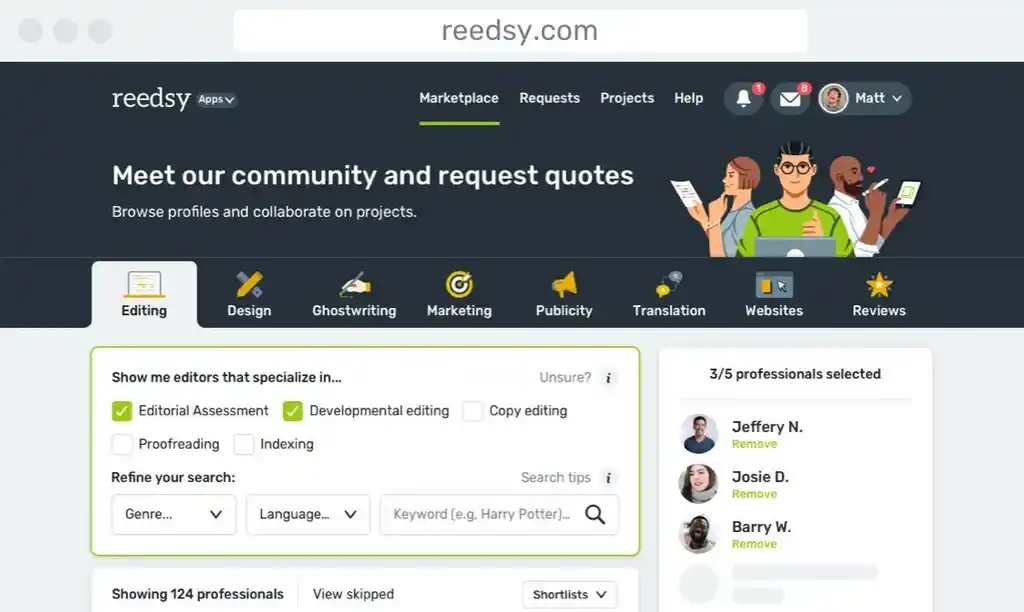
Hire a professional editor on Reedsy

Sean L.
Proofreader/editor for 14+ years, reader for 40+, and as a lifelong fan, horror is my go-to genre.
Request a quote
Lisa S.
Book indexer with over 20 years' experience at major publishing houses including Routledge and Cisco Press
Request a quote
Crystal B.
I'm an editor with over ten years of experience in copyediting and proofreading, specializing in children's, middle-grade, and YA fiction.
Request a quoteFortunately, if an editor is truly passionate about your project, they’re often willing to meet you halfway. Again, you can ask to pay in installments, or you may be able to arrange a discount — especially if you’ll be working with them on multiple books.
Be respectful and honest in your communications, and you’ll surely find a great professional who will work for you.
Head to the final part of this guide for tips to help you get the most out of your collaboration.