Posted on Dec 19, 2025
How to Design a Book Cover: 10 Dos and Don’ts

Your book’s cover is one of its most important marketing assets. A great cover instantly conveys tone and draws readers in, whether in a physical bookstore or online. In fact, a professional-looking book cover can potentially double your sales.
As Reedsy’s in-house illustrator with over 25 years of design experience, I know exactly what distinguishes an excellent book cover from an amateur one. Of course, the best way to guarantee a professional-looking cover is to hire a professional — but in case you need to DIY your cover for whatever reason, I’ll share my secrets to designing a cover concept that will help your book stand out.
Then, in the next post in this guide, I’ll walk you through the process of bringing your concept to life in your preferred design software.
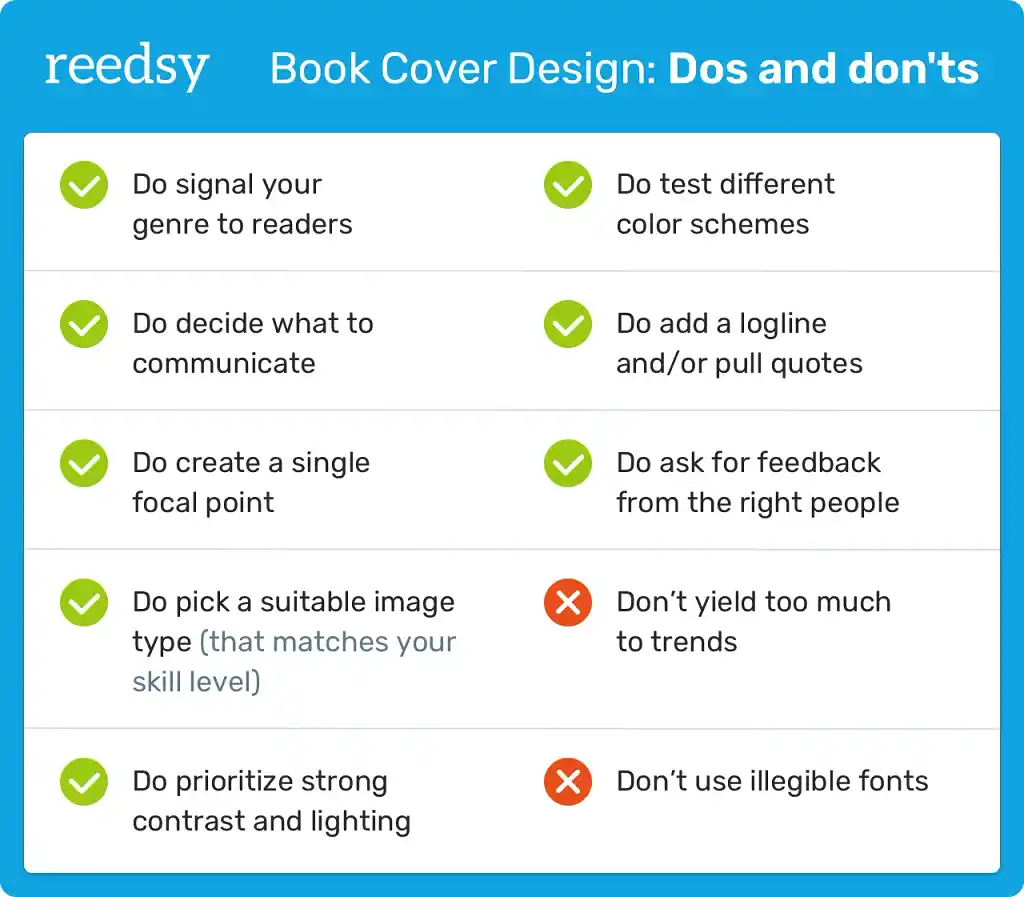
✅ Do signal your genre to readers
Naturally, you want your cover to be eye-catching and set your book apart from the crowd. But you don’t want it to stand out so much that readers have no idea what’s in it. Your cover needs to clearly indicate your genre and subgenre — and to do that, it must share certain visual cues with similar (successful) books.
To increase your knowledge of your genre’s norms, read my guide to researching book cover trends here. You should only start designing in earnest once you have a strong understanding of the color palettes, typography, imagery, etc. that signal your genre to readers.
Q: How do you keep up with industry trends?
Suggested answer


I keep up with industry trends in a few different ways. I regularly research bookshops, both online and in person, to see what is happening on the shelves right now and how design is shifting across genres. Social media is also useful, especially Instagram and Pinterest, which are full of designers, illustrators and publishers sharing new work and fresh ideas.
I also follow design blogs, agencies and publishers, and I keep an eye on what is being shortlisted for design awards. Often, those projects are the ones pushing boundaries and setting the direction for what comes next.
That said, I do not believe in following trends for the sake of it. For me it is about being aware of the landscape, so that I can make informed choices: when to align with current styles, and when to deliberately do something different so a book stands out.
And honestly, nothing beats wandering around a bookshop, picking up the latest releases and seeing what catches your eye. It is my guilty pleasure and my favourite research lab all in one!
Clare is available to hire on Reedsy ⏺

I stay on top of industry trends in several ways, but being an avid reader helps the most. The majority of the genres I specialize in are the ones I read myself, so I naturally absorb what works for readers — from themes and tone to popular visual cues.
I also keep an eye on bestselling covers, explore new tools and techniques, and follow other designers and illustrators for inspiration. Combining this ongoing research with my own reading experience helps me create covers that feel current, professional, and true to the story.
Alexandra is available to hire on Reedsy ⏺

Always looking for what is out there, on new book's releases. Reading about trends not just on books but in design, fashion, and color trends. Social media is also one of the best ways to keep up with the new trends.
I like to interact with younger professionals and keep a GLOBAL MINDSET when looking around.
Veronica is available to hire on Reedsy ⏺
❌ Don’t yield too much to trends
That said, don’t let design trends dictate your every move. What is ideal for one cover may not work for another, even if they share the same genre and themes.
At design school, we learn that each problem requires a unique solution. Remember: design is first and foremost about communication — in this case, with potential readers. You should never get carried away by trends at the expense of effective communication.
Let me illustrate my point with an example. I designed this cover for an anthology of various romantic and erotic stories:

It’s not your typical romance/erotica cover — because this isn’t your typical romance/erotica anthology. All the stories share a strong female perspective and discuss themes of inner exploration and self-knowledge.
I felt that erotic photographs of models would betray the true nature of this work. Likewise, I didn’t want to use colorful vector art of a couple, as this could convey the tone as too light and “beachy” — or imply that all the stories were about the same two people.
Instead, my design contains a degree of sensuality, but remains restrained, harmonious, and elegant. The key-shaped zipper symbolizes how the woman is opening the door to her inner self. This almost literary symbolism communicates that there is more to the collection than love affairs and sex.
In short: know the trends in your genre, but don’t adhere to them blindly. Every decision should be based on what best serves the communicative intent for this specific book.
Speaking of which…
✅ Do decide what to communicate
Communicating your genre, one way or another, is key. But beyond that, it’s up to you what you want readers to take away from your book cover.
You can communicate characters, tropes, setting, themes, emotions, and more — but not all at the same time. To help you maintain focus during the design process, decide on your top communicative priorities now.
Personally, I like to think about my primary goal in terms of its degree of abstraction. Do I want to depict something tangible about the story’s events, or do I want to convey the abstract emotions, tone, or themes prevalent in the book?
You can see that these goals will lead to very different concepts. The first will result in a literal image of a key scene, setting, or character, whereas the second may lead to more open-ended or abstract imagery or symbolism.
Now let’s talk about how to actually come up with a cover concept. Don’t worry about professional design tools or precise measurements yet — just get your ideas down on paper.
✅ Do create a single focal point
I recommend that you start with your focal point: the part of your cover that will capture readers’ attention. Note that you’ll want to draw them in with one strong image, rather than trying to handle multiple plot points or themes equally.
Note: The central "image" doesn’t have to be an image at all. Plenty of effective book covers spotlight creative typography instead, as I’ll show you in the examples below.
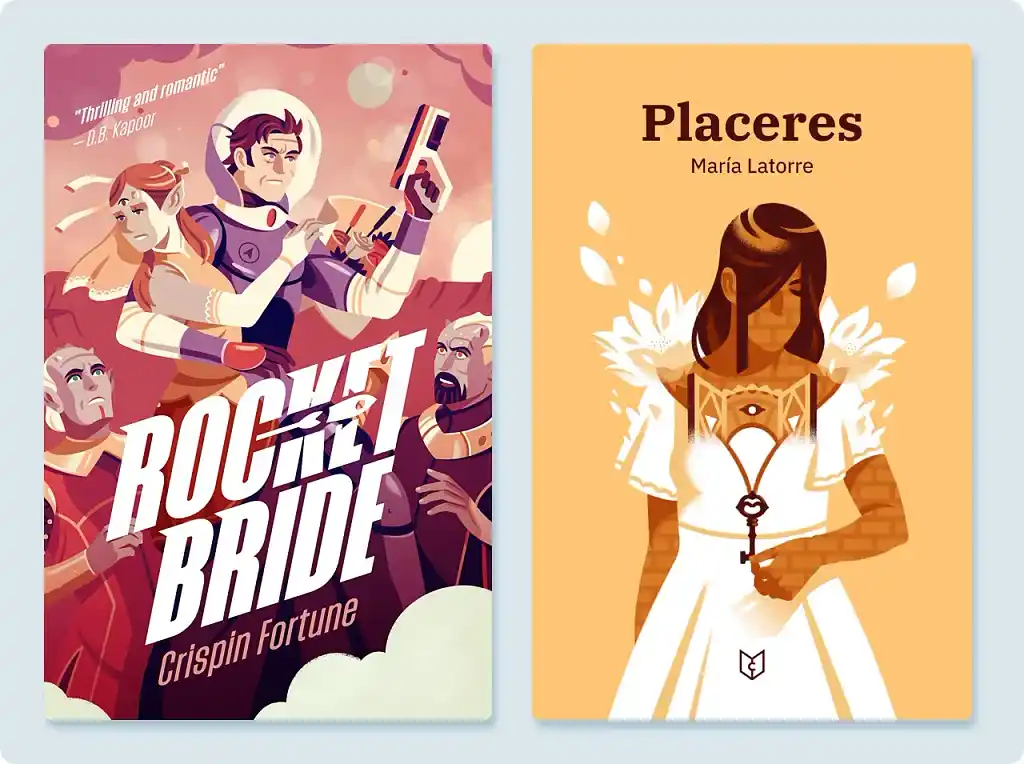
You’ll probably need to brainstorm multiple concepts before you come up with one that feels right. I usually do 5–6 sketches before I find a concept that speaks to me (and my client). For instance, I came up with six different ways to depict the escape scene in Rocket Bride:
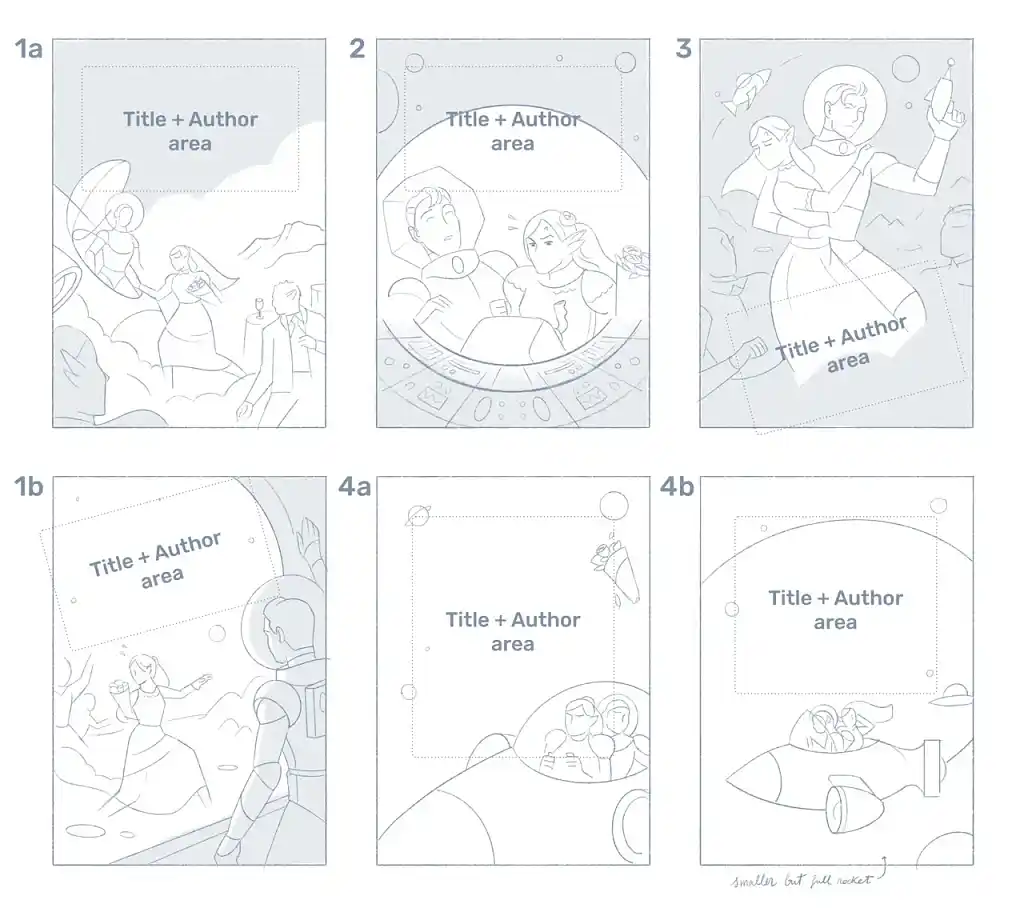
With that in mind, here are some of my favorite ideas for focal images to help inspire you (alongside your research, of course).
Character(s)
I may be a designer, but even I understand the importance of developing compelling characters for a given story. It follows that a visually intriguing character can similarly draw readers in.
You can portray your character(s) realistically or unrealistically, depending on your communicative intent. For literal depictions, you might like to highlight the protagonist’s most interesting or prominent physical traits, or position two characters in a way that reveals the nature of their relationship. For abstract portrayals, you can weave symbolism into the image or omit certain features to represent loss of self, some sort of narrative mystery, etc.
Let’s look at two examples with different communicative intents:
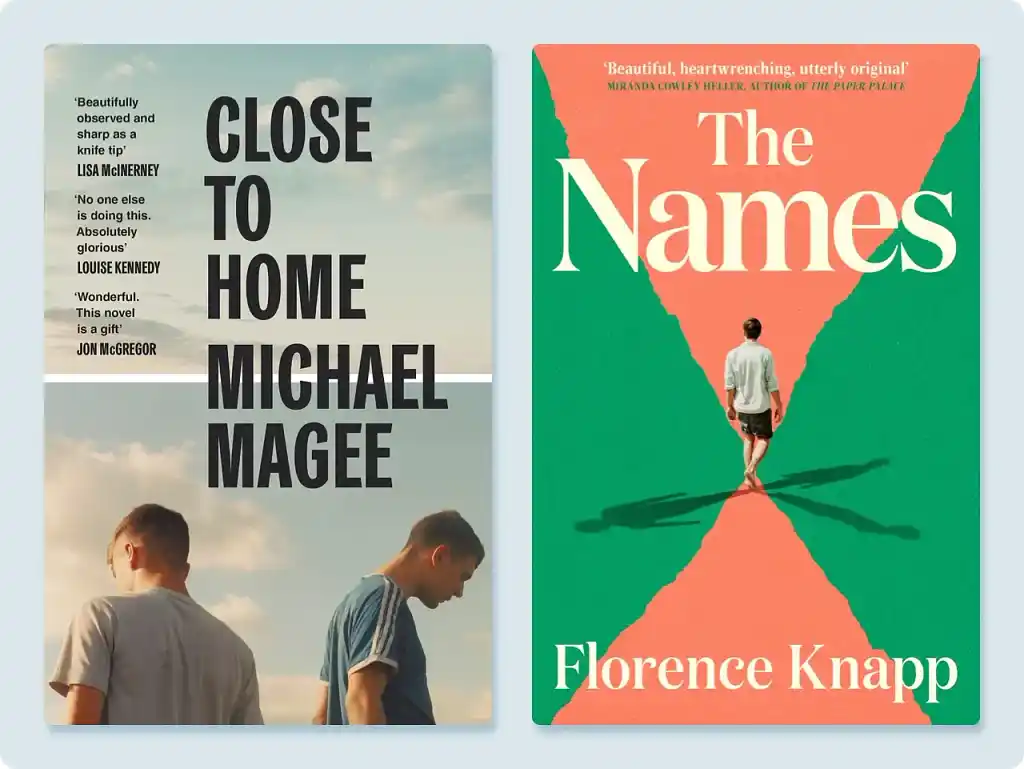
The cover of Michael Magee’s Close to Home uses realistic imagery of two young men, who — crucially — have their backs to each other. We can deduce that their relationship is strained, hinting at character-driven conflict.
The cover of Florence Knapp’s The Names, on the other hand, adds an abstract feature to the otherwise nondescript character: three shadows. These imply that the book will explore multiple identities and the character’s sense of self.
See how these characters’ faces are deliberately obscured — a common practice in many genres. There are several reasons why this might be the case, but I think it boils down to the fact that readers want to put themselves in a protagonist’s shoes. Seeing a specific face on the front cover can make it harder to do that.
Location
If the setting of your story is particularly interesting or important, you might prefer to feature a location on your cover. I see this a lot in historical fiction, science fiction, and fantasy, where much of the story’s appeal is its worldbuilding, as well as in horror, where the creepy setting establishes the atmosphere.
That said, I advise you not to overwhelm the reader with a complex landscape. Instead, draw the reader’s attention to one main image — perhaps a particular building or natural feature.
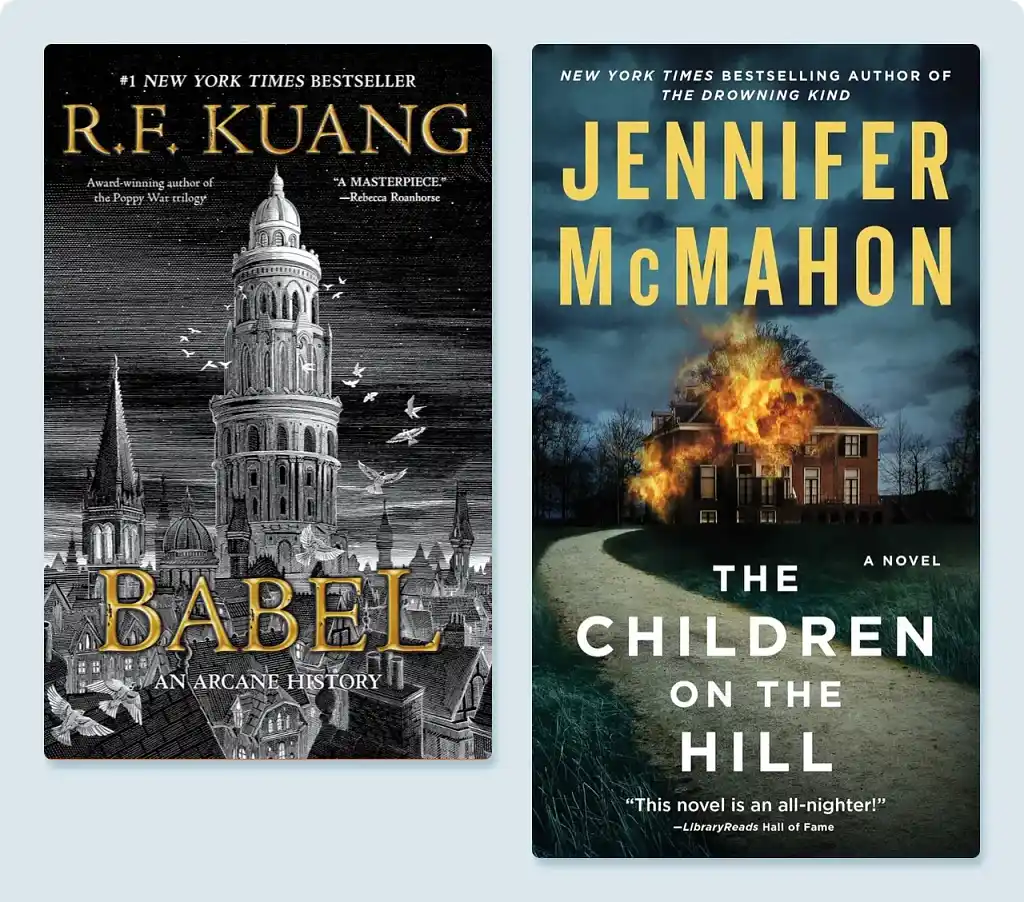
On the cover of R. F. Kuang’s Babel, for instance, a single tower stands out from the rest of the cityscape. The building is old-fashioned and imposing, hinting at the historical setting and the dark academia genre.
The cover for Jennifer McMahon’s The Children on the Hill, meanwhile, focuses on a burning building — instantly conveying the dark nature of the novel and sparking intrigue (no pun intended) as to the fire’s source.
Q: What sources of inspiration do you turn to when creating book covers?
Suggested answer
My main source of inspiration always comes from the book itself. I focus on its emotional core — the atmosphere, themes, and tone — and translate that into a single visual that feels true to the story. Beyond the book, I draw inspiration from films, TV shows, digital illustration, and other visual arts, which offer fresh ways to approach composition, color, and mood.
I also pay attention to genre trends and bestselling covers, blending those insights with my artistic influences. This combination helps me craft covers that are faithful to the story while standing out in the market.
Alexandra is available to hire on Reedsy ⏺

The first and best source of inspiration is the work itself. I love to read the works in their entirety, if possible, and steep myself in the words, characters, and worlds of the book. Often a scene, or simple well written line can set off a whirlwind of ideas.
I love when authors send other imagery that excites them, as that often excites me too and gets us into the world of visual communication. Some authors have gone as far as to create entire mood boards and playlists, which I love! (You know who you are!)
Artists also inevitably bring with them everything else excites them. For me this is other paintings, other stories, music, poignant moments from real life, and more. In my experience the best images come from fusing the author’s world and enthusiasm with my own, and together we pull off something we are both genuinely stoked about.
Charles is available to hire on Reedsy ⏺

The starting point is always the story. Then comes the world around me: the September breeze, the open window, the neighbor hanging laundry, the child running along the beach, and the shapes of his movements, my cats, the people I observe, the shifting colors of nature. Afterwards, I turn to references, exploring different cultures, clothing, and traditions to enrich my imagination and transform it into images.
Sasha is available to hire on Reedsy ⏺
Iconography
An increasingly popular approach to cover art is to focus on a simple but iconic symbol. Whereas iconography was previously confined to mostly literary fiction, you now see it on plenty of genre fiction covers too.
I think minimalism has become more popular because it suits the modern market: a good icon is memorable and evokes an instant meaning, allowing it to make an impression even when a user only scrolls past it for a split second.
You can reuse existing symbols (with permission, of course), or invent a brand new one. To come up with an icon, reflect on the main themes and symbols in your novel. Is there a recurring image or sentiment that you wish to convey?
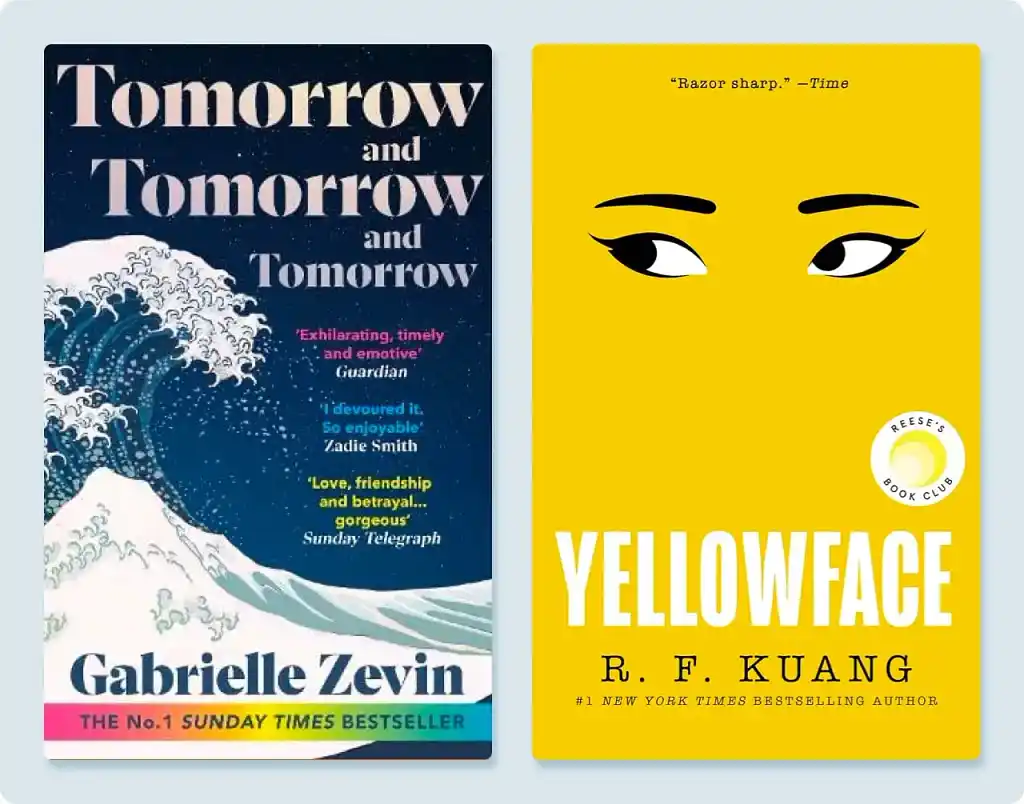
The cover of Gabrielle Zevin’s Tomorrow and Tomorrow and Tomorrow recontextualizes Hokusai’s famous woodblock print The Great Wave off Kanagawa — which simultaneously nods to a Japanese-inspired video game in the novel and to its themes of resilience and transience.
The cover of R. F. Kuang’s Yellowface uses original art that has now become iconic thanks to the book’s success. The pair of eyes on a yellow background embodies the offensive practice of yellowface, forefronting the novel’s perhaps-uncomfortable themes of racism and exploitation.
🚨A word of warning: Icons are powerful for a reason. There is no room for error or embellishment — meaning they require extreme care in their creation. If you go the iconography route, try to think through every possible interpretation, or risk the dreaded miscommunication!
Typography
Finally, remember that you can focus on the title itself. You can convey a lot of meaning through creative typography. Just look at the examples below:
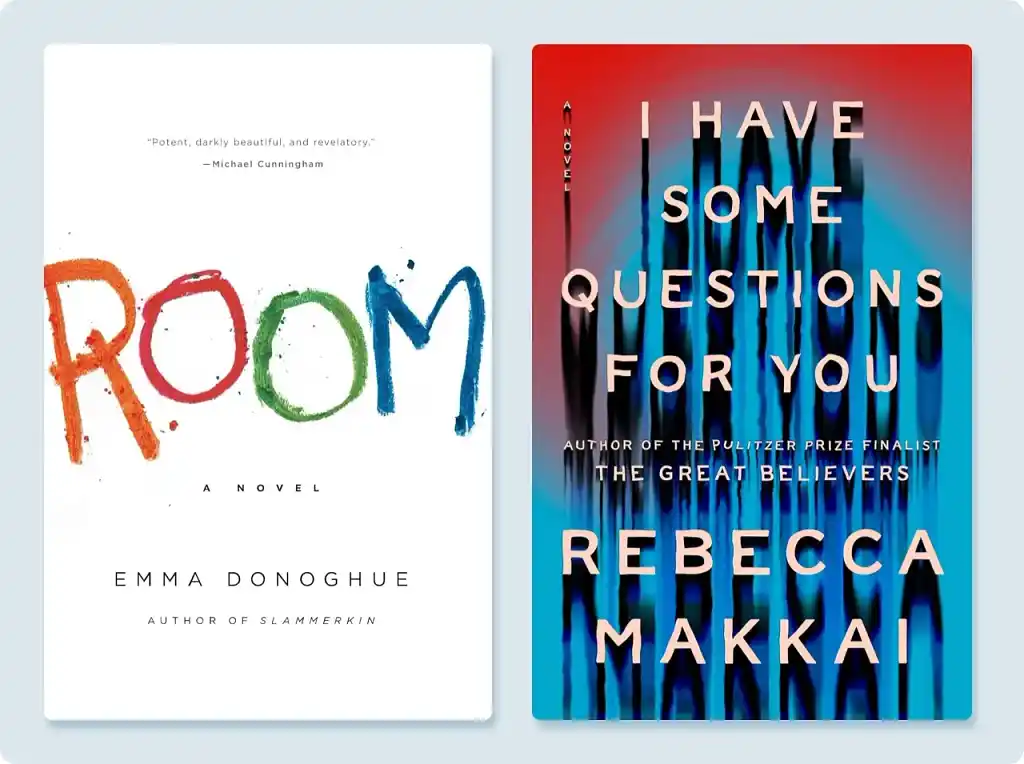
The title of Emma Donoghue’s Room looks like it has been hand-painted by a child, alluding to the 5-year-old narrator of the story. The bright colors also inspire hope, promising that this tale of abuse will not be entirely depressing.
In contrast, the shaky shadows on the cover of Rebecca Makkai’s I Have Some Questions for You, combined with the harrowing red and blue colors, indicate that this is a mystery/crime book which may indeed be scary.
Whichever focus you choose, make sure your cover paints an accurate picture of your book’s contents. Don’t mislead the reader with the promise of an atmosphere or theme that your book never delivers.
Q: How do you best work with clients to capture their vision for their book cover?
Suggested answer

Firstly, always listen to what the client is saying and - read between the lines - what do they really want. Read the brief. Then read it again. I don't just slavishly give the client exactly what they ask for. They are paying me for my expertise. So I will consider what they want to achieve (which is usually different than what they initially want to see). Then I will come back with ideas that will achieve their aims. Its a bit of back-and-forth between me and the client until we align on the final cover. Clients tell me all the time, they could never have expected the final cover to look how it does, and how thrilled they are with the result. Sometimes a client will come with a firm idea or element. If that serves the book then great, I will incorporate it in a way that optimises what the cover needs to communicate. Its ultimately about communicating clearly with the client.
Wayne is available to hire on Reedsy ⏺
The best way to capture a client’s vision is to start by asking lots of questions. I like to find out not just about the story, but also about any concerns or fears they might have, what they do and don’t like, and how they want the book to feel on the shelf. Sometimes a video chat helps enormously to get a sense of their taste and personality.
If a client has a specific idea, I always do my best to use that and make it look professional. If I think the project could benefit from a different approach, I will suggest alternatives, but always as part of a collaborative discussion.
Stage one of my process is research and idea generation. I play around, try out unusual or even odd concepts, and see what comes from that experimentation. With every idea I present, I include variations in colour, composition, or typography so the client can see the possibilities.
Many authors actually do not know exactly what they want, and that is great too. In those cases, I cast my visual net wider, presenting lots of ideas and styles to see what resonates with the book. Once we have settled on a direction, the refining and to-and-fro can take several stages to resolve. Getting every detail right on the spine and back cover is equally important. From there, we work together to shape a cover that is both creatively exciting and commercially strong.
Clare is available to hire on Reedsy ⏺
Communication is key. Asking questions and asking for examples of favorite covers is a start.
After that I like to send a few different concepts. I like to make it clear that the first round is still like a shot in the dark and work in progress. Specially when the client is not sure what they want. The best way to understand what a client expectation is, for design and style, is to send a few different options first and start working from there.
Veronica is available to hire on Reedsy ⏺
✅ Do pick a suitable image type (that matches your skill level)
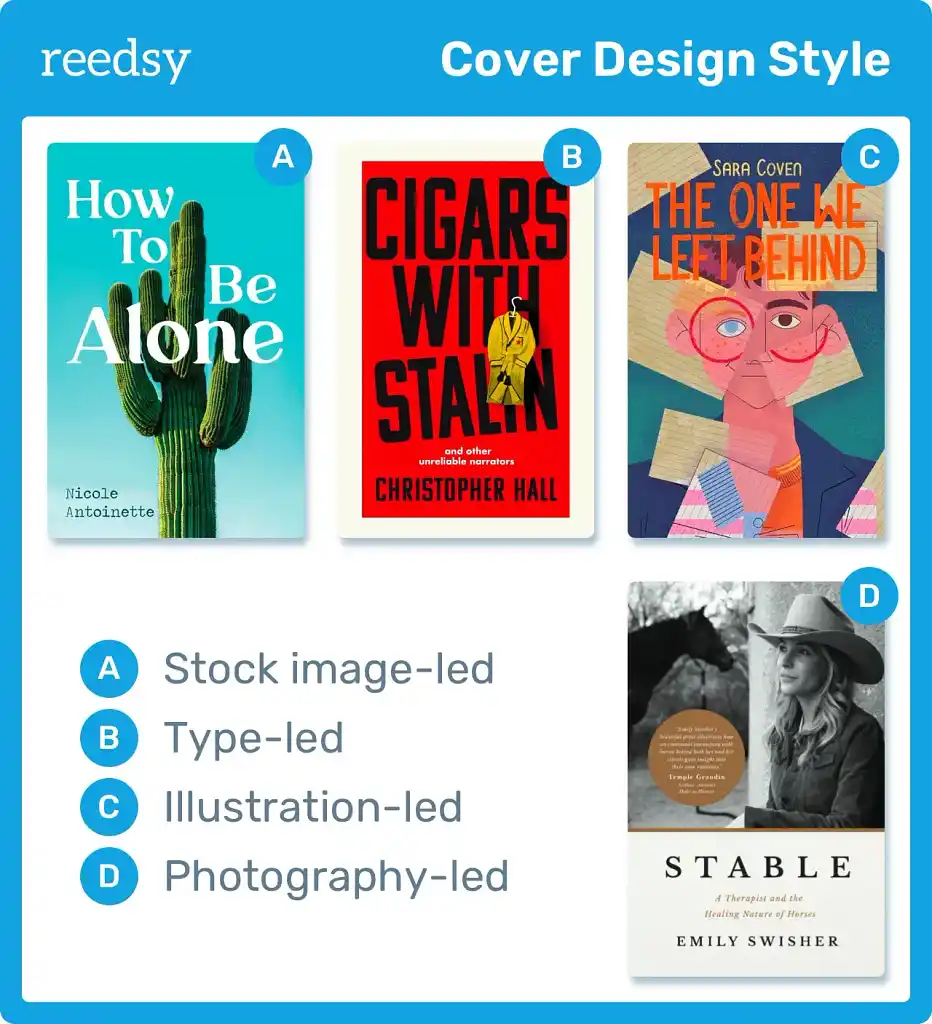
Once you have a concept you’re happy with, the next step is to pick your image type. You have four main choices: a stock image, an illustration, a photograph, or a type-led design. Each has its pros and cons — you are limited only by your budget or DIY skills.
Stock image
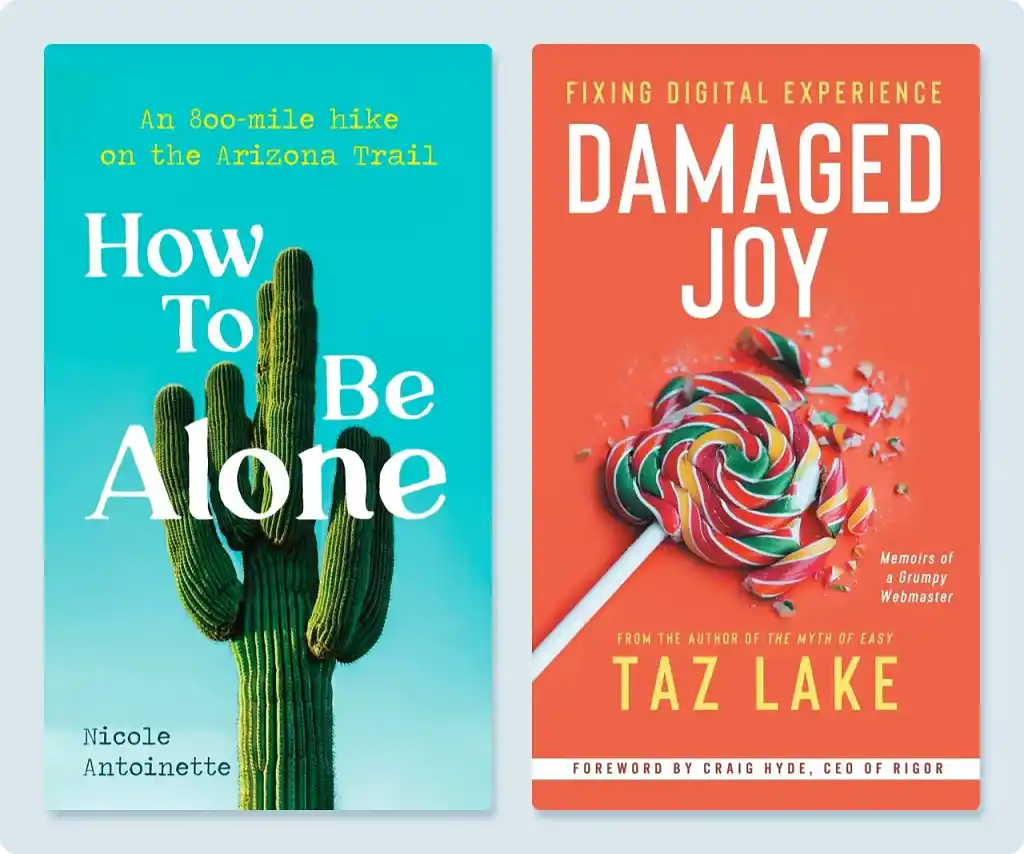
Many covers released by major publishers feature stock images that are then cropped, manipulated, or edited into the design. You see a lot of these covers in certain romance subgenres (think Colleen Hoover), as well as crime/thriller and self-help.
|
✅ Pros |
❌ Cons |
|
Less expensive than a dedicated photo shoot |
Impersonal |
|
Flexibility in digital post-editing |
Limiting if you don’t have high-level image editing skills |
|
Risk of dozens of other covers using the same image |
Illustration
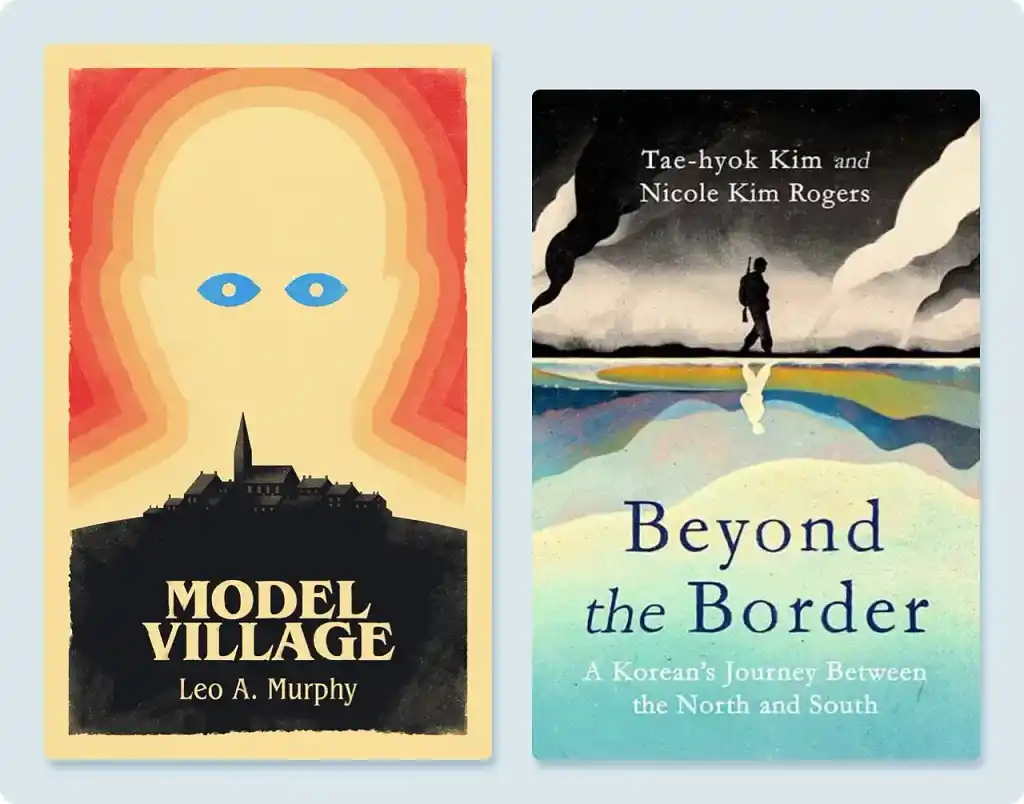
Illustrations on book covers come in a vast array of styles; they’re arguably the most versatile, sophisticated approach to cover design (though also the most time-consuming).
Illustrated covers range from intricate, life-like illustrations of the book’s world (as seen on many fantasy and science fiction covers) to evocative works of abstract art (on literary fiction covers, etc.).
|
✅ Pros |
❌ Cons |
|
Anything is possible (with the right illustrator) |
Time-consuming |
|
Can create truly bespoke imagery |
Most authors are unable to DIY an illustration |
Photograph
These days, you only usually see specially commissioned photography on celebrity memoir covers, where the biggest selling point is the author. But any cover can benefit from a custom-shot photograph.

|
✅ Pros |
❌ Cons |
|
Get the exact image you need |
Expensive to hire a photographer |
|
100% unique |
Type-led design
A type-led design has always been common in nonfiction and literary fiction — but I see it increasingly in genre fiction, too. The focus of the design is a creative manipulation of the typographic elements (title, author name, etc.).
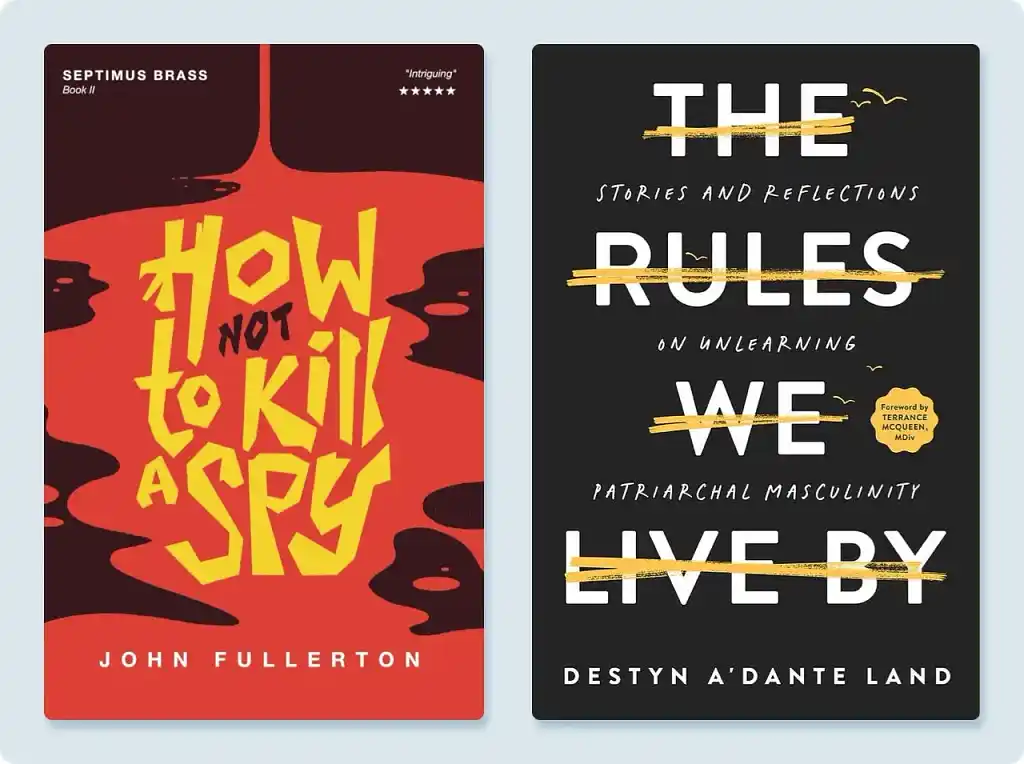
|
✅ Pros |
❌ Cons |
|
Striking |
Not always as clearly “communicative” as other imagery |
|
Legible at almost any size |
|
|
Simpler to create than other designs — and potentially faster |
Once you've settled on the style of your focal image, you can look for a professional to execute your design, or continue refining it yourself if you are confident you can pull it off.
If you do choose to DIY your cover, read on for more of my design dos and don’ts as you begin to create your cover in your chosen software.
Q: What factors do you consider when calculating your rate for a book cover design?
Suggested answer
When I calculate my rate for a cover design, I take into account the tools and time required to achieve the final result. Most of my recent covers are created using 3D software combined with Photoshop for digital painting, retouching, and fine adjustments. Working in 3D allows me to avoid relying heavily on stock photos, which gives authors more unique, customized visuals — but it also means the process can be more time-intensive than a photo-based cover.
My pricing reflects the hours it takes to model, render, and refine a scene, along with the additional cost of purchasing 3D assets when needed. I also factor in the creative scope of the project, the number of revisions, and the level of detail the story requires visually. All of these elements ensure that the final cover not only looks striking but also fits the market and communicates the essence of the book effectively.
Alexandra is available to hire on Reedsy ⏺
If we are talking about a full color cover illustration I start with a flat rate for most quotes. This rate is calculated on many things, including, in no particular order: time, comparing market rates, my skill and experience, and rights I am agreeing to sell. I compare this against other things like complexity, exposure of images, any extras the client may be asking for including additional rights. I am also keeping in mind how this will translate to an hourly rate.
I have found that there is a fairly clear link between how much I charge and the quality I produce, which comes down to time. I like to read as much of the manuscript as the client will give me, ideally the whole book. If we add up reading the book, sketching and ideating, communication and negotiation with the client, assembling reference and photoshoots, painting the illustration, revisions, type and cover design, assembling the final files, billing (which Reedsy takes care of) and back end business organizing, then divide that by the total cost we get a rough hourly. This informs how many jobs I need over a given time.
In an ideal world I would work on an image until it’s done. In a world with deadlines and money, the more I charge the fewer jobs I need to work on at once and the more time, love and attention I can devote to the task at hand, which, for me, always yields better results.
Charles is available to hire on Reedsy ⏺
When I price a cover design project, I think about the overall workload. Is it going to be a simple design with strong typography, or something more involved with custom illustration or heavy photo work? I also look at the research and creative time it’ll take to land on a concept that feels right for the story and the market.
I factor in the practical side too — like prepping files for different formats and making sure they’re print ready. And of course, the amount of collaboration and revisions an author expects can change how much time I’ll need to put in.
It comes down to the mix of creative effort, technical work, and how much back-and-forth is needed to get the perfect cover.
Roderick is available to hire on Reedsy ⏺
✅ Do prioritize strong contrast and lighting
With the foreground out the way, you’ll be ready to think about your background. Again, less is more here. A simple backdrop or even just a block color will do nicely. Remember: you don’t want to overstimulate or confuse the reader.
The main thing you’ll need to consider for your background is contrast. In order to make your focal image and text stand out, choose a different color (usually a gentle hue) or make use of shadows to prevent your background from overwhelming the other design elements.
However, be careful not to rely on shadows here, there, and everywhere. The lighting must be consistent, meaning all the shadows are cast by the same imaginary light (the exception, of course, being the cover of The Names!). If you’re struggling to make this work, that might be a sign to consult a professional designer.
Hire an expert

Kristen A.
Available to hire
Big 5 publishing Creative Director and Designer with 15+ years experience and award-winning book cover designs.

JOSE R F.
Available to hire
Cover Designer and Book Illustrator with + 10 years of experience. Editorial Art Specialist. I help authors bring their ideas to life!

Roderick B.
Available to hire
Book cover designer + illustrator making striking covers for unique books.
✅ Do test different color schemes
Don’t be afraid to experiment with different color palettes. Remember that every color has hidden connotations and your choices should be deliberate, rather than random.
When I was finalizing my design for Rocket Bride, I tested six different color variations:
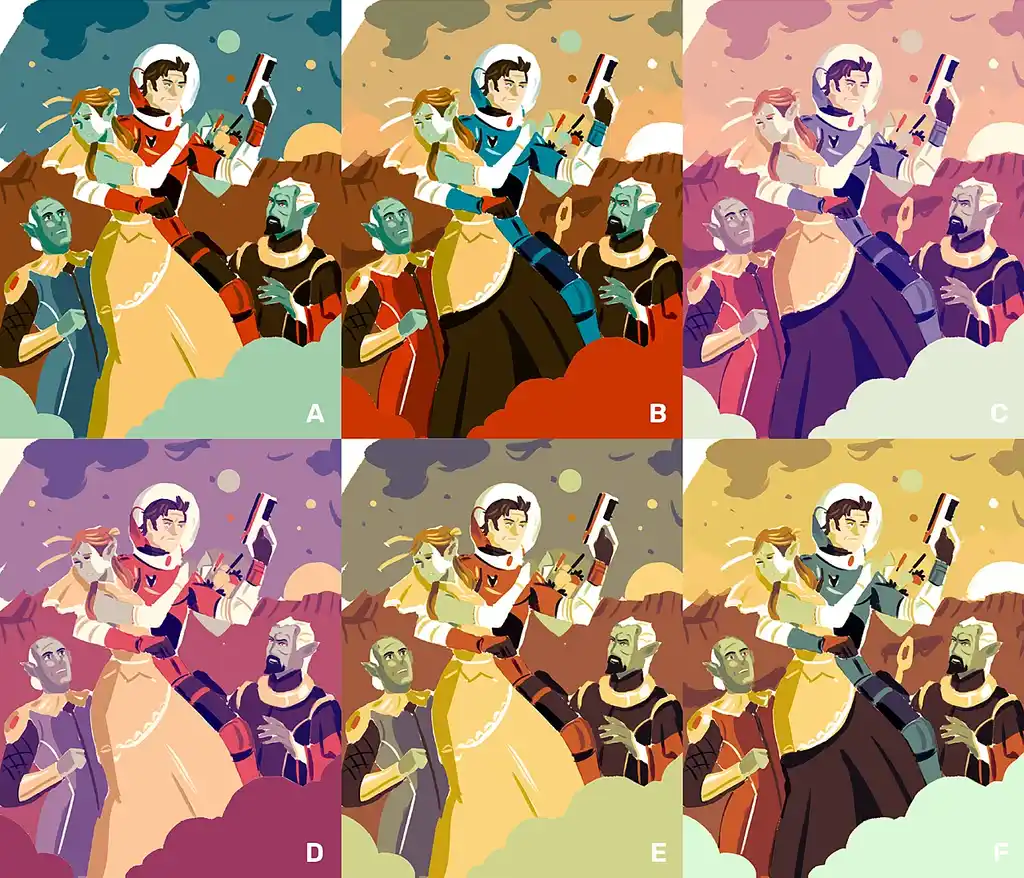
I chose to move forward with option C because it uses pastel shades often seen on romance covers — offsetting the sci-fi setting and letting the readers know that this isn’t just a straightforward shoot-’em-up in space.
Q: How did you experiment to discover your book cover design style?
Suggested answer
I wouldn’t say I have a defining personal style. My covers are always focused on the market and what works within a particular genre. Being a commercial designer and art director is a bit like being an actor: I put myself in the shoes of the reader or buyer and imagine what they are looking for, how the book will feel on the shelf, and what will catch their eye.
Thinking like the buyer makes it easier to make design choices that are both creative and commercially effective. It helps me balance originality with clarity, so the cover stands out while still fitting within the expectations of the genre. Every project is an opportunity to explore ideas, but the ultimate goal is always to create something that resonates with its audience.
Clare is available to hire on Reedsy ⏺
I’ve always strived to improve and provide my clients with the best artwork I can create, experimenting with different techniques and approaches along the way. Funny enough, there was a time when I worried I didn’t have a recognizable style — and maybe I still can’t claim that 100%!
Over time, though, my work naturally evolved. By focusing less on “having a style” and more on honing my craft, my covers became more polished and personalized without me even realizing it. That process of experimentation and growth is really what shaped the style I use today.
Alexandra is available to hire on Reedsy ⏺

Often times your style comes from your limitations. Most of my favorite illustrators have a style that's quite different from mine and it's not from lack of trying. When I was starting out I would try to make a design in the style of someone I emulated and found myself unable to achieve it. So much of illustration and design is about problem solving so instead of giving up you have to navigate around it and maybe even embrace it to find success.
For example, I remember trying to do a cover with a city in the background. I love drawing people but I'm bored by pretty much everything else. My brain doesn't have any architectural acumen and eventually I just gave up on that part. I skipped ahead to laying out the text and found that it covered so much of my drawing, making the background almost irrelevant. I didn't want to lose the idea so I experimented with turning the text into the city itself. I've always been more an illustrator than a graphic designer so this felt like a world unfamiliar to me but I loved the outcome I had stumbled upon and found my style continuously moving into designs like these. Some people are maximalist and their art is amazing, but with book covers in particular, we've got so many ideas we have to condense and make apparent at the same time.
When I hit a roadblock with my style not working with the brief or connecting to my initial idea, "simplify" is usually my mantra. I look for ways to shave it down and make it more economical. Style doesn't come easy and often times you have to elbow your way through a lot of designs to reach the final one. That can be intimidating for me because it feels like the illustrations I make during this process are wasted, but just like going to the gym, the exercise creates the effect. Don't be afraid to scrap something so that it can be reborn anew. If you're good, your style never just reaches a set point. It continues to morph as you absorb new passions and experiences. Trust that your style is inherently inside of you always, it just needs the shaping from the expert that is you.
Nick is available to hire on Reedsy ⏺
❌ Don’t use illegible fonts
It isn’t just color and contrast that determine whether your text is readable. Its legibility also depends on your choice of fonts.
Something to keep in mind: unless you’ve decided on a type-led design, you don’t need to be too unique with your typography — and in fact, you should avoid it! Text written in a highly ornamental or unusual font runs the risk of being difficult to decipher, so I recommend sticking to tried and true typefaces.
Another big red flag on a book cover is having too many different fonts. You only need 2-3 fonts maximum. More than that will look unprofessional and may distract readers from the rest of your design. If you can stick to a single font family, using different weights if necessary, all the better.
Pro tip: Don’t make your name too big or too small on the cover. In general, the more famous the author, the larger their name — so if this is your debut book, stick to a readable but modest size.
Q: What common mistakes do authors make when designing their book cover, and how can they avoid them?
Suggested answer

You don't need every aspect of your story represented on the cover! I get a lot of authors who run through a list of very specific objects, places, and characters they want on the cover, but many times that doesn't align with the best selling strategies for their genre. Depending on the genre, to capture your audience, you may want to focus on a character or two only, or perhaps one setting. But usually not all of it. The main purpose of a cover is to capture the feeling of your book, not tell the whole story. Oftentimes the cover is more of a metaphor or abstracted visual that just indicates a mood. Less is more!
Caitlin b. is available to hire on Reedsy ⏺
A common mistake authors make when designing their book cover is trying to make everything shout. Not every element needs to be front and centre. Part of the skill of a designer is creating the right hierarchy, so the reader’s eye knows where to go first, whether that is the title, the visual, or another key element.
Another issue is not fully understanding the market. Sometimes authors pick the wrong age group or try to make a cover that will appeal to the largest possible audience. In most genres, this rarely works. It is far more effective to focus on the target audience for the book and design something that resonates strongly with them.
Authors often love their characters and want to showcase a favourite moment from the story. While that is understandable, it may not always be the best visual for selling the book. Understanding the story, its tone, and its audience is key to selecting the right imagery and creating a cover that works both creatively and commercially.
Clare is available to hire on Reedsy ⏺

The biggest mistake would be not being open to input. Most people in the book world have a working knowledge of what particular books are supposed to look like. BUT, there is a great big world of book creatives out there who specialize in every single aspect of making a book. Cover design is no different. Authors and designers should ideally have an organic collaboration. Reedsy has given me the opportunity to cultivate this exact skill while working with authors.
Michael is available to hire on Reedsy ⏺
✅ Do add a logline and/or pull quotes
Ideally, the title and author name won’t be the only text you put on your cover. To lend your book credibility, you can quote a short snippet from an advance reader review or signpost readers to your previous bestselling title(s).
Additionally, you might like to add a logline: a one-sentence teaser designed to capture the reader’s interest.
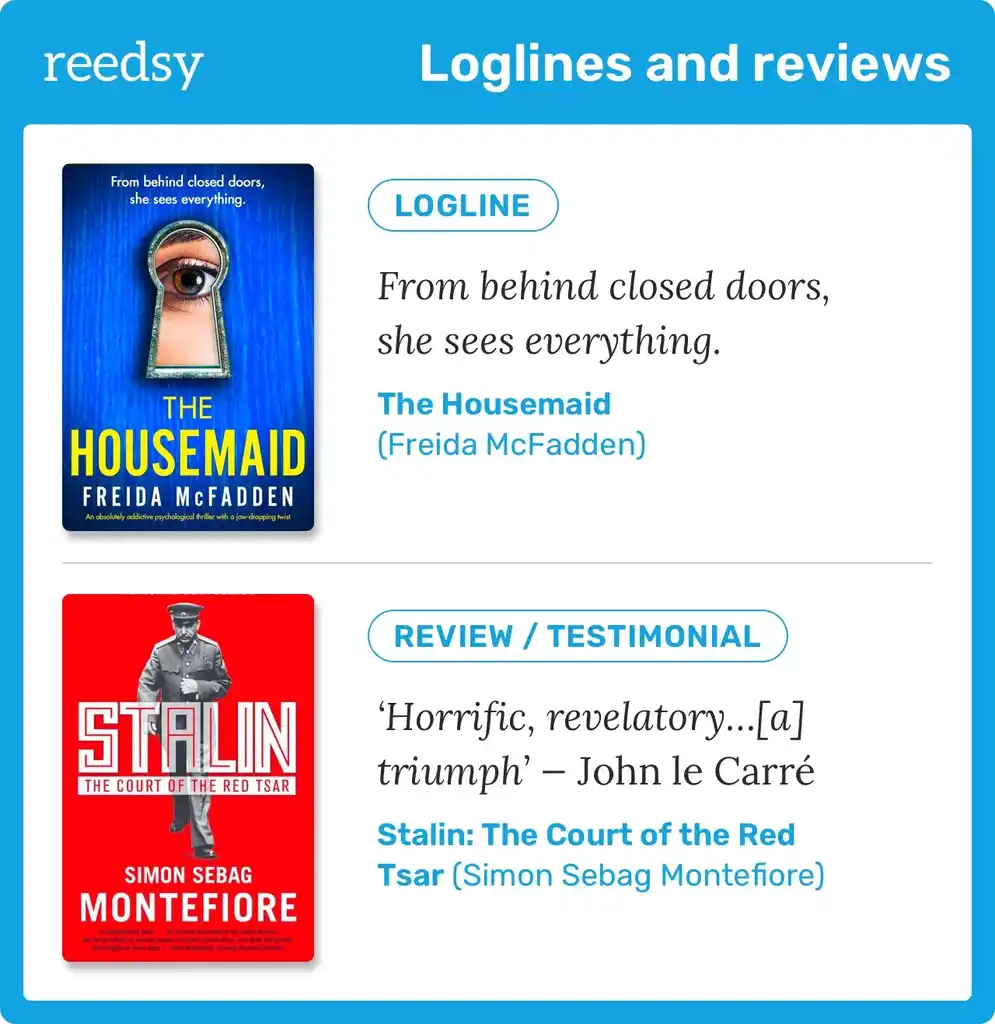
Any loglines and/or quotes should be smaller than the title and author’s name, but still legible on an Amazon book page.
✅ Do ask for feedback from the right people
Once you’re satisfied with your design, it’s time to show it to other people. As with your writing, an extra pair of eyes can spot things you can’t see in your work yourself.
That said, don’t just ask your partner or best friend for their opinion; seek out people who are genuinely voracious readers of your genre. You can look to online forums like Reddit communities and Facebook groups — or if you have a newsletter or decent social media following, you can even run a poll for your fans.
Finally, once you’ve collected feedback, don’t ignore it. If your book cover doesn’t appeal to these readers, there’s very little chance that less engaged readers will pick up your book.
Q: How many rounds of revisions do you include in your initial offer?
Suggested answer

For book cover designs, I typically provide unlimited revisions. I view each project on Reedsy as a genuine collaboration, with everyone working toward a shared goal.
So far, this approach hasn’t been abused. Rather, it assures authors that I’m committed to refining the cover design until they are completely satisfied with the outcome.
Jonathan is available to hire on Reedsy ⏺
Take your time and keep workshopping your concept until you’re 100% happy with it. Then, head to my next post to find out how to actually convert it into a file that is ready for publication.