Posted on Oct 26, 2026
How to Get Book Reviews in 2026

Ricardo Fayet
Reedsy co-founder and Chief Marketing Officer, Ricardo Fayet has worked with hundreds of authors on their launches and marketing campaigns. He is the author of two bestselling guides on marketing for authors, and a regular presenter at the largest writers' conferences.
View profile →Imagine you're deciding on a new car to buy. Would you sooner get behind the wheel of a model all the experts love that has dozens of favorable reviews, or one that no one has voiced an opinion on yet?
Most people pick the former, and understandably so. Social proof is what turns browsers into buyers — and fuels discoverability on retail platforms like Amazon. As an author, securing book reviews is a top priority, even before your official launch.
But how can you persuade those first few people to read and review your book? And how can you keep up momentum over time? Here are the eight most effective ways to obtain reviews as a self-published author.
Find reviewers before launch
There are three broad types of reviews to seek out before your launch date:
-
User reviews from readers who post on sites like Amazon, Goodreads, or BookBub
-
Editorial reviews from industry professionals
-
Social reviews from content creators
To get Amazon’s algorithms on your side, you’ll need readers to add their user reviews of your book in the first few days following its release. But even the most prodigious reviewers can’t finish a book that quickly — so get your manuscript into their hands at least a month before launch.
The book you send doesn’t need to be polished, but it does need to be finished. That means a thorough self-edit, beta reader feedback, and developmental editing, all done before you start reaching out.
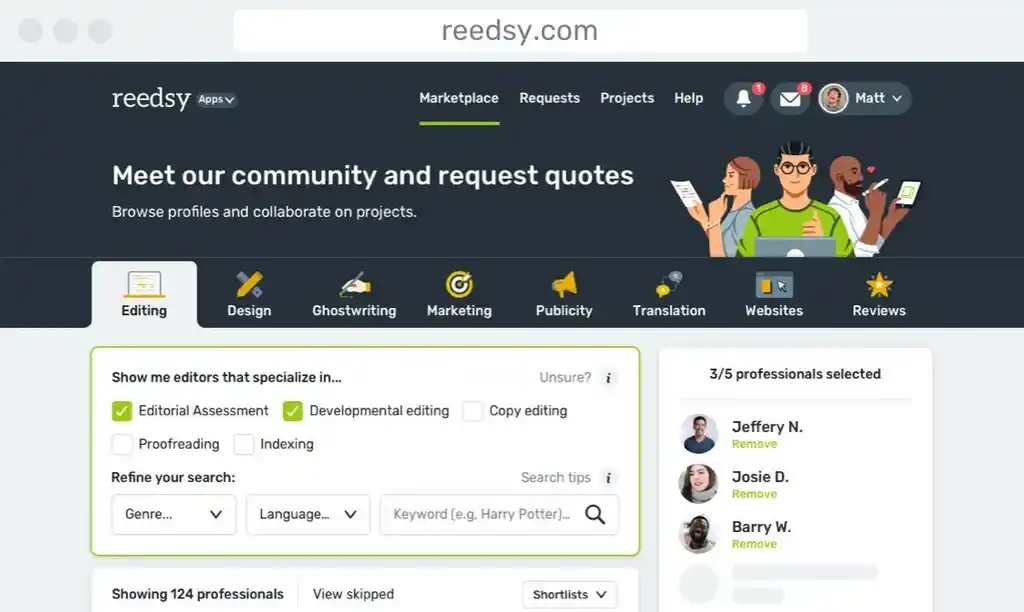
Hire a professional

Jon R.
My focus is memoir, upscale fiction and LGTBQ+ in all genres. I run an award-winning publishing house and editing genuinely thrills me.
Request a quote
Janet G.
Storytelling is my passion. A longtime editor and multi-award-winning writer, I help authors connect, compel and entertain. (AI-free zone!)
Request a quote
coll K.
Picture book author with 10 years experience working with NYC publishers. My passion is picture books. Let me share my knowledge with you!
Request a quoteWith your finalized manuscript ready, here are some tried-and-true ways to secure those early reviews:
1. Build a street team of interested readers
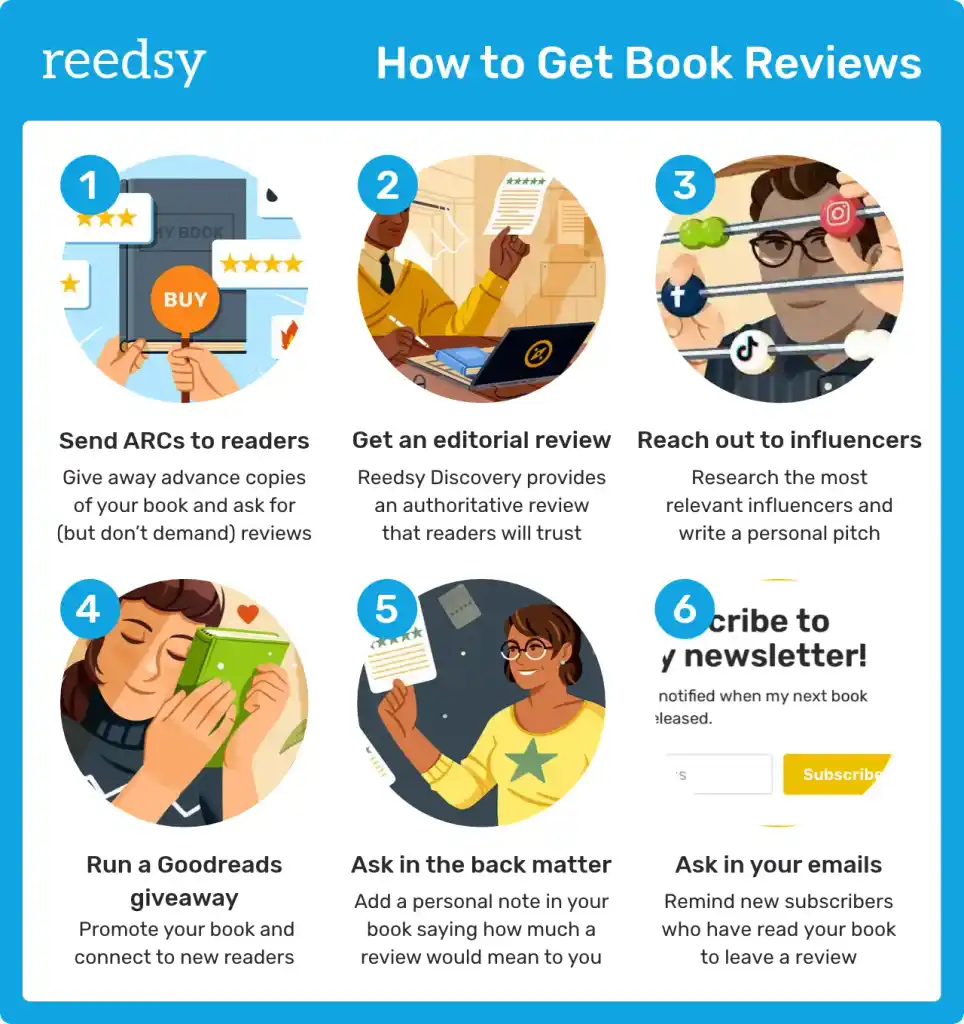
Your author street team is the community of people who spread the word about your books. To enable this group to post early user reviews, you should provide them with advance reader copies, or ARCs, of your book — completed manuscripts that you give away for free.
Our preferred method for finding ARC readers is always to ask for volunteers from your subscriber base: the fans who receive your newsletter or follow you on social media. If you don’t already have one, now’s the time to set up a mailing list. You can ask for volunteers via a Google form and then send the ARCs directly to respondents as a digital copy via a service like BookFunnel.
Before you start firing off emails with links to your ARCs, it’s important to mention who you shouldn’t be hitting up for user reviews. According to Amazon’s terms, you must not ask a family member or close friend to review your book; you must not arrange a review swap with another author; and you must not offer readers a financial incentive to leave a review. This means you can’t explicitly tell someone they’ll get an ARC if they guarantee a review — you must simply gift it to them and politely request that they leave their thoughts.
Case Study: After building a mailing list from scratch two months before the release of his debut children’s book, author Ben P. Fisher managed to secure 100 Amazon reviews in just 5 days. Take a closer look at his review strategy to learn how he did it.
2. List your book on an ARC platform
Your street team will likely be a small group, so many authors also use ARC platforms to reach a wider pool of readers who enjoy reading early editions of books.
These sites are primarily a way to generate user reviews. Certain platforms, like NetGalley, attract industry professionals, so occasionally, you may receive a review that qualifies as editorial (see below) — but this is not the norm. Here’s an overview of some of the most popular ARC platforms.
|
🧰 Review Site |
💸 Cost |
⏳ Promotion length |
🏆 Best for |
|
BookSirens |
$10 setup + $2 per reader, or $100/year for unlimited ARCs |
3-month promotion per book |
Affordable pricing model; 75% review-to-download rate |
|
NetGalley |
$575 for a 6-month listing, but reputable third party services offer discounted options |
Up to 6 months (shorter periods available through third party services) |
Access to experienced readers (e.g., librarians, booksellers, educators) |
|
Hidden Gems |
$20 deposit (covers your first 10 readers), then $3 per extra reader, up to a $400 max |
Turnaround time scheduled around your release date (most reviews land within a week or two) |
Review push right as your book launches |
|
BookSprout |
$9 - $29 per month based on plan tier |
Campaign length specified by author |
Affordability; Audiobook review campaigns (Advance Listening Copies) |
ARC sites should ideally complement, rather than replace, your own list-building efforts since they can’t guarantee how many users will download, read, or review your title — if any. Before turning to ARC sites, consider posting a request in genre-specific Facebook groups and subreddits. It’s free and often just as effective.
3. Submit your book for an editorial review
User reviews from your street team and ARC readers will carry weight with Amazon’s algorithms — but they might not convince your most skeptical readers to hit ‘buy’. For that, you need a voice with a touch more authority.
Editorial review sites like Reedsy Discovery give you access to honest testimonials from experienced publishing professionals. We’ve compared the top review sites and we believe that Reedsy Discovery offers the best value for money without compromising on quality. However, you can submit your book to as many review sites as your budget allows.
|
🧰 Review Site |
💸 Cost |
📄 Review word count |
⏳ Turnaround time |
🏆 Best for |
|
Reedsy Discovery |
$299 |
350+ words |
30 days |
Affordable editorial credibility |
|
Kirkus Indie |
$450 to $599 ($150 extra for expedited) |
250–500 words |
7–9 weeks (4–6 weeks expedited) |
Historical industry credential |
|
BookLife |
$399 ($499 for books over 100,000 words; $150 extra for expedited) |
~300 words |
6 weeks (4 weeks expedited) |
Opportunity for extra promotion (pay $100 to feature in Publishers Weekly) |
|
Foreword Clarion |
$579 |
~400 words |
4–6 weeks |
Access to booksellers and librarians |
Submit well ahead of your launch so you’ll have all your reviews to hand before your book goes on sale. A strong editorial quote on your front cover could be what seals the deal for many potential buyers.
Case Study: Self-published mystery author Robert French used Reedsy Discovery to turn around the performance of the fifth book in his Cal Rogan Mysteries after the first four had gained little traction. Read about his experience to learn more about his successful launch process.
4. Pitch book bloggers and influencers
More readers than ever turn to Substackers, Bookstagrammers, and BookTokers for reading recommendations. Coverage from a well-matched influencer will take more effort to secure — but can be worth it if they have an engaged following.
Start by making a list of relevant blogs and creators. Search for phrases like “YA romantasy reviewer” on social platforms and look up comparable titles to see where they’ve been covered. Then narrow your list by:
-
Genre and audience — match these to your book as precisely as possible.
-
Posting frequency — one to two times a week is ideal. More than that and your book might get lost.
-
Community size — a small, highly engaged following can drive more sales than a large, passive one.
Once you have a shortlist, start organically engaging with their content before reaching out. Then check their account bio or website for a preferred contact method, read their submission guidelines, if they have them, and don’t contact people who aren’t currently accepting queries.
Keep your pitch brief and specific: address them by name, mention titles similar to yours that they’ve reviewed, and include your book’s details and a concise description. Track your outreach in a spreadsheet. Follow up once after a week — but not more than twice. At that point, assume they’re not interested.
When a positive review comes in, quote it in your marketing materials exactly as you would an editorial review.
Tip: When a creator posts their review, repost it or quote-post it. It validates the reviewer and helps promote your book at the same time.
If you need help identifying and reaching out to influencers, you can use Reedsy to find a marketer who specializes in influencer marketing
Q: What aspects of book marketing should authors focus on learning and handling themselves to save money while promoting their work?
Suggested answer

Social media activity can be a key part of most marketing plans, but many authors struggle to find time for it, or worry that they aren't handling it correctly. It can be really tempting to outsource this. However, if you are working with a book marketer who has experience in the publishing industry, creating both content and social media strategies for author accounts, then for authors early in their career the cost of this service could outweigh the benefits of long-term content creation. Instead, I'd suggest learning a little more about social media strategies for authors, perhaps from those very marketers who you were considering to run the accounts for you.
Although social media can take up a lot of time, it doesn't have to: even spending 30 minutes one day a week to pre-plan your content can give you plenty of posts, and there are free scheduling tools available so that you don't need to come back to the platforms later in the week to post.
Once you've had a go at using social media in your marketing by yourself for a little while, I'd suggest having another check in with a professional to get an audit of your channels, where they can then recommend ways for you to improve in future, to keep you on the right track and keep increasing your sales.
Ailsa is available to hire on Reedsy

Marketing a children’s book doesn’t have to require a huge budget. Being selective with where you are focusing your efforts, time, and budget will help maximize your return on investment. This can be getting testimonials from an author's own network, mazimizing your discoverability on Amazon through precise categories and keywords, and targeting special interest group for endorsements or bulk buys. For instance, if a picture book is about aviation, contacting aviation museums, organizations, and stores would be a great start. For kids books, reaching educators and librarians is important for word of mouth and for in-person event opportunities. Positive feedback from a teacher or librarians gives a book credibility and validation and lets families know this book is vetted, so to speak, and worth purchasing.
Tara is available to hire on Reedsy

All of it. If you execute a proper runway to launch program you don't need to spend any money on marketing. The key is to start early. Include people in the creation of the book. Everyone in an author's circles of friends/family/followers should know the book is coming. Once a book has been published, the promotional activities come across as selling. Before a book comes out, all of your promotion is "sharing", and your audience will be far more receptive to that.
Chris is available to hire on Reedsy
5. Run a Goodreads Giveaway
Goodreads is the largest platform for "social cataloguing" books where readers log, rate, and share reviews of the books they’ve read.
Once you’ve created your Goodreads Author Profile, you can set up a Giveaway which allows you to offer free print or ebook copies of your book to readers through either the standard package ($119) or premium package ($599). Both packages include your book in the Giveaways section of Goodreads, add your book to the Want to Read lists of all entrants, and Goodreads will send recipients a reminder to review your book. The premium tier provides a feature placement for your book on the Giveaways homepage.
As with ARC platforms, Goodreads cannot guarantee reviews — and the ones you get might be brief. However, Giveaways can help you reach new readers and gauge early audience responses.
Case Study: Author John Chase connected with a marketing professional on Reedsy who revitalized his Amazon presence and helped him increase his memoir sales ten-fold. Check out his story to find out how he enhanced his marketing strategy.
Keep reviews coming after launch
Amazon’s algorithms will need a steady trickle of positive reviews to keep your book ranking favorably. Here are three simple but effective ways to keep them coming.
1. Ask for reviews in your back matter
The last pages of your book are the perfect opportunity to ask an eager reader to leave a review. Add a short, friendly note thanking them and explaining why reviews matter for indie authors. Many readers genuinely don’t know how much a single review can help. In your ebook, add a direct link to your Amazon or Goodreads page to make it as easy as tapping a button.
Here’s a basic version of the message:.
Thanks for reading my book! If you can spare a few minutes, an honest review would mean the world to me and helps other readers find my work.
Not every reader will respond, but authors who do this consistently report a meaningful uptick in readers who leave a review.
Q: What topics should authors cover in their newsletters to keep readers engaged and build a strong following?
Suggested answer

Authors can write about a lot more than just their book! Ideas to write about are:
- Top 10 favorite books - Write a blog post about your ten favorite books and then share it with your newsletter audience.
- Behind The Scenes - This is a broad category. You can write a newsletter about how you got the idea for the book, or about how certain characters came to be, their motives or any backstory that may not have been mentioned.
- Appearances and events - This should go without saying, but letting your audience know about any scheduled appearances in person or online is great to share with your mailing list.
- Ask them something! - Make your audience feel important and seen by asking for their input on something. Make sure it's something that you really want to know because the public can sometimes surprise you!
- In Depth Bio - You can write a more in-depth bio and share it with your audience. This pulls back the curtain and allows your fans to learn more about you, further strengthening their interest and trust in you / your author brand.
- A Short Story - Write a quick story and share it with your subscribers. Giving away free content is critical to gaining and keeping customers/fans these days.
This is just scratching the surface. I hope this has sparked some ideas of what authors can write newsletters about.
Chad is available to hire on Reedsy
2. Ask again in your welcome email
You can ask “warm” readers (those who’ve already read your book) to leave a review in your welcome email when they sign up to your mailing list. They’re primed to engage and a gentle nudge might be all it takes to get them to act.
3. Turn early reviews into more reviews
Don't let your strongest reviews just sit on one platform — they should be working for you everywhere:
-
Printed in your book’s dust jacket
-
Displayed in Amazon A+ content
-
Featured on your author website
-
Shared in posts on your social media accounts
-
Spotlighted in your email newsletter
-
Included in pitches sent to content creators or local bookstores asking them to promote or carry your book
All the strategies work best when combined. No single platform will do the job on its own – it’s the sum total of all your channels that will build your review momentum. And don’t forget that reviews are just one piece of the puzzle. For the full picture, be sure to check out our guide to marketing a book.