Guides • Understanding Publishing
Last updated on Mar 06, 2026
How to Self-Publish a Children’s Book in 6 Magical Steps

Martin Cavannagh
Head of Content at Reedsy, Martin has spent over eight years helping writers turn their ambitions into reality. As a voice in the indie publishing space, he has written for a number of outlets and spoken at conferences, including the 2024 Writers Summit at the London Book Fair.
View profile →If you write for children, self-publishing your children's book can be a great route to take. Increasingly accessible and with a quicker turnaround than traditional publishing, the self-publishing option is becoming more and more attractive.

In this post, we'll walk you through how to self-publish a children’s book in 6 steps.
 Click to tweet!
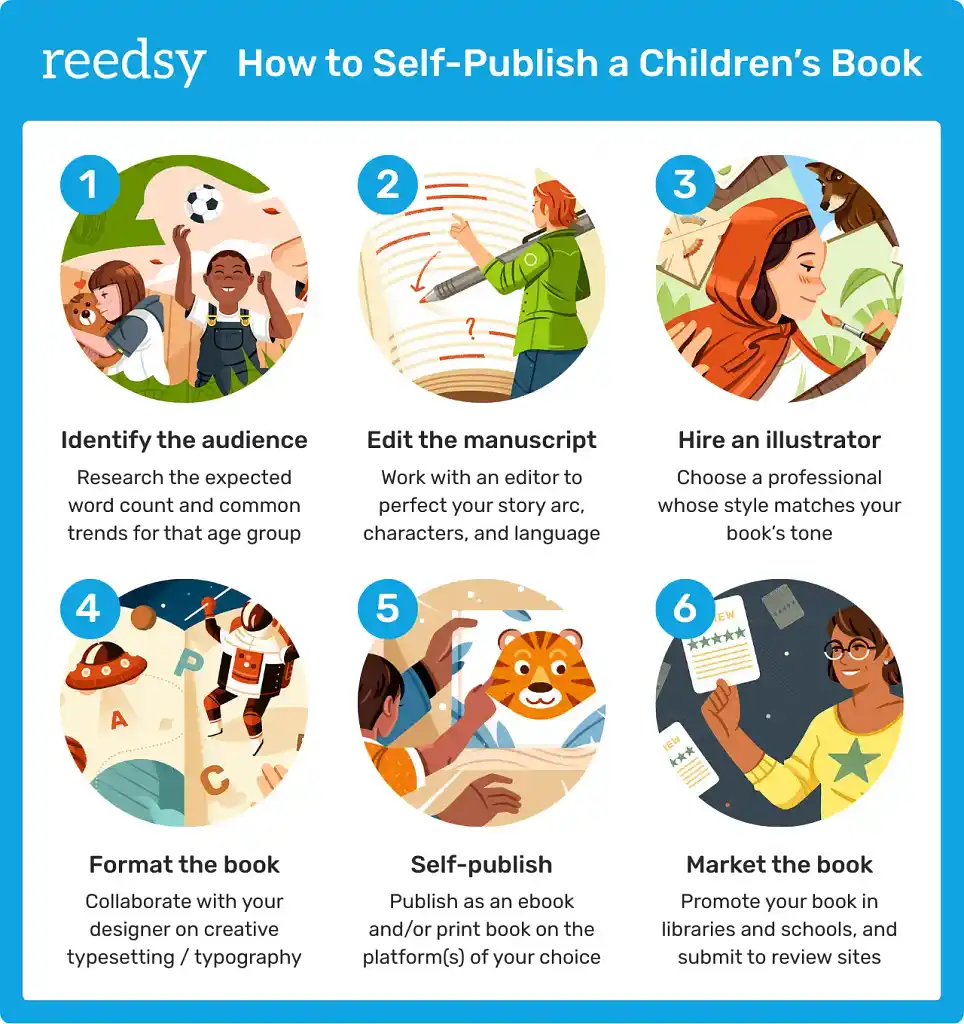
1. Identify the audience for your children's book
Ideally, you would’ve done this before writing your children’s book, although it’s easy to get swept up in that lightbulb moment of an exciting story idea. In researching the market, you’re essentially identifying your target audience, their preferences, and their habits — all of which can help improve your book and strengthen its reach.
If you’ve already done your research, now’s the time to revise and refine it before moving forward. If you haven’t done much other than revisiting your own favorite children’s stories, here are a few things to ask yourself.
What type of children’s book have you written?
The categorization of your book is the foundation of all the work that follows, from editing to designing to marketing. What you don't want to do is to stray too far from the market conventions of your niche while producing and promoting your book.
The main categories of children’s fiction are summarized in the table below.
| Type of Children's Book | Age Range | Word Count |
| Picture Book/Board Book | 0-6 years old | < 1,000 |
| Early Reader | 6-7 years old | 2,000-5,000 |
| Chapter Book | 7-9 years old | 5,000-10,000 |
| Middle Grade | 9-12 years old | 30,000-50,000 |
| Young Adult | 12-18 years old | 50,000-100,000 |
Q: How do I write characters that children can relate to?
Suggested answer


Child readers are just like adult readers – they want to read about characters that seem alive and three-dimensional. Make sure when telling your story that you aren’t just describing what happens to the characters, but showing their thoughts and feelings throughout the events that take place.
It’s always good to think about the specific age range you are writing for when considering what emotions your characters might be experiencing and what problems they would encounter. Younger children might be thinking more about their family and new experiences, whereas older kids and teens could be navigating relationships with friends or struggling with issues at school.
Even when the setting is more fantastical, it doesn’t stop you from finding things a reader might relate to. Perhaps a character discovers they have magical powers or is the heir to an ancient kingdom. They might still be worried about learning how to use a sword, excited to explore a new world, or afraid of a villain hurting those close to them.
Another tip is to be wary of making your characters too perfect! Especially when writing for older children, remember that kids can:
- Be jealous of others
- Make impulsive decisions
- Get angry or grumpy
- Crack jokes and poke fun at things
Relatable characters won’t always do the right thing in every situation, and having them learn, grow, and make mistakes is part of telling a captivating story.
Humour is also a great tool for showing personality and making your characters seem more well-rounded. Think about what a child might find funny when placed in a new situation. What are the things that would make your characters laugh?
Overall, always remember to treat each character as a unique individual with their own quirks and flaws, just like you would with adult characters.
Vicky is available to hire on Reedsy ⏺
What are some recent popular titles in this niche?
Browse through the books at your local bookstore or library, or even online on Amazon, to see what new children’s titles look like, what kind of stories they tell, and what topics they cover. For instance, children’s books about diversity are on the rise, as are those about famous historical figures.
Trends like these should by no means dictate your work, but they do reflect the tastes of children as well as the concerns of parents and educators who will actually be buying your book. Keep them in mind as you go along.
FREE TOOLKIT
Children's Book Publishing Kit
Turn your idea into a book with our workbook, picture book template, and query letter template.
2. Edit the manuscript
If you want kids to ask their parents to read them your book over and over again, you need a strong story, which means several rounds of manuscript revisions. Of the many types of editing, the first step for most writers is typically developmental editing, followed by copy editing.
At this stage, ask yourself:
- Do you have a clear story arc?
- Are the characters memorable, with distinct voices?
- What do you want kids to feel when reading your story?
- Is your tone appealing or interesting?
- Is the language too complex or too simple for your target audience?
The best Children's Book editors are on Reedsy!
Sarah K.
Available to hire
I'm a British Asian Cambridge-educated editor and author with over 20 years experience in publishing.

Fleetwood R.
Available to hire
Experienced developmental editor with expertise in science fiction and fantasy, working with publishers and independent authors.
Claire R.
Available to hire
Children's book editor * Former school librarian * MA Writing for Children * Collaborative, reader-first approach to editing
Once you’ve done your best to refine your book by yourself, it’s time to enlist outside perspectives, starting with beta readers and progressing to a professional editor.
Work with a professional editor
As an indie author trying to tightly control your self-publishing budget, you might be tempted to do all the editing yourself to minimize costs. However, you’ll find that since picture books are so short, editing rates are often quite affordable, especially when compared to full-length novels, or even middle grade books. According to real data from the Reedsy marketplace, the cost to edit an average 1,000 word picture book is $340 for a developmental edit and $210 for a copy edit.
Q: At what stage of writing should an author hire each type of editor?
Suggested answer
I probably get asked this question more than any other.
I always recommend a first-time/debut author hire a developmental editor, and that should happen when you as an author simply don't know what else to do to make your novel better. For one person, that might be after the first draft is complete, and for some other person, that might be after multiple drafts and beta readers. Still another writer might need a developmental editor after they've written only half their book, just to make sure they're on the right track with genre. But whenever you reach the point where you don't know what to do next to improve your manuscript, that's when you hire a developmental editor if you haven't already. I always recommend a dev. writer for someone writing their first book, working in a new genre, working in a genre with non-realistic world-building (like SFF or supernatural horror), or working in a genre where there's a step-by-step investigative aspect, as an early mis-step in a book like that can have serious consequences for plot developments to come later. In hiring for a developmental edit, you also need to make sure you're ready for serious feedback; a developmental edit is always going to be offered with revision in mind, so you should still be ready for more serious work on the manuscript.
A line editor should only be brought in once you feel a book is pretty well in place. The content/story is all there, the characters are who they are, and the organization is set. There shouldn't be any remaining plot holes, but there may be scenes or aspects that need more development, character arcs that need tweaking, worldbuilding that needs more explanation, etc. You're at a point where you want feedback, but not feedback that's going to drastically change the work.
A copyedit comes at the point when you're focused on language. Clarity, progression, error-elimination, tense correction, needless word/phrasing repetition, etc. I often combine line/copyedits for writers because it makes for a more cost-effective approach, and especially in that case, there may still be minor revision to come (say, for a few scenes or chapters that you then may want the editor to take a second look at), but generally speaking, revision should be pretty well complete before this point.
A proofreader should only come in to catch last and final issues, preferably post-formatting if you're planning to self-publish. They should not be expected to catch any issues related to character or story.
Jennifer is available to hire on Reedsy ⏺

There are, generally speaking, three different levels of edits to think about and evaluate when you're looking to hire an editor: Editorial Assessments, Developmental Edits, and Line or Copy edits.
There's also Book Coaching, Proofreading, and fact-checking, which I'll circle back to at the end.
Editorial assessments are a great first step once you've finished your manuscript. You're hiring an editor to give you a high level view of your work and get a written assessment of the areas that need to be strengthened. This should give you enough feedback to go back into the manuscript and start making editorial changes to help get your novel into a better place.
Developmental edits can take place at a similar time frame, when the manuscript is finished and you're ready for another set of eyes to get in there, but each author is going to have their own needs between a developmental edit and an editorial assessment. Where an editorial assessment offers feedback in a single letter, a developmental edit goes much further, suggesting and also showing the places in which your story might need to be restructured or characters altered and shifted.
Line edits or Copy edits, should happen after all other editing is done. Think of this as the last polish once everything else is set and ready to go. This is where sentence by sentence edits happy to make your writing stronger and clearer.
Proofreading and Fact-checking would also happen after copy edits. These are truly the final stages when you're not making large changes anymore and simply fixing / correcting all of the pieces that are already in place.
Book Coaching stands a bit alone, as this is a bespoke service that some editors offer. You can get a book coach incredibly early on if you want to hire someone to help you form your ideas, characters, plot, etc. Or you can bring them in halfway through when you need to figure out next steps.
Matt is available to hire on Reedsy ⏺
Reedsy editor and picture book specialist Leila Boukarim explains that the more time an author spends with their draft, the more attached they become to it, posing an obstacle when trying to create a book that resonates with people who have no idea who the author is, what their process looked like, and what their intentions were when they wrote it. “All readers want is a good story. Editors, thanks to their industry experience, can help authors answer the question ‘So what?’ and focus on the essence and the heart of the story, cutting away anything that isn’t serving the work, and fine-tuning word choice and structure with the target audience in mind.”
It is these insights that only a specialist children’s book editor can offer that convince most authors to invest in professional editing.
Q: How do I balance getting professional editing with keeping my own voice?
Suggested answer

An editor shouldn't be rewriting your work. Your work should still sound like you, even after a heavy line edit. The reviews I really cherish from clients and writers are the ones that remark on the fact that I've retained their voice throughout the editing process, as I think that's the core purpose of an edit: giving a manuscript a glow-up rather than completely changing it.
Your best friends in choosing an editor who'll do this are (1) a detailed brief that describes the voice and tone you're aiming for and (2) sample edits. The first makes it clear what you want, while the second helps you check whether an editor will be the right fit for you. I also always make it clear to authors that my edits are suggestions, and I'm always happy to discuss why I'm suggesting a change and to provide alternatives if desired. Editors are there to support your project, not to lead it.
Claire is available to hire on Reedsy ⏺
A professional editor should respect your voice and project. Honestly, it's as simple as that.
The best way to be sure that will happen is to hire an experienced editor and also ask for a sample edit, especially with line/copyedits. Seeing that sample edit and thinking about how the editor engages with your voice should tell you everything you need to know. Chances are, you won't agree with everything an editor recommends because editing is a subjective business, but if the editor is keeping in mind your particular voice and project, and if they're experienced and aligned with your vision, you should probably expect to agree with 80-90% of their recommendations.
That said, there are exceptions! I once had an author tell me she only agreed with about 40% of my copyedits, and I was horrified. I immediately told her that meant we weren't a good fit...and then she told me that she'd had three previous editors, and she'd only agreed with about 10-15% of what any of them had suggested! In fact, she was thrilled with my work! This particular author was simply extremely attached to even the smallest nuances of her language use, and had a lot of trouble working with an editor at all. I came to realize that her taking even 40% of my suggestions was actually a pretty serious compliment, odd as that may sound.
With developmental edits, things get a little trickier, but respect is still the ultimate goal. An editor shouldn't be trying to rewrite your story. Ideally, you want a developmental editor who will respect your story and help you find its full potential without injuring your vision. If they point out plot holes, they might point out different ways to address those fixes (and you can talk to them in advance about whether or not you want them to), but they won't insist on you taking any of those fixes; they'll only strongly suggest you fix the plot hole. Similarly, if you've got a 180,000 word paranormal romance on your hands, they'll be right to talk to you about the realities of publishing and how difficult it will be for you to find an agent, but they shouldn't be rewriting the book for you or lecturing you. (In a case like this, I'd personally be having a conversation with the author to talk about their publication plans, the realities of publication, and options for how to go forward, whether that would mean splitting the book into two or cutting subplots...but it would be a conversation, and not a lecture). If an editor is telling you how to rewrite your book and you didn't ask them to do so, they're not the right fit for you, and you should move on--because yes, it's a matter of respect for your project and you.
Jennifer is available to hire on Reedsy ⏺

A good editor of any kind—developmental, copyeditor, etc.—is going to honor your voice and want to help you hone it. It's good to keep in mind that your editors are not trying to make your writing less unique, they're trying to guide it to be the best it can be. With that understanding in place, make sure you're reading their feedback from a place of trust and open-mindedness. Once they've read a few hundred words of your manuscript, an editor will often have an idea of your voice and will do their best to work with your voice, not against it.
Editors will often offer an explanation for an opinion-based change, and it's important to hear their perspective. (And if your editor isn't offering an explanation for a particular change from the get-go, feel free to ask them for one.) If you find that you're declining a lot of changes in an ongoing partnership, try to afford your editor the same respect and offer an explanation as to why their changes aren't working for you. That will improve their sense of your goals for your manuscript and they can adjust their feedback accordingly. They'll probably be really excited to now be on the same page and might have some fresh new ideas!
Another thing to keep in mind is that sometimes—especially in creative writing—you may think you're doing something clever on the sentence level, and then your editor tells you they're confused by it and/or that it's wrong. As in grammatically incorrect, or conveying the wrong message, or illogical, or any number of things for which there is technically a black-and-white rule in the English language. In these instances, remember that in general the impression you want your reader to get is more important than being clever. Sometimes you may just need to be disappointed that the clever thing you thought you were doing wasn't so effective after all. And if you feel strongly about maintaining a style that's sometimes "wrong" (maybe it's important to your character building), work with your editor on how to make sure you're still being understood by the reader.
Above all, remember that your editors are on your side! They want to help your writing be its best, not be exactly like everyone else's. Your editors want to work with you. Make sure you're working with them, too!
Mira is available to hire on Reedsy ⏺
When you’ve got the words perfected, you move on to a very exciting stage of the publishing process — enriching the narrative with illustrations.
3. Hire a professional illustrator

Lively illustrations are a prominent feature among the best children’s books, adorning both cover and interiors with immersive visuals that little readers will want to run their fingers along.
For Reedsy picture book illustrator Caitlin B. Alexander, who specializes in nostalgic, fresh, and colorful picture book artwork, the goal is to bring the author’s created world to life: “I try to do it in a way that adds even more lush detail, fun hidden treasures, and visual storytelling to the book. The art should reflect the mood and audience of the book, and elevate the professional quality even further.”
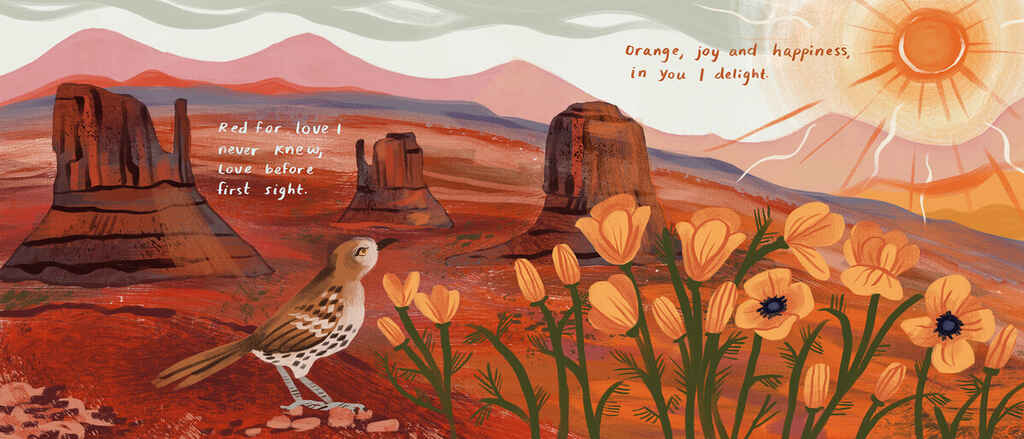
Picture book illustrators, in other words, do far more than just “decorate” your story. They also act as your creative collaborators, helping you organize your story into the 32-page picture book format, planning out what’s going to go in each double-page spread.
For an example of how an illustrator can be instrumental in your book’s success, read about Zenda Walker’s creative collaboration with illustrator, Anthony Foronda, here.
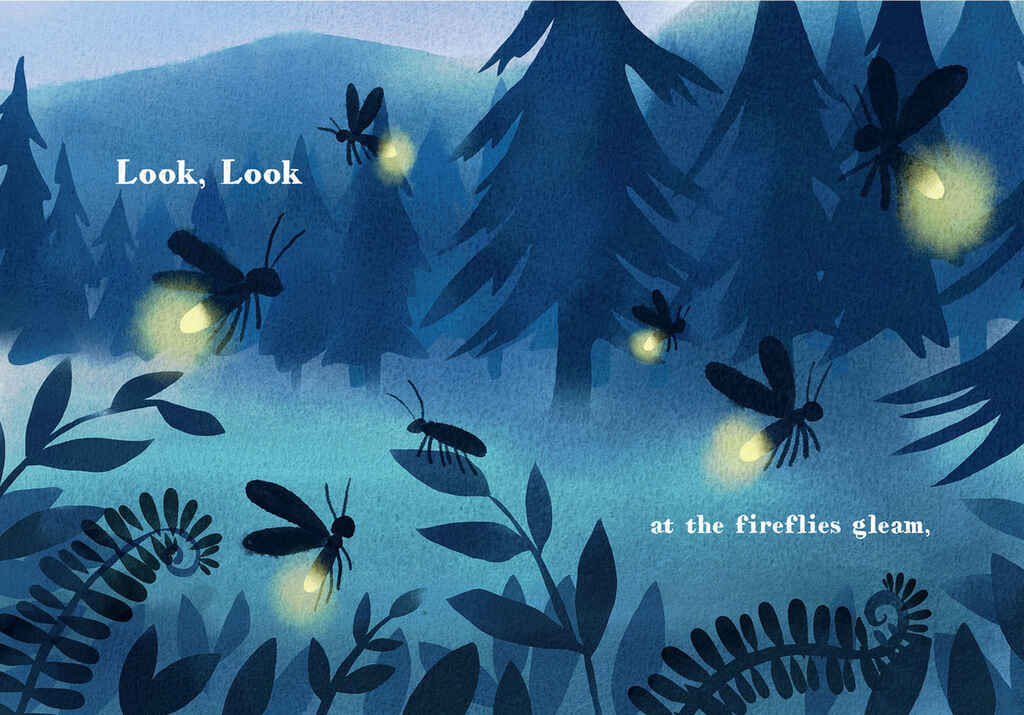
There are countless ways to lay out a double-page spread and its corresponding text — just take a look at these examples from illustrators on the Reedsy marketplace:
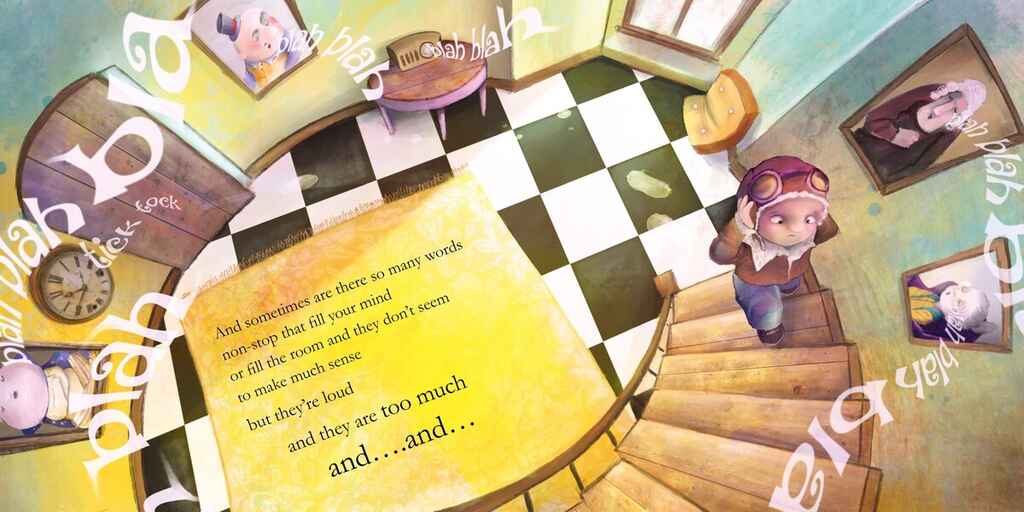
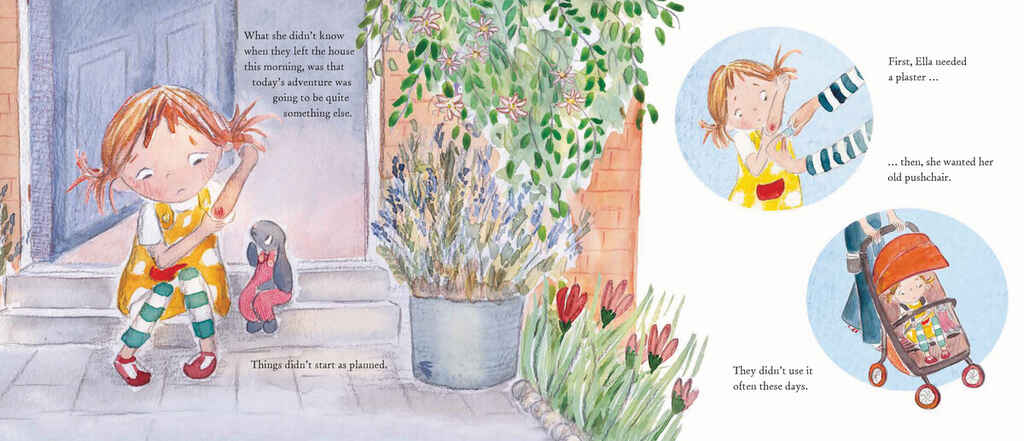
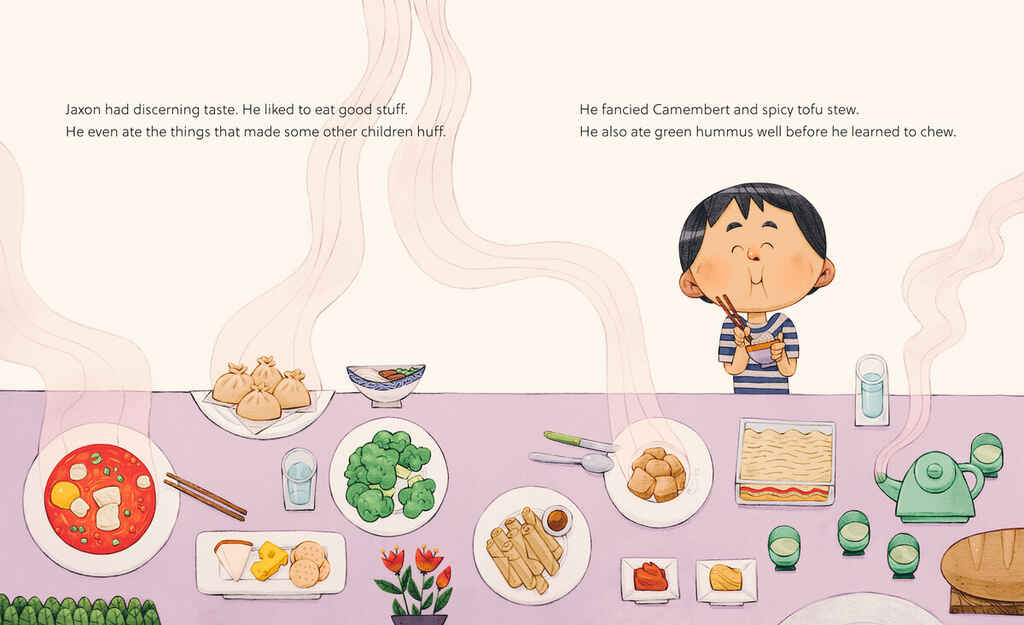
As you can see in the examples above, some illustrations fill an entire double-page spread, with text overlaid in parts of the illustration that are intentionally left uncrowded, while others feature smaller, inset illustrations that allow text to be arranged in the remaining blank space.
These are decisions you’ll make with your illustrator’s help, working to lay out your text across the 32 pages that typically comprise a picture book.
Q: What criteria should authors consider when selecting an illustrator whose style and approach align with their story's tone and themes?
Suggested answer

Take a look at an illustrator's portfolio and compare that first with the typical style of the genre of your story-- for example, you'd probably want to eliminate an artist who does bright, colorful character-based romance cover designs if your book is a serious historical fiction. You want to see the mood of your story already in that cover designer's portfolio, usually.
Caitlin b. is available to hire on Reedsy ⏺
Where to find an illustrator
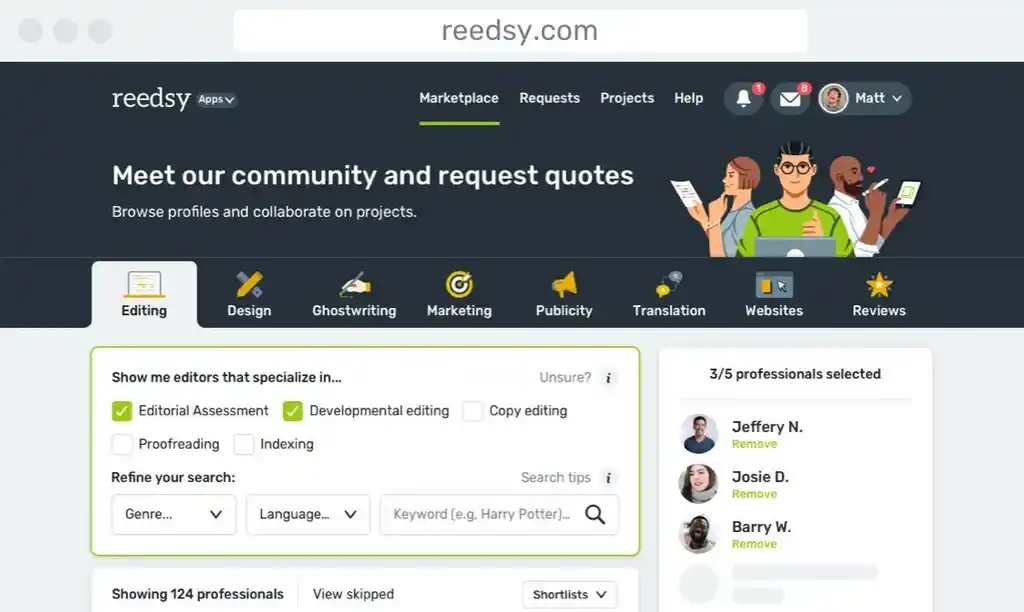
Many children’s book illustrators work on a freelance basis, and you can locate them through social media or their own websites. You can also check out Reedsy’s marketplace — we vet every professional on our platform to ensure that every author has the best experience working with an illustrator.
The next post in this guide covers how to find a children's book illustrator in greater detail, so head over to that for an in-depth look at the factors you should consider when searching for the right artist to work with.
Hire an expert

Dora D.
Available to hire
Illustrator and designer with 10+ years of experience in creative business. I will create visual words that will support your story.

Nathalie K.
Available to hire
Children's Book Illustrator working with vivid colours, in a detailed, highly rendered style! I do both covers and interior Illustrations.

Gabriela G.
Available to hire
Illustrator from Portugal, merging digital and traditional art to bring life into stories with a touch of nature's inspiration 🎨
If you're curious about how much an illustrator may cost you, we first recommend taking the 10-second quiz below that will give you an estimate based on real data.
💸
What will it cost you to hire a children's book illustrator?
Find out here! Takes 10 seconds.
Not all illustrators will arrange text and format your pages — that is often the role of specialist book designers. The next couple of steps will show you how that can unfold.
4. Format the illustrations
Patching texts and illustrations together the way you would make a PowerPoint presentation, while easy and quick, is not how you keep children engaged. Every element of your book layout design (also known as typesetting), from margin size to typeface, will be extremely important for capturing young readers’ fleeting attention, so make sure you get it right.
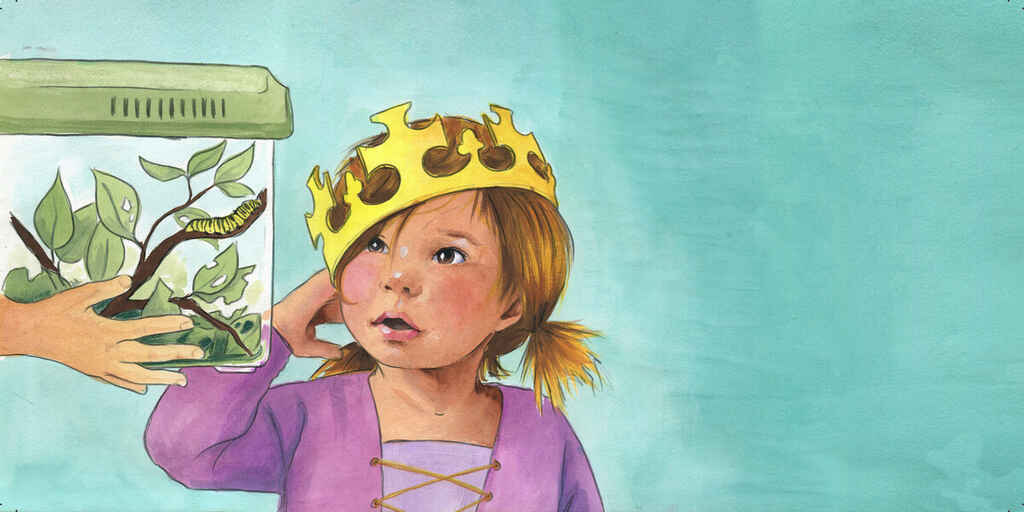
If you’ve commissioned a number of illustrations from an illustrator but they don’t offer typesetting services, your next step is to bring the illustrations to a layout designer — someone who will finalize page layout and typography.
The power of typography
To help you visualize what a layout designer brings to the table, take a look below. These examples were created by illustrators and passed onto professional typesetters to arrange the images and add text, leading to the delightful results you see below.
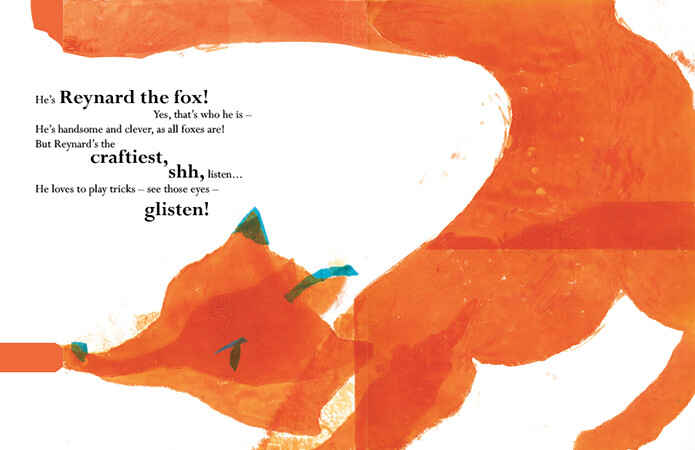
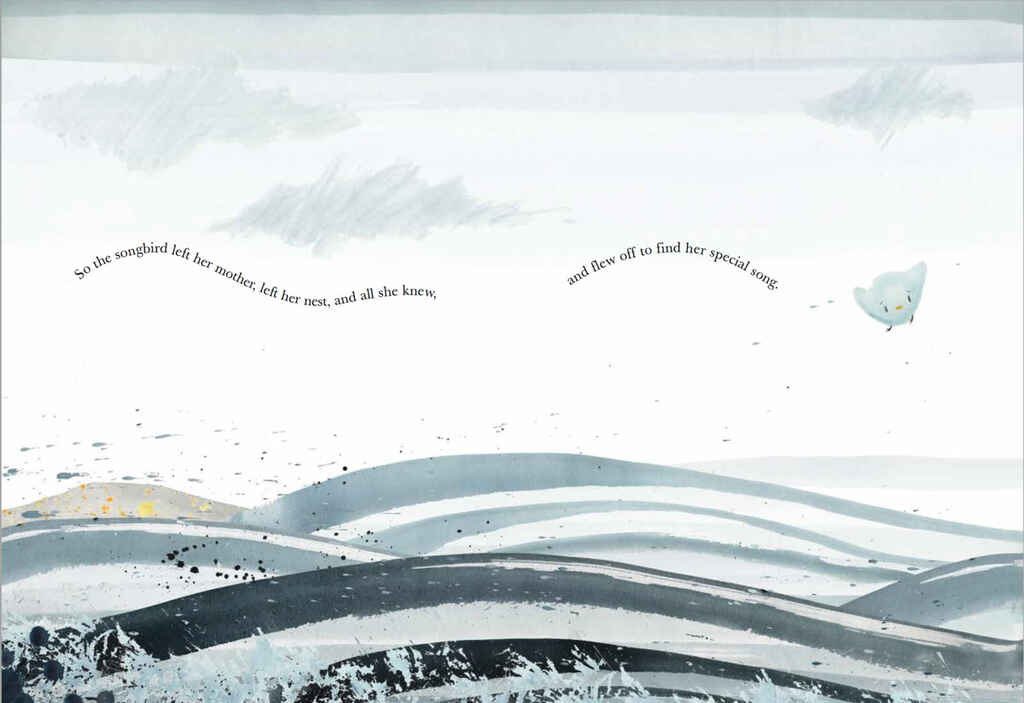
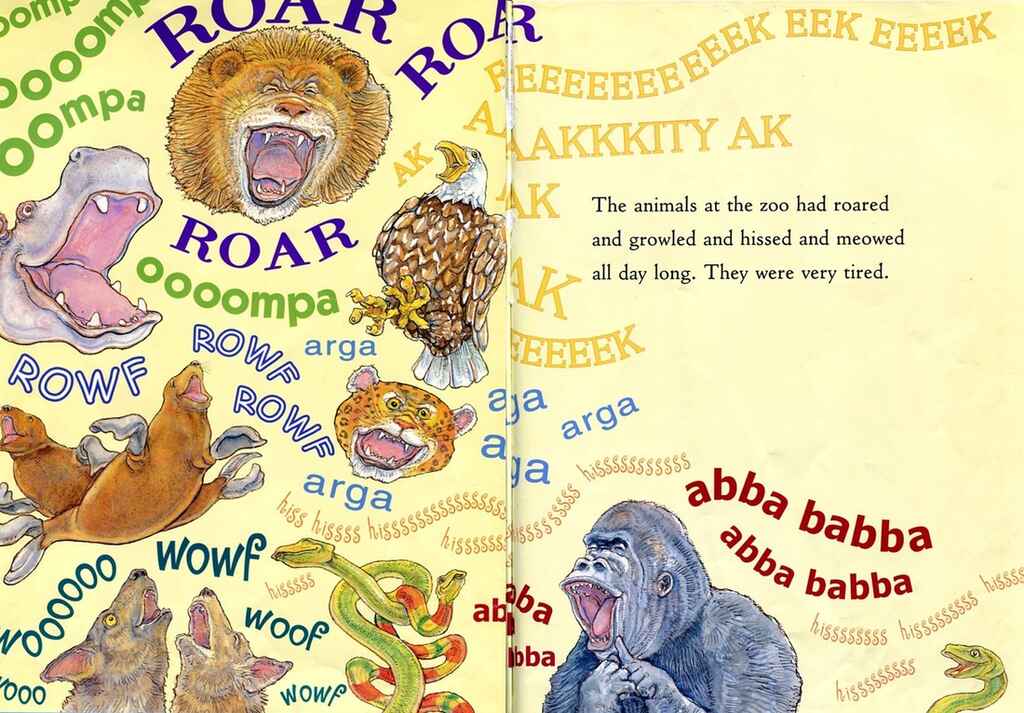
Notice the unusual ways in which all three designers arranged the text around these images? The first uses different font sizes to indicate the excitement of encountering Reynard the fox, the second uses text to poetically trace the songbird’s flight, and the third playfully uses various fonts, colors, and sizes to illustrate the chaotic animal noises coming out of a zoo. Fun, right?
To learn more about the process of bringing existing illustrations to a layout designer, read K.A. Leigh and Derek Roberts’ story here — with Reedsy designer David Miles’ help, they turned their illustration into an attractive picture book cover.
Those trying to DIY this part of the process will struggle — Amazon has tried to make things easier by introducing a formatting tool called the Kindle Kids’ Book Creator, but it doesn’t guarantee professional-looking products. Ultimately, to produce a professional, fit-for-purpose children's picture book or chapter book, you’d still need some design expertise.
Q: What are the most common formatting mistakes authors make when submitting children's manuscripts, and how can they be avoided?
Suggested answer
It depends on the end-goal of the manuscript. One issue I see frequently is that many picture book authors think they need to have an illustrator before reaching out to an agent or publisher. You do NOT need an illustrator for either of those.
The second note I have is that I see too many illustrator notes. If you're hoping to have a picture book published or represented, you need to keep in mind that you'll often have less creative control over the illustration. A few light notes are totally fine, but you'll want to let the illustrator have creative control.
For picture books, you also don't need to space each "page" or "spread" on a fresh page. Usually, the page-breaks and spreads will be decided by the illustrator and editor. It's often better if you send it without page breaks and just as a standard document with double spaced lines and standard font and font size (Times New Roman 12pt).
In terms of MG or YA, you'll want to set up your chapters with heading styles and populate the table of contents using those headings versus going in and typing the actual pages and such.
Val is available to hire on Reedsy ⏺

Including illustrations (Don't! unless you are an author-illustrator)
Funky fonts (You can't go wrong with Times New Roman, double spaced, 12 pt size)
Extensive art notes (It's important to leave room for the illustrator to tell part of the story; keep these to a minimum)
Pagination (Too early in the manuscript stage! Just use paragraph breaks for now)
Rennie is available to hire on Reedsy ⏺

This is for all manuscripts, really.
Standard manuscript format is Times New Roman, 12 pt font, though a font like Calibri works fine too. The manuscript should be double spaced with new paragraphs indented. There should not be an extra line break between paragraphs! Word's default is to add those line breaks, so you'll have to go in and remove them!
Whenever a new character/person is talking, it's a new paragraph.
Each chapter should start on a new page.
Use CTRL/ENTER to start a new page versus hitting the return key until there's a new page.
Page numbers can be at the top or bottom, and in that same header/footer you should include the manuscript's title and your name: GREAT BOOK/Author name.
Kim is available to hire on Reedsy ⏺
Below are some resources to help you better understand the many aspects of interior book design. Dig in and find out about it for yourself — although we strongly recommend collaborating with a professional to ensure a high-quality, thoroughly enjoyable book.
- "What is Typesetting? Your Guide to Interior Book Design" (Click here)
- "What is Typography, and How Can You Get It Right?" (Click here)
- "What are the Standard Book Sizes in Publishing?" (Click here)
5. Pick a publishing company
Congratulations — you’ve finished crafting your book! It’s now time to determine how you’ll share this beautiful volume with the world.
Do you want print books or ebooks? Should you print on demand, or in bulk? Which printing company and distribution channels should you use? What about your ISBN? Let’s go through these issues one by one.
Ebook vs. print
Whether ebooks genuinely help children read is an ongoing discussion between researchers, educators, and parents. The electronic format makes books easier to buy, carry, and interact with (thanks to audio excerpts or animated images). For an author, it provides the chance for wider reach at a lower cost.
Q: What are the most common mistakes authors make when self-publishing?
Suggested answer

Something I have seen quite a lot lately in the self-publishing world: trying to do everything by yourself. Thinking that you just need Photoshop to make a cover, spell-checking software to edit, a dictionary and a bit of knowledge to translate. Never underestimate the value of a human professional who has spent years studying and then honing their skills. There is more to translation than substituting one word with another, just as there is more to a cover than a bunch of drawings and a title.
Find the right professional for you and your project, and work closely with them; you won't regret the expense, I promise. Also, yes, some types of stories and tropes are very popular right now, and those seem like a safe bet, as far as marketing and selling go - but likely there are a lot of similar books out already. In traditional publishing, variety is sorely lacking, because a tried and tested product seems safer; let's avoid repeating that mistake. Write the story that's in your heart and then strategically find your niche audience. You'll find them starved for exactly your flavour of creativity.
Mariafelicia is available to hire on Reedsy ⏺

One of the most common mistakes I see with self-published authors is setting unrealistic timelines for their publishing journey. Many writers plan their schedule far too tightly and only reach out to professionals—whether editors, designers, or marketers—at the very last minute.
This creates unnecessary stress on both sides: the author feels rushed and overwhelmed, while the professionals either have to decline the project or take it on under less-than-ideal conditions. In the worst case, authors struggle to even find available professionals because their preferred timeline doesn’t allow for the necessary lead time. Many professionals book out months in advance, so it’s wise to plan at least four months ahead—and in many cases, even that may not be enough time.
It’s also important to remember: as self-publishers, you are free to set your own pace. Unlike in traditional publishing, there is usually no external deadline or audience impatiently waiting for the book—especially when it’s a debut. That pressure often comes only from a self-imposed timeline. Instead of rushing, it’s far wiser to take the time to do everything properly, work with professionals without stress, and then launch the book when it’s truly ready.
Publishing a professional-quality book requires space for collaboration, revisions, and creative breathing room. When timelines are compressed, the process becomes about “getting it done” rather than “getting it right,” which can ultimately compromise the quality of the finished book. A thoughtful, realistic schedule not only reduces stress but also ensures that every stage of the process—from editing to design—has the attention it deserves.
Sabrina is available to hire on Reedsy ⏺

One of the biggest traps authors fall into when self-publishing is thinking that the hard part ends once the book is written.
In reality, self-publishing is as much about production as it is about creativity, and overlooking that side can leave even the best manuscript looking unprofessional.
I’ve seen too many writers skip professional editing, try to design their own cover, or leave marketing as an afterthought, and the results are usually disappointing. But just as important, and often less discussed, are the mistakes around the actual printing and publishing process. Authors frequently go with the first printer they find rather than getting at least three quotes, which is a sure way to overpay.
Others don’t ask whether VAT will be added on top of the quoted price, only to discover the true cost later.
Perhaps the most heartbreaking mistake is not asking to see samples of the paper and materials being used; the author waits excitedly for their book to arrive, only to be handed a flimsy volume on cheap stock that feels nothing like the work they poured their heart into.
The truth is, self-publishing is about producing a product as much as sharing a story. Taking the time to ask questions, compare options, and insist on seeing exactly what you’ll be paying for can mean the difference between a book that looks like an amateur project and one you’re genuinely proud to hold in your hands and which reflects the hard work you have put in as well as the hopes, naturally enough, of your client to hold a book in their hands which is a quality item.
Edward is available to hire on Reedsy ⏺

I've read a fair number of self-published books, and one thing I have noticed is that an unprofessional interior book design does impact my reading experience.
Interior book design is about all that invisible work that makes a book visually pleasant to read. If the lines break poorly, if the font is too big or too small, if the line spacing is too tight or too loose, if the font selection is one that's difficult on the eyes, especially after reading for a long time--all of this will subtly make your reader tired while reading, and, perhaps subconsciously, less likely to enjoy reading your book. They might not even know why! And by the end, they may be left with this feeling that they didn't want to pick up the book to read it as much as they have other books, which is not a feeling you want your readers to have, especially for something so easily fixable.
A well typeset book is unnoticeable. That's the point! Your reader doesn't notice the words on the page. Instead, they glide over them, immersed in the story. But a poorly typeset book stands out. Your reader's attention is pulled from the story again and again because the words are too squished together to read easily, or because there was one dangling line all by itself on the last page of a chapter and that looked odd, or because the font for the text messages was inconsistently applied.
Interior book design is an important part of the publishing process that I think a lot of self-publishing authors overlook.
Emily is available to hire on Reedsy ⏺

Two mistakes I've encountered through my work with self-publishing authors are definitely common, but perhaps not super obvious at first thought.
Mistake #1: Hoping to ultimately publish with a traditional publisher, but self-publishing first as a means to “test things out.”
Self-publishing should be a conscious and very intentional choice that you make because the process appeals to you, not something you do as a test drive. Once it’s published, it’s published. In fact, as a former slush pile evaluator, I quickly learned that a previously-self-published submitted manuscript was often a no-go for the publisher I worked with. Why? Well, any self-published copies of the book that had been already sold are sales the publisher might have otherwise been able to count on — chances are, if you’ve self-published your book, you’ve already gotten all your friends and family to purchase a copy. Those are all opportunities for sales no longer open to the publisher. So, if you want to self-publish, that's great! But make sure that, whatever you decide on, you're making an intentional and conscious choice.
Mistake #2: Consider your use of copyrighted works and get permission!
This applies to nonfiction and fiction works alike: If you are including previously published content in your book, do your research and understand what may require permission to use. If you're including lengthy quotations or extracts from books, short quotations to open your book chapters (i.e., epigraphs), song lyrics (yes, even just one line of a song), poetry, or photographs/artwork, you will need to seek permission clearance from the copyright holder to legally include that content in nearly all cases. I can tell you, based on several years of experience in permissions editing, that the process of figuring out who the copyright holder is, applying for clearance, hearing back, and finalizing the clearance can take MONTHS. And you may not even be granted permission, after all that effort! It can also be very expensive — publishing companies and record labels especially will charge you per usage and based on the amount you've used. So, do your research, know the risks, and decide accordingly.
Lesley-anne is available to hire on Reedsy ⏺
I think the biggest mistakes all come back to the same three issues: 1) Rushing to publication, 2) Over-confidence, and 3) Reliance on friends/family instead of professionals.
1) Rushing to publication. Many first-time authors finish a draft and are so proud of themselves that they believe the work to be done. But while it's true that writing a 50-100,000 word story is a real accomplishment, a first draft is only a draft. Hiring a proofreader or asking some friends to proofread and give some quick feedback so that you can get the book out there simply isn't enough. Rather than rushing to publish, it's important to take the time to make sure the book is fully developed, ready for an audience, and clearly placed in the market upon release. If getting a professional edit or cover done means you need to take some time to save for those services, then you need to do so. Rushing to publish just so you can move on to the next book or say you're done is a route to finishing, but it's not a route to having a book that can succeed or satisfy readers.
2) Over-confidence. Confidence is a great thing, but you don't know what you don't know. It's important to research market/genre expectations, and you need to be practical. No matter how great a story you've written, you can't just put a book up on Amazon and expect readers to find you. Have confidence in your work, but know that it also takes a professional editor, professional cover, and real marketing to make your work stand out. Unrealistic expectations are a recipe for being so disappointed that you end up paralyzed when it comes to writing the next book. Planning or expecting that your work will be the exception to the rule won't gain you anything but disappointment.
3) I hear all the time that someone's mother or friend is an English teacher, or reads non-stop, so obviously their editing is taken care of. But just like editing and writing are different skillsets, editing and teaching and reading are all very different. Some of my first beta readers were incredibly smart individuals who had degrees in English. Their feedback got me nowhere, either because they wanted to encourage me or because they simply weren't thinking critically about what I was writing and what the story could be (vs what was already on the page). You need to have objective strangers giving you feedback because you need the honesty that will come from that objectivity. Relying on friends and family alone is a good way to be blindsided by negative reviews. Similarly, you can have the best of intentions by letting your friend or son design your cover...but if it's not up to professional standards, you've handed that person a compliment and feather in their cap at the expense of your book. Readers won't care *who* did the cover for your book, but they will care if it looks professional.
Jennifer is available to hire on Reedsy ⏺

I don't know if they are most common, for sure they are the most striking. I'll divide them into two categories:
I. PRODUCTION MISTAKES
1. Cover.
The only thing worse than self-made cover is a self-made cover that is missing the mark of its genre. Which happens depressingly often.
Don't do one or another. Yes, it takes time and money to find the right designer. It is worth doing it right, many times over.
2. (No/sloppy/self-) Editing.
There is no worse reading experience than reading an interesting story full of typos or weird wording.
There is never enough editing. And when your early readers (or reviewers!) tell you there is something wrong with your text listen to them and fix it.
3. Hurry.
Don't write and publish in a rush. Some people are clueless, so they screw their cover design and/or editing. But most production mistakes are born from trying to publish too quickly.
Don't cut corners. Do a couple of rounds of mocking up a cover. Do a few rounds of editing. Share your first draft with beta readers.
And take time to set up your marketing right.
II. MARKETING MISTAKES
I make a living advertising books. Many of the mistakes below come to the one advertising adage: You confuse, you lose.
1. Forgetting the "self" in self-publishing.
You have no idea how many times I've heard from authors this line: "I hate marketing. I want to put it on autopilot and/or delegate out."
I always say to my clients that I'm their second-best option; the best option is an author themselves. Even if I understand the book market, I'll never understand their book as good as them.
If you genuinely want your book to succeed, you must be its Chief Marketing Officer.
Yes, from time to time there are new tools that can market your book on autopilot. In 2016, Amazon ads; in 2020, BookTok. But they work only for some time, even if measured in years.
What lasts? You, at the helm of all your marketing efforts.
2. Title, subtitle, keywords, categories and blurb.
The good news is that as a self-publisher you can always fix those later (well, not the title).
The bad news is how many authors disregard those crucial elements. They shape the understanding of your book by the store's algorithms and readers.
Your book description is your sales page, not a synopsis. Write it accordingly!
3. Abdicating the marketing.
See point #1. There are plenty of shoddy services out there. There are plenty of services that overpromise and underdeliver. And authors, in their desperation to make their 'baby' successful, are falling for them.
4. Chasing visibility.
In my practice, I've seen authors spending - consistently for months - a few thousand dollars to sell a few dozen copies of their book in the vain pursuit of "visibility."
Visibility is worth spending money on only during the launch and promotions.
Michal is available to hire on Reedsy ⏺

The most common mistakes authors make when self-publishing are: 1) Not focus-group testing yout title and subtitle, Check with Amazon for duplicate titles, and ask friends/colleagues 2) Not obtaining at least 2 endorsements, for front and back cover. 3) Not creating a publisher name for themselves Amazon. If you publish under your personal Amazon account, the "publisher" will be listed as "independently published," which can erode credibility. Instead, set up your KDP account in the name of a publisher you invent. There are many more, like poorly-designed covers and interiors, but these are of the most overlooked.
Michael is available to hire on Reedsy ⏺

Common mistakes:
Unrealistic or distorted view of public interest (Harsh, I know.)
Family and friends aren't fans--neither are paid reviews. It is important to be as objective as possible when assessing your book's popularity. I say this because many indie and early-stage authors believe they need what NY Times BEst Selling authors need, and that can lead to a lot of wasted time and money.
Acting as your own publishing company
It may seem like creating a separate name as your "publishing company" but the reality is, you don't yet have a company. This can be misleading to actual publishers that may be interested or contribute to the mistake mentioned above. These days, authentically doing everything on your own is more appealing to readers and publishers than the "fake it 'til you make it" strategy.
Starting a blog
If you aren't ready to commit to a regular schedule or writing blogs in batches, you don't need a blog on your website. Focus more on a simple and clear website and point of sale, then drive traffic to it. A blog isn't going to get you traffic unless you treat the blog itself as a business of its own.
Chad is available to hire on Reedsy ⏺
On the flip side, ebooks mean more screen time for children, they’re often more distracting, and studies have shown that children retain more information through reading prints. Then there’s the indisputable fact that most of us grew up reading physical children’s books and may find it difficult to imagine one that’s not actually in print.
That said, certain kinds of children’s titles seem well-suited for ebook distribution. For instance, language learning books that schools can use to build children’s vocabulary are more convenient to use and store in digital form. YA novels for older children, who are more likely to own e-readers, are also good ebook candidates.
In any case, you can produce printed and ebooks if there’s a market for both. (Note, however, that the two formats will have different ISBNs — you can read all about that here.)
Print on demand vs. offset printing
If you’re set on printing your book, the next question is how that will happen. An indie author can choose between POD and offset printing services, although more companies offer the former service. Nonetheless, we've provided a table here, breaking down the pros and cons of both types of printing to help you decide.
| Print on demand | Offset printing | |
| Pros |
|
|
| Cons |
|
|
Amazon KDP vs aggregators
There are many self-publishing companies that can print and distribute books for indie authors, and Amazon is a common choice. As unsettling as you may find the growing omnipresence of Jeff Bezos’s empire, it’s undeniable that Amazon provides substantial exposure to a wide audience.
Moreover, its publishing division, Kindle Direct Publishing, invites just about anyone, regardless of their expertise, to bring out their own book. The process of publishing on Amazon is quite simple: you create a KDP account, upload your book, fill in the product details, and hit publish.
Our Amazon self-publishing guide offers a comprehensive walkthrough, for those interested. Check it out here.
The advantage of publishing exclusively on Amazon is that you get a higher royalty rate, but if you want to diversify and reach more stores, you can go wide using an aggregator.
6. Build reviews through marketing
You may be wondering whether we’ve strayed from the main question of how to self-publish a children’s book in this step, but rest assured we’re not. Marketing is an integral part of publishing even when you’re taking the traditional route, but especially when you’re doing everything yourself!
As an author, you want not only to boost your book’s exposure but also present a friendly face behind your stories. It’s how you connect to children and parents alike.
This is no easy task. Luckily, bestselling author Eevi Jones has put together a 10-day course on how to market a children’s book, available for free through Reedsy! It covers everything from getting book reviews to leveraging social media — and it’s definitely not something you should overlook.
That said, here are some crucial marketing strategies in children literature.
📚 Get your book into libraries. Parents and educators trust such an institution to endorse valuable titles — sitting on the shelf of a local library is an impressive stamp of approval.
🏫 Go on tours at schools (in person or virtually). Why not go directly to your readers? If you cannot visit a school physically, email them and ask if they’d consider virtual events.
⭐ Get positive early reviews. “Good reviews” don’t just mean five-star reviews — they also include comments from reputable blogs, sites, or newspapers. If you’re wondering how you can buff up your book’s profile, check out our step-by-step guide on how to get book reviews here.
Q: What marketing strategies are most effective for promoting a self-published children's book to the right audience?
Suggested answer

Know exactly who you are marketing to, and your book will sell so much easier than if you try to market to "every parent." Instead of targeting parents of children aged 5-8, be specific and craft your copy and ads to appeal to a niche of parents, such as "Parents of girls ages 5-8 who love to play in the mud and sing silly songs about frogs." The more specific you can be, the better.
Lisa is available to hire on Reedsy ⏺

Making sure you build in enough time into your publishing timeline for an ideal marketing launch is important. This would be at least two to four months in advance of the book's publication date. Creating buzz before the book lands in stores (or online), such as submitting for advance trade reviews from review journals, will help optimize your book for great sales numbers that first week. And hopefully, those initial sales will then prompt consumer reviews early on.
Another important--and easy--marketing tactic for self-published authors is to never underestimate the power of local marketing. An author's community is generally looking to champion someone who has done well or achieved something exciting within their own backyard. A local story or coverage about an indie author's book can go a long way to generating a larger story outside of their community. And sometimes that can even organically lead to amazing coverage in a major newspaper or television segment.
For children's books, it can be challenging for a self-published author to get into schools and libraries unless you are distributed through a wholesaler. Pounding the pavement has its rewards, going to local schools and libraries, offering a storytime or autographing, leaving behind sell sheets for your book. Educators and librarians are huge influencers and their word of mouth is gold for many families and caregivers of young children.
Tara is available to hire on Reedsy ⏺
With good marketing, your lovingly crafted children’s book can touch the hearts of young readers anywhere.
In the next post, we'll talk about the cost of publishing a children's book.