Guides • Understanding Publishing
Last updated on Oct 14, 2025
How Much Does It Cost to Publish a Children’s Book?

Dario Villirilli
Dario Villirilli is a senior content marketer, editor, and SEO strategist with many years of experience in publishing. He is Managing Editor of the Reedsy Blog and has also written for IngramSpark, ProWritingAid, Written Word Media, and PublishDrive.
View profile →In the previous chapter of this guide, we discussed how to self-publish a children’s book, covering everything from getting your book edited, illustrated, and formatted. But how much will it cost you in total?
Based on average quotes from the Reedsy marketplace, self-published authors can spend between $2,387 and $4,400 on professional editing, illustrations, cover design, and formatting.
To help you better understand these costs (plus how much you'll be looking at to print and distribute your books), let's dive a little deeper in the average costs of self-publishing a children's book.
Editing
 An editor’s quote for any given book is hugely influenced by the time they need to put into the project — which is usually determined by word count.
Picture books require less editing
As a rule of thumb, picture books tend to have fewer than 1,000 words, making them one of the most affordable books to have edited.
For a 1,000-word picture book manuscript, editors on Reedsy charge an average of:
- $374 for developmental editing; and
- $231 for copy editing.
It’s fairly common for authors to hire the same editor to provide both services since this might reduce the time spent on each stage and thus result in a healthy discount, compared to hiring two separate editors.
Q: How do I know when my book is "ready" for professional editing?
Suggested answer
If you've gotten as far as you can get when it comes to improving your book, and you find that you don't know what to do next, that's when you're ready to hire an editor.
That sounds pretty simple, but no matter what genre you're working in, it's the most solid advice I can offer. You could play with a book for a decade after first drafting it, tweaking characters and plot and scene or working to explain a scientific theory more clearly, but unless you're confident in what needs to happen to elevate the book, you're only postponing the process of getting feedback on what you've created.
It should be noted, though, that if you do know what needs to happen next, you're better off waiting on hiring an editor. If you know already that your book has a plot hole, or the romance needs more scenes to land on those beats which romance readers are going to expect, do that before sending your work to an editor! Otherwise, an editor is going to spend time detailing out a plot hole that you already know about, or talking about what's missing from the romance even though you already know it's missing. You'll be paying them to tell you what you already know, and they'll feel like they've wasted their time/energy when you tell them you already knew about the issue they've spent real time describing.
You might be wondering, "Is it okay to send my book off to an editor and tell them about a particular issue I'm having, so they'll know it's already on my mind?" The answer is definitely yes. When you do, just let them know whether or not you need feedback on that area.
For instance, I've had an author tell me that they already know a particular character is acting too immature for her age, but it's on their radar and they're brainstorming how to 'age up her actions'. If someone tells me that in advance, I don't have to waste time explaining how/why a character is being immature because I know the author is on the same page. I can simply focus on helping them nail down those areas that need correction and potentially give them ideas for how to fix the issue.
Similarly, I've had authors tell me they already know about a plot hole (insert plot issue here), but are struggling with how to fix it in a way that won't force a total rewrite. If they tell me that, I can spend time brainstorming on their behalf and help them figure it out, vs wasting time explaining in detail why the plot hole is a plot hole at all.
When all is said and done, though, an editor is simply there to help you find your book's full potential. When you don't know what to do next? That's when you call on them.
Jennifer is available to hire on Reedsy

You will know that your book is ready for professional editing once you have tried everything with it that you can do yourself. This means having done a first draft, sorted out serious plot or structural issues, and addressed glaring errors of consistency or weakness. You should have a feeling that the message or story is fully expressed, if not perhaps flawless. If you find yourself rephrasing sentences but no longer making noticeable improvements, that's a good sign you're ready. An editor's role is to lift your work from good to polished, not to finish half-thoughts. When you both love your manuscript and don't know how to improve it, it's time to bring in professional eyes.
John is available to hire on Reedsy
Middle grade and young adult books require more revision
Editors will treat middle grade (MG) and young adult (YA) novels pretty much the same way they would a book for adults. They tend to come in at around 30,000 to 60,000 words, on average, and though their readers may be younger, the books still require a lot of attention to story structure, character development, pacing, and precise use of language. In addition, there’s nothing more cringe-worthy to a teenager than adults trying to be “hip” — so an editor might also need to spend some time ensuring the manuscript is written in an age-appropriate register.
The average cost of editing a 30,000-word middle-grade book is:
- $913 for developmental editing; and
- $671 for copy editing.
The average cost of editing a 60,000-word young adult novel is:
- $1,742 for developmental editing; and
- $1,254 for copy editing.
| Editing Type |
Picture Books (1,000 words) |
MG (30k words) |
YA (60k words) |
|
Copy Editing |
$231 |
$671 |
$1,254 |
|
Developmental Editing |
$374 |
$913 |
$1,742 |
✨ Check out our editing costs calculator here for more average rates across all genres and services (including proofreading).
Q: How do I balance getting professional editing with keeping my own voice?
Suggested answer

An editor shouldn't be rewriting your work. Your work should still sound like you, even after a heavy line edit. The reviews I really cherish from clients and writers are the ones that remark on the fact that I've retained their voice throughout the editing process, as I think that's the core purpose of an edit: giving a manuscript a glow-up rather than completely changing it.
Your best friends in choosing an editor who'll do this are (1) a detailed brief that describes the voice and tone you're aiming for and (2) sample edits. The first makes it clear what you want, while the second helps you check whether an editor will be the right fit for you. I also always make it clear to authors that my edits are suggestions, and I'm always happy to discuss why I'm suggesting a change and to provide alternatives if desired. Editors are there to support your project, not to lead it.
Claire is available to hire on Reedsy

A good editor of any kind—developmental, copyeditor, etc.—is going to honor your voice and want to help you hone it. It's good to keep in mind that your editors are not trying to make your writing less unique, they're trying to guide it to be the best it can be. With that understanding in place, make sure you're reading their feedback from a place of trust and open-mindedness. Once they've read a few hundred words of your manuscript, an editor will often have an idea of your voice and will do their best to work with your voice, not against it.
Editors will often offer an explanation for an opinion-based change, and it's important to hear their perspective. (And if your editor isn't offering an explanation for a particular change from the get-go, feel free to ask them for one.) If you find that you're declining a lot of changes in an ongoing partnership, try to afford your editor the same respect and offer an explanation as to why their changes aren't working for you. That will improve their sense of your goals for your manuscript and they can adjust their feedback accordingly. They'll probably be really excited to now be on the same page and might have some fresh new ideas!
Another thing to keep in mind is that sometimes—especially in creative writing—you may think you're doing something clever on the sentence level, and then your editor tells you they're confused by it and/or that it's wrong. As in grammatically incorrect, or conveying the wrong message, or illogical, or any number of things for which there is technically a black-and-white rule in the English language. In these instances, remember that in general the impression you want your reader to get is more important than being clever. Sometimes you may just need to be disappointed that the clever thing you thought you were doing wasn't so effective after all. And if you feel strongly about maintaining a style that's sometimes "wrong" (maybe it's important to your character building), work with your editor on how to make sure you're still being understood by the reader.
Above all, remember that your editors are on your side! They want to help your writing be its best, not be exactly like everyone else's. Your editors want to work with you. Make sure you're working with them, too!
Mira is available to hire on Reedsy
A professional editor should respect your voice and project. Honestly, it's as simple as that.
The best way to be sure that will happen is to hire an experienced editor and also ask for a sample edit, especially with line/copyedits. Seeing that sample edit and thinking about how the editor engages with your voice should tell you everything you need to know. Chances are, you won't agree with everything an editor recommends because editing is a subjective business, but if the editor is keeping in mind your particular voice and project, and if they're experienced and aligned with your vision, you should probably expect to agree with 80-90% of their recommendations.
That said, there are exceptions! I once had an author tell me she only agreed with about 40% of my copyedits, and I was horrified. I immediately told her that meant we weren't a good fit...and then she told me that she'd had three previous editors, and she'd only agreed with about 10-15% of what any of them had suggested! In fact, she was thrilled with my work! This particular author was simply extremely attached to even the smallest nuances of her language use, and had a lot of trouble working with an editor at all. I came to realize that her taking even 40% of my suggestions was actually a pretty serious compliment, odd as that may sound.
With developmental edits, things get a little trickier, but respect is still the ultimate goal. An editor shouldn't be trying to rewrite your story. Ideally, you want a developmental editor who will respect your story and help you find its full potential without injuring your vision. If they point out plot holes, they might point out different ways to address those fixes (and you can talk to them in advance about whether or not you want them to), but they won't insist on you taking any of those fixes; they'll only strongly suggest you fix the plot hole. Similarly, if you've got a 180,000 word paranormal romance on your hands, they'll be right to talk to you about the realities of publishing and how difficult it will be for you to find an agent, but they shouldn't be rewriting the book for you or lecturing you. (In a case like this, I'd personally be having a conversation with the author to talk about their publication plans, the realities of publication, and options for how to go forward, whether that would mean splitting the book into two or cutting subplots...but it would be a conversation, and not a lecture). If an editor is telling you how to rewrite your book and you didn't ask them to do so, they're not the right fit for you, and you should move on--because yes, it's a matter of respect for your project and you.
Jennifer is available to hire on Reedsy
Bear in mind that Reedsy professionals have years of experience at the highest level. While finding cheaper options is possible, you may be gambling on the quality of service you'll receive.
Now that we have a better idea of what it costs to perfect your content, let’s see what you might pay to make your book look like a million bucks.
Illustration & Cover Design
 While children have no shortage of imagination, beautiful artwork can make their reading experience more engaging and highly memorable.
Fully illustrated picture books
Unless you can draw to a professional publishing standard, the best way to translate your story into a visual narrative is to hire an illustrator. If you’re in the market for one, you can find plenty of amazing children's book illustrators on Reedsy to work with.
Over the past three years, the average children's book illustrator on Reedsy has charged between $1,540 and $4,950 for a 24-page picture book.
Their exact quotes will vary depending on:
- The illustrator’s experience;
- Their illustration style (minimalist vs detailed);
- The complexity of the project (is research needed?); and
- The actual number of double-page, full-page, or half-page illustrations your picture book requires.
 Click to tweet!
A picture book illustrator’s quote normally includes everything from draft concepts, typography, interior design, and the book cover design. But if you’re looking to work with a dedicated cover designer, their quotes will be roughly in line with the cost of a middle-grade or young adult title, which we’ll look at right now.
Q: What criteria should authors consider when selecting an illustrator whose style and approach align with their story's tone and themes?
Suggested answer

Take a look at an illustrator's portfolio and compare that first with the typical style of the genre of your story-- for example, you'd probably want to eliminate an artist who does bright, colorful character-based romance cover designs if your book is a serious historical fiction. You want to see the mood of your story already in that cover designer's portfolio, usually.
Caitlin b. is available to hire on Reedsy

Once you find an illustrator that aligns with your story's tone and theme, make sure their style is consistent in their portfolio. Have they worked on picture books before? Can they design a book spread?
You can always ask for a test and have them do a character sheet for you. You want to make sure your illustrator can draw your character over and over again. You also want to make sure the character looks like the same from all view points.
Marci is available to hire on Reedsy

I think the most important thing is emotional resonance. Style matters, of course, but it isn't the whole story. An illustrator can have technically beautiful work, but if it doesn't feel like the world of your book, something will be missing.
When reviewing portfolios, I'd encourage authors to look beyond surface aesthetics and ask themselves how the artwork makes them feel. Does it capture the atmosphere they want readers to experience?
I also think authors should look for an illustrator who can interpret the story rather than merely reproduce what's written on the page. Illustration is a creative partnership. The most rewarding projects are those where the illustrator brings their own observations, memories, and visual language to the work, adding layers that enrich the narrative.
For example, on a current commission, an author described a family gathered at a window watching a sunset. As I read the scene, I was reminded of evenings spent walking along the seafront in Aberystwyth, seeing people standing at their BnB windows for the golden light. Each group, unaware of the other groups. was absorbed in its own small moment.
That memory helped me understand what I needed to show the characters feeling and informed the emotional atmosphere of the illustration. It wasn't about reproducing the description exactly; it was about finding a visual expression for the emotion at the heart of the scene.
Practical considerations such as reliability, communication, and experience in the genre are all important. But ultimately, I believe authors should look for an illustrator whose work makes them feel something similar to what they hope their readers will feel.
Style may catch your eye, but emotional understanding is what brings a story to life.
Patricia is available to hire on Reedsy
Book covers only
By the time your reader picks up middle grade and young adult books, they’re probably less reliant on illustrations — but that doesn’t mean they don’t care what your book looks like. Ultimately, authors writing books for these age groups will need a quality cover design to draw readers in.
According to quotes from the Reedsy marketplace, 60% of children’s book covers from experienced designers cost under $750. As we detail in our main guide to self-publishing costs, the final quote you receive will depend on factors like:
- The designer’s level of experience;
- The style and complexity of the design;
- The number of design iterations you need; and
- Whether you’re just publishing an ebook, or print and audiobook editions too.
If you are seeking a cover design for a picture book, your designer can adapt an existing illustration from your book, reducing their need to research or create images for your project. This, in turn, can reduce your costs.
Q: What factors do you consider when calculating your rate for a book cover design?
Suggested answer
When I calculate the price of a book cover, I think beyond the hours it will take me to complete. A cover is the first impression a reader has of a book, and creating one involves much more than simply placing an image and a title together. It’s about translating the spirit of the story into a visual form that resonates with the right audience, and that process varies greatly from project to project.
One of the first considerations is scope. Some authors need only a digital front cover, while others require a full wraparound design for print, with spine and back cover included. There may also be requests for interior design or promotional graphics to accompany the launch. The nature of the design itself also plays a role: a cover built with custom illustration or hand lettering demands a very different level of time and artistry than a cover that relies on photography and an existing typeface. Both approaches can be powerful, but the amount of originality and craftsmanship involved inevitably shapes the fee.
Research and concept development are another invisible yet essential part of the process. A historical novel might send me digging through archives for visual references, while a contemporary title often involves exploring cultural trends and building moodboards. This stage is where the design starts to take shape, long before a single line or color is put on the page.
Revisions are also part of the calculation. I usually include a few rounds in my fee, so the author has room to refine the vision while keeping the project on track. Usage and distribution matter as well — a cover for self-publishing on digital platforms has a different scope and licensing implication than one created for a major publishing house with wide international circulation. And of course, the timeline can affect the price: a project that requires me to reshuffle my schedule to meet a tight deadline is not the same as one with more breathing room.
For this reason, I usually work on a flat project fee, tailored to the complexity of the book. A cover with custom illustration, bespoke typography, and full wraparound design will naturally fall on the higher end of my range, whereas a photo-based cover with lighter adjustments will be priced more modestly.
Ultimately, I view pricing as a way to ensure respect on both sides. The author gains clarity and knows what to expect, and I can dedicate the time and creative focus needed to do justice to the book. A strong cover has the power to become inseparable from how a story is remembered — and its price reflects the care it takes to create that.
Nvard is available to hire on Reedsy

When I calculate a rate for a book cover design, I take several factors into account. The subject matter and target age group can influence the amount of research and concept work needed at the outset — some projects require deep visual exploration, while others are more straightforward.
I also consider whether the design will involve illustration. That might mean creating the artwork myself, commissioning and art directing another illustrator, or combining photography and illustration, each of which carries different levels of work.
Practical elements also play a part: how many editions are required (for example, hardback, paperback, eBook), whether it’s a standalone or part of a wider series brand, if a series branding needs designing, and the level of Photoshop work or complex typography involved. Some effects in Photoshop take some time to get the feeling and atmosphere across, some simple typographic concept led covers may look easy, but they are in fact the hardest to finesse.
All of these details help me gauge how much time, creativity, and collaboration a project will need, and I set my fee to reflect that.
Clare is available to hire on Reedsy

If we are talking about a full color cover illustration I start with a flat rate for most quotes. This rate is calculated on many things, including, in no particular order: time, comparing market rates, my skill and experience, and rights I am agreeing to sell. I compare this against other things like complexity, exposure of images, any extras the client may be asking for including additional rights. I am also keeping in mind how this will translate to an hourly rate.
I have found that there is a fairly clear link between how much I charge and the quality I produce, which comes down to time. I like to read as much of the manuscript as the client will give me, ideally the whole book. If we add up reading the book, sketching and ideating, communication and negotiation with the client, assembling reference and photoshoots, painting the illustration, revisions, type and cover design, assembling the final files, billing (which Reedsy takes care of) and back end business organizing, then divide that by the total cost we get a rough hourly. This informs how many jobs I need over a given time.
In an ideal world I would work on an image until it’s done. In a world with deadlines and money, the more I charge the fewer jobs I need to work on at once and the more time, love and attention I can devote to the task at hand, which, for me, always yields better results.
Charles is available to hire on Reedsy
In addition to the cover design, you may also be looking to hire a professional to take care of your typesetting and interior design.
🤓 Not sure what typesetting entails? Click here to learn more!
Formatting
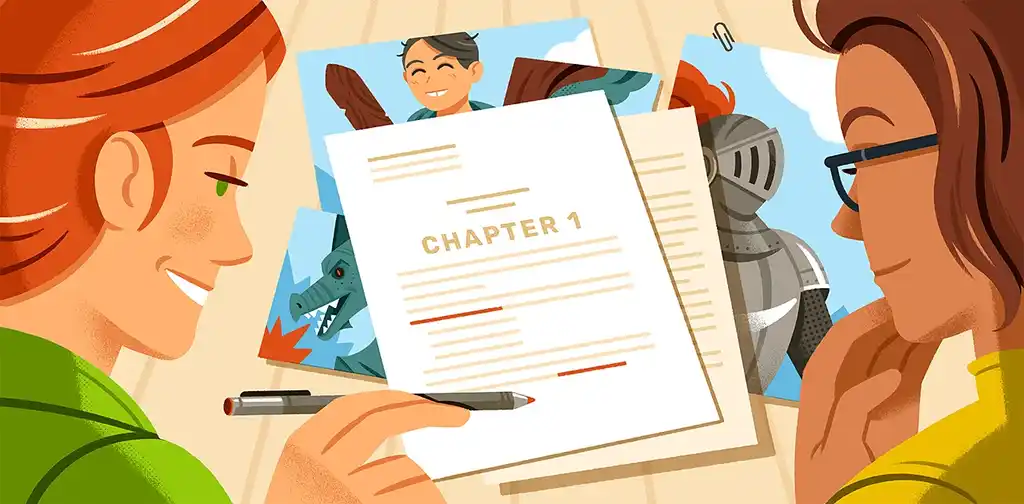 Properly formatting your interior design is critical for a great reading experience, especially when dealing with print editions. Professional illustrators or cover designers may do this for you as part of their service for picture books. If they have the right experience with interior design, then this is an option we’d recommend, as hiring a dedicated interior designer can cost between $250 and $750.
That said, you might be able to format your own book for free.
Format your book for free with Reedsy Studio
If your book is mainly text-based (like a children’s novel or a collection of short stories), you can write and format your book with a free tool like Reedsy Studio. It’s an easy-to-use software that allows you to turn your manuscript into a flawless, export-ready ePUB file for ebooks or PDF for print editions. All you need to do is to get those words flowing.
To try Reedsy Studio, sign up below and start using it today.
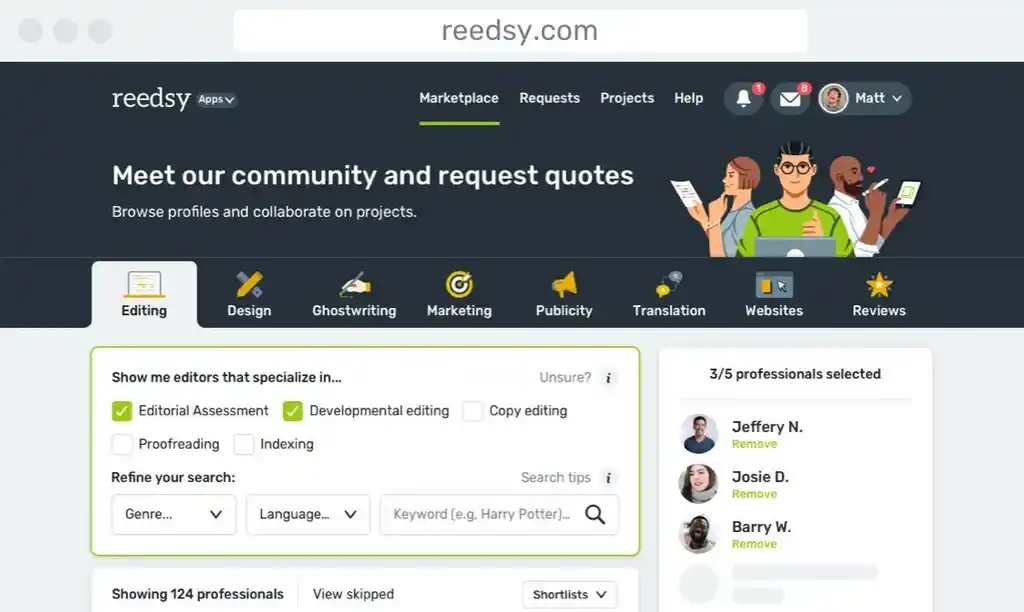
Looking for a professional formatting tool?
Sign up for free to start using the Reedsy Book Editor within seconds.
Learn how Reedsy can help you craft a beautiful book.
Once your book is finished, you may want to (understandably) hold it in your hands 一 as well as to sell physical copies to the general public. So, let’s look more closely at print and distribution options.
Print and Distribution
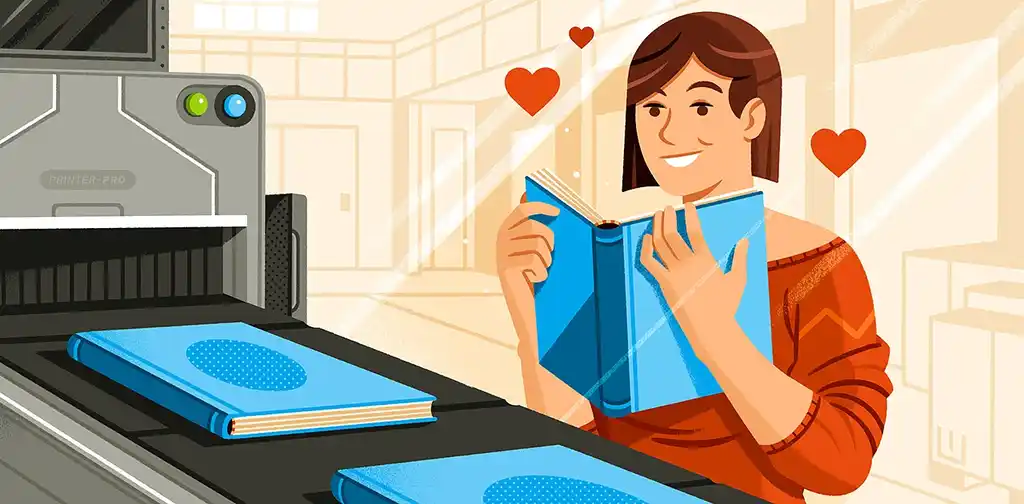 While some parents enjoy reading books to their kids on a tablet, most still prefer buying the physical version — if only to limit “screen time.” Print editions are also a must if you plan to distribute your book to libraries, schools, or if you want aunts, uncles, and grandparents to buy it as a present for their young ones.
There are two options to print your book:
- Print on demand (POD); and
- Offset printing services.
Let’s have a quick look at the financial implications of both.
POD is low risk, but expensive for picture books
POD services — which print one copy at a time, based on actual purchases — are the preferred option for authors who are publishing children’s novels, as the cost-per-unit is relatively low, averaging around $7 per book, usually deducted from royalty payments. This solution is also extremely convenient if you don’t want to pay in advance for a bulk order that might not sell, or don’t want to deal with storing and distributing the books yourself.
Q: What are the most common mistakes authors make when self-publishing?
Suggested answer

Something I have seen quite a lot lately in the self-publishing world: trying to do everything by yourself. Thinking that you just need Photoshop to make a cover, spell-checking software to edit, a dictionary and a bit of knowledge to translate. Never underestimate the value of a human professional who has spent years studying and then honing their skills. There is more to translation than substituting one word with another, just as there is more to a cover than a bunch of drawings and a title.
Find the right professional for you and your project, and work closely with them; you won't regret the expense, I promise. Also, yes, some types of stories and tropes are very popular right now, and those seem like a safe bet, as far as marketing and selling go - but likely there are a lot of similar books out already. In traditional publishing, variety is sorely lacking, because a tried and tested product seems safer; let's avoid repeating that mistake. Write the story that's in your heart and then strategically find your niche audience. You'll find them starved for exactly your flavour of creativity.
Mariafelicia is available to hire on Reedsy

One of the most common mistakes I see with self-published authors is setting unrealistic timelines for their publishing journey. Many writers plan their schedule far too tightly and only reach out to professionals—whether editors, designers, or marketers—at the very last minute.
This creates unnecessary stress on both sides: the author feels rushed and overwhelmed, while the professionals either have to decline the project or take it on under less-than-ideal conditions. In the worst case, authors struggle to even find available professionals because their preferred timeline doesn’t allow for the necessary lead time. Many professionals book out months in advance, so it’s wise to plan at least four months ahead—and in many cases, even that may not be enough time.
It’s also important to remember: as self-publishers, you are free to set your own pace. Unlike in traditional publishing, there is usually no external deadline or audience impatiently waiting for the book—especially when it’s a debut. That pressure often comes only from a self-imposed timeline. Instead of rushing, it’s far wiser to take the time to do everything properly, work with professionals without stress, and then launch the book when it’s truly ready.
Publishing a professional-quality book requires space for collaboration, revisions, and creative breathing room. When timelines are compressed, the process becomes about “getting it done” rather than “getting it right,” which can ultimately compromise the quality of the finished book. A thoughtful, realistic schedule not only reduces stress but also ensures that every stage of the process—from editing to design—has the attention it deserves.
Sabrina is available to hire on Reedsy

I've read a fair number of self-published books, and one thing I have noticed is that an unprofessional interior book design does impact my reading experience.
Interior book design is about all that invisible work that makes a book visually pleasant to read. If the lines break poorly, if the font is too big or too small, if the line spacing is too tight or too loose, if the font selection is one that's difficult on the eyes, especially after reading for a long time--all of this will subtly make your reader tired while reading, and, perhaps subconsciously, less likely to enjoy reading your book. They might not even know why! And by the end, they may be left with this feeling that they didn't want to pick up the book to read it as much as they have other books, which is not a feeling you want your readers to have, especially for something so easily fixable.
A well typeset book is unnoticeable. That's the point! Your reader doesn't notice the words on the page. Instead, they glide over them, immersed in the story. But a poorly typeset book stands out. Your reader's attention is pulled from the story again and again because the words are too squished together to read easily, or because there was one dangling line all by itself on the last page of a chapter and that looked odd, or because the font for the text messages was inconsistently applied.
Interior book design is an important part of the publishing process that I think a lot of self-publishing authors overlook.
Emily is available to hire on Reedsy
On the other hand, POD services are not as convenient for picture book authors. For instance, to print a 24-page picture book, you can expect to pay around $12 per copy 一 depending on factors like book format, page size, page count, and print options (black & white vs. colors). On top of that, you’ll have to add shipping costs, inflating the bill further, depending on whether you choose regular or express delivery.
There are several POD services you can choose to use. However, here's a quick look at the costs you can expect from two of the most popular printers of picture books.
|
Service |
Trim size |
Printing cost per copy |
Domestic shipping |
|
Lulu |
7.5”x7.5” (19x19 cm) |
$10.28 |
From $3.99 |
|
Blurb |
8”x10” (20x25 cm) |
$15.99 |
From $4.94 |
Note: These costs are based on 24-page full-color hardbacks.
When you look at the numbers, you quickly realize that you’re almost guaranteed to make a loss, since you can’t really price your indie book double what well-known authors charge 一 which is between $5 to $10.
However, don’t despair 一 while POD for picture books doesn’t make sense financially, you could still use it to gauge interest in your book by doing a small print run of around 50-100 copies and getting it into people's hands. If you've already sparked the interest of potential buyers, then you should probably consider offset printing for the following batch. Even though you’ll pay a salty bill upfront, your average cost-per-copy will be much lower, granting you a higher profit.
Offset printing gives better value, but with higher risk and upfront cost
The cost to offset print a picture book is much lower than POD services, although it comes with a higher risk and upfront expense 一 in case your book doesn’t perform as well as you hoped. With services like PrintNinja or IAPC, you can expect to pay around $4.30 per copy for an order of 1,000 hardcover picture books 一 60% less than what you’d pay with POD.
The price drop, however, is not as significant for middle grade or young adult novels, since black and white paperbacks (with a color cover) are around $4.90 per copy 一 only a few dollars less than POD services.
Remember that offset printing costs depend on how you customize your book (e.g. binding options, paper quality, cover types). It also matters if you’ll receive your copies from overseas or not. In fact, these prices do not include shipping and storage costs, which can add an extra $500 to $1,500 per order 一 depending on your location.
Overall, printing your self-published children’s book can significantly bump up your final costs. If you’re just getting started and you don’t know how many copies you’ll be able to sell, it’s wise to use POD services first to gather some data and test your book’s market. However, if you already know your book has buyers waiting to part with their money for it, offset printing is a better option as it will lower your overall costs.
We hope this guide has helped you better understand what budget you should set aside if you want to publish your work and inspire the next generations with your storytelling.
For the next part of our guide, we'll talk about how to use a children's book template to visualize your story page-by-page before adding illustrations.