Welcome to Reedsy’s French name generator
A French name generator is a tool that helps writers find authentic names for French-speaking characters. It’s an act harder than it may look! French is spoken across five continents, and naming traditions vary significantly across those communities. A name that reads as quintessentially Parisian may sound dated in Montreal or unusual in Dakar.
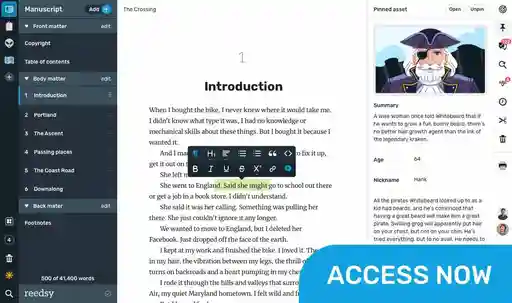
Reedsy's French name generator takes that context seriously. Tell it where your character is from, what era they inhabit, what kind of person they are, and it will return ten names with the reasoning behind each one.
How to use this name generator
Start with what you know. Region and era are the two most load-bearing inputs, then add character details — personality, social background, genre — and any regional preferences you have.
The generator returns ten names with explanations, which you can select-to-keep for your favorites.
So you want a good French name?
Names are where most writers start — and where the work of characterization is actually just beginning. Here are a few things worth knowing as you write:
- French names are era-legible in ways that matter. Marcel and Gaston belong to an older France. Théo and Léa are firmly contemporary. Naming a twenty-something character Geneviève in a present-day Paris novel isn't wrong, but it's a choice that carries meaning.
- Regional identity is encoded in names. Breton names like Gwenaëlle or Yann carry a distinct Celtic heritage that sets them apart from Alsatian, Basque, or Provençal naming traditions. If your character comes from somewhere specific, their name can reflect that, and readers familiar with France will notice when it does or doesn't.
- Francophone doesn't mean French. A character from Quebec, Senegal, or Martinique inhabits a different naming culture than one from metropolitan France, as they’re shaped by different histories, different languages in contact, different relationships to French colonial and postcolonial identity.
- Surnames tell their own story. French family names often have occupational, geographic, or descriptive origins. Dupont ("of the bridge"), Leblanc ("the white"), Dubois ("of the woods") — these names carry quiet histories that can add texture to a character's background, especially in historical fiction.
A note on our use of AI
We built this tool for writers, which means we thought carefully about what AI should and shouldn't do here. The generator uses AI to produce names that better fit your character's specific context and needs — archetype, personality, genre, world — while explaining its reasoning for each one.
Here’s what it won’t do for you: it won’t write your story, name your character, or make creative decisions for you. It simply generates options for you.
More importantly, your inputs are not (and will never be) used to train any AI models. Treat whatever comes out as raw material: a starting point that belongs entirely to you. Every result is yours!