Welcome to Reedsy’s Arabic name generator
Arabic names carry meaning in a way that English names rarely do. Noor means light. Tariq means one who knocks at night, a reference to a star that appears after dark. Layla evokes night itself. When you choose an Arabic name, you're often choosing a word that will shape how readers experience the character who carries it.
This Arabic name generator draws on the language's deep naming traditions to suggest authentic Arabic names for your characters. It’ll also provide the meaning behind each name, so you can make an informed choice rather than guessing.
How to use this name generator
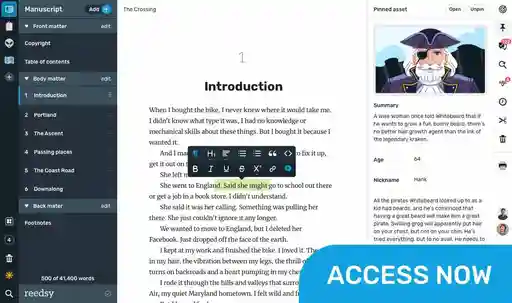
Tell the tool a little about your character (e.g. their gender, their background, any traits or themes you want the name to echo), and it will return ten options with reasoning for each.
Keep the names that interest you, and discard the rest! You can also run another generation if nothing clicks. In total, you’ve got four generations per session, which is usually more than enough to find something worth working with.
So you want a good Arabic name?
A name is the first act of characterization, and one of the trickiest. Here are a few things worth knowing as you write:
- Naming conventions differ across regions. Arabic-speaking communities span North Africa, the Levant, the Gulf, and beyond, and naming traditions vary significantly between them. A name common in Egypt may be rare in Morocco. A Gulf name may sound distinctly formal to a Lebanese reader. If your story is set in a specific place, pay attention to regional patterns, not just Arabic names in general.
- Many Arabic names are gendered, but not all obviously so to Western eyes. Names like Nidal (struggle) or Hind can be used for different genders depending on the region and family. The generator will indicate typical usage, but you should absolutely double-check if you're writing for an audience that includes Arabic-speaking readers.
- The relationship between given names and family names is often layered. For instance, some Arabic naming traditions use a nasab structure. This shapes how characters address each other, how formal or informal a scene feels, and how lineage functions in the story.
- Meaning matters, but so does sound. Arabic names often translate beautifully, but they also need to work on the page in English. Think about how the name will read in dialogue, how it will sound in a reader's head, and whether English-language readers will find it navigable.
- Research beyond the name itself. Read widely in Arabic literature and in fiction by Arab and Arab diaspora writers. Susan Abulhawa, Laila Lalami, Khaled Hosseini — these writers will teach you more about what authentic characterization looks like than any generator can!
A note on our use of AI
We built this tool for writers, which means we thought carefully about what AI should and shouldn't do here. The generator uses AI to produce names that better fit your character's specific context and needs — archetype, personality, genre, world — while explaining its reasoning for each one.
Here’s what it won’t do for you: it won’t write your story, name your character, or make creative decisions for you. It simply generates options for you.
More importantly, your inputs are not (and will never be) used to train any AI models. Treat whatever comes out as raw material: a starting point that belongs entirely to you. Every result is yours!