Welcome to Reedsy’s English name generator
An English name generator is a tool that helps writers find the right name for characters from English-speaking backgrounds. That said, “English name” is by no means a neutral category! It's one of the most historically layered naming traditions in the world, absorbing waves of Norman French, Latin, Old Norse, Welsh, and Celtic influence over a thousand years. A name like Eleanor, for instance, carries a different weight than Tyler. Charlotte reads differently than Mackenzie. The names feel self-evidently "English" — but they arrive from very different places, eras, and class contexts.
That's what makes our character name generator useful. Rather than returning a random list of common names, it generates ten options with the reasoning behind each. Names that look similar on the surface often mean very different things in context, and context is what you're actually writing.
How to use this name generator
Tell the generator what you know about your character. Genre helps! A name for a Regency heroine needs to feel period-appropriate, while a name for a contemporary thriller protagonist has different demands.
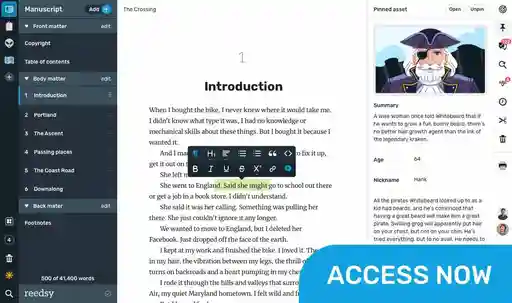
You can also add character details if you have them: personality, social background, what you want the name to carry or avoid. The generator will return ten names, each with an explanation of what it communicates and why. You can then use the select-to-keep mechanic to hold onto candidates, then run another generation if you need more range. You have up to four generations per session.
So you want a good English name?
Names are where most writers start — and where the work of characterization is actually just beginning. Here are a few things worth knowing as you write:
English names are more era-specific than they look. Names cycle in and out of fashion in patterns that are surprisingly trackable. Dorothy and Vera peaked in the 1920s, for instance. Karen and Linda dominated the 1950s and 60s. Emma and Olivia are more contemporary. Getting the era right — or choosing to subvert it deliberately — is part of making a character feel real rather than vaguely placed in time.
Class and regional identity are encoded in names. This is especially true in British fiction, where names like Nigel, Rupert, or Arabella carry entirely different social freight than Shane, Darren, or Chantelle. American naming traditions, meanwhile, encode class differently. Your character's name is quietly telling the reader something about where they came from.
Historical periods have their own naming logic. Just take Medieval English names, which may look almost foreign to contemporary eyes. If you're writing historical fiction, research the naming conventions of your specific period and region rather than reaching for names that feel generically "old."
English names travel and change. The same name can land very differently in London, Lagos, Auckland, or Toronto. A character named James in a British colonial context carries different connotations than one in contemporary California. If your story crosses cultures or continents, think about how your character's name functions in each context it appears in.
Surnames are characterization, too. English surnames carry their own histories — occupational names like Fletcher or Cooper, place names like Ashford or Moor, patronymics like Johnson or Williams. In contemporary fiction especially, the combination of first and last name does composite work. A character named Sebastian Worthington reads differently than one named Sebastian Kowalski, even if Sebastian is doing the same things in the same scenes.
Read the fiction, not just the name lists. The best way to develop an instinct for English names is to read widely across eras and regions — George Eliot for Victorian naming, Zadie Smith and Bernardine Evaristo for contemporary multicultural Britain, Richard Russo and Ann Tyler for American regional texture. The names in good fiction are never accidental.
A note on our use of AI
We built this tool for writers, which means we thought carefully about what AI should and shouldn't do here. The generator uses AI to produce names that better fit your character's specific context and needs — archetype, personality, genre, world — while explaining its reasoning for each one.
Here’s what it won’t do for you: it won’t write your story, name your character, or make creative decisions for you. It simply generates options for you.
More importantly, your inputs are not (and will never be) used to train any AI models. Treat whatever comes out as raw material: a starting point that belongs entirely to you. Every result is yours!