Welcome to Reedsy’s Celtic god name generator
A Celtic god name generator is a tool that helps writers create names for original deities inspired by Celtic mythological tradition. And of course, Celtic mythology is not a single tradition. It encompasses the Irish cycles, the Welsh Mabinogion, Scottish Highland traditions, Gaulish religious practices recorded by Roman observers, and the Brythonic traditions of what is now Cornwall and Brittany.
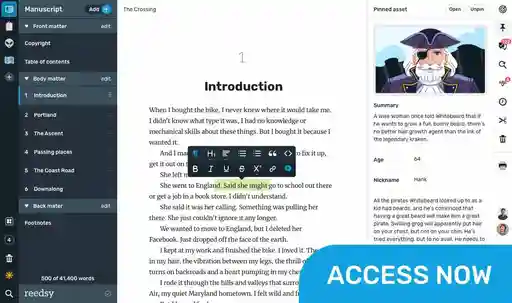
Our Celtic god name generator takes your deity's domain, alignment, worship style, and world-building specifics, and returns ten names with the reasoning behind each to aid you in capturing that indescribable quality that all the best Celtic god names hold: the sacred that feels embedded in landscape, in the relationship between the human and the non-human, in a sense that the divine is present in groves and rivers and thresholds rather than enthroned above them.
How to use this name generator
We recommend starting with domain and alignment: they're the inputs that most directly shape what kind of deity you're naming. Worship style adds further texture: a deity honored at forest shrines with offerings feels different from one invoked in battle.
Use the additional details field to specify which Celtic tradition you're drawing on, and to describe your world's specific relationship to that tradition. List any deity names already established in your pantheon; consistency across a pantheon is what makes it feel designed rather than assembled. Ten names will return, each with etymological reasoning and an epithet.
So you want a good Celtic god name?
Celtic mythology is one of the richest and most tonally distinctive traditions a fantasy writer can draw on.
Here are a few things worth knowing as you build:
- Celtic deities resist clean portfolios. In Greek mythology, Zeus is god of the sky, Poseidon of the sea, Aphrodite of love, so the domains are relatively tidy. Celtic deities tend to be more multiply-natured: the Dagda is associated with agriculture, wisdom, weather, and the dead simultaneously, for instance.
- Landscape is theology in Celtic tradition. Rivers, hills, sacred groves, and liminal spaces are sites of divine presence in ways that differ from the Olympian model of gods who visit earth from elsewhere. Deity names that encode place, season, or natural phenomenon reflect that theology more accurately than names built purely around abstract concepts.
- The Irish and Welsh traditions have distinct characters. Irish mythological names tend toward harder consonants and a more martial, heroic register — Cú Chulainn, the Dagda, Lugh. Welsh names are often softer and more lyrical — Rhiannon, Arianrhod, Pwyll. Gaulish names, as recorded by Romans, tend toward compound constructions that are often partially preserved. If your world draws on a specific tradition, the additional details field is where to say so!
- Epithets were central to how Celtic deities were named and invoked. Rather than a single fixed name, Celtic deities were often addressed through descriptive epithets tied to their domain or aspect
- Internal consistency makes a pantheon feel real. If your world has multiple Celtic-inspired deities, remember that their names should feel like they emerged from the same linguistic world.
A note on our use of AI
We built this tool for writers, which means we thought carefully about what AI should and shouldn't do here. The generator uses AI to produce Celtic-inspired deity names — with etymological roots and epithets — that fit your world's specific pantheon, your deity's domain and alignment, and the tone of your world-building.
Here’s what it won’t do for you: it won’t write your story, name your character, or make creative decisions for you. It simply generates options for you.
More importantly, your inputs are not (and will never be) used to train any AI models. Treat whatever comes out as raw material: a starting point that belongs entirely to you. Every result is yours!