Blog • Understanding Publishing
Posted on Feb 17, 2026
How Much Do Authors Make? Advances, Royalties, and Additional Income Explained

Loretta Bushell
Loretta is a writer at Reedsy who covers all things craft and publishing. A German-to-English translator, she specializes in content about literary translation and making a living as a freelancer.
View profile →According to The Author’s Guild, the median annual income for full-time authors across all publishing routes (outside of academia) was $25,000 in 2023. However, there is a gigantic difference between what thriller writer James Patterson earns and what up-and-coming solarpunk authors see in their bank accounts at the end of the month.
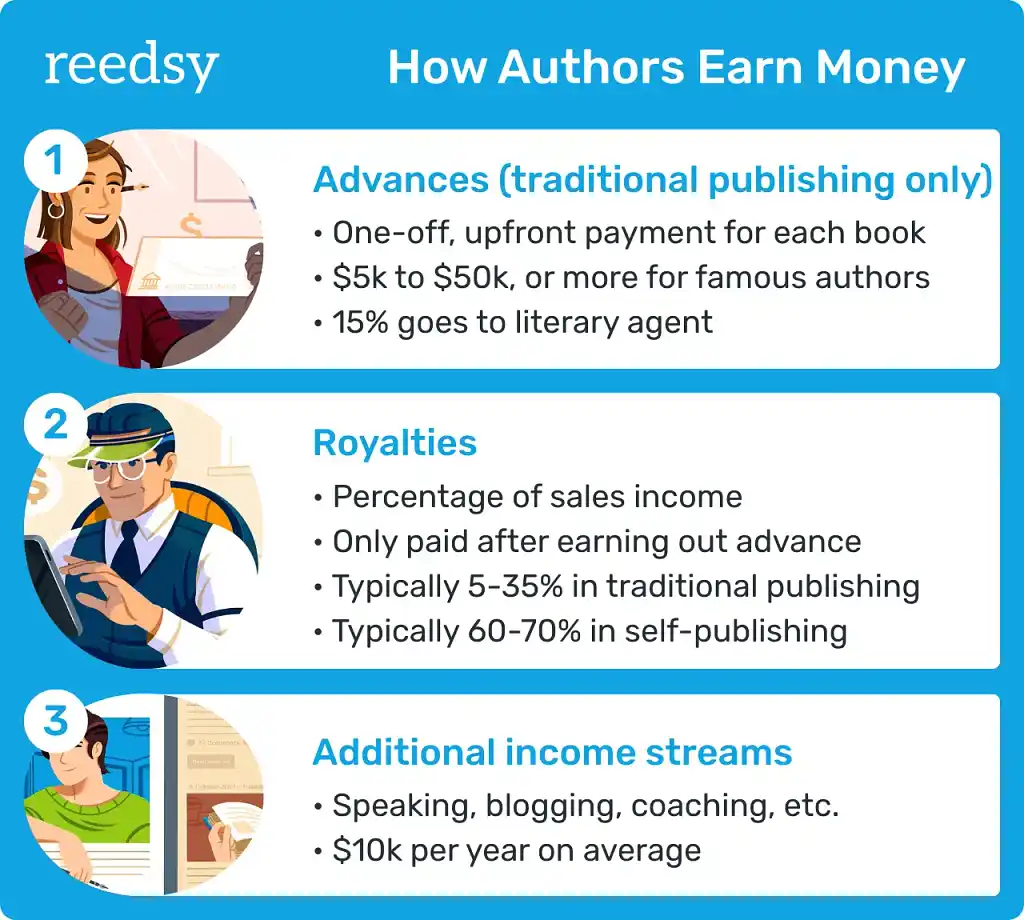
In this post, we’ll look at the three pillars of an author’s income: advances, royalties, and additional revenue streams. In consultation with some of our top editors and literary agents, we’ll discuss the factors that affect each of these and reveal industry averages in both traditional and self-publishing — helping you understand where your money will come from and how much you could make as an author.
If you don’t find it too gauche, let’s talk money!
Advances (traditional publishing)
An advance is a sum that a publisher pays an author upfront for the rights to their book. This amount is then deducted from the author’s royalty earnings, meaning you only receive further payments from the publisher once your cut of the profit is more than your advance.
Example
Let’s say you receive a $10,000 advance and 10% royalties on a $20 book. That means you earn $2 for every book sold. However, the first $10,000 of royalties goes to “earning out” the advance. In practical terms, you won’t see another penny until you’ve sold 5,000 books.
If you don’t “earn out” your advance (and many authors never do), you don’t have to give any money back. An advance is guaranteed income from your book, even if it doesn’t sell a single copy.
But it’s not guaranteed income today. You won’t get a novelty giant check with the full whack on your signing day. Advances are often paid in several installments over a period as long as two years, and if you have a literary agent, around 15% of the agreed advance goes to them. So signing a book deal doesn’t usually mean you can quit your day job right away.
Q: How important is it for first-time authors to adhere to standard word counts, and what flexibility do they have based on genre or target audience?
Suggested answer

In a very loose way, it's important to adhere to genre standards in word count simply because they've developed over time in response to what works best in the market. There are always exceptions, but those are usually backed up by an established author or sweeping support from retailers, librarians, or the media backing the book.
BUT FIRST: write the book you want! This is your book, and you can always edit it down or beef it up. It's important to write for yourself first, because the best story will come out of that. And if you change it later, so be it. Don't let market expectations stop your drafting or creative process!
Grace is available to hire on Reedsy ⏺

It's incredibly important, not because authors shouldn't be able to bend or break the rules, but because these "standard word counts" are systemic. It isn't agents insisting on word counts for no reason; it filters from book buyers to internal publishing salespeople, then to editors and agents.
Having too few words can be worse than having too many. Think about the end goal: you want readers to buy your book. If they feel like they're getting less than they paid for then they won't buy the book. For example, if you wrote 30,000 words when most books in your genre are more like 60,000-70,000 words, then readers looking at your book compared to a competitor might be inclined to think the book that has more words has more heft and therefore is more worth their money.
When it comes to too-high word counts, then you run into a different issue and that's with publishing costs. it costs money to print pages, and if you've written 500,000 words, then that book is going to cost even more to produce (not only the paper in such an extreme case, but also in the binding of that book to make sure it holds up). If it costs more to create, then that can negatively impact publishers' profits. If a publisher is evaluating your work that's 500,000 words versus a similar work that's only 125,000 words, why wouldn't they choose the shorter book? It also takes up less physical space on a bookshelf, so bookstores might be able to keep more copies on the shelf.
Genre and target age range here are the great determining factors. Epic Fantasy, for example, which takes place in a world not our own, usually requires a higher word count for the simple fact that the world has to be built. Nonfiction business books, on the other hand, are usually around 60,000 words, as those readers don't need to be transported to another world, but instead need to have points clearly articulated.
Matt is available to hire on Reedsy ⏺
If you're planning on querying agents and going the traditional route, then adhering to standard word count expectations is essential. Are there exceptions to the rules? Sure, but you never want to plan on being the exception to the rule when you're already going up against long odds.
Querying is incredibly competitive, and an agent seeing that your manuscript is already in the target word count range for your genre tells them that you're probably aware of market expectations and have given real thought to your project's development. On the other hand, if they see a word count that's 20k outside the realm of expectations, that tells them they're either going to have to work with you to get the word count down/up, or potentially have a more difficult time selling your project to publishers.
On the other hand, if you're planning on self-publishing, word count isn't all that important. You don't want to write something the length of a short story and call it a novel, but the important thing in the self-publishing world is to tell a good story. Whether your mystery novel is 30k words, 60k words, 90k words, or even 130k words, your readers won't care as long as the story is great, whereas an agent would likely say no immediately if they saw a query for a 30k or 130k mystery novel, without even getting past that first sentence of your query where they'd see the word count.
If you don't know whether or not you plan to publish traditionally, the best way to set yourself up for success is to research the target word count range for your genre/audience, and then adhere to that expectation as closely as possible. Do be aware that word count expectations can change over time, so you want to make sure that your source for target word count is fairly recent.
That said, if you don't want to put extra pressure on yourself to meet industry standards before you're even done drafting, then there's no reason to focus on anything other than writing the best story you can; then, once you're done, you can take a look at word count expectations, hire a developmental editor to get expert eyes on your novel, and decide from there what makes the most sense for a publication plan.
Jennifer is available to hire on Reedsy ⏺
Factors affecting an advance
The size of your advance depends on a few factors, some of which are interrelated.
1. Your track record and public profile
If you’re already famous, you’ll likely have no trouble getting your hands on a good advance. British TV presenter Richard Osman secured a 7-figure advance for his first-ever book deal, as publishers knew he could tap into his massive fan base to sell his novels. Matt Haig, on the other hand, worked in Ibiza nightclubs before becoming a novelist — and his modest £5,000 advance reflects his relative level of fame at the time. Sixteen years and over twenty books later, Haig’s The Midnight Library would sell for £600,000.
You don’t have to be ultra-famous to negotiate a higher advance. If you have a decent social media following or newsletter subscriber base, that can work in your favor, especially in nonfiction. If there’s evidence that people like your short-form content, there’s reason to believe they’ll like your book.
2. The size of your target market
Even if you’re not already in the public eye, you’ll secure a higher advance if your book is likely to appeal to a large audience, so you can expect to earn more if your genre is popular and less if it’s quite niche. Author and Reedsy editor Sean Fletcher says that romantasy is the genre that currently pays the highest advances. “I know new authors who have gotten over six figures. Publisher interest in this will be strong for a while yet, but it doesn't mean that every advance will be so high, or that other genres can't get strong advances.”
3. How many publishers are interested
If you do happen to be famous and/or writing in a lucrative genre, there may be multiple publishers interested in your work. In this case, the book deal will go to auction and the value of the advance may rise significantly as publishers try to outbid each other. Viking won the rights to Richard Osman’s first two Thursday Murder Club books in a 10-way auction.
4. The size of the publishing house
Big 5 publishers (Penguin Random House, Macmillan, Simon & Schuster, Hachette, HarperCollins, and their imprints) typically pay higher advances than smaller, independent presses. However, this doesn’t make smaller presses “worse” — they will typically offer higher royalty rates, which can end up being more profitable for you in the long run. (We’ll get into that later.)
5. Luck!
Unfortunately (or fortunately, depending on which way the cookie crumbles), the publishing industry doesn’t always make sense. Some book deals defy expectation and explanation!
Q: Assuming a book deal, how long can an author assume the process will take from querying to seeing their book on the shelf?
Suggested answer

Having been an acquisitions editor for a division of Random House, I can tell you publishing is a marathon, not a sprint. On average, the journey from query to bookstore shelves is about two years. That might sound like forever, but every step along the way has its own milestone worth celebrating.
Here’s what it looks like:
- A Spark. An editor loves your query! Cue the happy dance. They’ll ask for more—maybe a full proposal, sample chapters, or even the whole manuscript if it’s fiction.
- The Back-and-Forth. This is the “let’s make it even better” stage. You might be asked for clarifications or revisions before your project goes to the publication board. Think of it as a friendly brainstorming session with high stakes.
- The Green Light! Once the pub board approves, a contract is drawn up. Negotiations and signatures can take 2–3 months. Then it's official and you can make announcements in public.
- The Writing Zone. You’ll usually get around six months to deliver your manuscript. This is when the real writing (or rewriting) magic happens.
- The Editorial Polish. Once you submit your manuscript, your editor helps refine your work. Developmental edits, line edits, copyedits… it’s like giving your manuscript a deep massage. This adds another 2–3 months.
- The Final Stretch. Your book is typeset, proofread, and sent to print. Depending on where it’s printed, this can take another couple of months.
- Meanwhile, the sales and marketing teams are busy building buzz, and you are stirring up excitement with pre-sales posts.
So yes—it’s a two-year adventure. But the good news? That “long runway” gives publishers time to rally booksellers, reviewers, and readers, so when your book finally launches, it’s not just quietly slipping onto a shelf or into the Amazon masses, it’s arriving with fanfare. Publishing is a process of patience, persistence, and plenty of celebratory moments along the way.
Alice is available to hire on Reedsy ⏺

Querying is the first step of a journey through traditional publishing. After you've sent out your queries, the next steps might look something like this:
- Full requests: Literary agents who are interested in your query will request the full manuscript from you so they can read the whole book and decide whether to offer representation.
- Offer of representation: After reading your book, the literary agent has decided they would like to represent you and take you on as a client, so they send you an offer of representation. This is a good time to follow up with any other pending queries and let them know that you've received an offer of representation. Generally, you should give other agents 2 weeks to get back to you after you've let them know you've received a competing offer of representation.
- Submissions: Once you've signed with a literary agent, your agent goes out with your manuscript on submission. This might happen right away (if your agent believes your manuscript is ready) or after a round or two of revisions. The amount of time this might take varies greatly.
- Editor interest: Editors who are interested in your book may have to drum up internal support at their publishing house before they can make an offer. This could look like the editor bringing the project to their editorial meeting, then presenting it at an acquisitions meeting. This could take up to 2 weeks depending on the process at that particular publishing house. You may have a call with the editor as well to make sure your visions are compatible.
- Book deal offer: Your prospective editor will send an offer to your agent, and they will negotiate.
- Editing begins: Once you've come to an agreement on the book deal, you will begin working with your editor. All in all, it generally takes about 2 years between a book deal and the book's publication date. This looks like about 1 year of editing and revising, and then 6 months of the book moving through different stages of production, and then it goes out to the printer, is physically produced, and ships to distributors, who then sell to booksellers, who then stock the book.
Of course, the timelines for the items I've listed here vary greatly. But generally speaking, it's safe to assume at least 2 years between book deal and publication...plus the amount of time you've had between querying and getting that book deal. This is part of the reason I encourage authors not to chase trends and instead to focus on writing compelling characters—traditional publishing is slow, so write from the heart. Strong character work and a good command of craft will appeal regardless of the shifting trend cycles.
Christine is available to hire on Reedsy ⏺

Allow a publisher's editorial board 30 - 60 days to finalize an offer and negotiate details. After that, expect 8 to 16 months before your cover sees the light of day. Why so long? Legitimate publishers allocate marketing and trade sales resources on their calendar. They also sometime like to schedule titles based on best selling seasons for a particular genre.
Mike is available to hire on Reedsy ⏺
Average advances for non-celebrity authors
To complicate things further, publishers aren’t very transparent about their advances, so there’s very little public data out there to base any averages on.
The most illuminating source of author advances in recent years was the 2020 Twitter campaign #PublishingPaidMe. Started by fantasy author L.L. McKinney to expose the stark disparities between advances paid to white authors and BIPOC authors, the results of this informal questionnaire are available in this public spreadsheet. Remember to take these numbers with a grain of salt: the advances are from 5–10+ years ago, and the demographic is restricted to Twitter users.
Case study
Zakiya Dalila Harris and Viet Thanh Nguyen are both previously-unknown authors whose debuts became major bestsellers. While Harris received an advance of $1 million for The Other Black Girl, Viet Thanh Nguyen received a mere $35,000 for The Sympathizer. The lesson? First-time novelists can land a huge advance with a strong enough pitch — but a low advance doesn’t mean you can’t be just as successful.
For more up-to-date figures, we again turned to our freelancers who have spent years on the inside.
Fiction ($5,000–$50,000)
Our experts generally agreed that most advances for little-known fiction authors in the US fall in between $5,000 and $50,000. In the UK, the range is typically a bit lower: £1,500–£25,000.
However, Rose Tomaszewska, a Reedsy editor with 13 years of Big 5 experience, was quick to point out exceptions. “If there's an auction between two or three publishers and you've got a strong agent, you could get up to £40,000–£50,000. If there are more than five publishers competing, you could get up to £250,000. And in the US, figures can be far higher.”
Reedsy freelancers also pointed to differences between Big 5 publishers and smaller independent presses. “Advances from small presses are often lower, but the trade-offs can be favorable,” said Fletcher. “They may come with better payout schedules, higher royalty rates, and stronger individual marketing.” In fact, Fletcher himself had accepted a lower advance for one of his own fantasy series in exchange for a higher ebook royalty rate.
Nonfiction ($8,000–$100,000)
It’s a slightly different story with nonfiction. Jenna Love Scrader and Sally Collings warned that genuinely unknown authors will struggle to secure a book deal at all. “Today, more than ever, publishers are intensely allergic to risk,” said editor Sally Collings. Even when publishers do gamble, the advance they offer will sit firmly at the bottom end of the spectrum: high four figures or low five figures at most.
On the other hand, first-time authors with a substantial existing following (e.g., on social media or a blog) can land a significant advance. Collings revealed that one of her debut nonfiction authors secured a $100,000 advance from a Big Five publisher in the spirituality/personal development space. “He had a substantial following and clear market demand, so that wasn’t a gamble on the publisher’s side; it was a calculated bet on an existing audience.”
Q: How can authors effectively identify and describe their target audience for a book proposal?
Suggested answer

Authors should read books in the category and genre they are shooting for. There is that old tale about how people in the banks learn to spot counterfeit money--by handling legit money. If you are reading in your target category and genre, you should be able to tell if you book is fitting into that category and genre. That's how you identify your audience, I think. It's time consuming, but I don't think there is a shortcut.
Then to effectively tell an agent who your audience is you might say something like,
XXX is a 30,000-word, MG, mystery novel. Readers who love Taryn Souders' books should like XXX as well.
Just give the word count, the category, the genre, and some comp books. The agent will understand the audience.
Sally is available to hire on Reedsy ⏺
Start by imagining your target audience as one person—not a vague crowd. Who is this book really for? Give that reader a name, an age, a life stage. Begin with demographics like age, gender, marital status, profession, or family situation. Then dig deeper into psychographics: What do they care about? What values shape their decisions? What do they believe about themselves or the world?
Most importantly, ask:
- What problem do they want to solve that your book helps address?
- What keeps them up at night?
- What do they dream about changing in their life?
Once you’ve gathered this picture, write it out as if you’re introducing that person to an agent or editor. For example: “Meet Sarah, a 42-year-old teacher who…” The more specific and relatable you make this description, the easier it is for publishers (and ultimately readers) to connect with your book.
Alice is available to hire on Reedsy ⏺

For nonfiction books it's important that an author understand to whom they are writing. The best way to identify the target audience is to think about your goals for the book. Why are you writing it? Are you interested in sending a particular message to help others in some way? Do you want to share useful information? Do you want people to know more about you and your ideas, maybe because you have a business that offers some kind of service? Why are you sitting down to put these ideas down on paper?
Once you know your 'why', you can identify your 'who': who are the people who will want to read or listen to that message? Are you writing to prospective clients, people interested in a certain topic who just want to know more, colleagues in your industry, people who are struggling with some kind of issue, people with certain goals?
Once you know 'who' - you can do some research to look at the demographics of your target reader. If you're writing about a certain approach to a problem: who has the problem? What is their typical gender, age, location, and economic level? Why are they motivated to buy a book on the topic? What other books have they read related to this topic?
When you're writing about your audience in a book proposal, use those demographics. Tell the publisher who will be most likely to want to read your book - give numbers, such as "X% of women in this age group are interested in losing weight" or "Y% of respondents to a survey said they were concerned about raising healthy kids". Find credible sources (and cite those sources in the proposal). You can also let the publisher know what other, similar books your target reader has likely read, especially if that book has positive feedback and has sold decently well; for example: "The reader has enjoyed books like "Guns, Germs, and Steel".
Identifying a motivated target reader is absolutely vital to being successful in submitting your work to publishers. Publishers need to know there is an existing audience that will want to buy your book.
Melissa is available to hire on Reedsy ⏺
Royalties on sales
Whatever your advance, your agreed royalty rates will fall into much more predictable brackets.
Royalties are ongoing payments an author receives from the publisher (or retail platform, in the case of self-publishing), calculated as a fixed percentage of each sale. As mentioned above, traditionally published authors will only receive royalties after earning out their advance.
Royalties are typically either calculated based on a book’s list price (the price printed on the back), or on net receipts, which is the amount received by the publisher after any discounts. Royalties on net receipts are lower, but are the industry standard in traditional publishing. Some self-publishing platforms, however — including Amazon KDP — pay royalties based on the list price.
Q: Should authors sell exclusively on Amazon?
Suggested answer
It depends on your ultimate career/business goals. A book that is only published on Amazon looks like a self-published book. For non-fiction, if your goal is the elevation of your thought leadership status, you benefit from your book being "everywhere". Including links to numerous retailers on your website is not a traffic flow exercise, where we are trying to spread out your sales - it is a branding exercise. We want to show the prospective reader, or podcast host, or convention booker that your presence is as far and wide as possible. Widespread distribution increases perceived legitimacy.
Chris is available to hire on Reedsy ⏺

In the children's book world, an author selling their book only on Amazon is not ideal for several reasons. Most advance trade review outlets will only review books that have a broad distribution, or at least are sold also in bookstores or non-traditional book outlets. Also, selling only on Amazon largely cuts out the school and library distribution, which typically use wholesalers. Amazon, in my opinion, is an important part of book sales, naturally, due to its huge marketshare of children's book sales, but best done in conjunction with other sales and marketing opportunities.
Tara is available to hire on Reedsy ⏺

For most authors—especially if you’re just starting out—selling exclusively on Amazon is a smart move. Managing multiple platforms can be overwhelming, and Amazon’s KDP Select program gives you some great tools to build momentum. Page reads from Kindle Unlimited and features like countdown deals make it easier to get your book in front of readers without spreading yourself too thin.
That doesn’t mean you’re stuck with Amazon forever. Once you’ve got some traction—like more reviews, a growing fanbase, or even a backlist—you can start exploring other platforms or even direct sales. But starting with Amazon keeps things simple and helps you focus on what matters most: reaching readers and building your audience.
If you’re new to publishing, Amazon isn’t just a platform—it’s the best foundation to launch your career.
Jd is available to hire on Reedsy ⏺
Factors affecting royalty rates
Royalty rates are far less variable than advances, but they are affected by:
-
The size of the advance. A lower advance usually equates to higher royalty rates. Since there are no advances, self-publishing has the highest royalty rates of all.
-
The book format. Ebooks have the highest royalty rates, followed by hardcover books, and then paperbacks.
-
In self-publishing: The price. Amazon KDP, the most popular distribution platform for self-publishing authors, offers double the royalties for ebooks priced within a certain range (see below).
-
The territory. Royalties can vary by market, both in traditional publishing and self-publishing.
Average royalty rates
The table below shows the typical royalty rates authors receive from Big 5 publishers, smaller traditional presses, and Amazon KDP (other self-publishing platforms offer similar royalty terms).
|
Big 5 |
Small press |
Amazon KDP |
|
|
Royalties on ebooks |
25% |
25–50% |
70% on ebooks priced $2.99-$9.99 35% otherwise Small file delivery fee deducted from 70% royalty only |
|
Royalties on print books |
10–15% for hardcover 5–8% for paperback |
5–25%, rising to 20–50% on a no-advance contract |
60% for books sold on Amazon 40% for books sold elsewhere Printing costs are deducted from royalties |
Remember that if you have a literary agent, they will keep an average of 15% of your royalties.
Average royalties per book sold
Now let’s put theory into practice. Imagine you write a 328-page book. You sell the ebook for $7, the hardcover for $25, and the paperback for $15.
Here’s what your gross royalties per book sold might look like (after earning out any advance):
|
Book format |
Big 5 gross royalties per sale |
Small press gross royalties per sale |
Amazon KDP gross royalties per sale |
|
Ebook ($7) |
25% = $1.75 |
35% = $2.45 |
70% = $4.90 |
|
Hardcover ($25) |
12% = $3.00 |
25% = $6.25 |
60% = $15.00 |
|
Paperback ($15) |
7.5% = $1.13 |
20% = $3.00 |
60% = $9.00 |
Now let’s factor in agent commissions, printing costs, and file delivery fees. We based the printing costs on Amazon KDP pricing for a 6x9” book, and the ebook delivery fees on a 2MB file size (figures correct as of February 2026).
|
Book format |
Big 5 net royalties per sale |
Small press net royalties per sale |
Amazon KDP net royalties per sale |
|
Ebook ($7) |
$1.49 |
$2.08 |
$4.60 |
|
Hardcover ($25) |
$2.55 |
$5.31 |
$5.41 |
|
Paperback ($15) |
$0.96 |
$2.55 |
$4.06 |
Of course, you’re not going to just be selling one copy. Let’s see how author earnings increase with scale.
Royalties over time
How many copies of your 328-page book would you need to sell to earn $10,000 in royalties? Or $100,000? Let’s compare.
|
Net royalties |
Copies sold by Big 5 publisher |
Copies sold by small press |
Copies sold on Amazon KDP |
|
$1,000 |
673 ebooks or 1046 paperbacks |
481 ebooks or 393 paperbacks |
205 ebooks or 112 paperbacks |
|
$10,000 |
6,723 ebooks or 10,458 paperbacks |
4,802 ebooks or 3,922 paperbacks |
2,041 ebooks or 1,112 paperbacks |
|
$50,000 |
33,614 ebooks or 52,288 paperbacks |
24,010 ebooks or 19,608 paperbacks |
10,205 ebooks or 5,557 paperbacks |
|
$100,000 |
67,227 ebooks or 104,576 paperbacks |
48,020 ebooks or 39,216 paperbacks |
20,409 ebooks or 11,112 paperbacks |
|
$1 million |
672,269 ebooks or 1,045,752 paperbacks |
480,193 ebooks or 392,157 paperbacks |
204,082 ebooks or 111,112 paperbacks |
You typically need to sell far fewer copies of a self-published book to earn meaningful royalty income. If you’re able to reach a large readership on your own, self-publishing can be the more profitable route. On the other hand, if most of your target audience shops in brick-and-mortar stores only, a traditional publisher is better positioned to reach those readers.
Case study
Rachel Nuemeier started out in traditional publishing, but transitioned into self-publishing to gain more control over her career. “If your book’s first print run is 2,000 copies and it sells out in two weeks, but there’s a paper shortage, the publisher will not print more copies and they will then hold your poor sales against you because that’s how publishers are.” But when it comes to self-publishing, “writing and marketing involves learning how to do it and then doing it, which is not about luck at all.”
Want to learn how to increase your indie book sales? Get Ricardo Fayet’s free ebook, How to Market a Book.
Average royalties per year
So, we’ve only looked at royalties over a book’s lifetime. But what about royalties per year? The Author’s Guild reported a median annual “book income” of $15,000 for full-time authors. This includes advances and royalties, so the figure we’re looking for is even less than that.
But savvy authors can strive to earn significantly above average with the right business attitude and a strong backlist. Writing more books is essential to turning writing into a full-time career — book series can be particularly lucrative. Written Word Media’s 2025 Indie Author Survey found that authors who had self-published 25+ books earned a median of $3,000 per month ($36,000 per year) from book sales, with 40% earning more than $5,000 per month ($60,000 per year).
Additional income streams
Earlier, we noted that the median annual income for full-time authors is $25,000, according to The Author’s Guild. If only $15,000 comes directly from book sales, where does the remainder come from?
The organization defines the rest as “author-related income”: revenue that isn’t directly related to book sales, but is connected to the author’s books or writing in general. This includes:
-
Speaking engagements at conferences, literary festivals, or schools
-
Blogging on platforms like Medium, Patreon, and Substack
-
Teaching, often on creative writing, language, or literature
-
Book coaching, either one-to-one or for small groups of aspiring authors
-
Copywriting, typically freelance work for businesses
-
Journalism, whether covering publishing or other topics
Some authors make more money through these activities than through their books, particularly when they haven’t published many titles yet.
Whether you’re traditionally published or self-published, you’ll have to be proactive to earn money this way. Conference organizers, paid newsletter subscribers, and mentees won’t magically find you — you have to promote yourself to them. To find out how, read our blog post about all the different ways to make money writing.
Although it’s a notoriously tricky question, we hope that you now have a better understanding of how much authors make — and how they make it. If you aspire to become a full-time author, don’t forget to check out our learning courses for detailed guidance on every step of the journey.