Blog • Understanding Publishing
Posted on Jan 19, 2026
How Long Does It Take to Publish a Book?

Loretta Bushell
Loretta is a translator, proofreader, and writer with 4+ years of experience in the publishing industry. She helps freelancers and authors build sustainable careers.
View profile →
Martin Cavannagh
Martin Cavannagh is a publishing professional with 10+ years of experience in content strategy, editorial development, and author education within the indie publishing space.
View profile →Once you’ve written and self-edited your manuscript, it takes on average 2–4 years to publish a book traditionally, and 3–8 months to self-publish a book.
That said, every book is different. Sometimes the stars align and a book gets published faster; other times, unforeseeable circumstances cause months of delays. With this disclaimer out of the way, let’s look at how long each step of the publishing process typically takes for both traditional publishing and self-publishing.
Are you interested in how long it takes to write a book? Head to this post to find out.
Traditional publishing
2–4 years
It’s time for another disclaimer: not every book lands a traditional publishing deal. Bestselling fantasy author Brandon Sanderson wrote thirteen novels that were rejected by everyone he sent them to before his “debut” novel, Elantris, was finally accepted by a publisher. If you find yourself in this situation, you can take inspiration from Sanderson and keep writing — or self-publish your book instead.
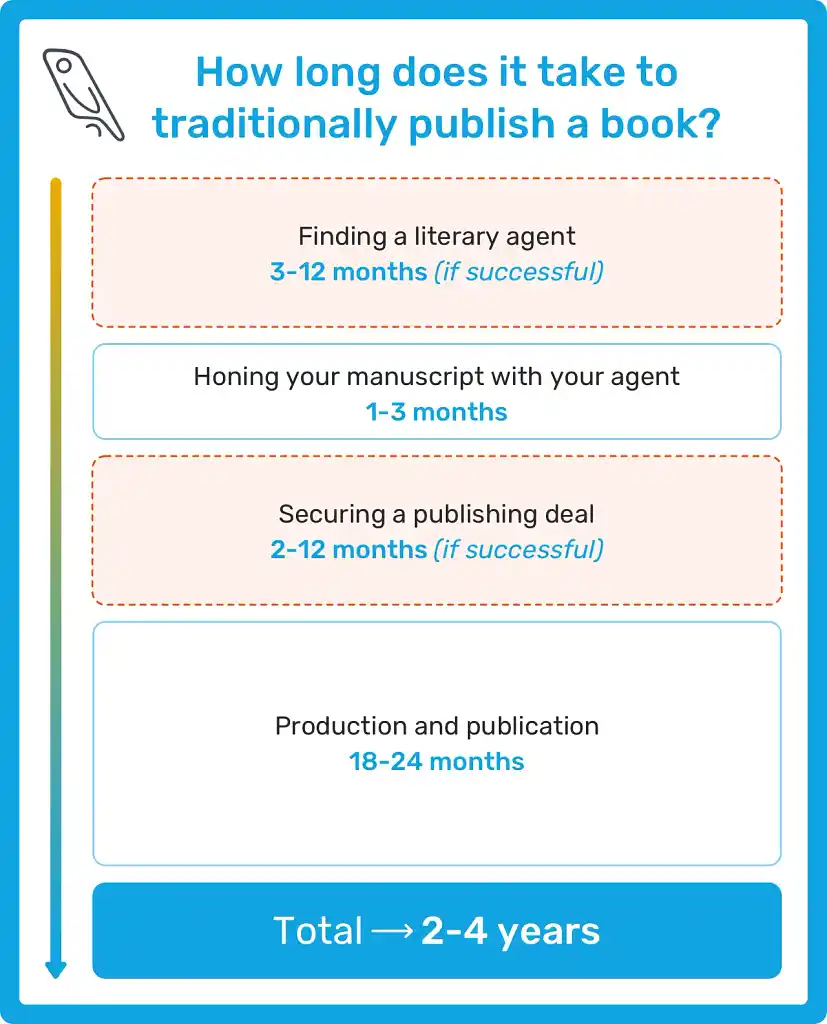
Finding a literary agent
3–12 months
Of course, how quickly you find a literary agent in part depends on how much time you can dedicate to the search. Querying more agents each month may lead you to a perfect match faster than querying fewer agents — but only if you take the time to carefully select the most promising leads.
Then you also have to factor in the agents’ response times. Many agency websites explicitly state the timeframe for a response — typically 8–12 weeks, but it can be more. Then, if the agent is interested in your query and requests the full manuscript, they’ll need more time to read through it and make their decision. So even if you’re lucky enough to entice the first agent you query, the research and waiting times add up to at least a few months.
For the sake of speediness, you may be tempted to query every relevant literary agent you can find at once — but this isn’t always the smartest move. If you send out, say, 20 queries and wait to hear back before sending more, you can improve your query letter and/or manuscript for the next round of submissions.
If lots of agents are keen to read your full manuscript but then reject it, you know that your premise is strong but your execution could be improved. Before querying more agents, you might like to consult a developmental editor to see how you can strengthen your narrative.
All things considered, it might take a year or more to secure literary representation. And remember: if you’ve queried 100+ agents with no bites, it may be time to move on to another book or take matters into your own hands and self-publish.
Q: Do you have any words of encouragement for authors struggling in the querying trenches?
Suggested answer

Querying is so tough these days! There's more agents than ever before, but yet imprints are folding, combining, etc. so the number of projects being sold hasn't increased, making it harder to catch an agent's eye.
There may be any number of reasons you're not getting full requests--your query letter doesn't capture the unique quality of your book making it stand out, your first pages fall flat and don't pique the agent's interest, or, quite simply, the agent isn't interested in your characters or plot. And there's nothing you can do about that last one. Every book isn't for every person. Every agent has meh topics they rather not read about. If an agent isn't into mermaids, they're unlikely to request a full from a query that describes a book about mermaids. That query was never going to land a full, and there was absolutely nothing about the query or your writing that could have changed that.
So, concentrate on what you can control and push aside the rest. Querying is not a comment on your worth as a human or as a writer. Publishing is a fiesty marathon. If your current project isn't getting bites, write the next thing. You'll improve with each project. Trust that the stars will eventually align when your idea and words will pack a punch. How can you make your project stand out as unique? What tropes can you put a spin on? Create characters we can't help but root for. Lean into what you--your background, your hobbies, your experience, can bring to a project that springs it to life in a way that can't be replicated.
But above all, know that it's not just you--the struggle is real for many, and the only thing you can do is simply keep writing.
Kim is available to hire on Reedsy

Don't lose faith!
I know that's easier said than done but try not to let rejections get you too demoralized. Most best-selling authors had the same struggle and likely went through many rejections before securing a deal. Unfortunately, it's all part of the process.
If you are getting form rejections then it is likely you are either choosing the wrong agents or there are issues with your query pack, so make sure you put as much work as possible into researching who you want to pitch to and refining your documents. Don't rush into querying. This is your one shot to catch the attention of that agent, so you want to get it right.
If you are getting requests for your full manuscript then you are likely on the right track and have a good submission pack. Don't be afraid to ask for feedback, but agents are very busy so you may not always get it.
I would also encourage you to keep writing while querying. Authors often get their second or third book picked up instead of the first one they queried, so don't lose hope. If you are tired of the rejections then use any feedback you have been given to write something new. There are no guarantees, but keep working at it and hopefully you will find your perfect agent eventually.
Finally, be kind to yourself. A rejection doesn't mean your book is rubbish - it just means that the agent can't see a place for it at this point in time. Many, many, many brilliant books have been turned down initially and then had great success when they found the right home. Don't give up hope.
Amy is available to hire on Reedsy

First of all: don’t give up. Rejection isn’t the end of the story—it’s part of it. Every “no” is simply a redirection toward the right “yes.”
Publishing is absolutely a business, but it’s also deeply relational. Editors and agents love working with people they genuinely like and trust. That means: go to writers’ conferences. Join a critique group or hire an author coach. Get to know professionals in the industry, not just for what they can do for you, but for how you can show up as generous, authentic, and collaborative. You never know when a writer friend might one day endorse your book, or when a connection you make over coffee might become a career breakthrough.
And here’s the bigger truth: querying is more than chasing contracts. It’s also a personal growth journey. You’ll discover your resilience, refine your craft, and grow into the writer you’re meant to be. One author I know literally turned her pile of rejection letters into a lampshade and said they helped light her way to publishing three novels.
Need more inspiration? Catherine Stockett, author of The Help, was rejected by 50 agents before one finally said yes. That “yes” led to a book deal, a bestseller, and eventually, a movie.
So hold fast to your dream. If you feel called to write, you probably are. Keep writing. Keep connecting. Keep becoming the kind of author people want to root for. The path may be long, but you’ll be stronger, wiser, and more yourself because of it.
Alice is available to hire on Reedsy
Honing your manuscript with your agent
1–3 months
Once you’ve signed with a literary agent, you might expect them to start pitching the book right away. But this is rarely the case. In reality, they’ll first want to make sure your manuscript or book proposal is as strong as it can be.
One of the reasons big publishers prefer to deal with agents rather than authors is that agents have a better idea of what sells. Your agent will see the potential in your draft and suggest changes that will make it more attractive to publishers — much like an editor would.
Depending on your schedules and the scope of the edits, this polishing stage can take anywhere from a few weeks to several months.
Securing a publishing deal
2–12 months
Once your agent is happy with your manuscript or proposal, they’ll start pitching it to publishers. From here, timing and luck play a big role. The market is always changing: sometimes, publishers are actively looking for more books like yours, and sometimes their lists are already full. It’s worth knowing a deal isn’t guaranteed. If your book doesn’t find a home, your agent may eventually step away from the project.
Fun fact: it took J.K. Rowling’s agent a whole year to get her a book deal for Harry Potter and the Philosopher’s Stone.
Q: Assuming a book deal, how long can an author assume the process will take from querying to seeing their book on the shelf?
Suggested answer
Having been an acquisitions editor for a division of Random House, I can tell you publishing is a marathon, not a sprint. On average, the journey from query to bookstore shelves is about two years. That might sound like forever, but every step along the way has its own milestone worth celebrating.
Here’s what it looks like:
- A Spark. An editor loves your query! Cue the happy dance. They’ll ask for more—maybe a full proposal, sample chapters, or even the whole manuscript if it’s fiction.
- The Back-and-Forth. This is the “let’s make it even better” stage. You might be asked for clarifications or revisions before your project goes to the publication board. Think of it as a friendly brainstorming session with high stakes.
- The Green Light! Once the pub board approves, a contract is drawn up. Negotiations and signatures can take 2–3 months. Then it's official and you can make announcements in public.
- The Writing Zone. You’ll usually get around six months to deliver your manuscript. This is when the real writing (or rewriting) magic happens.
- The Editorial Polish. Once you submit your manuscript, your editor helps refine your work. Developmental edits, line edits, copyedits… it’s like giving your manuscript a deep massage. This adds another 2–3 months.
- The Final Stretch. Your book is typeset, proofread, and sent to print. Depending on where it’s printed, this can take another couple of months.
- Meanwhile, the sales and marketing teams are busy building buzz, and you are stirring up excitement with pre-sales posts.
So yes—it’s a two-year adventure. But the good news? That “long runway” gives publishers time to rally booksellers, reviewers, and readers, so when your book finally launches, it’s not just quietly slipping onto a shelf or into the Amazon masses, it’s arriving with fanfare. Publishing is a process of patience, persistence, and plenty of celebratory moments along the way.
Alice is available to hire on Reedsy

Allow a publisher's editorial board 30 - 60 days to finalize an offer and negotiate details. After that, expect 8 to 16 months before your cover sees the light of day. Why so long? Legitimate publishers allocate marketing and trade sales resources on their calendar. They also sometime like to schedule titles based on best selling seasons for a particular genre.
Mike is available to hire on Reedsy

Querying is the first step of a journey through traditional publishing. After you've sent out your queries, the next steps might look something like this:
- Full requests: Literary agents who are interested in your query will request the full manuscript from you so they can read the whole book and decide whether to offer representation.
- Offer of representation: After reading your book, the literary agent has decided they would like to represent you and take you on as a client, so they send you an offer of representation. This is a good time to follow up with any other pending queries and let them know that you've received an offer of representation. Generally, you should give other agents 2 weeks to get back to you after you've let them know you've received a competing offer of representation.
- Submissions: Once you've signed with a literary agent, your agent goes out with your manuscript on submission. This might happen right away (if your agent believes your manuscript is ready) or after a round or two of revisions. The amount of time this might take varies greatly.
- Editor interest: Editors who are interested in your book may have to drum up internal support at their publishing house before they can make an offer. This could look like the editor bringing the project to their editorial meeting, then presenting it at an acquisitions meeting. This could take up to 2 weeks depending on the process at that particular publishing house. You may have a call with the editor as well to make sure your visions are compatible.
- Book deal offer: Your prospective editor will send an offer to your agent, and they will negotiate.
- Editing begins: Once you've come to an agreement on the book deal, you will begin working with your editor. All in all, it generally takes about 2 years between a book deal and the book's publication date. This looks like about 1 year of editing and revising, and then 6 months of the book moving through different stages of production, and then it goes out to the printer, is physically produced, and ships to distributors, who then sell to booksellers, who then stock the book.
Of course, the timelines for the items I've listed here vary greatly. But generally speaking, it's safe to assume at least 2 years between book deal and publication...plus the amount of time you've had between querying and getting that book deal. This is part of the reason I encourage authors not to chase trends and instead to focus on writing compelling characters—traditional publishing is slow, so write from the heart. Strong character work and a good command of craft will appeal regardless of the shifting trend cycles.
Christine is available to hire on Reedsy
Production and publication
18–24 months
If you land a book deal, the nervous waiting is over — but the waiting isn’t. Production (editing, design, etc.) will take several months, and even after that, you’ll often wait another 12 months or more for your launch date. Publishers prepare their release lists a year or more in advance, and like to start marketing new titles early. Your book might also be pushed to a later season, depending on what else is in the works and how well balanced the publisher’s list needs to be.
All in all, the traditional publishing route takes multiple years (if it is successful at all), and most of the factors that determine just how many years are beyond the author’s control. It’s like catching a plane: you have to organize your life around its schedule, and there’s nothing you can do if it’s delayed.
This lack of control is just one of many reasons why more and more authors are choosing to take charge of their own publishing journey by self-publishing.
Self-publishing
3–8 months
Self-publishing is far quicker than the traditional route. In theory, you could self-publish a book in about 3 days — the time it takes Amazon KDP (or equivalent) to approve a file.
In practice, though, it takes much more than 3 days for a manuscript to reach its full potential. Editing, design, and marketing takes a lot longer. For that reason, 3–8 months is a far more realistic timeline for self-publishing — still saving you a year and a half or more compared to going traditional.
Q: What are the most common mistakes authors make when self-publishing?
Suggested answer

Something I have seen quite a lot lately in the self-publishing world: trying to do everything by yourself. Thinking that you just need Photoshop to make a cover, spell-checking software to edit, a dictionary and a bit of knowledge to translate. Never underestimate the value of a human professional who has spent years studying and then honing their skills. There is more to translation than substituting one word with another, just as there is more to a cover than a bunch of drawings and a title.
Find the right professional for you and your project, and work closely with them; you won't regret the expense, I promise. Also, yes, some types of stories and tropes are very popular right now, and those seem like a safe bet, as far as marketing and selling go - but likely there are a lot of similar books out already. In traditional publishing, variety is sorely lacking, because a tried and tested product seems safer; let's avoid repeating that mistake. Write the story that's in your heart and then strategically find your niche audience. You'll find them starved for exactly your flavour of creativity.
Mariafelicia is available to hire on Reedsy

One of the most common mistakes I see with self-published authors is setting unrealistic timelines for their publishing journey. Many writers plan their schedule far too tightly and only reach out to professionals—whether editors, designers, or marketers—at the very last minute.
This creates unnecessary stress on both sides: the author feels rushed and overwhelmed, while the professionals either have to decline the project or take it on under less-than-ideal conditions. In the worst case, authors struggle to even find available professionals because their preferred timeline doesn’t allow for the necessary lead time. Many professionals book out months in advance, so it’s wise to plan at least four months ahead—and in many cases, even that may not be enough time.
It’s also important to remember: as self-publishers, you are free to set your own pace. Unlike in traditional publishing, there is usually no external deadline or audience impatiently waiting for the book—especially when it’s a debut. That pressure often comes only from a self-imposed timeline. Instead of rushing, it’s far wiser to take the time to do everything properly, work with professionals without stress, and then launch the book when it’s truly ready.
Publishing a professional-quality book requires space for collaboration, revisions, and creative breathing room. When timelines are compressed, the process becomes about “getting it done” rather than “getting it right,” which can ultimately compromise the quality of the finished book. A thoughtful, realistic schedule not only reduces stress but also ensures that every stage of the process—from editing to design—has the attention it deserves.
Sabrina is available to hire on Reedsy

I've read a fair number of self-published books, and one thing I have noticed is that an unprofessional interior book design does impact my reading experience.
Interior book design is about all that invisible work that makes a book visually pleasant to read. If the lines break poorly, if the font is too big or too small, if the line spacing is too tight or too loose, if the font selection is one that's difficult on the eyes, especially after reading for a long time--all of this will subtly make your reader tired while reading, and, perhaps subconsciously, less likely to enjoy reading your book. They might not even know why! And by the end, they may be left with this feeling that they didn't want to pick up the book to read it as much as they have other books, which is not a feeling you want your readers to have, especially for something so easily fixable.
A well typeset book is unnoticeable. That's the point! Your reader doesn't notice the words on the page. Instead, they glide over them, immersed in the story. But a poorly typeset book stands out. Your reader's attention is pulled from the story again and again because the words are too squished together to read easily, or because there was one dangling line all by itself on the last page of a chapter and that looked odd, or because the font for the text messages was inconsistently applied.
Interior book design is an important part of the publishing process that I think a lot of self-publishing authors overlook.
Emily is available to hire on Reedsy
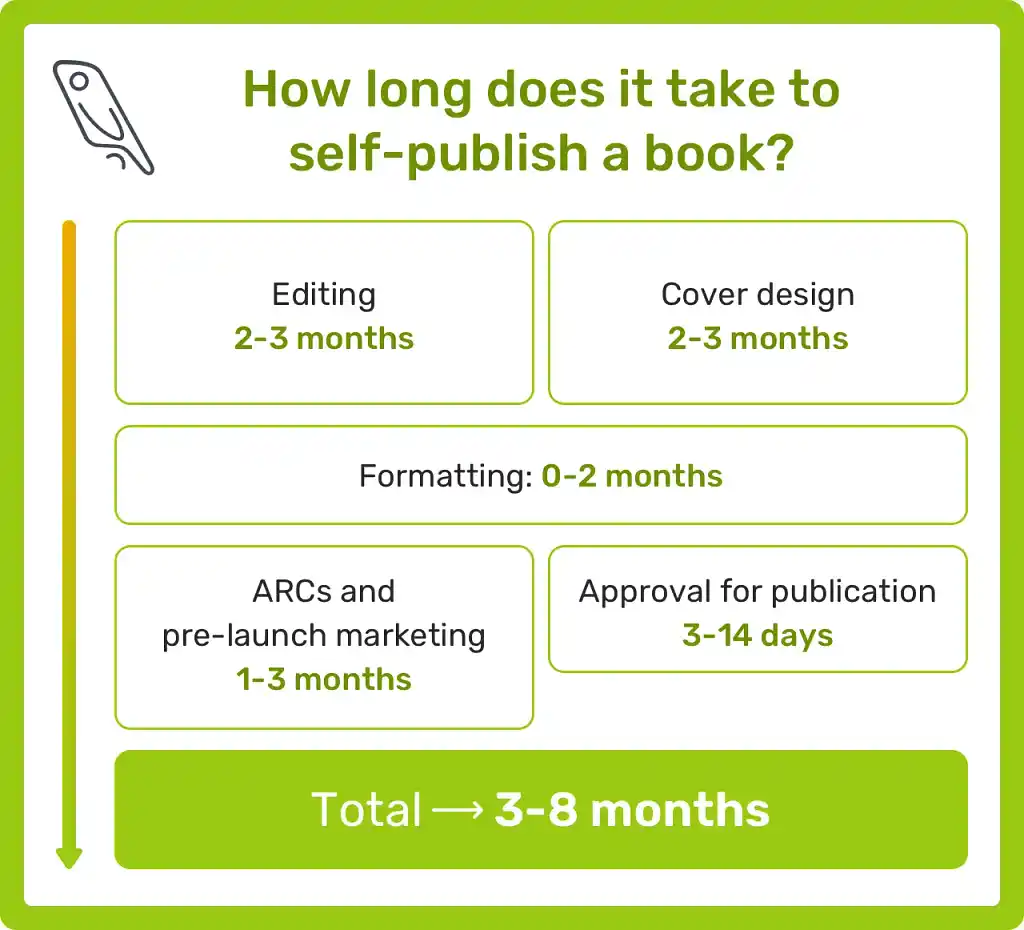
Editing and cover design
2–3 months
Authors who want their books to match the standards of traditionally published titles will, naturally, work with professional editors and cover designers — just like publishers do. Indie authors are often tempted to design their own covers using Canva and the like, but unless they have a specific background in book cover design, the best results will come from working with a professional designer who knows exactly how to attract the right readers. (It’s more complicated than it sounds!)
Some authors find that a copy edit is enough, while others also choose to get a developmental edit, which naturally adds time.
On the Reedsy marketplace, the average length of time from an editor accepting a project to delivering it is 57 days (just under two months). They’re not editing the book that whole time, but busy schedules mean you’ll need to book them in in advance. For designers, the average turnaround is 66 days (just over two months).
The good news is that these stages can overlap: cover design and copy editing can happen at the same time. If you’re working to a tight deadline, some freelancers can push you up in their schedule — though usually at a premium.
Q: What type of editing is essential for self-published authors to ensure the quality and professionalism of their book?
Suggested answer

I like thinking about the different editorial processes in terms of how a house might get built. So a developmental edit is really going into the essentials: getting the foundations right, doing the electrical wiring, laying the bricks, building the house. A copy-edit would be about making the house liveable: installing the kitchen, carpets, blinds, the wallpaper. The proofread would be when everything is in place and you want to do a final deep clean, vacuum, sweep.
I think it really depends on the author and their strengths, but authors work so hard and so long on their books that I think it's almost impossible for them to do the final two stages - copy-edit and proofread - with any kind of objectivity. They've seen those words on the page so many times. A fresh pair of eyes here is invaluable.
Thalia is available to hire on Reedsy

Every self-published book needs at least two types of editing: copyediting and proofreading. These are non-negotiable.
Copyediting catches grammar, punctuation, spelling, and consistency errors. It's widely considered "the most important professional editing layer" for indie authors. Proofreading is your final safety net, catching typos and formatting glitches in the finished layout before you hit publish.
But if your budget allows, developmental editing should come first. It's the big-picture pass. Plot structure, pacing, character arcs, argument flow. You can have perfect grammar and still publish a book that doesn't work. A developmental edit fixes the big stuff before you start to fix the little stuff.
The ideal sequence is: developmental → copyediting → proofreading. If money's tight, at bare minimum get a copyedit and a proofread. Skipping editing altogether is the fastest path to one-star reviews mentioning countless typos, and those reviews will follow your book forever.
Bottom line: professional editing is the single best investment a self-published author can make. Don't skip it.
Rob is available to hire on Reedsy
Formatting
0–2 months
After editing, your book will need to be formatted to a professional standard. For most authors, this can be quick and free: using Reedsy Studio, you can produce professional-looking ebooks and print files in less than a day.
Some books are tricker, however. Children’s books and books with lots of complex graphs or images may require specialist software or an interior layout designer. This could add another 2 months to your publishing timeline, but authors consistently tell us the professional touch is more than worth it.
ARCs and pre-launch marketing
1–3 months
After formatting, you’d be forgiven for thinking it’s time to publish. But wait! The most successful indie authors know that marketing starts long before publication. After all, traditional publishing houses start promoting new releases a full year in advance.
You can start a lot of the pre-launch marketing (author website, newsletter, social media posts, pre-orders) while you’re still editing or designing your cover. But there must be some pause between finalizing your book and releasing it. Why? Because that’s when you send out advance reader copies (ARCs).
ARC readers provide early honest reviews: the social proof you need to turn browsers into buyers on your chosen retail platform(s). Plus, if you send copies to book bloggers/vloggers, they can introduce your book to their existing audiences. Thirdly, you can secure an editorial review to quote on your cover or in your ads.
For nonfiction authors, ARCs should go to respected voices in your book’s field. Quotes from these people will help establish your authority on the topic.
We recommend setting aside at least a month for this stage, so small delays won’t derail your launch.
Approval for publication
3–14 days
Speaking of things that can derail your launch: don’t upload your book on your release date. It won’t be published instantly, and approval can take days, if not weeks. Instead, create your book's listing early and set a future release date, enabling pre-orders. (Side note: pre-orders can really help to “juice” retailer algorithms on your launch week, so remind your friends and followers to get in early.)
On Amazon KDP, you can upload your final files any time from one year to 72 hours before your release date. On Draft2Digital, you can add your files up until 10 days before. You might as well upload your book as soon as it’s finished, allowing the approval process to take place while you wait on ARC readers and continue your marketing efforts.
Q: What are the key elements authors must get right when setting up their book pages on Amazon or other retail platforms?
Suggested answer

Book Cover
I'm aesthetically blind, but I still have a couple of valid criteria - readability and fitting a genre. On Amazon, your book cover is your business card. People need to get what it is about with just a single glance. Don't try to be smart, try to be clear.
In non-fiction, it usually means a huge title that can be read in a thumbnail size. In fiction, it is a big image that screams the right genre (think dragons for fantasy, starships for SF).
Book Title (and subtitle)
In case of fiction, the title may be catchy and cryptic, but it needs to be short. Often, it is just an article and a single word.
In case of non-fiction, you'd better spell out in capital letters what your book is about.
For all books, subtitles are a great place to stuff in some keywords ("a medieval historical novel").
Book Description
Your book description is your sales page on Amazon.
It is not a synopsis, God forbid!
For fiction, think Hollywood movie trailers - something that reveals hints of the movie, but its main objective is to get the attention.
For nonfiction, spell out the features and benefits, but in a way that pique curiosity (“The undervalued habit that everyone can practice and tune into their self-talk (would you believe it can create new brain cells?!)”.
Emphasize your credentials in book's subject matter.
Format your description properly. Have a clear headline - the first short line (think: blog posts titles) that is separated from the rest of the blurb's text. And don't scare a reader with "the big wall of text." This is Internet! Nobody reads huge paragraphs anymore.
Keywords
On Amazon, you have seven fields with 50 characters.
Use five of those to brim. Why? Because the interface doesn't reflect the mechanics of Amazon keyword system. Those "seven fields" are actually a one huge tag cloud. Any word from one field can be connected to any word from another field.
Use one field to give the clear 'elevator pitch' for a book ("military space marines book”).
Use the word 'book' in this field. It will connect with all the other words in your keyword tag cloud.
Use the last field trying to indicate the category your book fits best.
Categories
12 years ago, it was a good idea to hit some niche category, so you could easily claim the bestseller status. Not anymore. Relevancy is the key. If your book is fiction, don't put it in obscure non-fiction categories (and vice versa).
The more specific you can get, the better for your positioning and algorithm's understanding of your book, e.g. Romance ->Historical Romance ->Scottish.
Bonus: Pricing
Don't price your 100-page novella eBook at $9.99.
If you have a fiction series, price the volume #1 lower. It is your lead magnet, if readers like it, they will buy next volumes at higher prices.
Michal is available to hire on Reedsy

Your book cover is the first thing readers notice, and it has to grab their attention right away. But here’s the thing: your cover gets them to click, but it’s your description that actually convinces them to buy.
A great book description needs to spark curiosity, set clear expectations, and connect with readers emotionally. If it doesn’t make them feel like they need to read your book, they’ll move on to something else.
Other details, like editorial reviews, awards, or even strong reader reviews, can help seal the deal, but the description is where it all happens. Think of your cover as the invitation—it gets readers to the party. Your description? That’s the host that keeps them there and makes sure they have a great time.
Jd is available to hire on Reedsy

I find that the most overlooked component of an Amazon book page is consistently the author bio. Of course the cover design and descriptive text are essential, but so too is the About The Author section. Particularly for non-fiction where the prospective reader is seeking confirmation of why you are credible to write on your subject matter. Readers are looking for subject matter experts, and your thought leadership status is what will sell your book. Beyond that, in the age of AI, you need to show that you are a real person. Over an author's career, it is the author that is the brand, not any one book. Show us that your credentials are legitimate, and that you are a worthy authority on whatever you are writing about.
Chris is available to hire on Reedsy
As many of these steps will overlap, most authors can self-publish in 3–6 months (or 5–8 months if you require complex interior design). But there’s no need to rush — a bit of wiggle room in your schedule will reduce stress and protect the quality of your book.
Remember: no two publishing journeys are the same. Don’t compare yourself to others; instead, focus on working steadily towards your own goals. And if you need a little help along the way, check out the rest of our blog or sign up for one of our learning courses.