Blog •
Last updated on Aug 17, 2026
How to Become an Editor in 2026: A Guide for Beginners

Savannah Cordova
Savannah is Editor-in-Chief of the Reedsy Blog. She has 8+ years of experience crafting content about how to write, edit, design, and publish your book as an independent author.
View profile →
Linnea Gradin
Linnea is Editor-in-Chief of Reedsy’s Freelancer Blog, with 6+ years of experience collaborating with experts to create resources on writing, self-publishing, and publishing careers.
View profile →This post was written based on insights from professional Reedsy editors Clem Flanagan, Eli Bortz, and Aja Pollock.
There are many different routes you can take to become an editor, but in general you want to: figure out what you want to edit, build the skills to do it well, get experience, and turn that experience into a steady stream of work. The five steps outlined in this article will walk you through how to realistically do that.
1. Choose your editing specialty
Editing is a broad field, so it helps to narrow down your career path early on in your journey. Knowing the lane you want to work in makes it far easier to pick the right courses, chase the right experience, and connect to the right clients or employers.
To start, you need to make two decisions: what you want to edit and how you’d prefer to work.
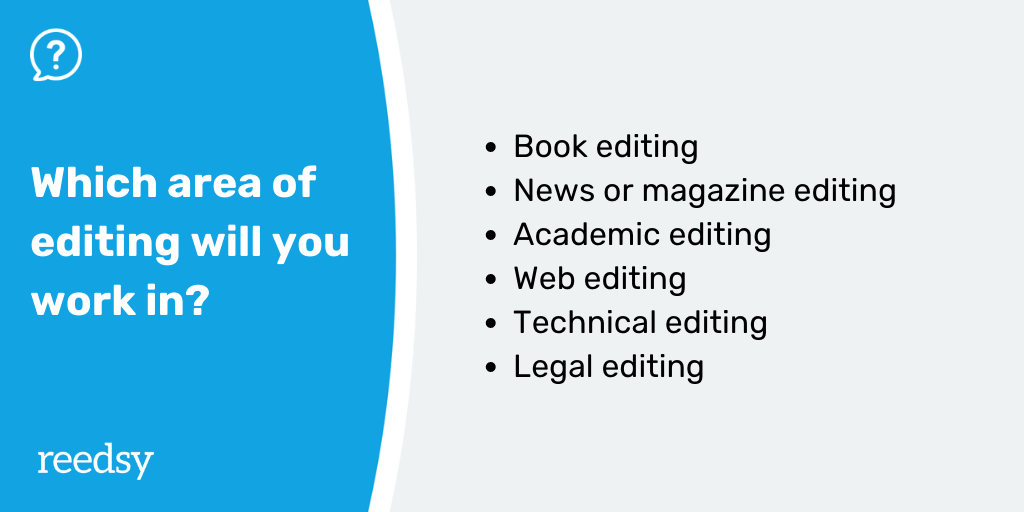
On the "what," these are the six most common types of editing:
- Book editing: Book editors work with authors to revise and shape manuscripts before publication. You can choose to focus on developmental editing for large scale issues like story structure or character development, copy editing for line-by-line style and grammar fixes, or proofreading for that final read-through. For more detail, see our guide to the different types of editing.
- News and magazine editing: In this field, you’ll structurally edit, proofread, fact-check, and commission articles, keeping everything consistent with house style. You can read our guide on becoming a magazine editor for more detail.
- Academic editing: As an academic editor, you’ll work with academic publishers or journals to edit scholarly work for accuracy, rigor, and ethical practice. You may also coordinate peer reviews.
- Web editing: Web editors manage an organization's digital content: writing and editing blog posts, commissioning pieces, and using SEO to grow organic traffic. You may call yourself “content editor” or “content manager.”
- Technical editing: For technical editing, it’s your job to make sure complex, specialist information is accurate and clearly communicated. Subject-matter expertise is often more valued than pure language skills for this field.
- Legal editing: Like technical editors, legal editors ensure the accuracy and compliance of legal texts, sometimes compiling case digests or researching legal issues.
On the "how," you have two broad paths. You can move between them both throughout your career, so just because you start down one route doesn’t mean you can never go the other direction. But, it’s good to understand how they differ:
- In-house: A salaried role at a publisher, magazine, or company. It offers more structure and mentorship, but can be competitive and often concentrated in a few cities.
- Freelance editing: Working with authors and clients directly, setting your own rates and schedule. Freelancing offers more freedom and can be faster to start, but you have to train yourself and build your own client base. This is where a marketplace like Reedsy comes in later, at step 5.
Whichever you choose, the next step is the same: build the skills.
Q: How did you find your niche in editing?
Suggested answer
I started my own publishing house back in 2015 when ebooks were making a name for themselves. I had also published my first novel with a different publishing house right when 50 Shades of Grey came out, but my book fell into a black hole, so I didn't get noticed. Once I opened up my own place, I decided to provide a home for books that didn't cross into erotica, but still had spice and encapsulated what the romance industry was about.
I did that for 15 years and now, while my specialty is to help authors with "clean" books, I edit all genres and all levels of heat. I can still appreciate those, too! Remember, specialty doesn't always mean 100% preference.
Stephanie is available to hire on Reedsy

I worked in fashion and women's lifestyle magazines for many years as a writer, an editor, a consultant and an editor-in-chief. That means I've written or overseen hundreds of stories in the lifestyle space and I've had to be very creative about making each one of them unique. As a reader I love smart, entertaining lifestyle writing, so I work hard to make my work as a ghostwriter meet those standards.
Ceri is available to hire on Reedsy
2. Build your skills, with or without a degree
Let's address the question every aspiring editor asks: do you need a degree to become an editor?
The short answer is no. A degree in English, journalism, or a related humanities subject can help your CV stand out, and if you can afford and commit to one it'll provide a solid foundation. But it is not the be-all and end-all of making a career in publishing, and plenty of successful editors don't have one.
Out of ten Reedsy editors we selected at random, six of them majored in Literature, one of them majored in journalism, one of them majored in medieval culture, one of them majored in history, political science, and journalism, and one of them majored in modern English studies. In other words, while most had a humanities background, none of them had a specific degree in editing or publishing.
If a degree isn't in the cards right now, don't fret. Many editors build their skills through short-term courses and certifications. Reedsy editor Aja Pollock, who has taken courses in copy editing, proofreading, and developmental editing, recommends them to anyone starting out:
"The foundational courses I took were all very helpful. They allowed me to develop a consistent process for each type of editorial work, and understand the expectations for each role and how it fit into the larger process of book publishing."
And if a course isn't an option either, hands-on practice is its own education. Reedsy editor Eli Bortz, who studied history, political science, and journalism, believes practical experience "beats any course or lecture you could ever attend." Sitting down with books on your bookshelf and breaking them down chapter by chapter or offering to beta read for cheap allows you to build a deep understanding of the mechanics of good story writing. Joining a critique circle to give and receive critique on your own writing can also help you in ways that a theoretical course never could.
The truth is, even with a stack of degrees, you may struggle to get clients or a staff role if you've never edited a full manuscript. It comes down to experience and a proven track record, so let's look at how to build just that.
3. Gain experience through internships and freelancing
There are two main ways to get your first real editing experience.
The in-house route: internships and entry-level roles
In an ideal world, you'd land an entry-level position that lets you learn on the job straight out of university. However, these roles are competitive and usually expect some prior engagement with editing or writing, so relevant extracurriculars (student reporter, campus editor) help.
To find openings, check Indeed, LinkedIn, and your college job portal if you're a recent graduate. Managing editors and publishers also post vacancies and networking events on social media or the publishing house’s own website constantly, so it pays to follow the right people.
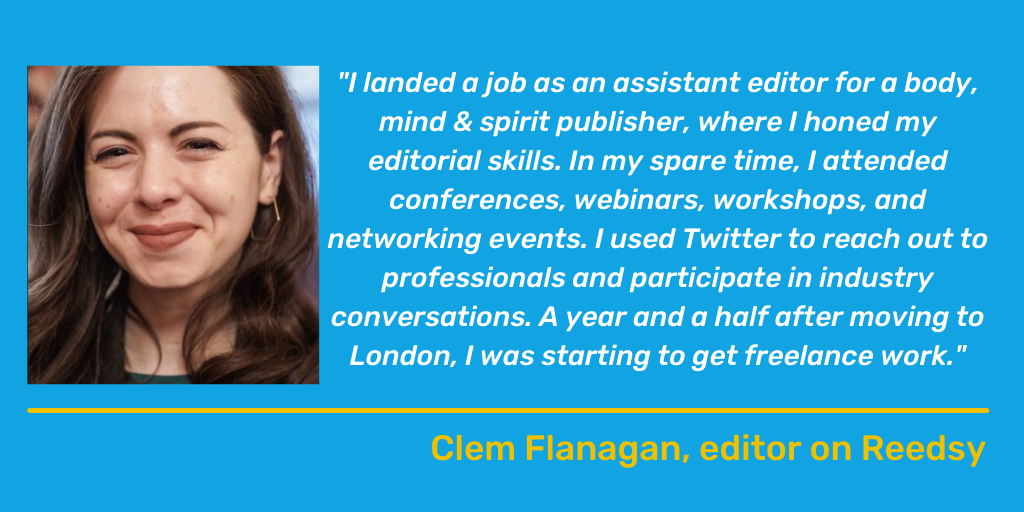
If you can’t find paid entry-level positions as an editorial assistant, unpaid or partially paid internships are how most editors get their start.
Reedsy editor Matt B. describes just how non-linear breaking in can be:
Q: How did you secure your first editorial assistant role, and what was the most challenging part of breaking into the industry?
Suggested answer

I finally got my start in editing and publishing through a lot of luck and a lot of determination. One of the hardest things about editing is that it is a very small community, and many of the roles are granted by knowing the right people or being in the right place at the right time.
I knew that it would be difficult to break into, so I applied to every internship and entry level position I could find when I was starting my career. That eventually landed me a role at a high school textbook publishing company, where I started as a Marketing Intern. Once you have your foot in the door, you have to do everything you can to become essential. I stayed in that role for almost 9 months before a role within the company finally opened up and I became an Editorial Assistant.
The toughest part of breaking in is the diligence. There are so few open entry level positions and SO many applicants that it can really feel like a fruitless endeavor. But there are ways in, and if you're struggling to get a position at your favorite genre publisher, then maybe you can look to different tracks and find other ways into editing. I'm not saying you need to follow my lead of working for textbooks or in marketing departments, but there is quite a bit more to publishing than just editorial.
Matt is available to hire on Reedsy
The freelance route: paid gigs from day one
If you can't find (or can't afford to take) an internship, you can start a freelance editing business and look for short-term gigs on freelancing sites. You might have to take work that doesn't thrill you at first, copy editing blogs or academic essays rather than the developmental book work you're aiming for, and that's fine as long as you learn and grow from it. Freelance gigs let you work with real authors and clients, sharpen your process, and build a portfolio you can show, all without waiting for a paid staff role to open up.
Both routes produce the same two things you need to take the next step: samples and a network.
JOIN OUR NETWORK
Supercharge your freelance career
Find projects, set your own rates, and get free resources for growing your business.
4. Build your portfolio and professional network
As you accumulate experience, you need to start thinking about the quality of the work in your portfolio, as well as building a solid network.
Your portfolio is your proof that you can do the job. For freelance work especially, clients want to see before-and-after samples, the types of editing you offer, and the genres or subjects you handle. It doesn’t hurt if you also have some well-known names — of publishers, editors, or authors — in that portfolio. Regardless, keep a running record of projects you're proud of (with permission to share where needed), and treat every gig as a potential portfolio piece.
Your network is how you’ll continue to find gigs or employment. From literary agents and journalists to academics and fellow editors, you'll naturally start to accrue contacts as you go. The editing world is small, and most editors are happy to refer writers to fellow professionals who are more experienced in a specific genre or looking for gigs. Authors also recommend editors to their writer friends constantly. Never underestimate word of mouth.
The way you build that network is simple: be a decent person to work with. Respond to requests politely even when you decline. Introduce people who might like to work together, recommend colleagues to authors, and (once you’ve gained more experience) treat your juniors with the same grace and patience you wish you had received when you first started out.
5. Land steady work as a staff or freelance editor
Once you’ve accrued enough experience and a wide network, it’s up to you to create the type of career that best suits you.
If you see yourself as an in-house editor in the long term, keep your eyes open for the next rung on the career ladder. Read job descriptions for editorial roles within and beyond your niche, and note down requirements like specialist software or emerging trends so you can work on those skills in your current role. Careers rarely move in a straight line: an editorial assistant on a magazine's lifestyle desk might move into nonfiction book publishing through a health or food imprint. If you're happy in your niche, the ladder-climbing begins from assistant editor up to senior and commissioning roles, but don’t be afraid to take a detour if needed.
🤓 Curious about how much money an editor makes? Head to this post on editor salaries for more information.
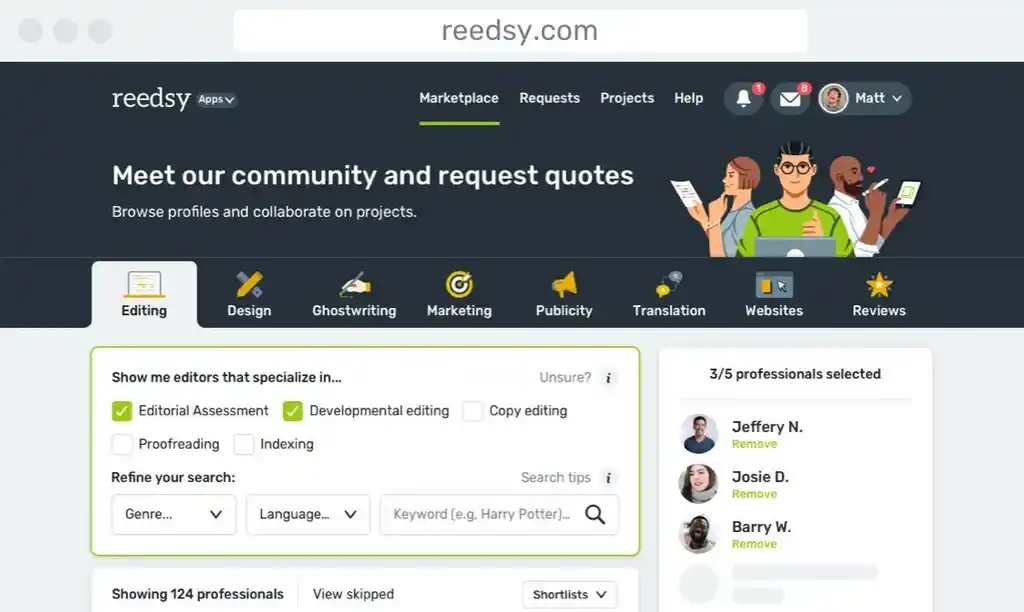
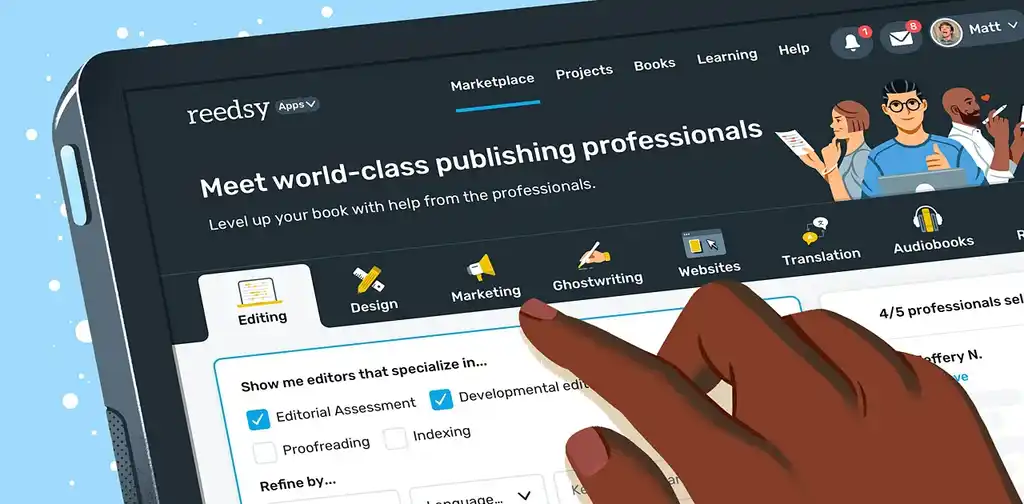
If you're going freelance, this is the point where you turn scattered gigs into a steady stream of returning clients or jobs in the same genre. If you haven’t already, start narrowing down the type of jobs you take on to the things that truly inspire you, and start charging for the expertise you have in that niche. Find gigs that align with your ambitions by joining a curated marketplace like Reedsy.
Ready to work with authors on Reedsy? Create a free Reedsy profile to start receiving project requests from authors. Get started here.
Down the line, a project you edited might top a bestseller list or win a major prize. If you've always wanted to make your mark in the cultural zeitgeist, becoming an editor is a rewarding way to do it.