Guides • Perfecting your Craft
Posted on Nov 10, 2025
24 Memoir Examples to Inspire Your Own

Loretta Bushell
Loretta is a writer at Reedsy who covers all things craft and publishing. A German-to-English translator, she specializes in content about literary translation and making a living as a freelancer.
View profile →Everyone has a story to tell. In fact, most people have multiple stories to tell, so choosing the focus and structure of your memoir is not always a straightforward task. While there are plenty of guides on how to write a memoir, sometimes it's easier to draw inspiration from real-life examples.
To that end, we’ll look at 24 successful memoirs from the past five years, divided broadly into eight types (though some books arguably cross multiple categories).
Let’s dive in.
 Click to tweet!
The autobiographical memoir
What’s the difference between an autobiography and a memoir? Both tell the author’s life story, but an autobiography is very factual and covers the writer’s entire life to date in chronological order, while a memoir reads more like a story, includes reflection and emotion, and zooms in on particular slices of life.
Q: How might authors start an autobiography with a compelling hook?
Suggested answer


First, the autobiography should have a plot and a sense of the author changing over time as a good character would in a successful novel. And the core idea of that plot can be revealed from the earliest pages.
Not "I was born in Philadelphia in the spring of 1961."
But "I was born at Albert Einstein Hospital in Philadelphia the day Alan Shepard blasted off to become the first American in space, and I was named for him and John Glenn."
Both of these are potential openers for the autobiography of my husband, Glenn Alan, who became a physics professor and a space enthusiast.
Another effective opening can be a description of the time and place and family into which you were born or first experienced something appropriate for the plot line of the autobiography--when your lisp shamed you in first grade or when your life really began as you escaped your abusive home at sixteen.
And like the prologue of a novel, your opening scene could be a significant event from your adulthood, even very recent, with the rest of the autobiography then backtracking to earlier days.
Ask yourself if there's a scene from your life that sums up everything that led to a crucial decision, or when you finally basked in the glory you'd earned through much hardship and hard work. Consider pausing that scene at a crucial moment and then returning to it as the culmination of the autobiography as it closes.
Cindy is available to hire on Reedsy ⏺

Instead of beginning at the beginning, i.e. starting straight off with your childhood and parents etc., an interesting way to start is by describing a key event or experience in your life, and relating that directly or indirectly to your overall story. Then you can proceed to the usual chronological order of things.
This is quite a common approach used in recent decades for famous people's autobiographies. It grabs the reader's attention and encourages them to read further.
John is available to hire on Reedsy ⏺

I always tell my memoir authors that the most important water a memoir opening has to carry is to launch a charm offensive. Make friends with the reader. Make them laugh, make them sigh, make them cry, or gasp with surprise. Go for hearts and minds. Work the room. Establish trust. Be vulnerable, honest and generous. Be funny at your own expense.
A lot of editors and ghosts like to choose a climax scene to begin an autobiography. They will find a moment when lots of stuff is happening- - the storm clouds gather, the city explodes, the battle is won or lost, or the sun breaks through after a terrible storm. Then, they will jump back to the beginning of the story, and place that scene in context, explaining how we wound up in such a consequential and incendiary situation.
I myself think that voice and relationship building, and beautiful writing is more important than action in a memoir. Action is important, but it's secondary to voice and reflection. Proust wrote an entire autobiography about eating a Madeleine tea cake. And it wasn't a short book. So every story is different, and will open in a way that is organic to itself, but there are some good rules I've developed over the course of a lifetime crafting memoir, that I thought might be helpful to memoirists learning to master their craft.
7 Tips for a Dynamic Memoir Opening
- Explode on to the scene with action already in progress. Don't introduce or preface, just cannonball it right into the middle of the pool.
- Develop a personal, and conversational voice. The reader should feel like you are speaking right to them. Words should come up off the page, and soar straight into the heart or the gut
- Be vunerable and radically transparent, but always hold a litte something back. Maintain mystery.
- Set the scene. Ambient detail is critical in memoir opens. Where are you? What does it look like, smell like? feel like? What is the weather outside? How is the room furnished? Who else is there? Build a fully dimensional world so your reader can move right in.
- Make your big idea clear right at the top. Why should they read your story? What are they going to get out of this book? What is the ROI? What do you intend to teach them, and why?
- Weigh every word. Memoir is the most voice-driven of all nonfiction genres, and good style is critical. Avoid formality, but write evocatively, beautifully be funny, moving, poetic, enlightening, and aspirational. Find universally human lessons of your experience, and share those with the language they deserve.
- Write in real time. Let the action unfold as you lived it, so the reader can live it too. One of the great gifts of memoir is giving you the chance to live your past over again, only this time, with the benefit of hindsight.
Happy Writing
Bev is available to hire on Reedsy ⏺
To add to the confusion, there is such a thing as an autobiographical memoir. This has the reflective tone of an autobiography, but has a broad scope, narrating an author’s entire life (though not necessarily in chronological order).
Let’s look at some examples.
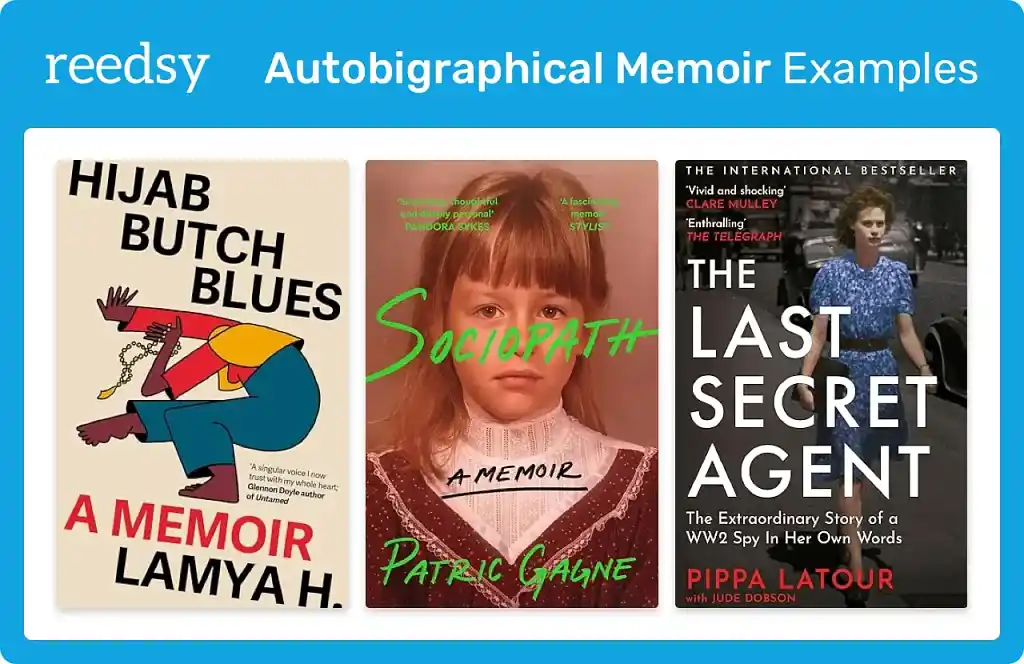
Hijab Butch Blues by Lamya H.
A queer, nonbinary, hijabi Muslim and immigrant, Lamya H. hasn’t just led an interesting life; she also has a lot to say on identity, faith, and self-acceptance. Hijab Butch Blues is structured thematically around lessons from the Quran and her deep insights are complemented by a fierce humor.
Sociopath by Patric Gagne
Sociopath: A Memoir gives readers a fascinating glance into life as a diagnosed sociopath that extends beyond the facts. As Patric Gagne talks about the nothingness she felt as a child and the realization she eventually had that she could love and be loved, she sends a clear message of hope: sociopaths aren’t all monsters and can in fact lead fairly normal lives.
The Last Secret Agent by Pippa Latour with Jude Dobson
Pippa Latour was the last surviving UK Special Operations Executive, and the only female agent to have written her story down. The Last Secret Agent: The Extraordinary Story of a WW2 Spy in Her Own Words is her autobiographical memoir, in which she shares her unusual childhood and extraordinary adulthood. Rather than a purely factual account, Latour’s memoir is emotionally driven, reflective, and at times suspenseful.
Hire an editor for your memoir

Eugenia N.
Available to hire
Editor and proofreader specializing in new age topics, memoir, and fiction. Versatile, sensitive, and progressive.

Rennie D.
Available to hire
USA Today bestselling author, passionate editor & collaborator; 18 years of experience in fiction & non-fiction for kids and adults

Penny S.
Available to hire
Deputy Chief Editor then Director of the Oxford English Dictionary; 23 years at the OUP. Now editing texts for a wide range of authors.
The “experience” memoir
One of the most popular subgenres of memoir is the “experience” memoir, which focuses on a specific experience that the author has gone through. Typically, this will be a negative ordeal, such as a bitter divorce, illness, or clash with addiction, but a more positive focus is also possible.
Regardless of the situation, the writer shares what they’ve learned from the experience and how it has shaped who they are today.
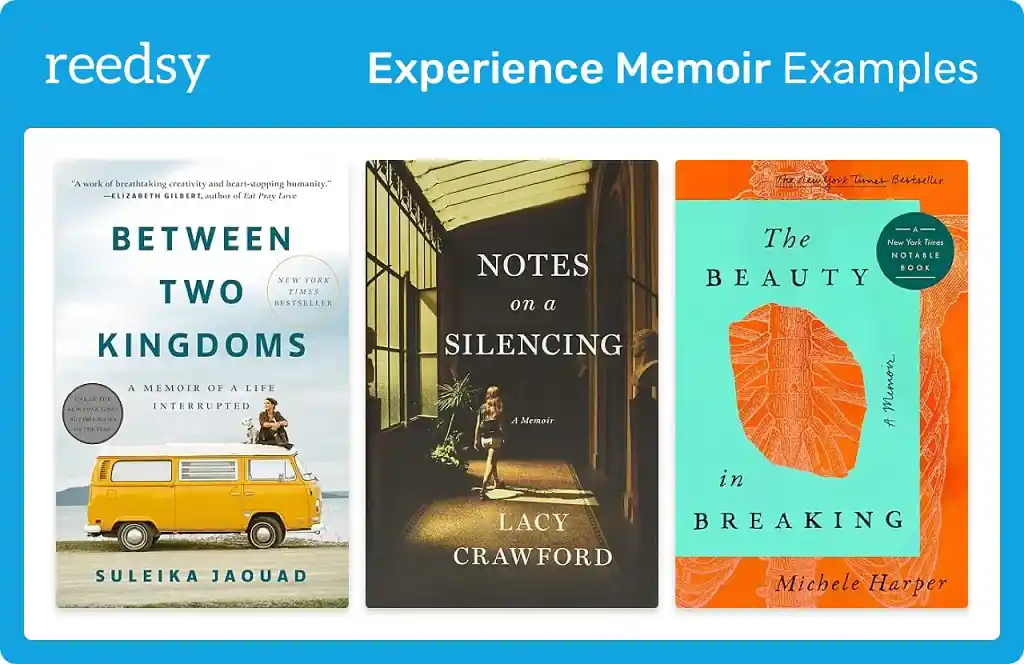
Between Two Kingdoms by Suleika Jaouad
Suleika Jaouad’s experience is of battling and recovering from cancer. Specifically, she reflects that when she walked out of the ward, she had been struggling to survive for so long that she no longer knew how to live. Between Two Kingdoms chronicles her 100-day road trip to meet the strangers who had written to her in hospital, and presents her musings on life as she re-enters the world of the healthy.
Notes on a Silencing by Lacy Crawford
Lacy Crawford attended a prestigious boarding school in New England, where she was sexually assaulted by two fellow pupils. In Notes on a Silencing, she finally gets to speak up about the traumatic experience, the impact it has had on her life, and the school’s previous efforts to silence her to protect its own reputation.
The Beauty in Breaking by Michele Harper
The Beauty in Breaking centers around an experience that is not inherently bad. A female, African American emergency room physician, Michele Harper reflects on her life as a doctor and how dedicating herself to the service of others has helped her heal her own wounds.
Q: What do agents and publishers look for in memoirs written by non-famous authors?
Suggested answer

When I vet memoir submissions, I'm looking for writers who pay close attention to scene-building. When did this event occur? Who was there? What are some accompanying sensory details? On the flipside, sometimes memoirs don't succeed because information is presented without being tethered to a scene or a narrative. If you're writing about your life as an amateur foosball player, that could be a compelling memoir! But it's a tough pill to swallow when readers encounter 10 pages of foosball history if there isn't an occasion for that material. Better, I think, to spin a yarn, then insert enriching backstory material insofar as the narrative-- and the scene-- requires it.
Kevin is available to hire on Reedsy ⏺

"Memoir is difficult." "Memoir is a hard market." "Publishers aren't buying memoir." You don't have to dig far to find these discussions in publishing spaces because, as in every genre, agents and publishers can only take on books that they think they can sell. So a memoir by a non-famous author needs to have a powerful and unusual story to tell and/or to tell a story that is common to many people in an effective way. There's an element of luck, too – the memoir you've worked on for years may just happen to chime with something that's happening in the zeitgeist.
Susanna is available to hire on Reedsy ⏺

Two words: strong brand. But what is a strong brand? It can mean many things for a non-famous author, including a large platform. Yes publishers and agents will skip through a book proposal to see how many followers the author has on social media. But other factors can tilt the scales in your direction. Do you have famous connections? Would the book be endorsed, or a foreword written by, a famous person. Bottom line, authors must overcome the obstacle of relative obscurity with solid reasons what an agent or publisher should take on the book.
Mike is available to hire on Reedsy ⏺
Authenticity, personality, and a strong voice that can tell you a story that has something to teach us all
Bev is available to hire on Reedsy ⏺
The “event” memoir
The “event” memoir is very similar to the “experience” memoir. However, there is one key difference: while an “experience” memoir might span years or even decades, an “event” memoir zeroes in on a clearly defined period of time — from a few minutes to a few months or years.
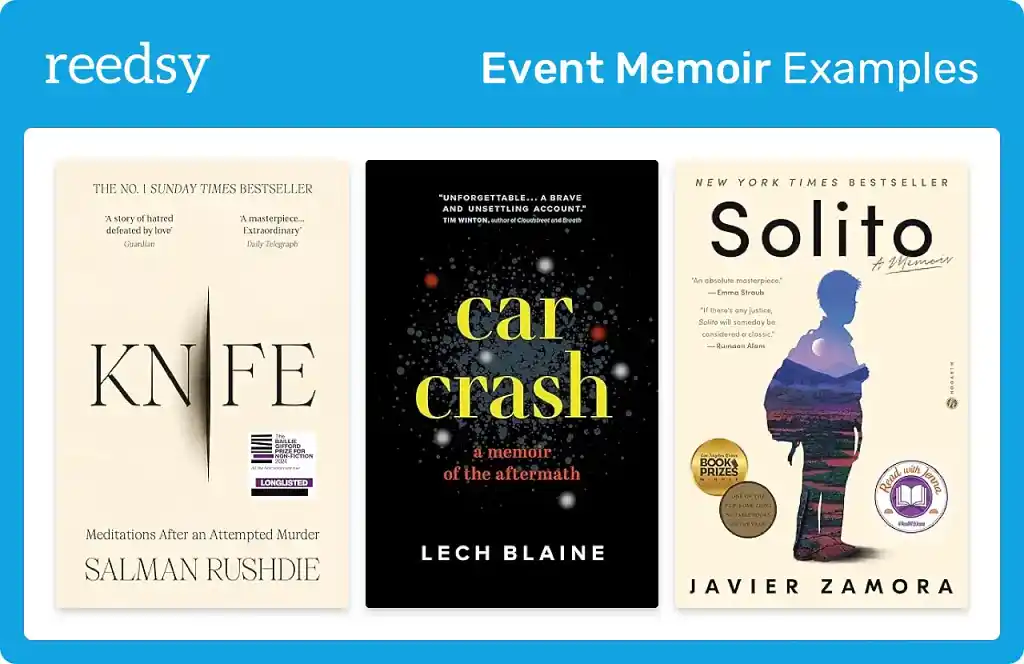
Knife by Salman Rushdie
On 12th August 2022, writer Salman Rushdie was stabbed onstage while preparing to deliver a lecture in New York. Nearly three years later, he opens up about the traumatic event and its aftermath in Knife: Meditations After an Attempted Murder.
Car Crash by Lech Blaine
As a teenager, Lech Blaine was in a car crash that killed three of his friends and left two others in a coma. The only passenger to escape unscathed, Blaine had to cope with grief, survivor’s guilt, and a whole host of unwanted attention. Car Crash: A Memoir of the Aftermath details Blaine’s experience of surviving a traumatic event in a society in which men are expected to be strong and silent.
Solito by Javier Zamora
At 9 years old, Javier Zamora embarked on a two-month journey from El Salvador to the United States, travelling alone amid a group of strangers. Solito: A Memoir recounts the many obstacles he faced, as well as miraculous kindness delivered at the most unexpected moments.
The “themed” memoir
The “themed” memoir can span the author’s entire life or any subsection of it. However, the story is told through the lens of a single theme: something that has been a constant at every turning point in the writer’s life or has driven all the decisions they’ve made.
The theme can be a tangible, such as football or food, or an abstract concept like belonging or grief.
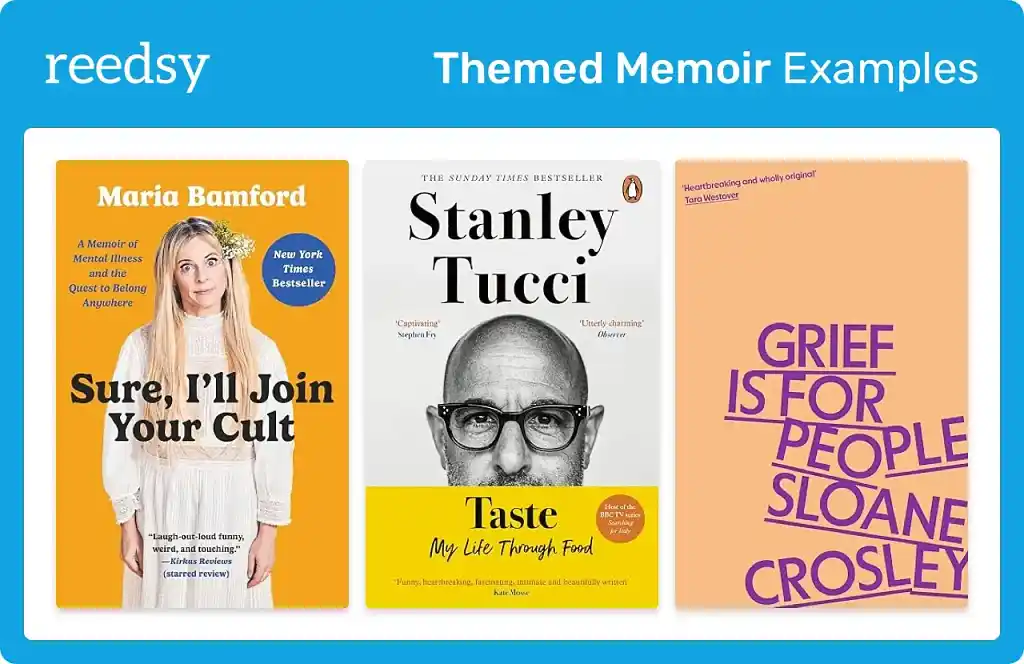
Sure, I'll Join Your Cult by Maria Bamford
Sure, I'll Join Your Cult: A Memoir of Mental Illness and the Quest to Belong Anywhere has an abstract theme. As the title suggests, outsider and comedian Maria Bramford looks back on her life as a continuous quest to belong. She returns again and again to her struggle to be a part of the world, as well as her struggle to even want to be.
Taste: My Life Through Food by Stanley Tucci
Famous actor and foodie Stanely Tucci presents the story of his life through a more tangible constant: mealtimes. Taste: My Life Through Food covers growing up, falling in love, and raising children — all around the dinner table. The memoir is a true celebration of a home-cooked meal.
Grief is for People by Sloane Crosley
Our third example takes us back to the abstract: grief. Sloane Crosley’s closest friend took his own life in 2019. An Oprah Pick of the Year 2024, Grief is for People: A Memoir tackles the topic of loss in all its different forms, while still managing to express a verve for life.
Q: What research should memoir writers conduct to ensure accuracy and depth before starting their first draft?
Suggested answer

When it comes to memoir, I think the most important thing to remember is, as obvious as it might sound, that the life of my client is the primary source.
That said, everyone's memory is slippery-we recall moments through the filter of emotion, later experience, and even family stories that may have become wildly embellished over the years. So, before I start drafting, I like to ground myself in two kinds of research: personal verification and contextual enrichment.
On the personal side, that might mean digging out old diaries, letters, emails, or even photographs. These aren’t just memory prompts; they help pin down details like dates, places, and the texture of a moment.
Talking to family or friends who shared an experience can also provide perspective. Sometimes they’ll remember things differently, which doesn’t have to undermine your story but can add depth and nuance.
On the contextual side, I’ll often research what was happening more widely at the time. What music was playing on the radio? What political or social events were unfolding in the background? Even small things, the price of a bus ticket, the football results that weekend, can enrich a scene and anchor it in time as well as act as a wonderful prompt or reminder.
In short, memoir research is less about becoming an 'archivist' of someones life (which makes it seem very technical anyway, which is not what you want at all) and more about giving yourself the tools to write with honesty, clarity, and texture. The aim isn’t to eliminate subjectivity (memoir thrives on it), but to make sure the shared recollections are as vivid and trustworthy as they can be-you will, with this in mind, notice what might best be called a 'disclaimer' in some memoirs which openly admit to how some stories may not be quite as they were at the time, else two or three characters known to the author have been combined into one.
As a ghostwriter, I carry out this same process alongside my clients: helping them test their memories against records, conversations, and cultural backdrops. That way, when we arrive at the first draft, we’re building not just on memory but on memory enriched — a story that feels authentic to the writer and alive to the reader.
Edward is available to hire on Reedsy ⏺

A memoir needs to be ghostwritten as the author themselves would write it, if they could. Further research shouldn't be necessary, unless there are facts that the author asks the ghost to confirm. If you start talking to other people you risk losing the author's own voice.
Andrew is available to hire on Reedsy ⏺

Memoir writers have to get to know the facts and the emotional details of their story. These can be dates, places, and events to verify that they are accurate in their facts, but also background—historical, cultural, or societal—applied to their life. Interviewing family and friends, or even witnesses, can fill in gaps and provide different perspectives. Again using journals, letters, or photos gets to authentic details and emotions. Writers also need to read similar memoirs to get information regarding narrative and pacing. It's not about simple factfulness, but resonance, infusing recollection with depth to the point that the narrative speaks meaningfully to humans.
John is available to hire on Reedsy ⏺
The family memoir
Some of the above memoirs have already touched on family relationships, a theme so important that it gets its own subgenre.
In a family memoir, the author acts as a mirror that re-focuses some of the light onto their family members, offering glimpses into the dysfunctional dynamics of a broken family or the incredible power of a close family bond.
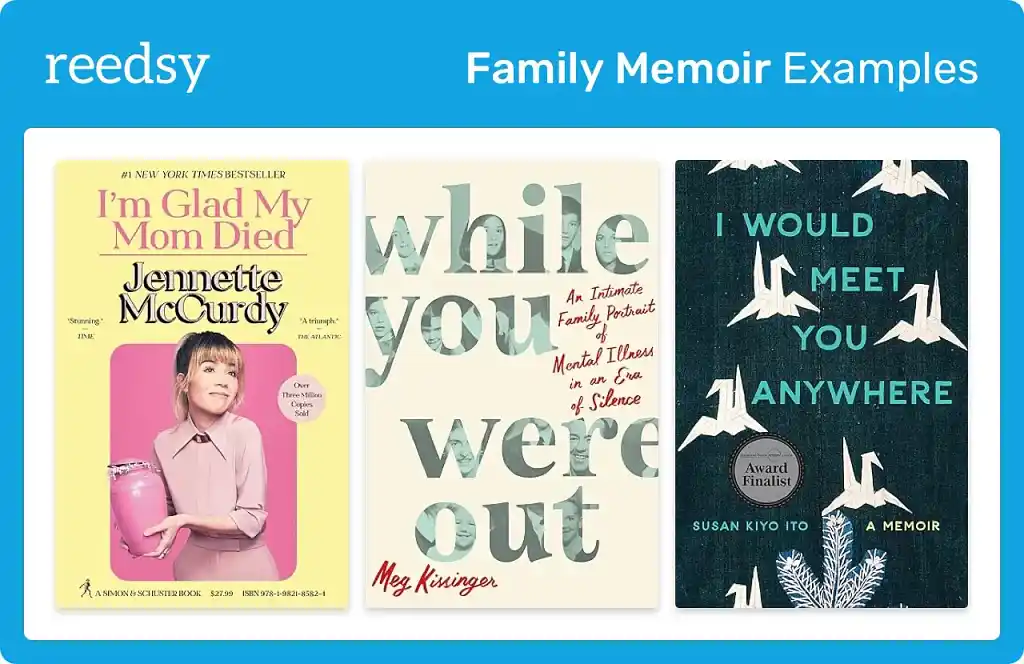
I’m Glad My Mom Died by Jennette McCurdy
Jennette McCurdy was a child star known for iCarly and Sam & Cat — but she never wanted to be. In I’m Glad My Mom Died, McCurdy opens up about her relationship with her abusive mother, whose dream she was making come true at the expense of her own wellbeing.
While You Were Out by Meg Kissinger
In While You Were Out, journalist Meg Kissinger shares her family’s severe struggles with mental health and exposes the system that failed to help them.
I Would Meet You Anywhere by Susan Kiyo Ito
Raised by adoptive nisei parents, Susan Kiyo Ito found her birth mother in her early twenties. Her touching memoir, I Would Meet You Anywhere, explores their relationship as they navigate the line between her birth mother’s desire for anonymity and Ito’s need to understand her origins.
Q: What advice do you have for first-time memoir writers?
Suggested answer

Can you ID one facet of your life that reflects a broader societal issue? If so, utilize that to transform your personal tale -- which might only interest a narrow demographic -- into a book with wider marketing appeal. (My fellow journalists call it a "news peg.") I handled Developmental Editing for a TV sports producer who achieved success in many aspects of the industry. But I urged him to use his memoir's subtitle to spotlight his experience with gender-equity issues. This helped push his book to being an Amazon #1 national bestseller. So milk your subtitle for all it's worth.
Joseph is available to hire on Reedsy ⏺
Listen carefully and ask all the questions that you think the eventual readers would ask.
Andrew is available to hire on Reedsy ⏺

In writing your memoir, my best advice for first steps is to zoom out and look at the end result as a "product." That's tough to do, especially with your life story. But if you start with a blank screen, the writing/drafting process can become overwhelming. Instead, create an outline that shows the chapters, and what stories/takeaways you want to share, and in what order. Don't do any "writing" at this stage, take on the role of architect, and develop a detailed plan for your book. When new ideas come, and they will, simply place them in the appropriate chapter for later expansion. Bonus tip: Use your voice recorder on your phone to talk out your book, then transcribe with free tools.
Michael is available to hire on Reedsy ⏺

1) Memoir is a story and needs a plot and an arc just as any story does. The main character—in this case, you—needs to go through some sort of transformation, preferably some kind of growth or process of discovery.
2) Choose a theme rather than trying to tell your whole life story. You might begin by sketching out everything you can remember, and in the process you will likely discover some themes that pop up. Choose a theme that is clearly something universal or that a certain audience is sure to receive value from or find compelling, then find those stories that relate to the theme.
3) Remember that images, actions, and scenes communicate much more than explanations. Thus we have the age-old writing adage: "Show more than tell." Take the audience into those vivid moments with you; try to remember the lighting, the temperature, your sensations, and paint a picture of what it was like. If you can't remember certain details, imagine yourself back there and fill in those details that convey your feelings, the relationships, the environment, etc.
Clelia is available to hire on Reedsy ⏺
My advice to first-time memoir writers is to go in with your eyes wide open.
As a ghostwriter, I’ve learned that you need an ego that can handle being invisible. You may receive no credit whatsoever for the book beyond your payment—no mention on the cover, in the acknowledgements, or at the launch.
You are, after all, called a ghost for a reason: you’re ethereal, fleeting, and sometimes it feels like you don’t exist at all.
On the subject of payment, never agree to take it as a proportion of sales. Politely say “no thank you” and agree a fee for the work itself. A memoir can take 4–6 months (or longer) to complete, and you simply can’t afford to invest that much time without a guaranteed income.
You should also be prepared for the demands of the process. Some clients will call regularly-often in the evenings or at weekends.
They’ll want you on hand, they’ll set ambitious deadlines, and they’ll make what can feel like unreasonable demands on your time.
They may even get on your nerves!
But this is all part of the territory.
If you can accept the invisibility, the intensity, and the unpredictability, then ghostwriting memoirs is one of the best niches you can work in as a writer.
Helping someone tell their life story is a privilege, and despite the challenges, I thoroughly and unequivocally recommend it.
Edward is available to hire on Reedsy ⏺
For novice memoirists, begin by writing truthfully more than flawlessly. Attend to the emotional truth of your experience prior to concerning yourself with structure or style. Allow that memory may be imperfect, yet reflection provides meaning. Select a definite theme or question to direct your story so that it becomes something more than an anthology of events. Be vulnerable, though uncomfortable, for authenticity draws readers in. Most importantly, write as if no one will read it, and then edit with readers in mind. That's where courage and clarity are found.
John is available to hire on Reedsy ⏺
The childhood memoir
Another distinct type of memoir is the childhood memoir, which usually focuses on the author’s life between 5 and 18 years old — though the range can vary depending on the story.
Even when the narrative ends before adulthood, memoirists often explore how their childhood has affected them in adult life.
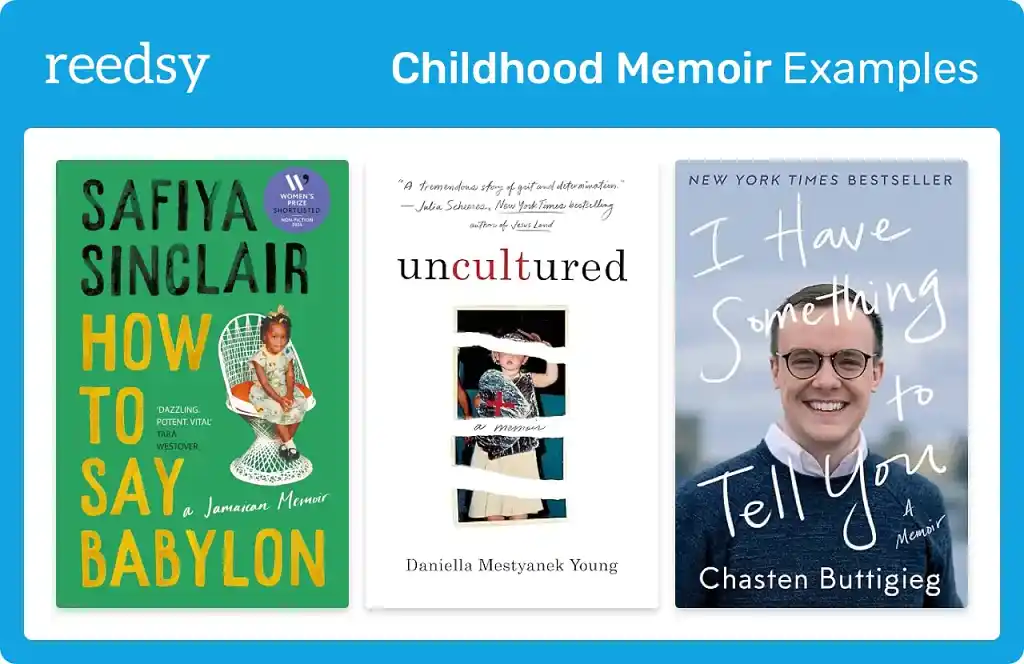
How To Say Babylon by Safiya Sinclair
Shortlisted for the Women’s Prize for Non-Fiction 2024, How To Say Babylon: A Jamaican Memoir recounts Safiya Sinclair’s strict Rastafarian upbringing under a father determined to save her from the corrupting influence of the Western world — and tells how poetry helped her find her voice.
Uncultured by Daniella Mestyanek Young
Daniella Mestyanek Young spent the first 15 years of her life in the religious cult known as The Family. In Uncultured: A Memoir, she opens up about the abuse she suffered there and her struggle to adapt to the outside world after she escaped. The memoir continues to tell Young’s story as she joins the US army in her twenties — and realizes that her new life in Afghanistan looks remarkably similar to the one she left.
I Have Something to Tell You by Chasten Buttigieg
In I Have Something to Tell You, the husband of 2020 presidential candidate Pete Buttigieg writes about his experiences growing up gay in rural Michigan, from realizing he was different to learning to accept himself.
The travel memoir
What happens when you put an author on a plane? Words fly!
Just kidding. While that’s perhaps not literally how the travel memoir subgenre was founded, being on the move certainly has something to do with it. Travel memoirs have been written for as long as people could traverse land — which is to say, a long time — but the modern travel narrative didn’t crystallize until the 1970s with the publication of Paul Theroux’s Great Railway Bazaar and Bruce Chatwin’s In Patagonia.
In a travel memoir, the author isn’t the star of the show: the place is. But alongside a description of the place, culture, and people, you can expect to learn how the author dealt with setbacks during the journey and what lessons they took away.
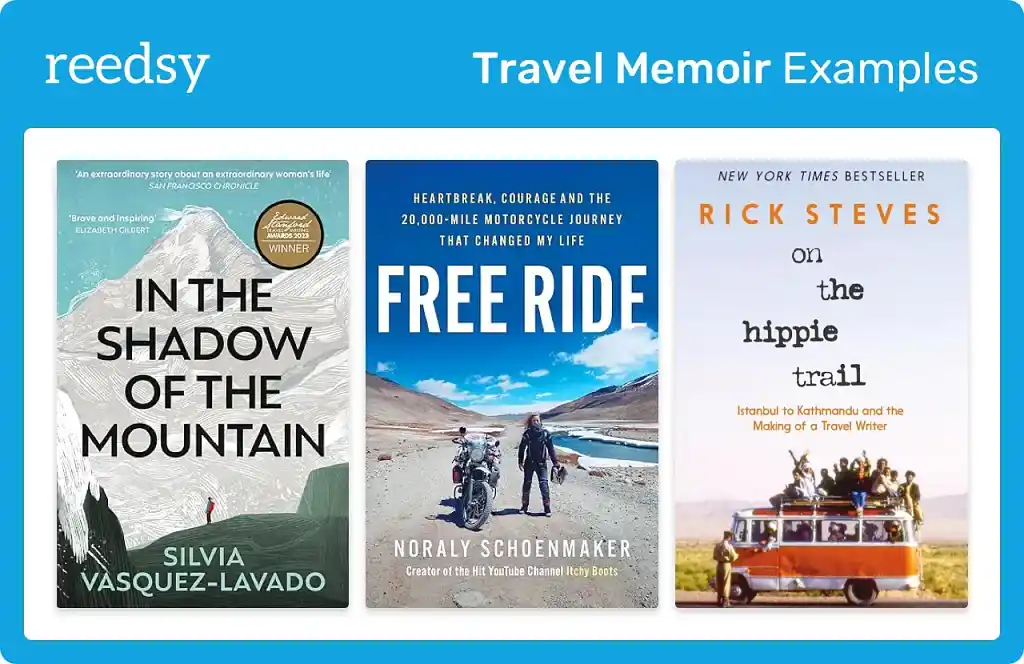
In the Shadow of the Mountain by Silvia Vasquez-Lavado
Winner of the Edward Stanford Travel Book of the Year 2023, In the Shadow of the Mountain chronicles Vasquez-Lavado’s trek up Mount Everest with five other women. Readers learn how the vastness of the mountain and the nearness of death helped each woman confront her personal trauma.
Free Ride: Heartbreak, Courage, and the 20,000-Mile Motorcycle Journey that Changed My Life by Noraly Schoenmaker
The title says it all! When Dutch author Noraly Schoenmaker discovered that her live-in partner had been having a long-term affair, she quit her job to fly to India — and ended up biking the whole way home. On the way, she discovered the beauty of nature, the kindness of people, and her own inner strength, which she wrote about in her memoir Free Ride: Heartbreak, Courage, and the 20,000-Mile Motorcycle Journey that Changed My Life.
On the Hippie Trail: Istanbul to Kathmandu and the Making of a Travel Writer by Rick Steves
Having written over 50 guidebooks and starred in his own TV show, Rick Steves is the leading American authority on European travel. But before he wrote travel guides for a living, 23-year-old Steves embarked on the adventure of a lifetime through Turkey, Iran, Afghanistan, Pakistan, India, and Nepal. In his first ever memoir, he combines his journals from the time with commentary on how the trip shaped who he is today in his memoir On the Hippie Trail: Istanbul to Kathmandu and the Making of a Travel Writer.
The celebrity memoir
Our final type of memoir overlaps significantly with the previous ones. To count as a celebrity memoir, the memoir simply needs to be published by a celebrity. Though many celebrity memoirs are admittedly ghostwritten, the best ones give us an honest and authentic look at the “real person” behind the public figure.
Note that we define “celebrity” broadly here as anyone who is (or has been) in the public spotlight. This includes:
-
Political figures (e.g. Barack Obama)
-
Sports stars (e.g. Andre Agassi)
-
Comedians (e.g. Trevor Noah)
-
Actors and actresses (e.g. Viola Davis)
-
Singers and musicians (e.g. Britney Spears)
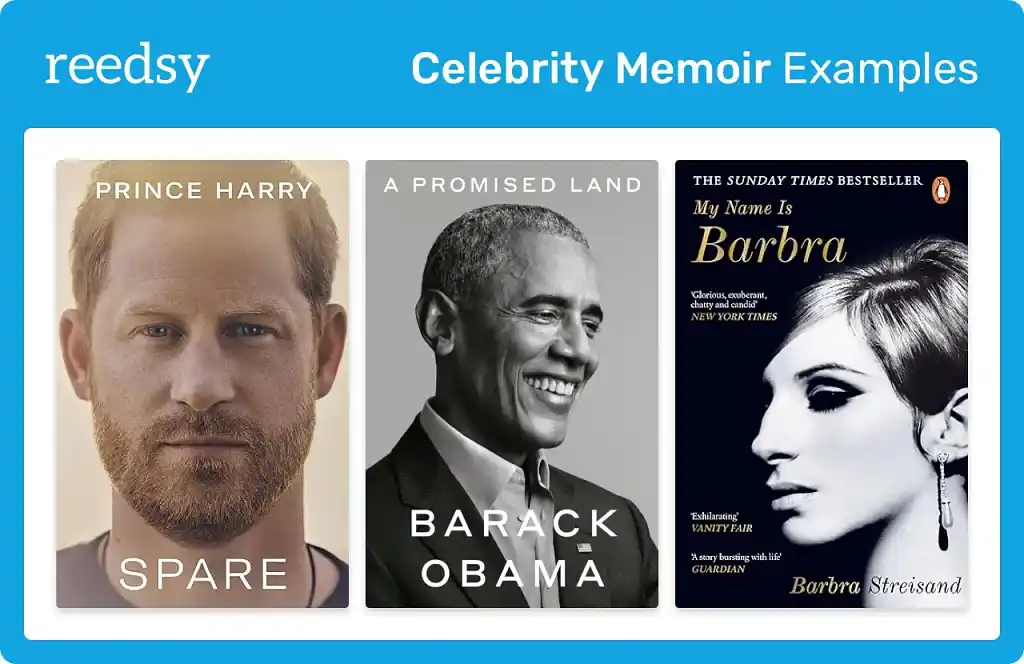
Spare by Prince Harry, Duke of Sussex
By far the highest selling memoir in recent years, Prince Harry’s Spare spares no detail about life in the British royal family and why he and Meghan chose to step down from royal duties — telling his side of the story for the first time.
A Promised Land by Barack Obama
In his first memoir, A Promised Land, the former US president offers a deeply personal account of his early life and career, which is introspective, candid, and inspirational.
My Name Is Barbra by Barbra Streisand
A mega memoir of almost 1,000 pages, My Name Is Barbra recounts the highs and lows of Barbra Streisand’s life in and out of the limelight, revealing her to be just as human as the rest of us.
Q: What are some powerful non-celebrity memoirs, and what makes them stand out?
Suggested answer
I love, truly love, A Homemade Life, by Molly Wizenberg. She had an amazing blog for many years, and even won a James Beard Award for it, and this book was her (first) memoir about growing up with food but also her relationship with her parents and her childhood in general. She is an incredibly gifted writer, a genuinely interesting person, and A Homemade Life moved me incredibly.
Jenny is available to hire on Reedsy ⏺
"Sold" by Zana Muhsen. I ghosted this about thirty years ago and people still contact me to say it is their favourite book ever. I think the secret was Zana's incredible honesty and authenticity - plus a powerful plot. "A Boy Called Hyppo" is another powerful story, ghosted for a boy who survived the Rwandan genocide. "The Boy Who Never Gave Up" is the memoir of a refugee from South Sudan who walked, as a boy, to South Africa.
Andrew is available to hire on Reedsy ⏺
Powerful non-celebrity memoirs like The Glass Castle by Jeannette Walls or Educated by Tara Westover are rememberable because they give unapologetic candor and deep personal transformation. The writers were not celebrities, but their voice was unforgettable. They didn't simply tell what had been done; they reflected upon it, and while doing so, they offered wisdom, resilience, and emotional truth. What is so captivating about these memoirs is the combination of vulnerability and story discipline. They are like books, loaded with tension, setbacks, and progress so that others can identify with the struggle. It is not how famous the author is but how they make a single life universal.
John is available to hire on Reedsy ⏺
Now that you know what a memoir looks like, it’s time to get out your pen and paper, and write your own memoir to pass down family generations! And if you want even more memoir examples to keep being inspired? We’ve got you covered: here are the 30 best memoirs of the last century.