Guides • Perfecting your Craft
Last updated on Oct 15, 2025
How to Outline a Memoir in 6 Steps (with Template)

Martin Cavannagh
Head of Content at Reedsy, Martin has spent over eight years helping writers turn their ambitions into reality. As a voice in the indie publishing space, he has written for a number of outlets and spoken at conferences, including the 2024 Writers Summit at the London Book Fair.
View profile →Memoirists are often daunted by the task of translating memories into a captivating narrative. Even with a clear understanding of your memoir's central themes and the stories you want to share, it can be challenging to weave them together seamlessly.
In this article, we’ll share 6 steps to organize your memories into a compelling narrative, along with a free template to help you plot your personal story.
How to outline a memoir:
 Click to tweet!
FREE RESOURCE
Memoir Outline Template
Craft a memorable memoir with our step-by-step template.
1. Order your stories chronologically
If you’ve worked through our article on how to write a memoir, you should already have a hand-picked selection of powerful memories. The challenge now is to piece them together, with each memory serving as a crucial puzzle piece in an overarching narrative.
A popular first step is to arrange your stories in chronological order. You could do this on a whiteboard, a notebook, or within your writing software of choice. For example, Reedsy Studio offers an outlining board where you can create notes for your stories, then drag and drop them around.
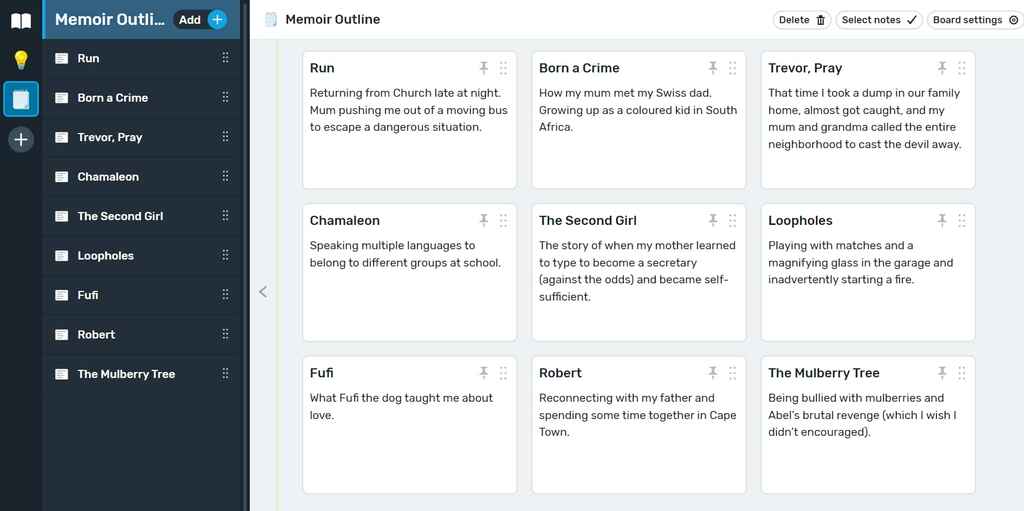
With this bird’s-eye view, it becomes easier to spot patterns and understand what fundamentally connects your stories together, helping you find a suitable story arc for your memoir.
👻 Want to collaborate with a master storyteller to bring your memoir to life? Hire a ghostwriter! They'll handle everything in the background, but your name will be the one on the cover.
Hire a memoir ghostwriter on Reedsy!

Stacia D.
Available to hire
New York Times Best Selling author of more than 300 children's books. I write mid-grade, picture books, YA and more!

Doug W.
Available to hire
Simply put, I connect authors and audiences. Nothing's more important than the emotional connection that makes a story unforgettable.
Seth M.
Available to hire
I have extensive experience finding new and creative ways to tell a story, especially when using humor to engage with young readers.
2. Pick a fitting story structure
Filmmaker Jean-Luc Godard once said that every story “has a beginning, a middle, and an end — not necessarily in that order.” When it comes to telling your own story, there isn’t a single way to structure them 一 you'll have to figure out what will have the greatest impact. To help you along, look at some of the most common memoir structures authors use.
Q: Should I outline my book or just start writing?
Suggested answer

There's no wrong or right answer here. The trick to writing--and the beauty and headache of it, in so many cases--is that authors have to figure out the process that best works for them, and no two authors are quite the same.
My suggestion is always going to be that authors should try each method, simply so that they know what works best for their own process and success. Some writers find outlining to be fun, but then they aren't interested in writing the book afterward because all of the 'discovery' already happened, so outlining actually takes the fun out of the writing process for them. Others may or may not enjoy outlining, but it's what works best for them because they feel paralyzed without that guide, whether it's a detailed, chapter by chapter outline or a more general one-page summary.
I do think that for non-narrative nonfiction, outlining from the start is generally the best idea, as it can help you solidify the scope of the work, pick out gaps in research, and get a better idea of audience and market right from the start. But when it comes to fiction, anything goes, and you just have to figure out what best works for you.
Jennifer is available to hire on Reedsy ⏺

Both methods can be successful—it just hinges on how your imagination runs most smoothly. Outlining provides a clear guide and prevents plot holes, but jumping in can preserve raw emotion and spontaneity. Most writers do a mix: they create a loose outline and then allow the story to develop naturally as they write. The secret is to be flexible and willing to change—don't let planning kill your creativity, but don't be afraid of a little bit of planning either. What does work for you in terms of writing regularly is the key.
John is available to hire on Reedsy ⏺
Three, in particular, stand out:
Chronological. For memoirs that cover a specific time period or event of the author’s life and have a clear, chronological timeline (e.g. defeating cancer, or climbing Mount Kilimanjaro.) For example, Jon Krakauer’s Into Thin Air recounts the 1996 Mount Everest disaster by chronicling the ascent, summit, and descent of the mountain.
Before/After. For memoirs that revolve around a particular event so central to the story that it makes sense to organize the book in a Before/After format, where the narration keeps cutting before and after that event occurred (e.g. being sentenced to jail, or surviving a hurricane). In Lee Lawrence's The Louder I Will Sing, the author describes his life before and after his mother was wrongly shot by police during a raid on their home, using the contrast to describe the two strikingly different realities he experienced.
Theme-based. For memoirs that aren't linked together by a specific timeframe, but rather a common theme, with each story offering a unique perspective into the author's life, yet all coalescing around a central theme. A good example is Trevor Noah's memoir Born a Crime, which explores his experiences as a mixed-race child growing up in Apartheid South Africa. Noah shares a range of poignant and often humorous stories, from going to Church with his mum to selling CDs to his first date, which all grapple with the book’s central themes of resilience and identity.
When outlining your own memoir, play around with your story notes and see if you can arrange them in a unique way that emphasizes your central message or story arc. If you find this especially challenging, don’t despair. You can always collaborate with a book coach 一 they’ll help you make sense of your tales and neatly organize them into a powerful narrative.

GET ACCOUNTABILITY
Meet writing coaches on Reedsy
Industry insiders can help you hone your craft, finish your draft, and get published.
But in the end, the old ways are often the best — and most stories are best suited to having a distinguishable beginning, middle, and end. Most often, the strongest outline is one that follows a chronological, novel-like structure. To that end, we’ve created a free downloadable template that will help you deconstruct your memoir scene by scene and synthesize an overarching narrative.
FREE RESOURCE
Memoir Outline Template
Craft a memorable memoir with our step-by-step template.
Let’s dive deeper into your memoir outline and see that your story hits all the right chords.
3. Hook the reader from the start
It’s never a bad idea to start your memoir with a moment of high emotion. When deciding whether your book is worth reading, readers will skim through the opening passages, either in-store or with Amazon’s Look Inside feature. If the first few pages don’t grab them, they won’t buy it. To engage readers from the get-go, open with a powerful moment from the middle or even the finishof your story.
Q: What is your number one tip for staying motivated to finish a draft?
Suggested answer
Remember why you started, and remember that a first draft is called a 'draft' for a reason. As long as you hold onto the purpose you started with, and understand that everything in a draft can be fixed/tightened/revised/expanded on later, you'll be fine.
Jennifer is available to hire on Reedsy ⏺
Work your draft as a promise to yourself, not a show for others. Improvement, not perfection, is the goal at this level. Set tiny, attainable goals—just one page or paragraph—and triumph over each. When energy is dwindling, revisit the "why" for your story: the emotion, message, or character that originally excited you. Keep in mind that all great books started as a cluttered draft. Finishing isn't happening quickly—it's arriving until your story quite literally does come into shape.
John is available to hire on Reedsy ⏺
For example, Cheryl Strayed’s memoir Wild (which we’ll reference throughout the rest of this post) doesn’t start with her mother’s death, failing marriage, or struggle with drugs. Instead, it begins on day 38 of her hike along the Pacific Crest Trail (PCT) when Strayed accidentally drops one of her hiking shoes off a cliff. It’s a moment of profound helplessness and loneliness, evoking feelings she’s been grappling with since her mother died, ones that she hopes to overcome on her journey.

Strayed hooks her reader right from the start. She knows they’ve picked up her book on the promise that they’ll get stories of hiking through the wilderness, and she delivers on it instantly, instead of spending the first 100 pages detailing her mundane ‘normal’ life.
This kind of opening (called in media res) is an effective way for memoirists to engage the reader right away, and leave them wanting to know more before providing background information and developing the story.
4. Lay out your goals and desires
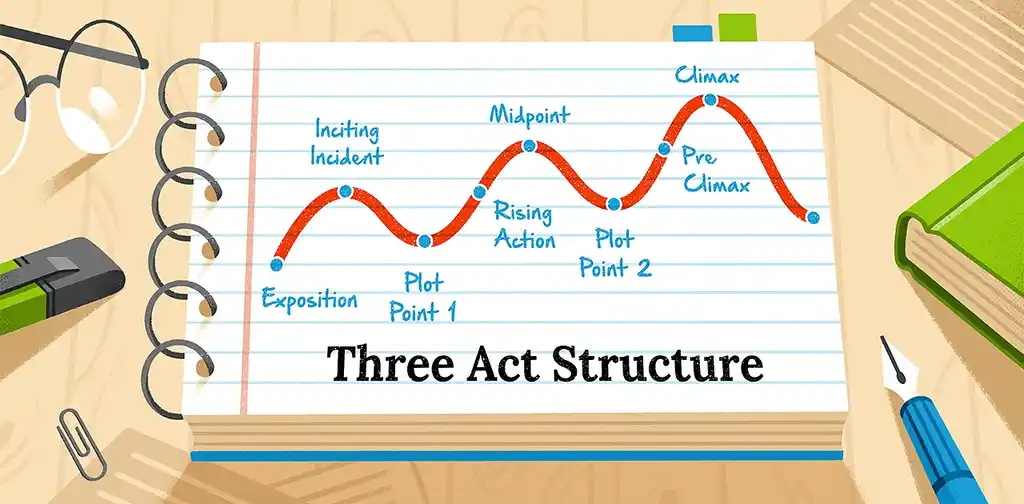
Once you’ve figured out your hook, it’s time to lay the foundation for your narrative. If you’re following the classic story structure in three acts, this would be your Act One.
FREE COURSE
How to Plot a Novel in Three Acts
In 10 days, learn how to plot a novel that keeps readers hooked
Some of the story elements you may want to include in the first part of your memoir are:
Exposition
As the main character, you’ll have to provide some background information about yourself (as long as it’s relevant to your memoir’s main focus.) You’ll want to paint a picture of who you were before the story starts, so that readers can follow along as you evolve through it.
In Wild, Cheryl vividly portrays the profound bond she shared with her mother, and how her death set her on a destructive path of substance abuse and infidelity.
If your memoir is about joining the Navy Seals, this is the part where you share your ordinary life before military training. If it’s about grieving for your late husband, your exposition and background details might detail how you fell in love with each other, and what made your relationship special.
An Inciting Incident
In most cases, you’ll be able to identify a defining moment that set your story in motion, and propelled you on a transformational journey. It’s the moment you fully decide to get out of your comfort zone to achieve your goals and desires.
Cheryl's turning point in Wild comes after she hits rock bottom in the wake of an unwanted pregnancy. Browsing through a store, she impulsively purchases a guidebook for the PCT, thinking that the trail may help her “walk herself back to the woman she once was.”

Of course, not all true life stories start with an earth-shaking epiphany or a serendipitous meeting. Maybe your decision to run an Ironman in your 40s was something that was brewing over a number of years, but try to think of a moment of high emotion that contributed to that choice. Was it the day you were fired from your job, or the time when a kid on the street called you 'old'? This moment could very well be your inciting incident.
Introduction of Main Theme
As your story develops, make sure that your personal objectives are tied to a larger, universal theme that can resonate with your readers. In Cheryl's story, her primary goal is to hike the PCT, but on a deeper level, her quest touches on the themes of redemption and self-discovery. As she writes in the first pages of the book:
“It was a world [the trail] I’d never been to and yet had known was there all along, one I’d staggered to in sorrow and confusion and fear and hope. A world I thought would both make me into the woman I knew I could become and turn me into the girl I’d once been.”
Think about what your memoir's theme really is (e.g. parenting, mental health, social inequality) and spotlight it from the very beginning.
Now that your story is truly in motion, with backstory, an inciting incident, and thematic heft, it’s time to get into the nitty-gritty.
5. Describe how you dealt with challenges
The second act of your memoir is often the trickiest. This is the section where you will usually deliver on the ‘promise of the premise’: if your book is about becoming an astronaut, this is the part where you’ll undergo training and plan for your mission. If you’re writing a memoir about hiking the wilderness, you better be in the woods by the start of the second act.
Q: What are false stakes in storytelling, and how do I avoid them?
Suggested answer
False stakes occur when a story presents a threat or punishment that doesn't really affect the characters or the story. Readers are told something is crucial, but nothing changes when it's resolved or ignored. It releases tension and kills trust. To avoid false stakes, make each threat relate directly to your main character's goals, connections, or personal growth. If they fail, there must be an outcome worth achieving—emotional, physical, or moral. Actual stakes have long-term consequences, even in a passing moment. Rather than crafting random danger or melodrama, link the stakes to the character's greatest desire or fear. When it matters to them, it will matter to the reader.
John is available to hire on Reedsy ⏺
The tough part comes with making sure that you’re building momentum, increasing the stakes, and not just telling anecdotes that don’t contribute to the bigger picture. For this reason, a memoir’s second act usually sees your hero (you!) responding to bigger and bigger obstacles.
Here are a few key plot points to consider to keep your narration strong:
Rising Action
During this part of the story, you usually face external and internal challenges in order to achieve your goal. The key to maintaining credibility is to share both your failures and successes, moments of both fear and courage.
On her first sleepless night camping on the trail, Cheryl is terrified of animal sounds. But as she grows more confident each day, she starts to join in with their howls. Despite her undersized boots, her heavy backpack, and her lack of camping experience, she manages to walk 100 miles through the Mojave Desert and reach the first campground. She also learns to trust strangers and ask for help, especially when it comes to letting go of some of her unnecessary baggage.

The rising action in your story may be less adventurous than in a travel memoir. If your topic is recovering from addiction, for example, it may include getting into arguments at Alcoholics Anonymous, before developing an uneasy friendship with your sponsor and growing more confident in your ability to get better.
Midpoint
This is a turning point in your story, like a crisis, triumph, or simply a realization, that pivots your journey in a new direction. Usually, it’s a moment that carries significant emotional weight and sets the stage for the climax to come.
Despite her growing confidence, Cheryl is forced to reckon with her emotions. This is when she loses her boots and feels helpless, used as the story hook. This time though, we get to see how she reacts: she reinforces her sandals with duct tape and keeps marching forward, with ever more strength and determination.
Dig around your memories and try to identify that path-altering, highly emotional moment 一 it may be your midpoint. In a memoir chronicling the journey of building a successful startup, the midpoint may be a promising call from angel investors, willing to pour some money into your idea. It’s the moment when things turn around.
It’s time to outline the final act of your memoir to end on a strong note and with a powerful message.
6. End by showing how you’ve changed
The Third Act is where the main conflict of your story is finally resolved, so the stakes and tension should be at their highest. Some of the key plot points to outline in this last section are:
Q: What's a novel with an unforgettable ending, and what narrative choices made it so impactful?
Suggested answer
"She turned away. Behind them lay pain and death and fear; ahead of them lay doubt, and danger, and fathomless mysteries. But they weren’t alone.
So Lyra and her daemon turned away from the world they were born in, and looked toward the sun, and walked into the sky."
-- The Northern Lights by Phillip Pullman
It is the most perfect ending to a book, full stop. It's emotionally-charged, especially considering the events that happened just prior to this moment (no spoilers!) It lifts the reader up, gives hope, and also a promise of more to come.
And it's poetic, from the word usage to the sentence structure. It sets the pace and tone with punctuation, and it ends with a strong visual that is breathtaking in its simplicity.
Grace is available to hire on Reedsy ⏺
A tragedy-ending novel is Markus Zusak's The Book Thief. Death's narration provides an otherworldly voice that creates a gentle sense of destiny from the outset. But when inevitable tragedy finally materializes, it still has cathartic effect because the strong emotional investment created by tiny, intimate moments rather than over-the-top gestures. Zusak's poetic writing and gradual unveiling of destinies make the climax both beauty and heartbreak—a reflection on love, loss, and the stories that keep us alive even after death.
John is available to hire on Reedsy ⏺
Pre-Climax
This is where you introduce your greatest challenge for the final act of your manuscript. It often involves a series of events that further escalate the conflict and heighten the anticipation for the ultimate resolution.
In Wild, Cheryl deals with debilitating thirst, dodgy hunters, and a heavy storm, but more importantly, she revisits some of her most painful memories, from the abuses of her alcoholic father, to the heart-wrenching task of putting down her mother's cherished horse after her passing.

In your memoir, this is the moment before the end of your story that threatens to dash your dreams once and for all. It may be the moment when a global pandemic hits, countries close borders, and flights to Vanuatu are suspended, threatening your quest to visit every single country in a year.
Climax
This is the point where the central conflict or challenge of your memoir comes to a head. It’s the culmination of everything you've built up to, and it should feel like a defining moment in your life. For Cheryl, it’s finally reaching the Bridge of the Gods and completing the PCT after a three-month-long hike. In your story, it may be the moment you complete an Ironman, sell your successful startup, or finally land in Port Vila, the capital of Vanuatu.
Resolution/Thematic Wrap-Up
The resolution is an opportunity for you to show the results of your journey and how you’ve changed as a result of it. Here you can again address the central theme of the book, sharing the lessons you’ve learned and how your perspective has changed over time.
For Cheryl, it’s all about redeeming her turbulent past 一 from cheating to heroine 一 owning up to it, and rediscovering that inner strength and beauty she had lost touch with. In your memoir, this is the time to reflect on what you learned from overcoming addiction or running a race, and muse on how you have been able to move forward since.

Aaand scene! It's important to keep in mind that every memoir is unique and may require a distinctive structure, but we hope that our suggestions and template will provide you with a solid foundation to write with more clarity and get that memoir published.
Also, remember that writing a book is a marathon. After outlining, writing, and publishing your memoir, you'll have to publish it! Proceed onto our post teaching you how to publish a memoir and rest assured that you have a solid roadmap in front of you.


1 response
Evelyn Sinclair says:
04/03/2018 – 21:17
I've read a lot of the Reedsy information about memoirs, finding it all very helpful and I'm around 20,000 words in. Recently I'm struggling over how to bring it to an interesting end, and whether I can reach the length of a novel.