Guides • Understanding Publishing
Last updated on Mar 02, 2026
How (and Where) to Find a Literary Agent in 2026

Martin Cavannagh
Martin Cavannagh is a publishing professional with 10+ years of experience in content strategy, editorial development, and author education within the indie publishing space.
View profile →
Tom Bromley
Author, editor, tutor, and bestselling ghostwriter. Tom Bromley is the head of learning at Reedsy, where he has created their acclaimed course, 'How to Write a Novel.'
View profile →
Isabella Peralta
Short Bio Isabella Peralta is an editor and writer with 7+ years of experience in the publishing industry. She is editor-in-chief of Reedsy's literary magazine, Prompted, and runs Reedsy's weekly writing contest, which has grown into a global community of over 800,000 writers.
View profile →A literary agent is a publishing industry professional who represents authors and their books to publishers. Once you have an agent, they’ll help you refine your pitch and submit your book — a crucial collaboration, as most major publishers only accept agented submissions.
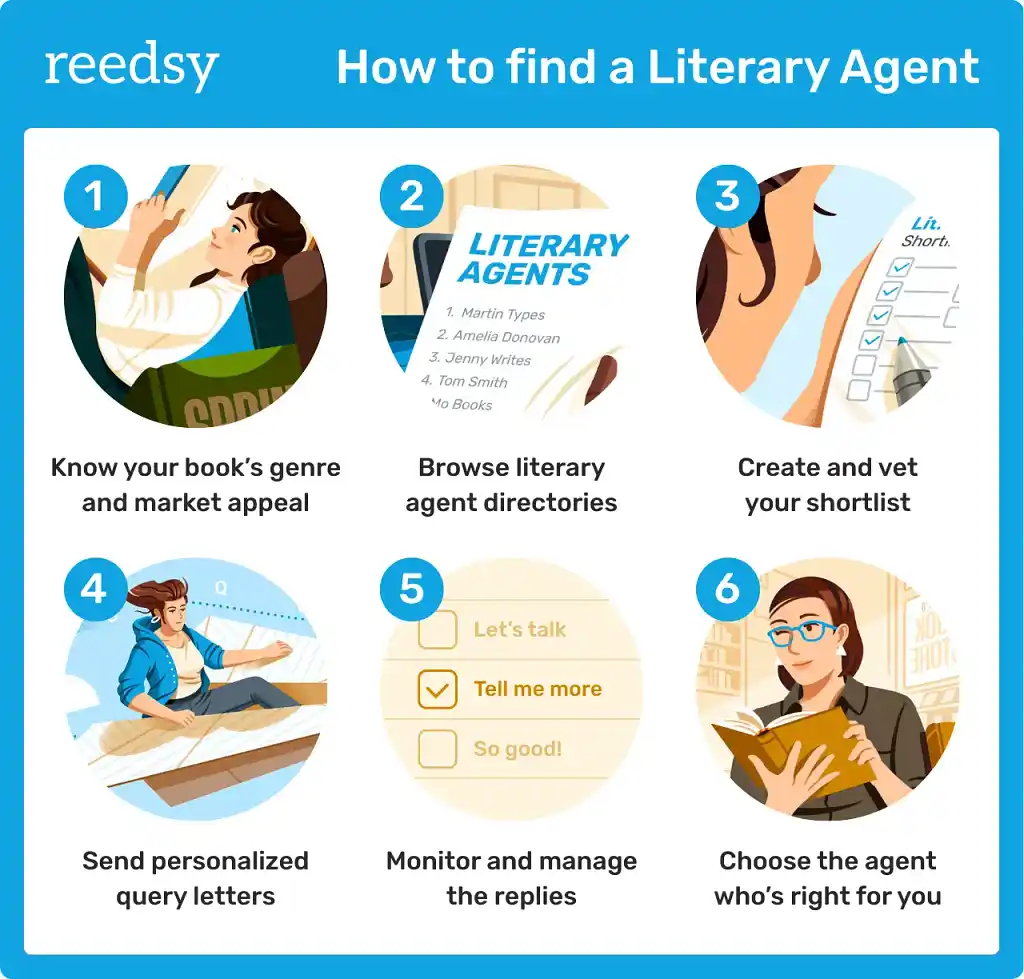
If your goal is to get a traditional publishing deal, then securing agent representation is key. Here’s how to do it.
1. Know your book’s genre and market appeal
In order to find an agent, you need to have a clear, confident understanding of your own book. Most agents specialize in specific genres, and submitting outside those genres — no matter how great the book — will result in an automatic pass.
Beyond genre, you should also be honest with yourself about your book’s commercial appeal. If your book is not exactly mainstream, think about how to pitch it to agents using different angles: how it will tap into a small but passionate audience, fill some kind of gap in the market, etc.
Here are a few simple ways to assess your book’s commercial viability:
- Browse bookstores. Is there a designated shelf for your book? What else is on that shelf?
- Find comp titles. Identify two or three published books from the last few years that share your genre, tone, and readership. If those books exist — and sold well — then that indicates a solid market for your book.
- Look at deal announcements. You can check out resources such as Publishers Weekly’s Deals of the Week; The Bookseller’s Book News; Publishers Marketplace’s Latest Deals page; and Literary Hub’s Book Marks for new book reviews.
Having absolute clarity on your book’s genre and market position will make every step that follows — from targeting agents to writing your query — much easier.
Hire an editor to improve your query letter

Michael S.
Available to hire
Versatile editor of award-winning fiction and nonfiction with 20+ years' industry experience.

Helen L.
Available to hire
Literary Agent and Developmental Editor. I represent incredible authors at Ki Agency. My editorial focus is on Fantasy, Sci Fi and Romance.

Louise S.
Available to hire
A detail-oriented proofreader with experience in basic copyediting. I specialize in fiction, creative non-fiction, and memoirs.
2. Browse literary agent directories
Now it’s time to find suitable agents. The good news is that you don't need industry connections to dive in! Several directories out there make the research straightforward:
|
Directory |
What does it include? |
|
Reedsy’s Literary Agent Directory |
A free, curated directory with agent profiles. Reedsy includes their preferred contact methods, the genres they work with, and their notable clients, and you can notably filter by genre and location. |
|
QueryTracker |
Hundreds of agents with key submission data, plus user-reported response times and querying experiences from other authors. Free to use, with a paid tier ($25/year) for advanced features. |
|
Publishers Marketplace |
Subscription service (around $25/month) that gives you access to the industry’s deal database. Search by genre and keyword to see which agents have been selling books like yours — and to whom, and for how much. |
|
Manuscript Wishlist (MSWL) |
Agents post the specific elements they’re seeking, from genre/subgenre to specific tropes, themes, and styles. Also searchable via #MSWL on social media. |
Another unusual method that can work well: check the acknowledgments pages of books you love. Authors almost always thank their agents by name — or if you can’t find any information in the acknowledgements, try Google. If a published book feels similar to yours in tone, genre, or subject matter, the agent who represented it could be a strong candidate for you.
As you browse these directories, build a running spreadsheet. Record each agent’s name, agency, genres they represent, preferred submission method and requirements, and whether they’re currently open to queries. And yes, you should record their information even if they’re not taking queries right now, as these statuses can (and do!) change all the time.
Q: How should writers research literary agents ethically and effectively before querying?
Suggested answer


Doing a deep Google search on target agents is actually a smart process, assuming the search relates to their professional endeavors not their private life. On platforms where agents are listed by genre, it's usually a database dump that doesn't highlight the specific interests of a given agent. Websites are professional, but also not terribly deep. Publisher's Marketplace often demands a fee to obtain significantly useful information. Social media highlights perspectives, which gives you a feel of the agent's personality or position on current events within and outside of publishing.
A deep Google search can reveal very useful things: interviews with agents on blogs, articles agents may have provided to organizations, positive and negative remarks on given experiences with agents, occasional deals they've worked out that are unique or exemplary, tips and tricks they've offered to beginning authors, and so forth.
Choosing an agent, or agreeing to work with an agent who has offered, is a very personal choice. Ideally it is a long-term choice viewed as a mutual partnership for success. Any and all information you can find about how their views on publishing, their views on the author-agent relationship, helps to better evaluate whether they align with you. You may find that the "Number One Agent Ever" simple isn't a personality match with you, via remarks they've made in an interview, or he/she feels very different than you on certain publishing subjects. Sometimes even value statements might make a difference. Working with a stranger can be awkward and difficult in the beginning, and anything you can glean to better understand who you're about to work with is beneficial. You, and the agent, want to enjoy working together. Weeding out people who just don't "click" keeps everybody happy.
Claire is available to hire on Reedsy

Professional research is absolutely necessary to determine whether an agent is a strong fit. What authors do they already represent? What books have they landed successful deals with recently? If they have a professional social media account, they are likely posting the types of books they like to read or advice about how to reach out to them. This is all healthy, necessary background research to ensure you're not wasting your time or theirs. They likely receive hundreds if not thousands of manuscripts, so if they're talking about how to stand out from the crowd, you should be listening.
But boundaries certainly exist and people will establish them intentionally; if their social media account is private, for example, it's likely wise that you don't request to follow if you don't know them personally!
Holly is available to hire on Reedsy
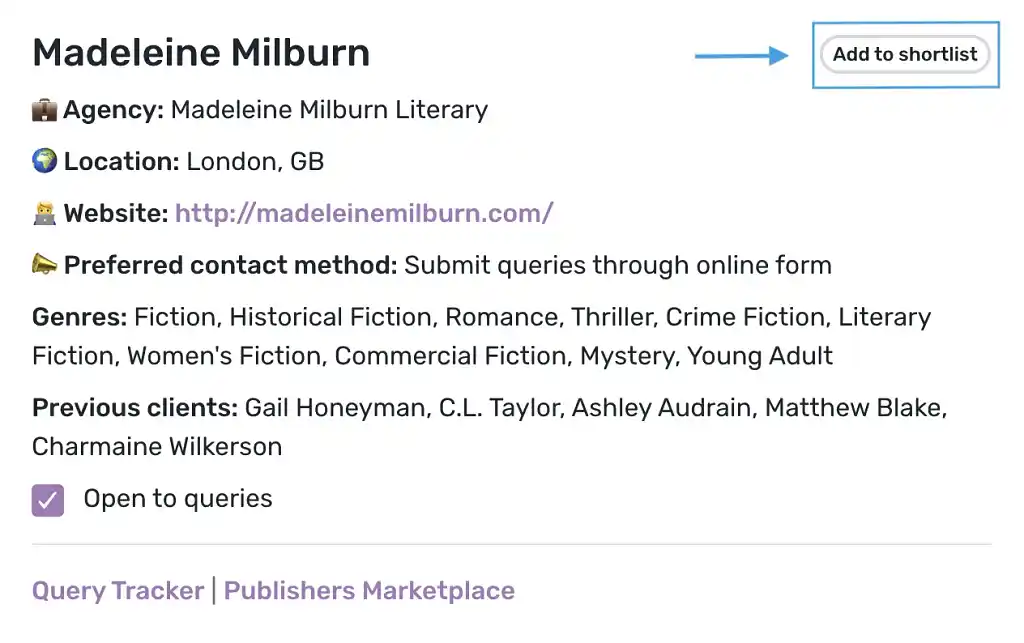
One more tip: you can supercharge your agent prospecting with the Shortlist feature in our Reedsy directory. Simply hit “Add to shortlist” on any entry that piques your interest — as many agents as you like — then “Save shortlist” to get their information right in your inbox.
Once you’ve spent some time on this initial research, the next step is to prioritize agents who are specifically looking for the story you’ve written.
3. Choose whom to query first
Don’t make the mistake of casting too wide a net. Though it’s useful to do extensive research at the start of this process, it’s also important to eventually narrow down your list — otherwise you’ll be querying based on quantity, not necessarily quality.
So once you have your “wider pool” of, say, 50+ potential agents, dive a little deeper to see who would be the best fit. Here’s how to do just that:
Review their sales record
Look up each agent’s deals on Publishers Marketplace or their agency website, and consider:
- Do they sell to the kinds of publishers you’d want?
- Are their titles similar to yours in style, subject, or ambition?
- Have they sold a book recently (e.g., in the past year)?
If the answer to any of these is “no,” you can strike the agent from your list.
Check their existing client list
You should also look at every candidate’s agency website to see whom they currently represent. Reedsy editor and agent Melissa Richeson confirms that looking at an agent’s current list definitely gives you a sense of their tastes.
However, Melissa also warns that your work might be rejected if it’s too similar to one of the authors on their list. “Most agents don’t want to sign a new author who would compete directly against one of their current authors,” she says.
Some similarities, in other words, are good — but not if you’re sliding into the exact same literary niche. Combine intel from their current list and their recently sold titles to make sure you strike the right balance.
Q: How do editors and agents evaluate whether a manuscript has commercial and craft potential?
Suggested answer

Potential is usually obvious in the first few sentences. The quality of the writing, pace and tone particularly, are evident from sentence one. But structure is important too, and if that's not in place, no amount of fine writing is going to fix it. So fine writing + tight structure (whatever these things look like in any given novel) is the clue that the manuscript has potential.
Potential is all about a writer being in control of their material. A writer I feel confident in from page one. The sense that although the manuscript isn't perfect and needs work, the writer fundamentally knows what they are doing. I look for a tone that fits the genre. This is really important, and often it's not working in manuscripts. Good pace is important too, again whatever that looks like in any given novel. This is often determined by the genre. For example, thrillers are pretty much defined by their fast pace, yet I've read many manuscripts described by their writers as thrillers that simply aren't, often due to slow pace.
Potential in a manuscript is always an exciting thing to find as an editor, and it is usually evident where a writer understands their genre, its pace, and its tone. That is a very strong start!
Louise is available to hire on Reedsy

The first thing I consider in a manuscript is how well the first line caught my attention and made me truly care. Even if is subconscious, readers are passing judgement on a piece immediately. This is why the first line is absolutely vital to setting up a successful manuscript. Unfortunately, most people have a very short attention span, and over 500,000 new fiction books are published each year, leaving no shortage of choices for readers. If a writer is adept at capturing an audience in just one line, it tells me they likely understand storytelling and know how to craft a narrative with a compelling voice.
Beyond this, I see potential in consistency. By this, I mean I always look for consistency in the voice throughout a manuscript and for characters to remain consistent in their choices or motivations. If characters are constantly doing strange and out-of-character things, it tells me the work is not well planned or fully developed. I look for plot consistency as well: is the central problem remaining the central problem, or have things drastically shifted somewhere along the way? If it has shifted, it is a sign that the original plotline/idea may not have been strong enough to carry the story.
I hope this helps! There are quite a few other small things I look for, but these are the two biggest ones I can typically spot right away.
Ciera is available to hire on Reedsy
Query only one person per agency
Another rookie mistake to avoid: contacting multiple people at the same agency. Perhaps unsurprisingly, it can come across as spammy and unprofessional.
Reedsy editor and agent Sally Apokedak notes that a single agent’s taste will likely represent the wider agency anyway: “Most agencies consider a pass from one agent to be a pass from the agency.
“You may send a different manuscript to a new agent, but don't send the same work to more than one agent per agency.”
On the flip side, Sally mentions that if an agent likes your book but their list is full, they might pass it along to someone else within the agency. So even from this perspective, you never need to query multiple people at an agency; your book will find its way to the right person regardless.
Check whether they’re actually open to queries
As noted above, an agent’s status can change anytime. Be sure to double-check right before you query (hours before, not weeks before).
At the same time, don’t get discouraged if an agent’s status has changed from open to closed — or if they’ve been closed to queries since you discovered them. Literary agents periodically close their submissions to catch up on reading, but most will open them again at some point. If there’s one you really love, you may just need to be patient.
4. Carefully vet your shortlist
Lastly, once you have your priority agents to query, do a final round of background checks. This vetting ensures that you only contact active, legitimate literary agents who can genuinely help your book get published.
Check their professional reputation online
QueryTracker lets users share their querying experiences, giving you insight into an agent’s response style and professionalism. Publishing forums like Reddit’s r/PubTips are likewise full of candid, detailed accounts of working with specific agents.
You also can’t go wrong with simply Googling “[agent name] scam?”. If anyone has had a negative experience with them before, it’s bound to show up somewhere on the internet.
Q: What qualities and practices make a literary agent effective for their authors?
Suggested answer

Honesty.
I suppose that's a quality that's necessary for any job, right?
I used to be a literary agent (part-time, in addition to ghostwriting and editing). So here's why honesty is crucial.
A good literary agent must be forthright, and constructive, in delivering bad news and harsh realities.
As an author, you want an ally who will assess strengths and weaknesses head on, so they can be addressed in a book proposal, and through all the crucial steps to help you grow your brand and audience.
Mike is available to hire on Reedsy
Verify through industry watchdogs
If you’re really unsure whether an agent is legitimate, check the site Writer Beware, or reach out to author Victoria Strauss (who runs it) directly. The resources on Writer Beware maintain excellent, comprehensive records of problematic agents and known scams.
🚩 The number-one red flag: any agent who charges an upfront fee — for reading, evaluating, or representing your manuscript — is not legitimate. Real agents only make money when you do. No exceptions.
Let’s now focus on the pitch itself: your query letter.
5. Send personalized query letters
A query letter is a one-page pitch that introduces you, your book, and why you’re seeking representation from that specific agent. Agents will decide whether to request your manuscript based on the strength of your query letter — so needless to say, it had better stand out.
If you’ve never queried before (or even if you have), check out our practical guide to query letters here. It’ll help you craft a query that nails all the important stuff, including:
- A hook to grab the agent’s attention;
- Your book synopsis;
- Your author background and credentials;
- Personalization for each agent.
Use all that research to your advantage
The personalization aspect is what separates a professional query from a mass email. Based on author testimonials and dozens of sample queries, here are some of the best ways to personalize your query letter:
- Quote from their agency profile or Manuscript Wishlist;
- Mention a book/author they represent and draw (concise!) parallels to your own work; or
- Refer to an interview they’ve done/external article they’ve written (in an actual publication, not on QueryTracker, MSWL, etc. — you may have to do a little extra digging here).
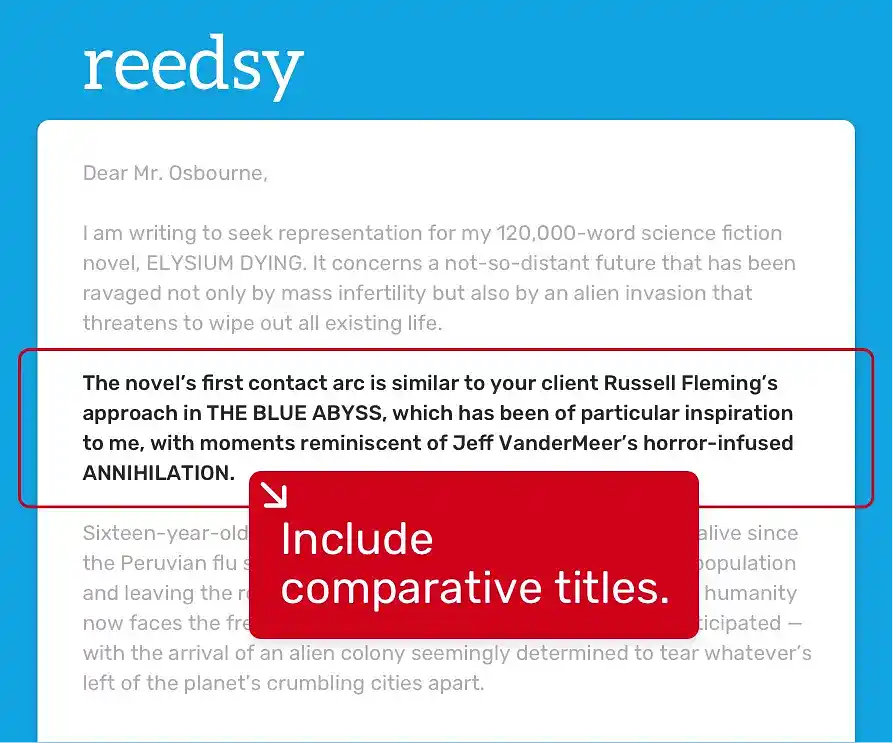
The good news is, if you conducted all the research we discussed above, you should already have a strong sense of a) what each agent wants and b) how your book fits the bill. So no need to go overboard; just tap into that knowledge for 1-2 sentences of effective personalization.
Query in batches
Now it’s time to make use of your agent priority order from Step 3. Start by querying your top 5-10 agents — putting real time and effort into the personalization, and ensuring that you’re adhering to their submission requirements.
Keep in mind that some agents only want your query letter from the get-go. Others want sample pages or an extended synopsis. Still others may even want the query and full manuscript in one fell swoop (though this is rare).
Every agent is different, so don’t forget to check those requirements. This is why it’s crucial to query in small batches first: so you can be detail-oriented without burning out.
Q: Do you have any words of encouragement for authors struggling in the querying trenches?
Suggested answer

First of all: don’t give up. Rejection isn’t the end of the story—it’s part of it. Every “no” is simply a redirection toward the right “yes.”
Publishing is absolutely a business, but it’s also deeply relational. Editors and agents love working with people they genuinely like and trust. That means: go to writers’ conferences. Join a critique group or hire an author coach. Get to know professionals in the industry, not just for what they can do for you, but for how you can show up as generous, authentic, and collaborative. You never know when a writer friend might one day endorse your book, or when a connection you make over coffee might become a career breakthrough.
And here’s the bigger truth: querying is more than chasing contracts. It’s also a personal growth journey. You’ll discover your resilience, refine your craft, and grow into the writer you’re meant to be. One author I know literally turned her pile of rejection letters into a lampshade and said they helped light her way to publishing three novels.
Need more inspiration? Catherine Stockett, author of The Help, was rejected by 50 agents before one finally said yes. That “yes” led to a book deal, a bestseller, and eventually, a movie.
So hold fast to your dream. If you feel called to write, you probably are. Keep writing. Keep connecting. Keep becoming the kind of author people want to root for. The path may be long, but you’ll be stronger, wiser, and more yourself because of it.
Alice is available to hire on Reedsy

Querying can be emotionally challenging and overwhelming for authors. Once you're in it, you're amongst a sea of probably tens of thousands of other authors at the same time, and there are, of course, only so many agents and agencies out there. Truthfully, the odds are not great; an agent will sign only about 1-3% of the authors they come across in their queries. This is why the query must be in tip-top shape: a query's only job is to make the agent curious enough to ask for pages. Then, they have to fall in love with the pages (the writing and the story, which are two different things) and have a vision for it in the current market.
If you go into it with the right mindset, it can make it easier. Expect to receive many passes; it's inevitable in 99.9% of cases. Your story isn't for everyone; no one's is. And there are so many reasons an agent might pass. Try not to take it personally; if they pass, then they were not the agent for you. You have to have thick skin though. Not every agent will reply, and if they do, they may give feedback or a reason they're passing or they may not. It's hard not knowing, but there's not much you can do about it. Agents are not paid for the time they spend on queries, and their top priority is the clients they already have, so unfortunately, queries often fall to the bottom of the priority list. And because we receive so.many.queries, it's very difficult to stay on top of them all. We simply don't have the time to respond to everyone. All you can do is do your best; ensure your query is spectacular so that it stands out, your pages are spectacular so agents see it as ready or nearly ready for submission to publishers, and research the agents and agencies first so you know you're shooting your shot with the most appropriate people in the industry. Follow their submission guidelines, don't cheat, and be friendly and professional. Get several pairs of fresh eyes on your query so you know it contains all the necessary elements (and doesn't contain anything that shouldn't be in it) as well as your manuscript, and make sure everything is ready before you begin querying. Being prepared says a lot about your work ethic, which is important to agents as well
It sounds cliche, but the only difference between those who find representation and those who don't is that the authors who found representation didn't give up. It takes patience, persistence, and perseverance. And it may not happen with your first completed manuscript, or even your second or third--but if your goal is to find an agent and be traditionally published, keep going. Keep learning, keep trying, keep connecting with other writers and industry pros. You've got this!
Kathleen is available to hire on Reedsy

Don't be afraid to tear up your query letters and start again. Be aware of the time of year -- you may be going 24/7/365 but agents and publishing houses don't do that. Check out Writer's Digest articles on query letter writing and examples of winners and losers. Check out Query Shark. Understand the different agent types and editors at small presses -- different query styles may be required. Send queries out, mark the calendar 4 weeks from that date, and forget about them until then.
Query letters are not a sales letter about you -- you love your book, your letter needs to make anyone want to love your book as well. :O))
Check out writing blogs/websites such as those of folks like Anne R Allen or Janice Hardy -- or any author you admire -- their tips on query letters may include something you've never considered.
Start your next book... c'mon! You might be surprised what's waiting to pop outa your head!
Maria is available to hire on Reedsy

Querying is so tough these days! There's more agents than ever before, but yet imprints are folding, combining, etc. so the number of projects being sold hasn't increased, making it harder to catch an agent's eye.
There may be any number of reasons you're not getting full requests--your query letter doesn't capture the unique quality of your book making it stand out, your first pages fall flat and don't pique the agent's interest, or, quite simply, the agent isn't interested in your characters or plot. And there's nothing you can do about that last one. Every book isn't for every person. Every agent has meh topics they rather not read about. If an agent isn't into mermaids, they're unlikely to request a full from a query that describes a book about mermaids. That query was never going to land a full, and there was absolutely nothing about the query or your writing that could have changed that.
So, concentrate on what you can control and push aside the rest. Querying is not a comment on your worth as a human or as a writer. Publishing is a fiesty marathon. If your current project isn't getting bites, write the next thing. You'll improve with each project. Trust that the stars will eventually align when your idea and words will pack a punch. How can you make your project stand out as unique? What tropes can you put a spin on? Create characters we can't help but root for. Lean into what you--your background, your hobbies, your experience, can bring to a project that springs it to life in a way that can't be replicated.
But above all, know that it's not just you--the struggle is real for many, and the only thing you can do is simply keep writing.
Kim is available to hire on Reedsy

Don't lose faith!
I know that's easier said than done but try not to let rejections get you too demoralized. Most best-selling authors had the same struggle and likely went through many rejections before securing a deal. Unfortunately, it's all part of the process.
If you are getting form rejections then it is likely you are either choosing the wrong agents or there are issues with your query pack, so make sure you put as much work as possible into researching who you want to pitch to and refining your documents. Don't rush into querying. This is your one shot to catch the attention of that agent, so you want to get it right.
If you are getting requests for your full manuscript then you are likely on the right track and have a good submission pack. Don't be afraid to ask for feedback, but agents are very busy so you may not always get it.
I would also encourage you to keep writing while querying. Authors often get their second or third book picked up instead of the first one they queried, so don't lose hope. If you are tired of the rejections then use any feedback you have been given to write something new. There are no guarantees, but keep working at it and hopefully you will find your perfect agent eventually.
Finally, be kind to yourself. A rejection doesn't mean your book is rubbish - it just means that the agent can't see a place for it at this point in time. Many, many, many brilliant books have been turned down initially and then had great success when they found the right home. Don't give up hope.
Amy is available to hire on Reedsy
Speaking of which, that brings us to our next point — handling agents’ responses (or lack thereof).
6. Monitor and manage the replies
Once the queries are out, the waiting game begins. Here are the various agent responses you can expect, and how to interpret each of them.
Manuscript requests are a green light
If an agent asks to read your partial or full manuscript, your query has achieved its purpose. Now send exactly what the agent has requested, in the format they’ve specified, as soon as you can. You want to catch them while your query is still fresh and they feel enthused (rather than obligated) to read your manuscript.
Remember, this doesn’t necessarily mean they’ll offer you representation — but it’s the first step. Even if they don’t extend an offer, they might still provide valuable feedback on your query, or refer you to someone else.
Personalized rejections are actually good
Most rejections are short, polite form emails, and that’s okay. But it also means that when an agent gives you any kind of feedback — even if it’s technically a rejection — you should listen! If you see the same note from multiple agents, take it extra seriously.
Rejections are not a final verdict on your work
It’s a publishing cliché for a reason: plenty of amazing books were rejected by agents before finding success. Douglas Stuart’s Shuggie Bain, which won the 2020 Booker Prize, only received a single publishing offer after years of rejections. Kathryn Stockett’s The Help was rejected by 60 agents.
So keep plugging away. Remember, one “yes” is all it takes.
Q: Is it appropriate to follow up on a query letter, and how long should an author wait before doing so?
Suggested answer

It depends on the agent. Many of them will post their specific guidelines on their websites—some will say that you can follow up in <x> weeks, and others will say that, if you haven't heard back from them in <x> weeks, to consider it a pass. If such information isn't on their website, it's a bit up to you, but I've heard ~3-4 months can be a good guideline to follow for query follow-ups. But definitely make sure that the agent doesn't have their specific timelines posted anywhere!
Chelsea is available to hire on Reedsy

Sure, there's no harm in following up, as long as you aren't being a pest about it.
Most agents have set response times, and may say something along the lines of "expect a response in 6-8 weeks". It's not appropriate to follow up before that window, and it also doesn't help to follow up more than once.
If an agent's website or query page say that it's an automatic rejection after that time frame, then you should take them for their word and consider your query rejected if it goes past that window.
Matt is available to hire on Reedsy

I believe it's perfectly appropriate to follow-up to a query letter, but keep the following in mind:
Read the agent's submission requirements on their website or social media account. Often, they will tell you their turnaround time or any special considerations. "If you don't hear back from me within two months, email again."
They also might say, "If you don't hear back within two months, it's a no from me." In which case, don't follow-up.
If there isn't a time listed, I would recommend nudging in four to six weeks.
And remember: be polite! Agents are human beings with *feelings* and receive hundreds of submissions. They will consider each one of them in due time.
Grace is available to hire on Reedsy
If you don’t hear anything, follow up
On a related note, don’t hesitate to follow up. While radio silence from an agent usually means “no,” it’s always possible that your query has gotten lost in their inbox — and even that small chance is worth a follow-up.
Reedsy editor and former literary agent Fran Lebowitz (who represented Julia Quinn of Bridgerton fame) puts it this way: “If they were going to say no anyway, then your slightly goofy, possibly annoying follow-up won’t change that fact. And if they haven’t decided, following up could make all the difference.”
Fran also recommends that any follow-ups stay “quick and fairly neutral. Self-deprecation is often unbecoming and self-fulfilling.” A line or two will suffice:
Have you had a chance to review my query? If I don't hear back, I'll assume it's a “no.”
On the flip side, if they requested your manuscript a while ago but you haven’t heard anything since, you can be more specific:
Hi, I hope you’re enjoying the manuscript. I know you might need more time to review it, but if you have a sense of when I might hear back, please let me know.
7. Sign with the agent who’s right for you
If you’ve sent your manuscript or book proposal to interested agents and received one or more offers, congratulations! You should be proud of your hard work and publishing savvy.
Q: How did you get started as a literary agent?
Suggested answer
Through a lot of luck and determination! I originally got started as a marketing intern for a high school textbook publisher, and from there I was able to transition to an editorial assistant role after nearly a year.
When I realized that becoming a literary agent was my dream goal, I applied to every literary agent assistant and office manager job I could. It took nearly a year of applications for me to finally be offered a position. After dozens of applications and interviews at more than half a dozen agencies, I was offered a role as an office manager at a literary agency. From there, I was able to get a job as an assistant to a literary agent who ran their own agency.
That was one of the best learning experiences of my career; there aren't classes taught on how to be an agent because so much of what we deal with on a day-to-day basis changes. Contracts vary by publisher, client needs change daily, even edits are subjective and based on the writing involved. Most agents learn the job by performing the job as assistants.
Because most literary agencies are small businesses, they have very tight budgets, which means assistants are not paid large salaries. I worked multiple jobs to pay my bills during this period, until I was able to begin cultivating my own client list as a literary agent in my own right.
Matt is available to hire on Reedsy
This answer will be different for every literary agent because we all have different backgrounds, and so many backgrounds can contribute to an agent's growth and expertise. For me, I was already an editor and wanted to move into the literary agent space as well. Additionally, I was very involved in the literary community through my own podcast, another hugely popular podcast, my own writing and network of writers, and the fact that I'd served as Co-chair of Editor's Canada and International Rep on the Crime Writers of Canada board. Even still, it's hard to get into agenting--you often need clients to be an agent, but you need to be an agent to have clients! My friend (who's also a literary agent) introduced me to the owner of an agency and we met. We got a good vibe from each other and he agreed to bring me on as an editorial assistant to introduce me to agenting. He was my mentor throughout the process, taught me so much, and it was the best move I could have made. I proved my worth and was moved into an agent position not long after, and the rest is history! Now, I enjoy the best of both worlds; I'm an editorial-minded literary agent who's growing my list of talented authors, and I'm a freelance professional editor who helps authors get their manuscripts ready for publishing, whether indie, self-, or traditional. Both roles are completely separate so that there's no conflict of interest, but I bring industry knowledge, experience, insights, and expertise into each.
Kathleen is available to hire on Reedsy
Interested agents will now offer representation, along with a brief outline of how they’ll pitch your book and further develop your career. But as exciting as this might sound, don’t rush into a contract with them.
Use your “consideration buffer” wisely
Most agents will give you 1-2 weeks to consider their offer of representation. Use this time to notify other agents who have your manuscript that you’ve received an offer. This is standard practice and often prompts other agents to respond with their own decision.
Have a face-to-face conversation
Get on a call with any agent offering representation. If they haven’t specified, now is the time to ask them about:
- How they plan to position your book;
- Whether they’ll do a round of editorial notes before submissions;
- Which publishers or imprints they’d target first;
- What their experience has been like with other clients;
- How they prefer to communicate with clients;
- And anything else that comes to mind.
They should be able to talk not just about this book, but about their vision for your career as a whole. Enthusiasm and investment matter — an agent who is excited about your work will fight harder for you.
Prioritize enthusiasm over prestige
In that vein, if you’re lucky enough to get multiple offers of representation, David Haviland recommends accepting the agent who seems most invested in you and your work.
“It may be tempting to go with a more established or prestigious agent,” David says. “But generally, those agents already have lots of major clients, who are likely to take priority.
“The ideal choice is often a newer agent, with fewer clients, who is keen to make their mark."
Finding a literary agent takes effort, patience, and a willingness to handle rejection without losing faith in your work. The writers who eventually find representation are the ones who didn’t give up — they kept refining their queries, learning from the responses, and writing no matter what.
Your perfect agent is out there, waiting for a book exactly like yours. It’s up to you to make sure they see it. Browse literary agents today and pursue your dream of getting published. Good luck!