Guides • Understanding Publishing
Posted on Feb 05, 2026
How to Find an Editor Who's Perfect For Your Book

Dario Villirilli
Managing Editor of the Reedsy blog, Dario is a graduate of Mälardalen University. As a freelance writer, he has written for many esteemed outlets aimed at writers. A traveler at heart, he can be found roaming the world and working from his laptop.
View profile →Finding the right editor for your book is actually quite straightforward as long as you clarify your priorities, do your research, and communicate your expectations clearly. Here’s how to find the perfect editor, complete with places to look and insights from our professionals.
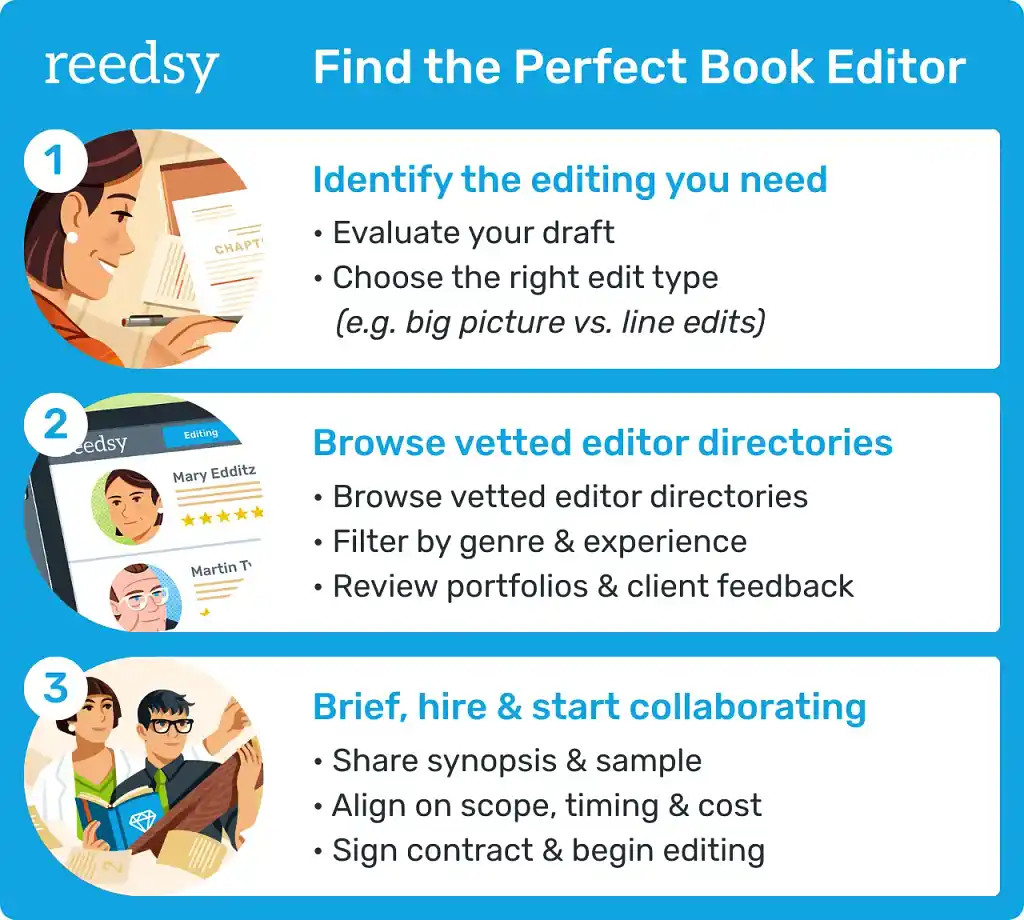
1. Identify the type of editing you need
Authors usually hire editors when they have done their best at self-editing and can no longer improve their own work. You must understand the state of your manuscript to determine what type(s) of editing it needs.
These are the main types of editing:
Editorial assessment: Often the first professional feedback a manuscript receives, an editorial assessment provides broad insights on major strengths and weaknesses in your plot, characters, and structure. This high-level evaluation helps you ascertain what to do next.
Developmental editing: Also called content or substantive editing, this involves detailed feedback on “big-picture” issues. Your editor will refine your ideas, shape your narrative, and help fix any major plot or character inconsistencies to strengthen your story's foundation.
Copy editing: Once you've solved your book's big-picture issues, a copy editor improves readability by catching word repetition, dialogue inconsistencies, grammar issues, and other mechanical problems. This ensures your prose is polished and professional.
Proofreading: The final major stage of editing, proofreading catches any remaining spelling, grammar, or formatting errors before publication. Proofreaders are your last line of defense against typos and inconsistencies that could distract readers.
What if you need multiple types?
If your manuscript requires multiple types of editing, just make sure you go through them in the right order. There’s a natural progression to this process: editorial feedback shapes your story's development, developmental changes require fresh copy editing of revised sections, and proofreading catches anything that slipped through earlier rounds. Each stage builds on the work that came before it.
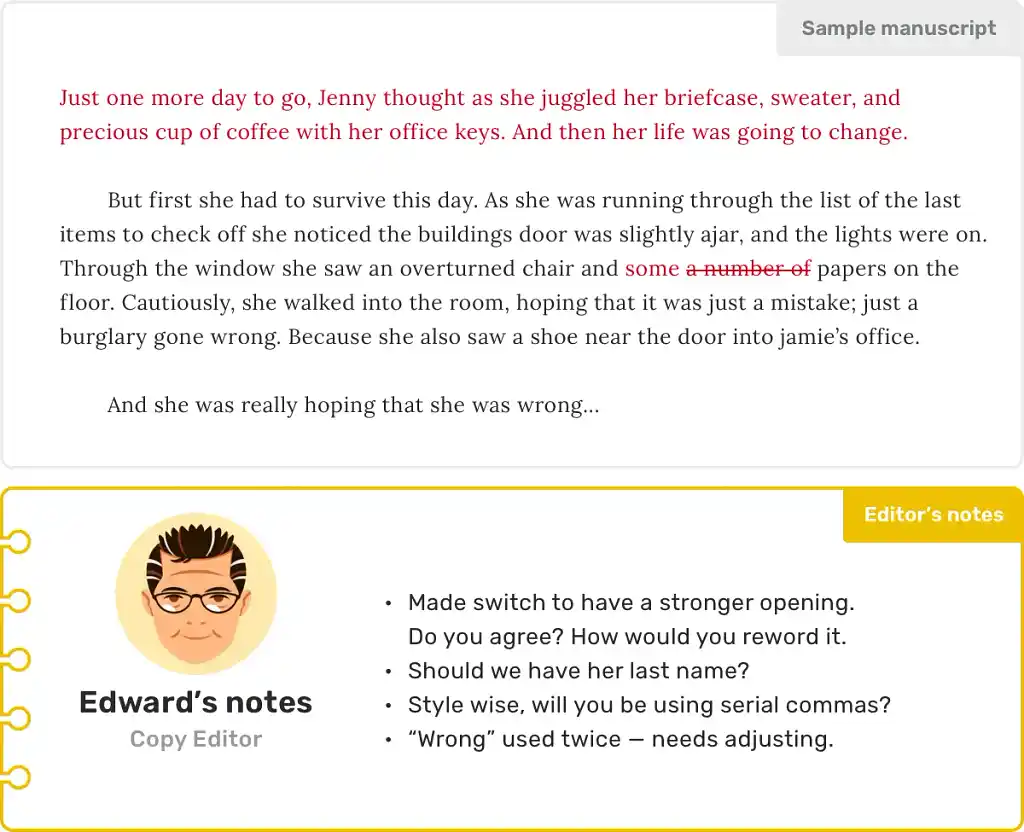
Of course, your book won’t necessarily need every type of editing. Many authors opt for a combination of developmental editing, copy editing, and proofreading. Check out the following sample suggestions for an example of the “middle” stage, copy editing:
Do you really need an editor?
You might be thinking: I’m a strong writer. I’ve taken classes and even worked with beta readers. Do I really need a professional editor?
The answer is yes.
Coaches, courses, and beta readers are valuable — but they’re complements to professional editing, not substitutes. Beta readers can flag moments where a character feels flat or a scene is confusing, but they usually can’t pinpoint why something isn’t working or how to fix it. They’re not trained to identify structural weaknesses or refine prose at a professional level.
That’s where editors come in. Professional editors prepare your manuscript for publication. They understand what agents and publishers expect, what readers in your genre want, and how to make your book market-friendly
If you’re unsure what kind of support your manuscript needs, simply take the quiz below:
🖋️
What kind of editing does your book need?
Takes one minute!
Once you know what your manuscript needs, it’s time to look for some candidates.
2. Browse directories of book editors
There are plenty of ways to find an editor.
You might start by asking fellow authors in your genre (or others in your literary network) for recommendations. Another surprisingly useful tactic is to check the acknowledgements section of books whose prose you admire. Note which editors the author mentions, then reach out.
But while these approaches can be effective, most authors today find editors through online platforms — where they can browse profiles, compare experience, and choose someone who’s a great fit for their book.
Here are some of the most legitimate sites:
Reedsy’s marketplace
We may be biased, but in our humble opinion, we have built one of the best places to find professional editors online. The Reedsy Marketplace is easy to use and features some of the most experienced editors in the industry, including those who’ve worked with Big Five publishers and bestselling authors. Only the top 1% of applicants are accepted, and every editor’s work history is carefully vetted.
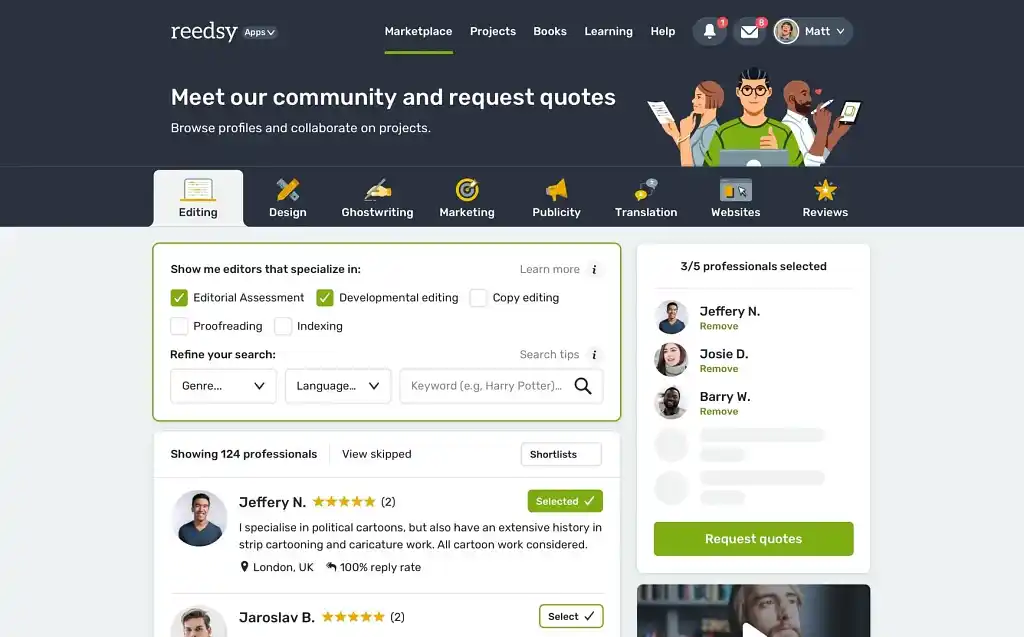
On each professional’s profile, you’ll find a clear overview of their experience and approach to editing. You can see past titles they’ve worked on, and check out reviews left by writers they’ve worked with recently.
Hire an expert

John B.
Available to hire
I specialize in children's books because kids will be your best critics and biggest fans -- next to a good editor.
Becca M.
Available to hire
I'm a novelist of many trad published novels & teacher of 30 years' experience, now a book coach ready to whip your manuscript into shape.

Peter L.
Available to hire
Seasoned editor / award-winning author / college teacher / pastor. I specialize in making writing flow like water–from sentence to book.
Other legitimate sites
If you want to look beyond Reedsy, there are other reputable directories out there as well. Most of these also let you filter editors by service type and subject expertise (though note they’re more regionally specific than Reedsy):
|
Name |
Market |
Key Features |
|
Editorial Freelancers Association (EFA) |
USA |
Rate chart available; membership open to all levels |
|
Editors Canada |
Canada |
Professional certification program; filter by language and subject |
|
Chartered Institute of Editing and Proofreading (CIEP) |
UK |
Professional levels (Entry to Advanced); reflects training hours |
|
Institute of Professional Editors (IPEd) |
Australia/New Zealand |
"Accredited Editor" designation for qualified members |
|
Editors of Color |
Global |
Focus on diverse editors; self-submitted, no formal vetting |
There are also other general freelance platforms like Upwork or Fiverr where you can find editors, but those are open marketplaces with minimal vetting. The list above sticks to industry-specific directories or trustworthy associations.
Now that you know where to find an editor, it’s time to sift through candidates and put a shortlist together.
3. Shortlist editors with the right experience
Beyond the type of editing service they provide, there are a few other important criteria you’ll need to consider when evaluating potential candidates.
Professional background
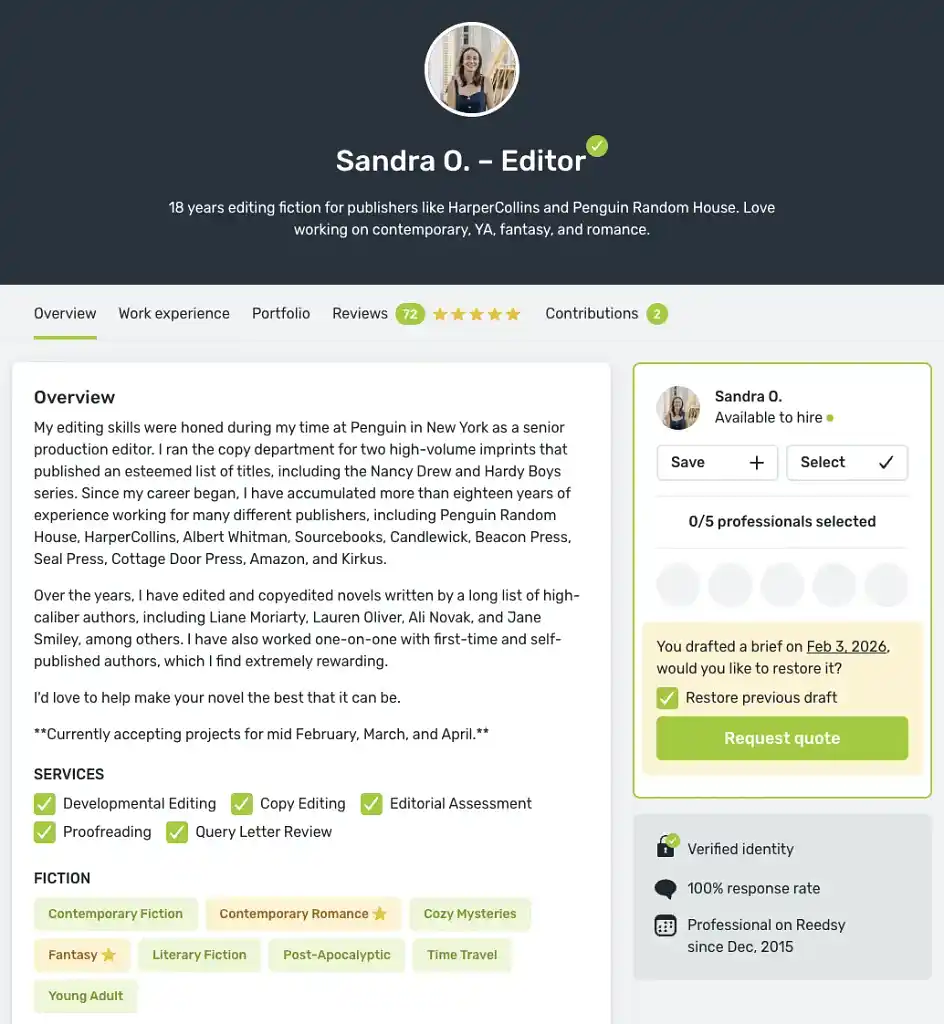
You want editors with enough industry experience to truly know the craft inside and out. That usually means several years working in the editorial departments of traditional publishers and/or experience as a literary agent handling acquisitions, backed up by a portfolio of published books with strong reviews. (All Reedsy editors meet these qualifications!)
Genre experience
Make sure your editor has worked in your genre, or at least shows genuine interest in your subject matter (they are readers too, after all!). More importantly, genre experience means they’ll have solid instincts about what works in your market and what doesn’t. A fantasy editor may be excellent at editing fantasy, but they’re less likely to (pardon the pun) be a wizard at editing memoirs or nonfiction books.
Editing portfolio
Look for editors who’ve worked on books with a similar audience, tone, and style to your own. A debut novelist will likely need more guidance than an established author; commercial fiction has different demands than literary work; and narrative nonfiction isn’t the same as academic writing. It all depends on what your book requires.
Client reviews
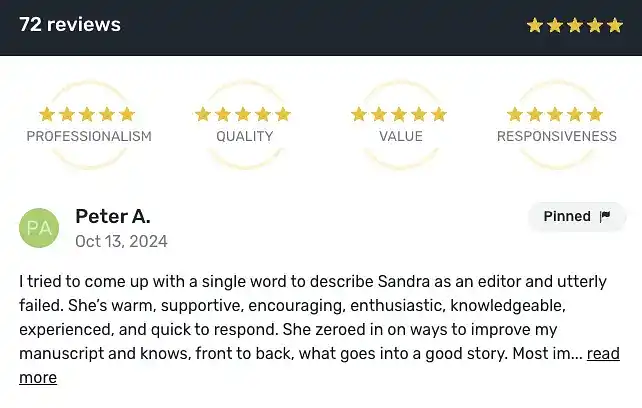
This is where you learn more about the human side of the collaboration. Is this editor very responsive? How do they deliver feedback? Some editors are blunt and direct, while others take a gentler, more encouraging approach. If you read a few reviews, you should be able to get a good sense of the person “behind the pen”.
Language specifications
This is easy to overlook, but it’s worth consideration. Many editors specify the dialect in which they’re most proficient (American vs British English, for example), and whether they’re comfortable with mixed-language dialogue, translated material, or localization. Make sure their language expertise aligns with your needs.
Certifications
While not required, certifications can be a helpful indicator of expertise, especially for copyediting and proofreading. A degree in English Literature or professional editing certifications show commitment to the craft. Still, don’t place too much stock in these — just treat them as helpful supporting evidence, rather than the deciding factor.
Once you’ve shortlisted a few editors who could be a good fit, it's time to reach out, share your book details, and figure out the logistics of working together.
Q: What steps can authors take to ensure an editor's communication style aligns with their needs, particularly when they are sensitive to criticism?
Suggested answer


First, a little tough truth: if you wish to be publishing for any length of time, you will undoubtedly encounter criticism. This could come from an editor at a publishing house, an editor helping improve your work, or reviews from readers on online retailers. Feedback from professional sources, such as myself and others here on Reedsy, are there to help improve your work, and help you and your book be as strong as it can be.
That out of the way, a few ways you can evaluate whether an editor's style meshes with yours:
- Read feedback from other authors in the editor's reviews
- Read the description of how an editor returns feedback. Some editors include this in their bio
- Reach out to the editor directly to ask how they like to communicate. I always love hearing from authors and getting their goals and preferences so I can determine how we can best work together
- Ask for a sample edit. Some editors will do a short sample edit to give you a taste of how they'll work on your book.
Every editor has their own opinion on giving feedback, and having clear communication upfront, during, and after the process, can help both you and the editor be satisfied with the collaboration.
Sean is available to hire on Reedsy ⏺

Nobody responds well to criticism! Nor should you! An editor should offer you a critique, not criticism. Admittedly, it can be hard to tell the difference when on the receiving end. If, however, you feel that an editor is telling you that something is bad, as opposed to how it can become better, that's a problem.
Solution: Ask for an editing sample before making a hiring decision. Sometimes I'll send a few pages from a previous project (with the author's permission) but ideally, if time permits, I'll edit a couple pages from the sample the author included in their Reedsy request. After all, my work product isn't a finished book; it's the changes and comments I make to the manuscript. Testimonials are great but without this sample, you'd be taking the quality of my work product on faith.
Am I giving away product? I guess, but I've been known to assemble a multi-course feast from Costco samples, so putting a few minutes into an editing sample seems like a fair way of paying it forward.
Eric is available to hire on Reedsy ⏺

I completely understand—receiving criticism on something as personal as your writing can be tough, and finding the right editor makes all the difference. To start, you can request a sample edit, which lets you experience how they deliver feedback firsthand. This gives you a chance to see if their approach feels constructive, respectful, and supportive, or if it might come across too harshly for your comfort. I’d also suggest having a candid conversation with potential editors; let them know that criticism can be challenging for you and ask how they handle sensitive feedback. A good editor will be receptive, flexible, and reassuring, offering explanations and encouragement tailored to your needs. Reading testimonials from past clients can also provide insight into an editor’s style—look for comments that speak to their empathy, collaboration, and communication skills. Ultimately, finding someone who respects your creative vulnerability and is committed to helping you grow will transform what can feel like a nerve-wracking process into a genuinely rewarding partnership. It’s about finding someone who not only edits but empowers.
Eilidh is available to hire on Reedsy ⏺

Feeling uneasy about feedback is completely natural—writing is personal, and every writer responds differently to critique. The key to a great editorial partnership isn’t just skill, but communication that fits your needs.
To find the right editor:
- Ask for a sample edit—but don’t just look at the changes. Pay attention to how feedback is phrased. Does it feel constructive and encouraging? Does the editor offer solutions rather than just pointing out issues?
- Look beyond testimonials. Read the Overview section of a prospective editor’s Reedsy profile to get a sense of their tone and personality. If their advice resonates with you, their feedback likely will too.
- Be up front about your concerns. A good editor should empower you, helping you feel closer to your goals and more confident in your voice. If critique feels overwhelming, communicate that early on. The right editor will adjust their approach to make feedback clear, actionable, and encouraging.
As an editor, I focus on making feedback practical and supportive, helping writers refine their work while preserving their voice.
If you'd like to see how we’d work together, I’m happy to provide a sample edit and discuss your preferences to help you decide if I’m the right editor for you.
Ian is available to hire on Reedsy ⏺

I give free samples so you can see my commenting style before you decide if we are a good fit. Be assured, my intention is to advocate for readers and help your words reach your audience smoothly; so my communication with you will always respect your position as the author.
Alex is available to hire on Reedsy ⏺

In your brief, explain this about yourself, and ask for sample edits. When you receive a sample, if a particular suggestion is troubling, ask the editor a good question about it.
Let's say the editor changes your dialogue tags like "remarked" or "sighed" or "countered" to "said" across the board.
Write to them saying, "I thought it was best to avoid repetition and use more descriptive terms. Can you explain why you recommend 'said' instead?"
A good editor will have a good-humored, honest, helpful, and encouraging response, like this: "Yes, it seems like it would be better to use varying terms, but 'said' and 'asked' just melt into the background and highlight what the character is actually saying. Sure, sometimes you want to use other terms for variety, but use them sparingly and when you really need them."
Cindy is available to hire on Reedsy ⏺

If you don't respond well to criticism, buckle up! The publishing life might not be the best fit for you as the criticism never ends (and I say this as someone who's been writing and editing professionally for thirty years! *sigh*).
That said, if you are worried about being critiqued (and we all our--writing is so vulnerable!), it's important to be up front about this. Let the prospective editor know that you are sensitive or new or feeling insecure. I believe most editors here are kind and striving to only offer "criticism" with the best intentions (and "sandwiching" them in all sorts of kind words!). But by being up front, you can gauge the editor's response. If an editor is cold in their reply, they're probably not the one for you. If the editor tells you (as I would!) that while critique is part of becoming a better writer (and certainly part of publishing books!), I want writers to know what I love about their work and that any criticism I offer is solely to make their project even better.
Caryn is available to hire on Reedsy ⏺
4. Brief them on your book project
Whether you’re using a mediated platform or emailing directly, your goal is to make a great first impression while giving editors enough information to provide an accurate quote.
Introduce yourself and your book
Start with a brief, enthusiastic overview of your project. Share your main character’s journey, the central conflict, and anything that makes your book unique. Keep it concise but engaging; you want to give editors a compelling taste of what they'd be working on.

Highlight your connection to the material
If you have a personal or professional connection to your story, mention it. A lawyer writing a courtroom thriller or a marine biologist crafting an ocean-based sci-fi brings credibility that editors will notice.
If nothing biographical stands out, emphasize your deep knowledge of the genre and explain what gap in the market your book fills.
Show you understand your category
If you can, mention a few comparable titles that share your book’s tone, audience, or themes. This signals that you’ve done your homework and understand where your work fits in the market — something editors appreciate!
Include the practical details & a sample
Be clear about your genre, manuscript word count, the specific editing services you need, your budget range, and your ideal timeline. The more specific you are upfront, the more accurate the quotes you'll receive.
Finally, attach your first chapter (or an excerpt of max 3,000 words) so editors can assess your writing style and see how their expertise aligns.
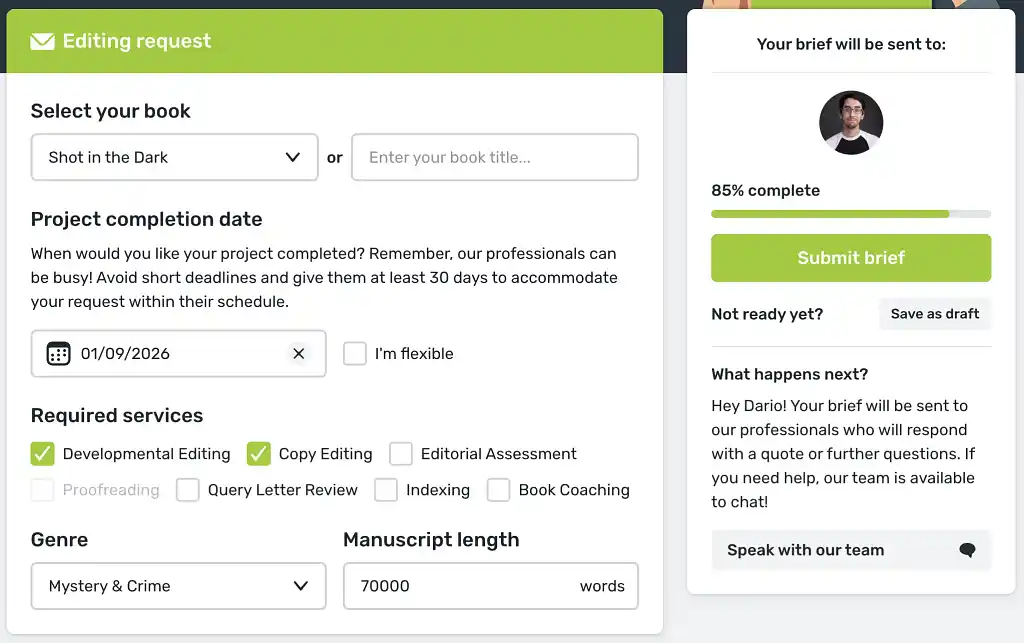
One of the advantages of using Reedsy over other platforms is that you can send one project brief to up to five editors at the same time, and compare quotes all in the same place. With most directories, you’ll need to contact editors individually, manage multiple email threads, and keep your own record of responses.
A note on sample edits
Some authors request sample edits to assess an editor’s style, but many experienced editors are too busy to provide them. More importantly, a small sample doesn't always reveal what it’s like to work with someone over the course of a full manuscript.
You’re better off evaluating editors through the criteria we’ve discussed (especially their reviews and portfolio). Do your research, then trust your judgment.
After several editors respond with their offers, you can compare and choose the best fit for your book.
5. Sign the contract and start the collaboration
Finally, it’s time to finally narrow down your options and select the perfect match. Here are a few more factors you should consider:
📝 Thoroughness: You can assess how thorough an editor is by the depth and scope of their reply. A response packed with thoughtful comments usually signals strong knowledge and enthusiasm for your project.
🗓️ Availability: Some editors may not be able to devote all of their time to your book right now. If your project is time-sensitive, try to find an editor ahead of finishing your manuscript.
💰 Cost: You’ll likely receive similar quotes, but if you have a limited budget, you may have to factor in small price differences. That said, if you’re really eager to work with a particular editor, talk to them about alternatives.
🎯 Pro tip from Reedsy co-founder Ricardo Fayet: “Ask if you can make the payments in installments, or if there’s room to adjust the scope of work to lower the price. Someone you really want to work with usually really wants to work with you too.”
With everything lined up, you’re ready to hire your editor and kick off the collaboration.
Review the contract and payment system
In practical terms, this step usually involves signing a contract and arranging payment. Most professional editors will provide their own contract, but if they don’t, ask for one or supply your own to make sure you’re legally protected.
For bigger projects, paying in installments is standard practice. A common setup is 50% upfront and the remaining 50% on completion, which helps keep both parties accountable. But hiring directly remains a risk: you’re responsible for contracts, payment terms, and trust — there's no safety net if things go sideways.
On platforms like Reedsy, you get an automatically generated contract (drafted by legal professionals), secure payment escrow, and built-in dispute resolution if anything goes wrong. Your payment is held until the work is delivered, protecting both sides.
The trade-off is that Reedsy charges a small commission (split between you and the editor), which adds about 10% to your cost compared to hiring directly. Think of it this way: Reedsy adds a bit of overhead for the convenience and safety it provides, whereas hiring directly might be slightly cheaper but requires a lot more due diligence.
Remember, editors are incredibly valuable collaborators for both experienced and new writers, so choose yours carefully. To learn more about how much editing will cost you based on your genre and word count, head to the next post in this guide.