Guides • Understanding Publishing
Posted on Nov 21, 2025
The Complete Guide to Ebook Distribution

Loretta Bushell
Loretta is a writer at Reedsy who covers all things craft and publishing. A German-to-English translator, she specializes in content about literary translation and making a living as a freelancer.
View profile →You’ve written your ebook. You’ve edited it. You’ve commissioned a cover, formatted the interior, and written a blurb. Perhaps you’ve even come up with a witty pen name. All that’s left is to distribute your ebook to online retailers and start selling. But how? And to which retailers?
As a self-publishing author, you have three main options:
- Join Amazon KDP Select and publish only on Amazon in exchange for exclusive benefits.
- Upload to multiple online retailers individually.
- Distribute to multiple online retailers at once via an ebook aggregator.
The table below gives an overview of these options. Note that you can also combine options 2 and 3 by uploading your ebook directly to the largest retailers, while using an aggregator to reach all the smaller ones.
|
🚚 Distribution option |
✅ Pros |
❌ Cons |
🏆 Best for |
|
1. Join Amazon KDP Select and publish only on Amazon in exchange for exclusive benefits |
Access to Kindle Unlimited, the “Netflix for ebooks”; exclusive promotions |
Can’t reach readers who don’t shop on Amazon; vulnerable to algorithm changes; hard to stand out |
First-time authors whose genre is popular on Kindle Unlimited and whose primary audience is based in the US and/or the UK |
|
2. Upload to multiple online retailers individually |
Reach a wide audience; keep 100% of the royalties from each retailer |
Can be time-consuming; requires research |
Authors who want to expand their reach beyond Amazon and would rather invest time now to save money later |
|
3. Distribute to multiple online retailers at once via an ebook aggregator |
Highly convenient; very wide reach |
Pay a percentage of net royalties or a flat fee for the service |
Authors who want maximum reach at the lowest effort and are willing to sacrifice some income for this |
Let’s look at each option in more detail, starting with the million-dollar question: should you join Amazon KDP Select?
Option 1: Join Amazon KDP Select
First things first, let’s clear something up: you can still publish on Amazon KDP without joining KDP Select, Amazon’s exclusivity scheme. In fact, you’ll almost certainly want to distribute your ebook to Amazon KDP regardless of your chosen distribution path; it would be a wrong move, in our opinion, to pass up on the 68% of the global ebook market controlled by the megacorporation.
Whether to join KDP Select is not such a straightforward decision. The opt-in program offers exclusive benefits in exchange for only selling your ebook on Amazon (print copies can be sold elsewhere). Fortunately, you can change your mind if you realize it’s not for you, as you only enroll in KDP Select for 90 days at a time. At the end of this period, you can opt out or continue to participate for another 90 days.
✅
Should you go Amazon-exclusive?
Answer these 5 questions to find out!
You can read our full article on KDP Select here, or read on for the key takeaways.
The primary benefits of the program are:
-
Access to Kindle Unlimited (KU), the “Netflix for ebooks.” Readers can read unlimited books from the pool for a set monthly price. Authors get paid per page read, but the exact payout changes monthly depending on the total number of KU subscribers and pages read that month. It’s typically just over $0.004, which equates to $1.20+ every time someone reads a 300-page book cover to cover.
-
Countdown deals (for 1 week in 90 days) and free promotions (for 5 days out of 90). In addition to an attractively low price, you get a guaranteed visibility boost during these promotions, as your ebook will be featured on the Kindle Store Deals page. This is great for boosting sales numbers and getting more reviews — which are crucial for long-term success on Amazon.
Naturally, these perks come at a cost. The main disadvantage is obvious: you won’t reach all the conscientious objectors and other readers who don’t shop on Amazon. But there are other factors to consider, too: if you put all your books in one basket, you’ll be very vulnerable to changes in Amazon’s algorithms, and it can be hard to stand out among the 1.4 million+ self-published books released on Amazon each year.

FREE COURSE
Amazon Algorithms for Authors
Learn to optimize your book description, pick categories, and sell more books.
So, is KDP Select worth it? The answer depends on three things:
-
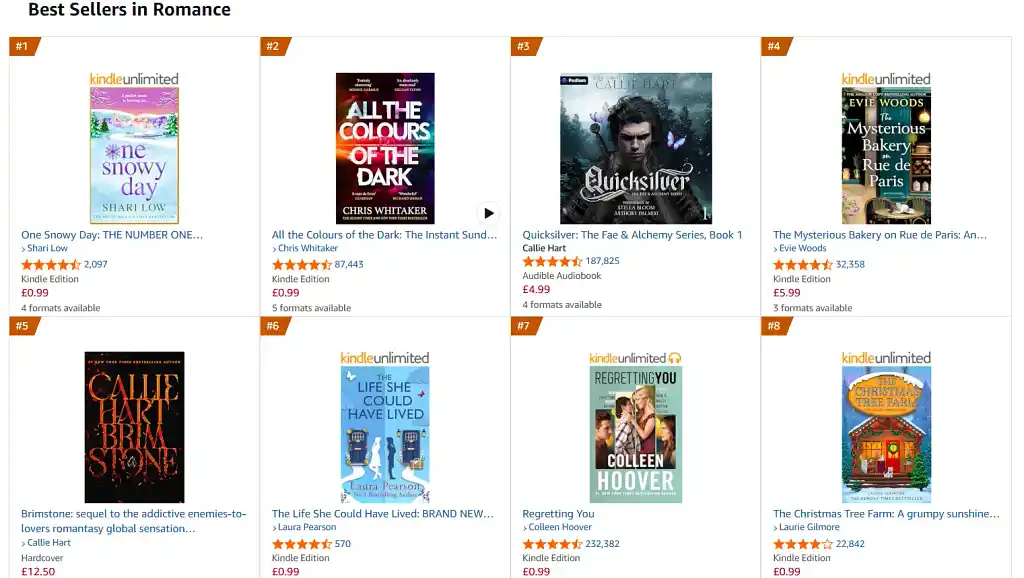
Your genre. Some genres are more popular with KU readers than others. Before making any decisions, head to the Amazon Best Sellers pages for your book categories. If none of the top 20 books display the KU logo, chances are your genre isn’t very popular with KU readers. Conversely, if half of the bestselling books are in KU, you should seriously consider joining KDP Select.
-
Your audience’s location. Amazon dominates the ebook market in the US and the UK, but not in all countries and regions. In Canada, for instance, it is rivalled by Kobo, so authors looking to reach Canadian readers may wish to distribute to Kobo Writing Life as well as Amazon — in which case, they can’t join KDP Select.
-
Your long-term goals. KDP Select’s promotional deals are great for short-term visibility and sales. But if you want to build a sustainable career as an author, you need to think more long-term. Amazon algorithms are subject to sudden changes, whereas you have complete control over your author website and mailing list. Once you’ve built a dedicated fan base, readers will appreciate the option to buy your book from their preferred store, and you’ll be able to make more money from consistent sales than from page reads.
FREE COURSE
Book Marketing 101
Learn seven tried-and-true strategies for boosting book sales.
In short, we recommend KDP Select to new authors whose genre is popular on KU and whose primary audience is based in the US and/or the UK. Once you’ve got a few sales and reviews, you can opt out and concentrate your marketing efforts elsewhere as you go wide.
If your target market is outside the US and the UK, your genre is not so popular on KU, or you already have an established following, we recommend that you don’t join Kindle Select and instead go wide from day 1.
⚠️ Once you’ve decided to go wide, stick with it. It’s a slow and steady race, and removing your book from other retailers to join KDP Select will undo all of your progress.
Option 2: Distribute to multiple online retailers
Distributing your ebook to multiple retailers yourself is definitely the hardest way to go wide — but it’s also the most profitable. If you can invest the time and effort into uploading your manuscript to each individual platform, you’ll get to keep 100% of the royalties each pays you, instead of giving a cut to an aggregator (see option 3). You’ll also be able to access sales data for each retailer directly, giving you a comprehensive understanding of your book’s performance.
There are hundreds of ebook retailers in existence, so it’d be extremely difficult (and time-consuming!) to distribute to every single one of them (if you want to get close, you’ll definitely need an aggregator). We recommend you pick three to five of the most popular retailers in your target market.
Here are the retailers with the largest market share in most English-speaking markets. Although we list the pros and cons of each, there’s nothing stopping you from distributing to all five retailers for the greatest possible reach. If you’ve got the time and patience, why not?
|
🛒 Retailer distribution platform |
💸 Royalties |
✅ Pros |
❌ Cons |
🤔 Worth it if… |
|
70% on ebooks sold for $2.99–$9.99 in certain territories; otherwise 35% |
Widest reach; user-friendly interface |
Difficult to stand out without a lot of marketing; 70% royalties only under certain conditions; poor customer service; susceptible to algorithm changes |
You want to be discovered by new readers (so basically worth it for everyone!) |
|
|
Apple Books (iTunes Connect) |
70% |
70% royalties without exception; reach loyal Apple customers; no price match, meaning you can charge more than on other platforms |
Only reach Apple users |
You want to reach loyal Apple customers (a younger crowd on average) |
|
70% on ebooks sold for $2.99+; otherwise 45% |
Popular in non-US markets, particularly Canada and Europe; user-friendly interface; strong promotional tools |
70% royalties only on sales above $2.99 |
You want to reach readers in Canada and Europe |
|
|
70% |
Humans (not algorithms) select featured books; 70% royalties without exception |
Limited reach (mostly US); have to submit complicated tax forms |
You value the human touch enough to work your way through lengthy documents |
|
|
70% |
70% royalties without exception |
Very small market share; bank info has to be reviewed |
You have time and energy to spare! |
Once you’ve selected your retail partners, you might be wondering how to distribute your ebook to them. Although it varies somewhat between platforms, the process generally looks something like this:
-
Create an account.
-
Enter your financial information.
-
Enter your book’s metadata, including its book description, genre/categories, and ISBN.
-
Upload your formatted manuscript.
-
Upload your book cover.
-
Set the price. Align it with other indie books in your genre, or price it just below to encourage initial sales and reviews.
-
Click “Publish.”
You can find specific guides to publishing your ebook on each platform below:
Option 3: Use an aggregator
If creating all those accounts sounds overwhelming, and/or you want to cover all bases without exception, you might be in need of an ebook aggregator.
An aggregator distributes your book to tens or hundreds of retailers and library partners in one go, in exchange for a cut of the royalties or a fixed fee.
Of the many ebook aggregators out there, we recommend Draft2Digital to most authors whose target readers live in major English-speaking markets. For maximum international reach and for publishing books in other languages, we recommend StreetLib. And for authors who find themselves selling a significant number of copies of their ebooks, we recommend switching to PublishDrive to make the most of the 0% royalty share.
The table below shows the pros and cons of these three aggregators in further detail.
|
🚚 Aggregator |
💰 Cost |
✅ Pros |
❌ Cons |
🏆 Best for |
|
No upfront fees; Draft2Digital takes 10% of the retail price per sale |
Hundreds of partners; user-friendly interface; good customer support; automated back matter |
Leaves out some non-Western markets |
Newer or smaller authors whose target readers live in the major English-speaking markets |
|
|
Free plan for 1 book with up to 29 distribution channels; other subscription options from $13.99 per month; keep 100% of net royalties |
Distribution to non-Western markets; no royalty share; user-friendly interface |
Monthly subscription fee for more than 1 book |
Authors who are confident they’ll sell a lot of copies and earn back their subscription fee from the higher net royalties |
|
|
Free plan, in which StreetLib takes 30% of net revenue; pro plan for $99 per year, in which StreetLib takes 15% of net revenue |
Choice of free and paid plans; distribution to non-Western markets; author portal in multiple languages |
Below-average royalty earnings; less user-friendly interface |
Authors publishing in languages other than English |
Whichever aggregator you choose, you’ll have to create an account and upload your ebook as previously mentioned. However, you’ll additionally need to select which retail and library partners to distribute to.
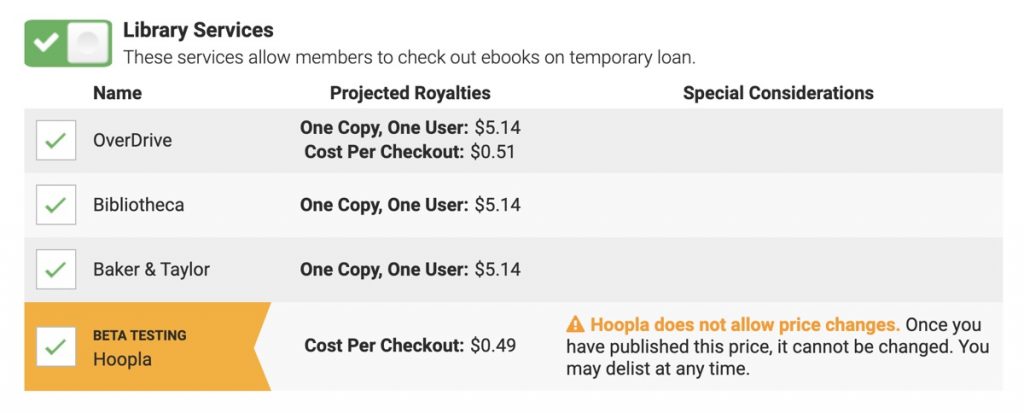
If you go with Draft2Digital or StreetLib, we recommend that you upload your ebook directly to your most promising retailers (including Amazon) and use an aggregator to distribute to all other partners. This maximizes profit from the retailers who pay you the most — without compromising on discoverability.
Whatever your decision, don’t forget the most overlooked step to successful ebook publishing: marketing. The sooner you create your marketing strategy, the better. Head to our blog post on marketing a book for pointers, or read our guide to print book distribution. Good luck!