Blog • Understanding Publishing
Last updated on Oct 12, 2026
The 18 BEST Self-Publishing Companies of 2026

Loretta Bushell
Loretta is a translator, proofreader, and writer with 4+ years of experience in the publishing industry. She helps freelancers and authors build sustainable careers.
View profile →
Martin Cavannagh
Martin Cavannagh is a publishing professional with 10+ years of experience in content strategy, editorial development, and author education within the indie publishing space.
View profile →There are quite a few companies out there advertising their services to self-publishing authors. Some of them are reputable, but many of them are vanity presses looking to take advantage of aspiring writers.
Before using a self-publishing company, it’s good practice to verify its trustworthiness. If you’re unsure, you can contact us directly by completing this form, and we’ll confirm if the company is reputable. Alternatively, you can keep things simple by sticking with a recommended company from the list below!
In this article, we’ll guide you through the 18 best self-publishing companies in the industry to help you determine which one(s) you need.
Hire a publishing professional

Mamie S.
Customer-focused and strategy-driven digital marketer with 10 years of experience at Abrams Books and Simon and Schuster.
Request a quote
Kate L.
12 yrs marketing experience in consulting, launching, and promoting books. Specialized in sci-fi, fantasy, gamelit/litrpg, spec fic, LGBTQ+
Request a quote
Eleanor P.
An award-winning book marketer and coach with 11+ years experience. Detailed sales-focused strategies, audits, social media, ads and more.
Request a quoteOur top picks
Every self-publishing company has its own strengths and weaknesses. The table below provides a quick overview of the self-publishing companies that we recommend to most authors.
|
🧰 Company |
🛎️ Service |
✅ Pros |
❌ Cons |
👑 Best for |
|
Reedsy |
Author services |
Free book formatting; top-quality editors and designers to suit different budgets; project and payment protection |
More expensive than Upwork and Fiverr |
Giving your book a professional polish |
|
Amazon KDP |
Direct ebook sales |
Unparalleled reach; marketing tools; free editing |
Hard to stand out; poor customer support |
Reaching a wide global audience |
|
Draft2Digital |
Ebook distribution to multiple retailers |
User-friendly interface; excellent customer support; automated back matter |
No KDP Select or KU enrollment when you “go wide” through D2D |
A user-friendly experience |
|
KDP Print |
Print-on-demand services |
Cheap printing costs; fast shipping times; wide reach |
Lower print quality than competitors; less likely to be ordered by brick-and-mortar stores |
Printing your book on a budget |
|
IngramSpark |
Print-on-demand services |
The go-to for brick-and-mortar stores; high-quality printing |
Tricky user interface; slow customer service |
Getting your book into physical stores |
|
Spotify for Authors |
Audiobook distribution |
Helpful marketing insights |
Confusing royalty system |
Marketing and sales analytics |
|
Voices by INaudio |
Audiobook distribution |
Wide reach; keep 100% of Spotify royalties |
Limited analytics |
Going wide when you’re already on Spotify for Authors |
Of course, there’s no single service that will work best for every author. Read on to find out which companies are well-suited to your specific needs.
Best author services
If you want your book to gain traction in the first place, it must be written to a high standard and presented professionally. So before you consider the companies below, make sure you’re 100% happy with the editing, design, and formatting of your book. Thankfully, there’s one place where you can access world-class talent and resources to manage all three 😉
Reedsy
🌎 Geographic reach: Global
🖋️ Service(s): Editing, formatting, cover design, illustration, and marketing
💰 Cost to authors: Varies by service; average costs here
🤝 Author collaborations in 2026: 20,000+
👑 Best for: Giving your book a professional polish
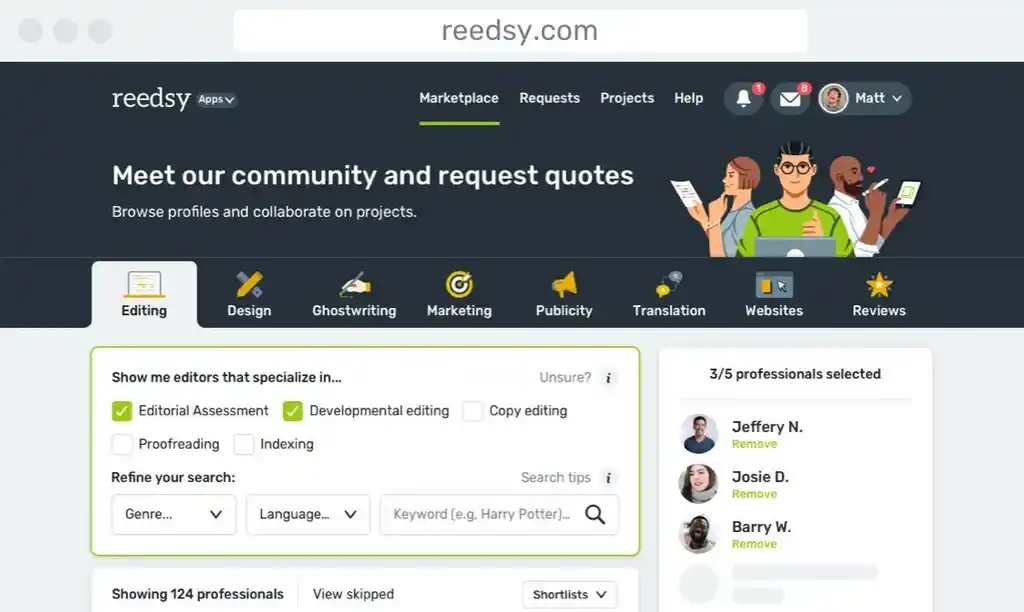
Reedsy’s marketplace connects authors to freelance publishing professionals with years of relevant experience in traditional publishing. Our 1,900+ editors offer services ranging from developmental editing to proofreading to transform your draft into a print-ready manuscript.
Or if an artistic eye is what you’re looking for, our cover designers and illustrators can create stunning visuals to bring your story to life. Once you’re ready to share your stories with the world, we also have audience development experts: dozens of marketing and advertising strategists who can showcase your book (and your brand) to readers.
Finally, if you’re not sure what you need, consider getting a publishing consultant to evaluate your book and plan out a publishing path for you. Whether you’re just starting out on this journey or looking to refresh your existing strategy, a consultant can advise on how to perfect your book and bring it to market.
Each of our 3,700 total professionals sets their own rate, and you can get quotes from up to five at a time, so you can find the best fit for your needs and budget. Admittedly, many of our professionals don’t come cheap — but that’s because they're committed to quality, human-driven workflows.
In addition to the marketplace, Reedsy also has a free book formatting tool that allows any author to quickly create professional-grade ebooks and print book files.
FREE FORMATTING APP
Reedsy Studio
Format your manuscript for print or EPUB with a single click.
|
Pros of Reedsy |
Cons of Reedsy |
|
➕ Work with experienced, vetted editors and designers |
➖ Can be more expensive than sites like Upwork and Fiverr |
|
➕ Format your book easily |
|
|
➕ Project and payment protection |
|
|
➕ Quick customer service |
Best ebook retailers
Ebook retailers are online bookstores where you can upload and sell your book directly to customers. While Amazon is the best-known ebook retailer, there are other strong alternatives depending on your audience and needs. Let’s compare the four main players.
Want to upload your book to multiple retailers at once? Consider using an aggregator.
Amazon Kindle Direct Publishing (KDP)
🌎 Geographic reach: Global
💰 Cost to authors: Free
💸 Royalties: 70% on ebooks priced between $2.99 and $12.99 or 35% outside this range
👑 Best for: Reaching a wide global audience
Amazon is the world’s biggest book retailer. It accounts for a whopping 68% of global ebook sales. With such a massive potential audience, it’s no surprise that a large majority of self-publishing authors choose to release their books on KDP. In fact, 87% of respondents to Written Word Media’s 2024 Indie Author Survey named Amazon as their top revenue source.
KDP’s size and popularity come with some disadvantages, though. It can be hard to gain traction without investing a lot of time and effort into promoting your book, and the platform has very poor customer support.
So why do authors continue to publish on KDP? Because for most writers, Amazon is the place to find readers — unless you have reason to believe your target audience shops elsewhere.
|
Pros of Amazon KDP |
Cons of Amazon KDP |
|
➕ Unparalleled reach |
➖ Hard to stand out in the crowded market |
|
➕ Various marketing and promotional tools, such as KDP Select (see below) |
➖ Lower royalty rates outside the $2.99–$12.99 price range |
|
➕ Edit for free even after publication (as long as the word count doesn’t change by more than 10%) |
➖ Notoriously poor customer support |
👩🏫 KDP Select
Note that Amazon KDP is not the same as KDP Select. KDP Select is Amazon’s exclusivity program — if you enroll in it, you can only sell your book on Amazon throughout a renewable 90-day participation period. In exchange, Amazon will give you access to price promotions and enrollment in Kindle Unlimited, where many readers discover new books (especially in certain genres like romance).
To find out whether KDP Select suits your needs, read our post “KDP Select vs. ‘Going Wide’ — Which Option is Right For You?”
Q: Should authors sell exclusively on Amazon?
Suggested answer

In the children's book world, an author selling their book only on Amazon is not ideal for several reasons. Most advance trade review outlets will only review books that have a broad distribution, or at least are sold also in bookstores or non-traditional book outlets. Also, selling only on Amazon largely cuts out the school and library distribution, which typically use wholesalers. Amazon, in my opinion, is an important part of book sales, naturally, due to its huge marketshare of children's book sales, but best done in conjunction with other sales and marketing opportunities.
Tara is available to hire on Reedsy

For most authors—especially if you’re just starting out—selling exclusively on Amazon is a smart move. Managing multiple platforms can be overwhelming, and Amazon’s KDP Select program gives you some great tools to build momentum. Page reads from Kindle Unlimited and features like countdown deals make it easier to get your book in front of readers without spreading yourself too thin.
That doesn’t mean you’re stuck with Amazon forever. Once you’ve got some traction—like more reviews, a growing fanbase, or even a backlist—you can start exploring other platforms or even direct sales. But starting with Amazon keeps things simple and helps you focus on what matters most: reaching readers and building your audience.
If you’re new to publishing, Amazon isn’t just a platform—it’s the best foundation to launch your career.
Jd is available to hire on Reedsy

It depends on your ultimate career/business goals. A book that is only published on Amazon looks like a self-published book. For non-fiction, if your goal is the elevation of your thought leadership status, you benefit from your book being "everywhere". Including links to numerous retailers on your website is not a traffic flow exercise, where we are trying to spread out your sales - it is a branding exercise. We want to show the prospective reader, or podcast host, or convention booker that your presence is as far and wide as possible. Widespread distribution increases perceived legitimacy.
Chris is available to hire on Reedsy
Apple Books

🌎 Geographic reach: Global (but restricted to Apple users)
💰 Cost to authors: Free
💸 Royalties: 70% on all ebooks regardless of price point
👑 Best for: Reaching younger adults
Apple Books is one of those “elsewheres” with a narrower user demographic. It might have a much smaller share of the ebook market than Amazon, but it’s still the go-to option for many loyal Apple users. Draft2Digital executive Dan Wood has noted in interviews that “Apple seems to have captured a much younger crowd.”
So if your target audience is especially young and tech-savvy, you might find better results on Apple Books than on Amazon — especially since you can enjoy 70% royalties at all price points. You’ll also face less competition from other authors.
|
Pros of Apple Books |
Cons of Apple Books |
|
➕ Best royalty structure |
➖ Limited to Apple users |
|
➕ Easier to stand out from the competition |
➖ Fewer marketing and promotional tools |
|
➕ Loyal customer base |
|
|
➕ Audiobook distribution also available |
Kobo Writing Life
🌎 Geographic reach: Global (but particularly prevalent in Canada and Europe)
💰 Cost to authors: Free
💸 Royalties: 70% on ebooks priced $2.99 and higher or 45% for ebooks priced below $2.99
👑 Best for: Robust promotional tools that don’t require platform exclusivity
Kobo Writing Life is another serious alternative to Amazon KDP. Owned by Canadian company Rakuten Kobo, this self-publishing platform makes ebooks accessible to readers from more than 190 countries. It boasts a particularly strong presence in the Canadian and European markets.
Similar to Apple Books, Kobo’s royalty structure is slightly better than Amazon’s. Plus, if you publish on the platform directly (as opposed to via an aggregator), you can access exclusive promotion opportunities and retain the freedom to make your ebook available elsewhere.
In fact, the only real advantage Amazon has over Kobo Writing Life is a higher market share, particularly in the US. (Though of course, if the US is where your target audience lives, there’s no getting around it.)
|
Pros of Kobo Writing Life |
Cons of Kobo Writing Life |
|
➕ Good royalty structure |
➖ Lower market share, particularly in the US |
|
➕ Exclusive promotion opportunities when you publish directly on Kobo Writing Life |
|
|
➕ Strong international reach |
|
|
➕ Audiobook distribution also available |
Barnes & Noble (B&N) Press

🌎 Geographic reach: Primarily the United States
💰 Cost to authors: Free
💸 Royalties: 70% on all ebooks regardless of price point
👑 Best for: Fast royalty payments
B&N Press is the self-publishing platform owned by the big-box bookseller Barnes & Noble. Despite the name recognition, its reach is limited: it’s not very well-known outside the US, and even within the US it has a much smaller share of the market than Amazon.
Q: What are the most effective ways for authors to begin monetizing their writing, particularly in the early stages of their career?
Suggested answer

If you are a non-fiction author you can use your book as a platform to get speaking engagements even before your book is published. Once it is published, ask the business you are speaking for to purchase books for each of the conference attendees and then include this purchase in your speaking "package."
Melody is available to hire on Reedsy

If by "best," we mean "fastest," then self-publishing is the way to go, since there're no gatekeepers, meaning no wait time. As soon as your book's done, you can get it up for sale. But if we mean best as in "long-term for your career," that becomes a fuzzier proposition because you need to weight the wait time, rejection, potential rewrites/edits, and possibility of never having something accepted inherent in traditional publishing against the prestige that still comes with making it into that world. It also depends what level of control you want for your work. You obviously get much more with self-publishing, but perhaps you'd benefit from the edit you might get from an editor at a legacy press. Lots of variables here, but my advice is always to be honest with yourself regarding your goals.
Legacy prestige is great and all—and, if it goes well, can be much more lucrative—but there's a lot to be said for having full control of your product.
Brett is available to hire on Reedsy

Take advantage of every single opportunity that comes your way in the beginning. Don't be too picky. If the front door is locked, go in the side door. Or find a window. I had great luck with blind queries in the beginning and that was before email, kids. I built many relationships that way, and most of all, keep believing in your talent, be agile, be diligent, and above all LEARN HOW TO SELL YOURSELF.
Bev is available to hire on Reedsy
On the plus side, B&N Press pays higher royalties than either Amazon KDP or Kobo Writing Life. It also pays these royalties the fastest — 30 days after the end of the month, compared to 45 on Kobo Writing Life and Apple Books, and 60 on KDP.
|
Pros of B&N Press |
Cons of B&N Press |
|
➕ Excellent royalty structure |
➖ Primarily limited to the US market |
|
➕ Get paid faster |
➖ Small market share compared to Amazon |
|
➕ Print-on-demand services also available |
Best ebook aggregators
Ebook aggregators save you time and energy by distributing to a bunch of book retailers at once and centralizing sales data. However, the downside is that you’ll have to pay an extra fee for the service. Let’s look at three of the most trusted options.
Draft2Digital (D2D)
🌎 Geographic reach: Global
💰 Cost to authors: $20 to open an account, plus $12/year if your annual earnings are below $100.
💸 Royalty share: Draft2Digital takes 10% of the retail price
📇 Distribution: Amazon, Apple Books, Barnes & Noble, Kobo, OverDrive, Everand, Bibliotheca, and hundreds of other stores and libraries
👑 Best for: A user-friendly experience
If you decide to use an aggregator, Draft2Digital is our go-to recommendation. They have excellent customer support, a user-friendly dashboard, and a sleek website design. But that’s not all — they also automatically add your newest ebook to the “Also by this author” section of every other ebook you’ve distributed via D2D. For authors with extensive backlists, this administrative bonus can save you a lot of time and hassle.
|
Pros of Draft2Digital |
Cons of Draft2Digital |
|
➕ Reach hundreds of stores at once |
➖ No audiobook distribution |
|
➕ User-friendly interface |
➖ No Amazon-exclusive perks (true for all aggregators) |
|
➕ Excellent customer support |
|
|
➕ Automated back matter |
PublishDrive
🌎 Geographic reach: Global
💰 Cost to authors: Free for 1 book with 29 distribution channels; from $13.99 per month for multiple books, more distribution channels, and promotional tools
💸 Royalty share: Keep 100% of your royalties
📇 Distribution: Amazon, Apple Books, Google Play, Barnes & Noble, Kobo, Everand, Bookmate, and hundreds more
👑 Best for: Authors who expect to make a lot of sales
Like Draft2Digital, PublishDrive has a modern interface and regular sales reports to keep you up-to-date on your profits. It distributes to over 400 stores and 240,000 libraries — including non-Western retailers like the popular Chinese e-commerce platform DangDang.
Q: What are the most common mistakes authors make when pricing their self-published books, and how can they avoid them?
Suggested answer
A big mistake I see authors make is not thinking through how their pricing affects readers. If you price your book too high, you risk scaring people off. If it’s priced too low, readers might assume it’s not worth their time. Finding the right balance—what I like to call the “sweet spot”—is so important.
The best place to start is by looking at other books in your genre. What are they priced at? This gives you a good idea of what readers are willing to pay. Temporary promotions, like dropping your price to $0.99, can help boost visibility, but I don’t recommend staying there. It’s easy to get caught in a “race to the bottom,” where constant discounts make your book feel less valuable.
As your book gains credibility—through reviews, awards, or just word of mouth—you can raise your price to reflect that value. Pricing isn’t just about numbers; it’s about showing readers that your book is worth their time and money.
Jd is available to hire on Reedsy
The most common mistake authors make when pricing their self-publishing books is not pricing it so that they are covering all of their outlaid costs. Some authors only look at comparative titles in the marketplace and how they are priced. Indeed, this is an important step in figuring out what to price a book, but if you are not making a return on investment to at least to recoup your spend, not to mention a profit, then your list price is failing you.
Tara is available to hire on Reedsy

My answer, as usual, is based solely on Amazon, where 80-100% of sales happen for most authors.
1. Missing KDP's thresholds for Kindle
Amazon pays you 70% of the retail Kindle price - if the price is in the range $2.99 - $9.99.
If the price is lower than $2.99 or $10 and higher - you will receive only 35% in royalties.
Kindle book which is more expensive than $10 and below $29 has no economic justification from the self-publishing point of view.
2. The same price for the paperback and Kindle
Those are two distinct products. Kindle should be cheaper than paperback. There are no production or distribution costs involved for an eBook.
Plus, Amazon customers are trained to expect cheap and discounted stuff, especially for such a flagship category like Kindle books.
3. Pricing too low
This happens more with hard copies. In 2025, Amazon introduced new royalty structure: 50% royalties for books cheaper than $9.99, and 60% for $9.99+ books.
The trick is in fine print, as usual. Those percentages are counted after deducting the printing (and distribution) fee. So, when the same book costs $8 or $12, your royalties will be dramatically different. Let's say the printing cost is $3: in the $8 scenario you will get half of the five dollars; in the $12 scenario, you will receive 60% of nine dollars ($2.5 vs. $6).
Avoid the less-than-$9.99 price range, unless you have particularly good reason to price your book so low.
With Kindle there is a dramatic difference between $2.99 book and $2.49 book because of the thresholds mentioned in point #1 (about $2 vs. 87 cents).
Personally, I find only one price point below $2.99 worth trying: 99 cents. It is good for entry point of a series or for promotional purposes.
4. Pricing too high
It applies especially to Kindle format. First, because the royalties’ thresholds penalize higher prices. Second, because Kindle readers are cheap.
First-time authors think: "It's just $5, a price of the coffee, surely people will be willing to buy my book." They forget that they don't sell coffee, but eBooks. Amazon customers have millions of other titles free or priced incredibly low to choose from.
In case of paperbacks, it is more about the subject matter and length of the book. If you try to sell your 70-page novella for $20, good luck. Non-fiction books solving specific problems are more "justified" to cost more.
In the fiction genres the competition is fiercer. Readers have plenty of alternatives, so if you overdo your price, they may skip your book and pick your competitor’s book.
5. Pricing out of market
If you aren't a household name, you'd better accommodate to market's expectations. Don't price your debut novel, or poetry book, or children book $50 - it is just too expensive.
Don't price your business manual $0.99 - people will think it's so cheap because it's trash.
Michal is available to hire on Reedsy
What really sets PublishDrive apart, however, is its subscription-based service. You get to keep 100% of your royalties and instead pay a flat monthly rate. If you anticipate a substantial number of sales, this model will save you money in the long run (and it’s free for your first book if you’re not too concerned about detailed sales reports and promotional tools).
|
Pros of PublishDrive |
Cons of PublishDrive |
|
➕ Reach non-Western markets |
➖ Flat rate can be more expensive if you don’t sell many copies |
|
➕ Keep 100% of your royalties |
➖ No promotional tools on the free plan |
|
➕ User-friendly interface |
➖ No Amazon-exclusive perks |
|
➕ Audiobook distribution also available |
StreetLib

🌎 Geographic reach: Global
💰 Cost to authors: Free for Basic plan or $99 per year for Pro plan
💸 Royalty share: Keep 70% of net revenue on the Basic plan or 85% on the Pro plan
📇 Distribution: Amazon, Apple Books, Google Play, Barnes & Noble, Kobo, Everand, OverDrive, and dozens of other retailers and libraries
👑 Best for: Publishing in languages other than English
StreetLib is even more internationally friendly than PublishDrive. Not only does it distribute ebooks across the globe, but it also offers author portals in several languages and regions, including South Asia, the Middle East, and Africa. If you plan to stick to the US and Europe, it’s got your back there as well (though you might not need it as much as more international authors).
The downside of StreetLib is that the company takes a higher percentage of your earnings than Draft2Digital or PublishDrive. If you’re keen to expand beyond western markets, StreetLib is worth the trade-off, but otherwise you can stick with another aggregator.
|
Pros of StreetLib |
Cons of StreetLib |
|
➕ Reach non-Western markets |
➖ Lower royalty earnings |
|
➕ Upload from 6 continents |
➖ No Amazon-exclusive perks |
|
➕ Choice of plans |
|
|
➕ Audiobook distribution also available |
Best print-on-demand (POD) services
While plenty of self-publishing authors rely heavily on the ebook market (especially if they’re getting reads through Kindle Unlimited), some readers still prefer getting their hands on a beautifully designed paperback.
POD services allow almost any indie author to put paperbacks up for sale without breaking the bank, since each book is only printed after an order has been placed. If this piques your curiosity, here’s a quick look at the major players in POD.
And for a deep dive, read our post where we personally tested and compared the nine best POD services out there.
KDP Print (formerly CreateSpace)
🌎 Geographic reach: Global
💰 Cost to authors: $1-$3 per paperback (color ink and thicker paper cost more) and $5-$6 per hardcover, but generally budget-friendly
💸 Royalties: 50% on print books priced up to $9.98 or 60% on books priced at $9.99 or higher
📇 Distribution: Amazon and other retailers through Expanded Distribution
👑 Best for: Printing your book on a budget
We recommend Amazon’s POD service for most authors. KDP Print has the cheapest per-unit printing costs, ships the fastest, and reaches not just the gigantic Amazon customer base, but also shops and libraries across the globe via the Expanded Distribution option.
That said, there are two main downsides to KDP Print: firstly, it has fewer customization options than competitors, and secondly, the print quality is not quite as high. If your book has unusual specs or includes lots of charts and images, it’s probably not the best option for you.
|
Pros of KDP Print |
Cons of KDP Print |
|
➕ Cheapest printing costs |
➖ Lower print quality |
|
➕ Fastest shipping times |
➖ Fewer customization options |
|
➕ Reach a huge global audience |
➖ Not the number one choice of brick-and-mortar stores and libraries |
|
➕ Distribute to external stores and libraries |
|
|
➕ Same platform as your KDP ebooks |
Q: What should authors look for when choosing a book printing service or POD provider?
Suggested answer

One of the biggest negative surprises I’ve seen with independent authors I’ve worked with is discovering that print quality can sometimes be inconsistent or disappointing. This happens especially with POD services, as they often rely on multiple printers in different parts of the world. So the same book can end up looking different depending on where it is printed. Some authors are lucky, others not so much.
Of course, it always depends on the budget and on the final goal of the book, but personally I think it’s really important to work with providers that own and control their own digital printers, without outsourcing the production to third parties. The price is usually higher, but so is the quality.
Many of these providers also offer bulk printing. In that case, the price per copy drops significantly as the quantity increases, and the final result is usually much better because the whole process is controlled in one place.
It’s also important to look carefully at the formats they offer. A wider range of formats gives you more creative flexibility and makes it easier to adapt the book to its genre and target audience. Paper options matter too: weight, finish, whiteness and overall quality all have a big impact on how the book will look and feel.
And, very important: the ISBN. A personal ISBN means freedom to sell. If you use a free ISBN provided by a platform (on KDP in particular), you are usually tied to that platform and can only sell through them. Having your own ISBN gives you much more freedom, because you can sell the book wherever you want and manage distribution more independently.
Luisa is available to hire on Reedsy
IngramSpark

🌎 Geographic reach: Global
💰 Cost to authors: $4.25-$6 per paperback (color ink and thicker paper cost more) and $7.95-$9 per hardcover (based on US costs)
💸 Royalty share: Varies depending on print costs and wholesale discount
📇 Distribution: Amazon, Barnes & Noble, Indigo, Foyles, Waterstones, and thousands of other retailers, libraries, and institutions
👑 Best for: Getting your book into brick-and-mortar stores
If you want to get your book into physical stores, you’re probably best off using IngramSpark. This subsidiary of the Ingram Content Group bridges the gap between self-publishing and traditional publishing by making indie books available through the same channels as major publishers.
Not only does IngramSpark distribute to more retailers than KDP Print, but it also produces books of a higher quality, and the company has a better reputation than Amazon among retailers.
The number one drawback of IngramSpark is its user interface, which can be difficult to navigate. Still, if you choose IngramSpark for your POD services, you might want to distribute your ebook via the platform as well for simplicity’s sake. We wouldn’t recommend it as an ebook distributor on its own, though, as other aggregators are more profitable and easier to use.
|
Pros of IngramSpark |
Cons of IngramSpark |
|
➕ Reach the most brick-and-mortar stores |
➖ Steep learning curve |
|
➕ High-quality printing |
➖ Slow customer service |
A word of clarification
IngramSpark doesn’t guarantee that stores will actually stock your book. They have the option to order it in, but you’ll still have to persuade them to do so. To increase your chances of getting stocked, make sure your wholesale discount is 55% and your book is refundable. You can also speak to nearby stores and libraries, which are often happy to feature local authors.
Blurb

🌎 Geographic reach: Global
💰 Cost to authors: $5-$7 per standard paperback and $18-$20 per standard hardcover
💸 Royalty share: Keep 100% of the royalties (Blurb’s share is built into the cost of the book)
📇 Distribution: Amazon, the Blurb bookstore, and over 39,000 other stores via Ingram
👑 Best for: High-quality image printing
Blurb produces excellent quality books — but its printing costs are prohibitively expensive. Even though you get to keep 100% of the royalties, this POD service is usually only worth it for projects with significant visual components (such as children’s books) or books with uncommon formatting requirements. In other words: choose Blurb if you refuse to compromise on printing quality, and money is no object.
|
Pros of Blurb |
Cons of Blurb |
|
➕ Exceptional printing quality |
➖ Very expensive |
|
➕ Wide range of specialty formats available |
|
|
➕ Reach thousands of stores or sell directly |
|
|
➕ Keep 100% of the royalties |
Best audiobook distributors
Lastly in terms of distribution, why limit yourself to ebooks and paperbacks? The Audio Publishers Association 2025 Consumer Survey found that 51% of Americans aged 18 and older have listened to an audiobook — that’s 134 million potential consumers in the US alone.
Q: What are some effective ways an author can supplement their income outside of book sales?
Suggested answer

If someone tells me that they are set on making their return on investment for a book project off their book sales, I do not work with them. They are delusional. It is almost impossible to make any money - much less pay back the amount of time and energy you invest in a ghostwriter or other collaborators - through book sales alone.
Instead, authors need to think of the book as a leverage point for other business opportunities. You can use the book to secure high profile (and paid) speaking engagements, to connect with new clients, or to general raise the profile of your brand. What you want to achieve with the book depends on your goals, and a premium ghostwriter or collaborator will help you not only produce a great product, but also help you think through how to leverage that stand-out book to get the highest ROI possible.
This is a great resource to learn more about the ROI of a book: https://authorroi.com/
Jeff is available to hire on Reedsy

For most authors, income from book sales should never be regarded as the mainstay of their earnings.
Royalties are modest at best and tend to arrive infrequently.
On a book that retails at £19.99, the average royalty for a traditionally published author is around 7.5 percent, which works out at roughly £1.50 per copy sold.
That’s before you consider that many publishers calculate royalties not on the cover price but on what they actually receive from retailers, which reduces the amount further.
Payments are often made only once or twice a year and, if you’ve been given an advance, you won’t see a penny in royalties until that advance has been earnt on sales.
All of this means that unless you’re selling in the tens of thousands, book royalties are not a reliable or regular source of income. Instead, most working writers sustain themselves by making use of their skills across a wide range of outlets. Blogging, feature writing, journalism and copywriting all offer more predictable fees, whether paid per article or on a retainer basis. Editing and proofreading services can provide steady work too, paid per project, per word, or by the hour, while ghostwriting, though variable, can be highly lucrative when the projects come in.
Teaching is another avenue. Writers often run workshops, lead community groups, or teach courses at schools, universities or online, all of which provide session fees that are far more consistent than royalties.
More modern approaches include producing digital content such as podcasts, online courses, or subscription newsletters via platforms like Substack or Patreon, which allow writers to build a community of supporters and enjoy regular income.
Even library lending can add a little extra through the UK’s Public Lending Right scheme, which pays authors each time their books are borrowed.
In the end, the crucial point is that being a writer opens the door to an enormous range of possibilities beyond the narrow lane of book royalties. You may have written a novel, but your skills can just as easily be applied to commercial copy, specialist features, editorial support, or teaching. Diversifying in this way not only brings in the stability you need to keep writing but also broadens your craft and strengthens your voice.
And yet, despite all this, books remain the heart of why most of us write. A novel or memoir may never pay the bills on its own, but it is where the art and joy of creativity truly lie. Approaching book writing as a passion first, rather than as a financial lifeline, allows you to create with freedom and authenticity.
The income you make elsewhere keeps you afloat, but the books you write remain the truest expression of your voice and imagination-and play a vital part in developing you as a writer until you reach a place where a book may make all the difference.
I wish you every joy and success.
Edward is available to hire on Reedsy

Most writers don't make a living off of their writing, and especially in the traditional space, it's dangerous to plan on doing so. However, if you're in the self-publishing space and working on writing fast, good books that are written to market (none of which is easy, by any means), you might be pretty close to doing so and just need to bring in a bit more in order to make things work. I've got a number of clients who live off their writing income as self-published authors, so it's definitely possible to get there. If that's the path you're on, you might consider supplementing your income in any number of ways, but it's important to consider your strengths.
1) You might offer proofreading or beta services to other writers in your genre, or even editing if that's in your skillset. That said, editing and writing are not the same thing: Don't assume you'll be a good editor (or even beta) for someone just because you've published successfully. The key is to know your strengths. You don't want to injure your reputation in the writing world by offering services you're not really equipped for or skilled at.
2) If you've already found some success in publishing, you might be able to hire out as a coach to help writers succeed in the self-publishing arena. Marketing and business can be tough skills to learn for artists, and if you've already mastered them to a certain extent, teaching others the same skills through coaching or workshops might be possible.
3) A number of the self-publishers I work with gain extra income from running successful podcasts or offering promotional services to other authors, so if either of those things is in your wheelhouse, it might be an option.
Jennifer is available to hire on Reedsy
You can self-publish your audiobook alongside your ebook on Apple Books, Kobo Writing Life, PublishDrive, and StreetLib. However, there are also specialized audiobook distributors you might want to consider, especially if none of these are your first choice for ebook distribution.
Below, we’ll look at direct retailers and aggregators, each of which has its own perks.
ACX / Audible
🌎 Geographic reach: Global
💰 Cost to authors: Free to distribute; on-platform production costs vary
💸 Royalties: 50% (for exclusive titles) or 30% (for non-exclusive titles); option to split royalties with producer in exchange for reduced upfront production costs
📇 Distribution: Amazon, Audible, and Apple Books
👑 Best for: Reaching a wide global audience
ACX is Amazon’s audiobook creation arm, and Audible is its arm for audiobook sales and streaming. While Audible does technically have its own storefront, most listeners access Audible content directly through their Amazon accounts.
As a result, Audible dominates the audiobook scene with a 63.4% share of the US market. And through the connected ACX platform, authors can find narrators and producers to help them create an audiobook that they can then easily distribute.
ACX does share some of KDP’s drawbacks. With so many titles available on Amazon, the landscape is competitive to try to stand out and gain listeners. Additionally, the company’s poor customer support (again, similar to KDP) can be a hurdle for producing an audiobook and attracting readers.
But with Amazon’s massive market share and global reach, ACX and Audible remain important platforms for eligible independent authors to find audiences and grow their community.
|
Pros of ACX / Audible |
Cons of ACX / Audible |
|
➕ One interface for creation and distribution |
➖ Restricted to authors resident in the US, Canada, the UK, and Ireland |
|
➕ Extensive global reach |
➖ Royalty system is not very transparent (but this applies to Audible royalties earned through aggregators too) |
|
➕ Earn more revenue by cutting out the aggregator |
➖ Poor customer support |
Spotify for Authors
🌎 Geographic reach: Global
💰 Cost to authors: Free
💸 Royalties: Not transparent
📇 Distribution: Spotify
👑 Best for: Marketing and sales analytics
Although Amazon is the market leader, Spotify’s popularity is growing rapidly — they’ve seen a 35% rise in audiobook listening hours between January 2024 and January 2025.
If you want to jump on the bandwagon and maximize your success among Spotify’s 696 million users, you should make an account with Spotify for Authors. Besides earning higher royalties by publishing directly, the main advantage of this platform is its detailed analytics. You can see your listeners’ age, gender, and favorite podcast categories, meaning you can figure out who your audience is and how best to market to them.
|
Pros of Spotify for Authors |
Cons of Spotify for Authors |
|
➕ Gain valuable demographic and behavioral insights on your listeners |
➖ Royalty system is not very transparent (but this applies to Spotify royalties earned through aggregators too) |
|
➕ Earn more revenue by cutting out the aggregator |
➖ New platform with minimal record |
Voices by INaudio (formerly Findaway Voices)

🌎 Geographic reach: Global
💰 Cost to authors: Free
💸 Royalty share: 80% of net revenue
📇 Distribution: Spotify, Audible, Apple Books, Bibliotheca, and dozens of other retailers
👑 Best for: Writers already on Spotify for Authors
Since a large number of people don’t listen to their audiobooks on Spotify, we recommend also choosing an aggregator to distribute to all the other major audiobook retailers.
The easiest option if you’re on Spotify for Authors is to link your account with their partner Voices by INaudio (and you’ll still get to keep 100% of your Spotify royalties). With competitive payment terms and global reach, it’s a hassle-free way to cast a wide net with your audiobook.
|
Pros of Voices by INaudio |
Cons of Voices by INaudio |
|
➕ Competitive royalty rates |
➖ Limited analytics |
|
➕ Reach all major retailers at once |
|
|
➕ Keep 100% of Spotify royalties |
Author’s Republic

🌎 Geographic reach: Global
💰 Cost to authors: Free to distribute
💸 Royalties: 80% of net revenue
📇 Distribution: Audible, Amazon, Google Play, Spotify, and dozens of other retail, streaming, and library partners
👑 Best for: Creating and distributing your audiobook in one place
Another option for audiobook distribution is Author’s Republic. Although you’ll have to give up some of your Spotify royalties, this aggregator has one major advantage over Voices by InAudio: you can create your audiobook on their site before you publish it. For authors who don’t know much about how to make an audiobook, this is an extremely convenient extra.
|
Pros of Author’s Republic |
Cons of Author’s Republic |
|
➕ Can also create the audiobook on their site for a fee (ranging from $50–$400+ per finished hour) |
➖ Lower royalties from Spotify (since this aggregator has no direct connection) |
|
➕ Competitive royalty rates |
➖ Limited analytics |
|
➕ Reach all major retailers at once |
Best marketing services
Getting your book published in your desired format(s) is only half the battle. You may have created a wonderful book and distributed it to your preferred retailer platforms — but you still need to get people buying it.
While most of the above companies offer some limited marketing tools, you’ll procure better results from a dedicated service. Thankfully, there are a few companies you can turn to for assistance.
Q: What aspects of book marketing should authors focus on learning and handling themselves to save money while promoting their work?
Suggested answer

Social media activity can be a key part of most marketing plans, but many authors struggle to find time for it, or worry that they aren't handling it correctly. It can be really tempting to outsource this. However, if you are working with a book marketer who has experience in the publishing industry, creating both content and social media strategies for author accounts, then for authors early in their career the cost of this service could outweigh the benefits of long-term content creation. Instead, I'd suggest learning a little more about social media strategies for authors, perhaps from those very marketers who you were considering to run the accounts for you.
Although social media can take up a lot of time, it doesn't have to: even spending 30 minutes one day a week to pre-plan your content can give you plenty of posts, and there are free scheduling tools available so that you don't need to come back to the platforms later in the week to post.
Once you've had a go at using social media in your marketing by yourself for a little while, I'd suggest having another check in with a professional to get an audit of your channels, where they can then recommend ways for you to improve in future, to keep you on the right track and keep increasing your sales.
Ailsa is available to hire on Reedsy
Marketing a children’s book doesn’t have to require a huge budget. Being selective with where you are focusing your efforts, time, and budget will help maximize your return on investment. This can be getting testimonials from an author's own network, mazimizing your discoverability on Amazon through precise categories and keywords, and targeting special interest group for endorsements or bulk buys. For instance, if a picture book is about aviation, contacting aviation museums, organizations, and stores would be a great start. For kids books, reaching educators and librarians is important for word of mouth and for in-person event opportunities. Positive feedback from a teacher or librarians gives a book credibility and validation and lets families know this book is vetted, so to speak, and worth purchasing.
Tara is available to hire on Reedsy
All of it. If you execute a proper runway to launch program you don't need to spend any money on marketing. The key is to start early. Include people in the creation of the book. Everyone in an author's circles of friends/family/followers should know the book is coming. Once a book has been published, the promotional activities come across as selling. Before a book comes out, all of your promotion is "sharing", and your audience will be far more receptive to that.
Chris is available to hire on Reedsy
Reedsy Discovery
🖋️ Service(s): Editorial review
💰 Cost to authors: $299
👑 Best for: A credible editorial review you can quote to promote your book
Reedsy Discovery helps thousands of self-publishing authors get the boost they need every month. You'll receive an editorial review from a high-caliber book reviewer whom readers trust. You can choose whether to keep the review private, publish it on our website, and/or cite it in your marketing materials. You'll also have a chance to be featured in our weekly newsletter, sent out to over 200,000 eager readers.
In addition, Reedsy’s marketplace has dozens of experienced book marketers who can help you optimize your book’s product page, plan an ad campaign, and perfect your email marketing strategy.
|
Pros of Reedsy Discovery |
Cons of Reedsy Discovery |
|
➕ Editorial review lends credibility to your book in your own marketing efforts |
➖ No sales tracking or performance analytics |
|
➕ Access a large audience of readers |
|
|
➕ Cheaper than other editorial review sites |
BookBub
🖋️ Service(s): Promotion services including featured deals and self-serve ads
💰 Cost to authors: $500-$1,000 for a Featured Deal in most genres, for a book priced $0.99 or lower; $1,000-$3,000 for books priced $1 or higher
👑 Best for: Authors willing to pay significant upfront costs in return for readers
Perhaps the single biggest promotional platform in publishing, BookBub offers self-publishing authors a powerful way to publicize their price promotions. Basically, readers receive a targeted newsletter every day with discounted books in their preferred genres.
As you can imagine, every author wants to make it into these newsletters. This means it can be very expensive to get a Featured Deal: hundreds to thousands of dollars depending on the book’s price and genre. Even if you’re willing to spend the money, it can be difficult to secure a deal, since you’ll need to be able to compete with other authors to land it. But if you do get featured, you’ll likely see a significant sales spike.
BookBub also offers paid ads, which are less competitive, as well as a space for readers to review your book and recommend it to others in the community.
|
Pros of BookBub |
Cons of BookBub |
|
➕ Get community reviews |
➖ Very expensive |
|
➕ Access a very large audience of readers |
➖ Highly competitive |
|
➕ Strong conversion from featured deals |
|
|
➕ Targeted marketing |
|
|
➕ Prestigious reputation |
Written Word Media
🖋️ Service(s): Promotional services, including email promotions and social media ads
💰 Cost to authors: $200-$500 for promotional “stacks” in most genres; $300-$800 for full book launch packages
👑 Best for: Smaller, less prestigious promotions that accumulate over time
Written Word Media offers a solution to BookBub’s exclusivity problem. It decreases the barriers to entry with several cheaper, smaller-scale promotion opportunities that also target specific reading interests.
While each individual campaign may not generate a huge sales spike like on BookBub, the cumulative effect of multiple promotions (which WWM sells to authors as “stacks”) can produce good long-term results.
|
Pros of Written Word Media |
Cons of Written Word Media |
|
➕ More affordable promotion opportunities |
➖ Smaller audience reach |
|
➕ Not as competitive as BookBub |
➖ Requires ongoing management |
|
➕ Targeted marketing |
You can find more marketing services over on Reedsy’s directory of book promotion sites.
Whichever self-publishing companies you choose, understand that it may take a bit of trial and error before you figure out your perfect self-publishing system. There's no single right way to go about it — but there are wrong ways, so remain vigilant!