Blog • Understanding Publishing
Posted on Nov 05, 2026
How Many Words in a Book? 2026 Averages and Trends from Reedsy

Hugh Davies
Hugh Davies is a writer and editor with 7+ years of experience. He has written courses on fiction and storytelling for an app with more than a million users and has penned award-winning short stories.
View profile →The average length of a published book is changing year-on-year. As an author, it’s important to know the current average for your genre — this number will help you work out if your book is meeting the present expectations of readers and publishers.
To work out the current average for each genre, we checked the latest data from collaborations between writers and editors on Reedsy Marketplace.
We drew two important conclusions:
-
In 2026, the average book length on our marketplace varies considerably by genre. The average length of a novel tends to be longer than a non-fiction book.
-
The average book length on our marketplace has increased in most genres since 2021. This contradicts the general assumption that books are getting shorter.
Our data comes from a sample of 8,890 books that were submitted to Reedsy for copy editing in 2026, along with a sample of 6,446 books that were submitted to Reedsy for copy editing in 2021. To minimize the impact of outliers, we use median averages as opposed to means.
Average book length (2026)
Fiction length
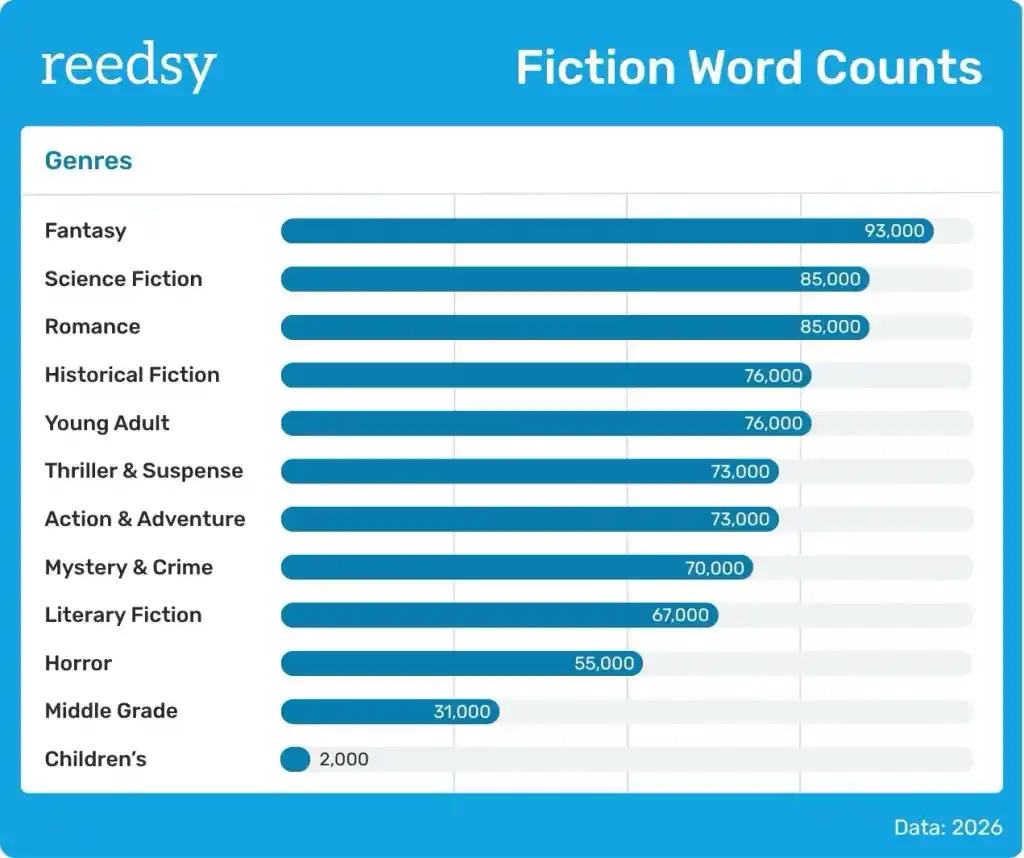
In 2026, most fiction genres have an average length of 50,000 words or more. The exceptions are middle grade and children’s — considering the genres’ younger readers, it’s no surprise that these books have fewer words.
Q: How important is word count when querying literary agents?
Suggested answer
You want to be within the right range for your genre, as much to show the agent that you are aware of these important commercial considerations as anything else! So you don't need to be obsessing over a few hundred words here or there (!), but ensuring you are within that benchmark is a great sign that you know your readership/market.
Abbie is available to hire on Reedsy
While writers often think in terms of word counts, most readers think in terms of page counts. If we assume 300 words per page — a good rule of thumb for a paperback book — we can convert our word counts into page counts.
This rule doesn’t apply to children’s books. They vary in terms of images and fonts, making page count hard to predict. Because of this, we’ve omitted them from the table below.
|
Genre |
Average word count |
Average page count |
|
Fantasy |
93,000 |
310 |
|
Romance |
85,000 |
283 |
|
Science Fiction |
85,000 |
283 |
|
Young Adult |
76,000 |
253 |
|
Historical Fiction |
76,000 |
253 |
|
Action & Adventure |
73,000 |
243 |
|
Thriller & Suspense |
73,000 |
243 |
|
Mystery & Crime |
70,000 |
233 |
|
Literary Fiction |
67,000 |
223 |
|
Horror |
55,000 |
183 |
|
Middle Grade |
31,000 |
103 |
As an author, you can use these average counts to inform the length of your novel. For example, if you’re writing a middle grade book, and your manuscript climbs past 50,000 words, it may be time to pare your story down.
Having said that, you should also bear in mind that these numbers are only guidelines. Harry Potter and the Sorcerer's Stone, one of the bestselling middle grade books of all time, is 75,000 words in length — more than double the current average.
Q: How important is it for first-time authors to adhere to standard word counts, and what flexibility do they have based on genre or target audience?
Suggested answer

It's incredibly important, not because authors shouldn't be able to bend or break the rules, but because these "standard word counts" are systemic. It isn't agents insisting on word counts for no reason; it filters from book buyers to internal publishing salespeople, then to editors and agents.
Having too few words can be worse than having too many. Think about the end goal: you want readers to buy your book. If they feel like they're getting less than they paid for then they won't buy the book. For example, if you wrote 30,000 words when most books in your genre are more like 60,000-70,000 words, then readers looking at your book compared to a competitor might be inclined to think the book that has more words has more heft and therefore is more worth their money.
When it comes to too-high word counts, then you run into a different issue and that's with publishing costs. it costs money to print pages, and if you've written 500,000 words, then that book is going to cost even more to produce (not only the paper in such an extreme case, but also in the binding of that book to make sure it holds up). If it costs more to create, then that can negatively impact publishers' profits. If a publisher is evaluating your work that's 500,000 words versus a similar work that's only 125,000 words, why wouldn't they choose the shorter book? It also takes up less physical space on a bookshelf, so bookstores might be able to keep more copies on the shelf.
Genre and target age range here are the great determining factors. Epic Fantasy, for example, which takes place in a world not our own, usually requires a higher word count for the simple fact that the world has to be built. Nonfiction business books, on the other hand, are usually around 60,000 words, as those readers don't need to be transported to another world, but instead need to have points clearly articulated.
Matt is available to hire on Reedsy
In a very loose way, it's important to adhere to genre standards in word count simply because they've developed over time in response to what works best in the market. There are always exceptions, but those are usually backed up by an established author or sweeping support from retailers, librarians, or the media backing the book.
BUT FIRST: write the book you want! This is your book, and you can always edit it down or beef it up. It's important to write for yourself first, because the best story will come out of that. And if you change it later, so be it. Don't let market expectations stop your drafting or creative process!
Grace is available to hire on Reedsy
If you're planning on querying agents and going the traditional route, then adhering to standard word count expectations is essential. Are there exceptions to the rules? Sure, but you never want to plan on being the exception to the rule when you're already going up against long odds.
Querying is incredibly competitive, and an agent seeing that your manuscript is already in the target word count range for your genre tells them that you're probably aware of market expectations and have given real thought to your project's development. On the other hand, if they see a word count that's 20k outside the realm of expectations, that tells them they're either going to have to work with you to get the word count down/up, or potentially have a more difficult time selling your project to publishers.
On the other hand, if you're planning on self-publishing, word count isn't all that important. You don't want to write something the length of a short story and call it a novel, but the important thing in the self-publishing world is to tell a good story. Whether your mystery novel is 30k words, 60k words, 90k words, or even 130k words, your readers won't care as long as the story is great, whereas an agent would likely say no immediately if they saw a query for a 30k or 130k mystery novel, without even getting past that first sentence of your query where they'd see the word count.
If you don't know whether or not you plan to publish traditionally, the best way to set yourself up for success is to research the target word count range for your genre/audience, and then adhere to that expectation as closely as possible. Do be aware that word count expectations can change over time, so you want to make sure that your source for target word count is fairly recent.
That said, if you don't want to put extra pressure on yourself to meet industry standards before you're even done drafting, then there's no reason to focus on anything other than writing the best story you can; then, once you're done, you can take a look at word count expectations, hire a developmental editor to get expert eyes on your novel, and decide from there what makes the most sense for a publication plan.
Jennifer is available to hire on Reedsy
Non-fiction length
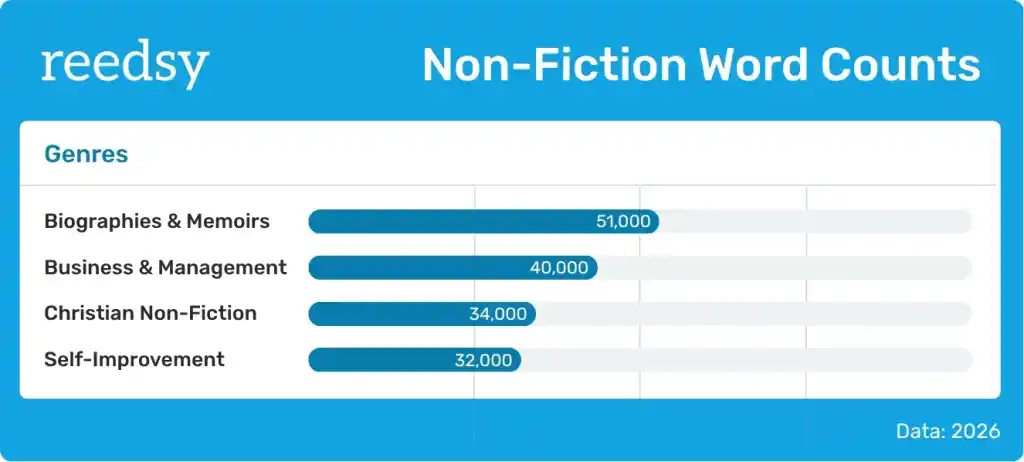
In 2026, the four most popular non-fiction genres (in terms of total submissions to Reedsy Marketplace) all averaged lower word counts than most fiction genres. If you’re writing non-fiction, bear this in mind: readers may expect concision.
|
Genre |
Average word count |
Average page count |
|
Biographies & Memoirs |
51,000 |
170 |
|
Business & Management |
40,000 |
133 |
|
Christian Non-Fiction |
34,000 |
113 |
|
Self-Improvement |
32,000 |
107 |
Q: What factors influence the ideal paragraph length in nonfiction writing?
Suggested answer

It's rare that you find paragraphs that are too short; usually authors struggle with paragraphs that are too long. How can you tell if your paragraphs are getting too long? My rule of thumb is: once they start to become confusing or hard to follow.
Non-fiction text should focus on getting across one main idea per paragraph. This breaks the text into nice digestible chunks, and makes it easier for the reader to see the flow of ideas. They won't need to dig line by line to find distinctions between concepts - the layout of the text itself will communicate where each main idea begins and ends. When I find a paragraph is becoming too lengthy, I'll look for a point where the discussion turns to a new idea, and split the paragraph there.
Let's get to the concrete numbers - how many lines are we talking? It varies depending on context, but in general if you're covering a complex concept then try to keep paragraphs on the shorter side. I'd look at breaking up a complex paragraph if it exceeded 9 lines or so, or even less if it's a particularly dense passage.
If the concept is more on the simpler side then you can afford to have paragraphs that are a little bit longer; I'd say a simpler paragraph is risking becoming overly long at about 11-12 lines. Again, it really depends on how the text is flowing and whether the paragraph is starting to feel difficult to follow.
At the end of the day, ideal paragraph length is as much an art as it is a science; it's something you'll need to feel out as you practice your writing and become more experienced in writing non-fiction. The golden rule is always the same, however: Make the reader's learning journey as smooth and pleasant as possible.
Ian is available to hire on Reedsy

There's no concrete rule, and this is where reading your work aloud can help you decipher how your writing sounds when it's spoken. Paragraph length can effect pace and flow.
Very long paragraphs make your book look dense and turgid. Readers can get bogged down in all the information and feel like they don't draw breath until they reach a paragraph break. Very short paragraphs can make the book feel bitty and disjointed, as if you're jumping from point to point. It can make your work read like a list of facts.
Paragraph length can be used to great effect. The occasional very short paragraph of just a couple of lines in between lots of longer paragraphs can add drama and tension to your writing. At the end of a chapter it can be a cliffhanger, but like everything less is more so don't do that in every chapter.
My biggest advice to anyone concerned with paragraph length is don't overthink it. Write the book first, and then in the editing process, read it aloud to yourself and you will hear if it doesn't sound right as we automatically pause after a paragraph. We don't notice that when we read to ourselves, but we do when we read aloud.
Kate is available to hire on Reedsy
As a mainly non-fiction editor, I work with paragraph length like this: the leading sentence in the paragraph provides a succinct idea, then the rest of the paragraph adds the potatoes to the meat, in two to three sentences. Let´s face it, readers often have short attention spans. They like white space and short bursts of meaning. Paragraphs of a few sentences, even if long ones, are good!
Sarah is available to hire on Reedsy
Book length trends (2021–2026)
We also investigated whether the length of books has changed over the past few years. It’s generally assumed that books are getting shorter, as the general reader has less time on their hands and less patience for longer books.
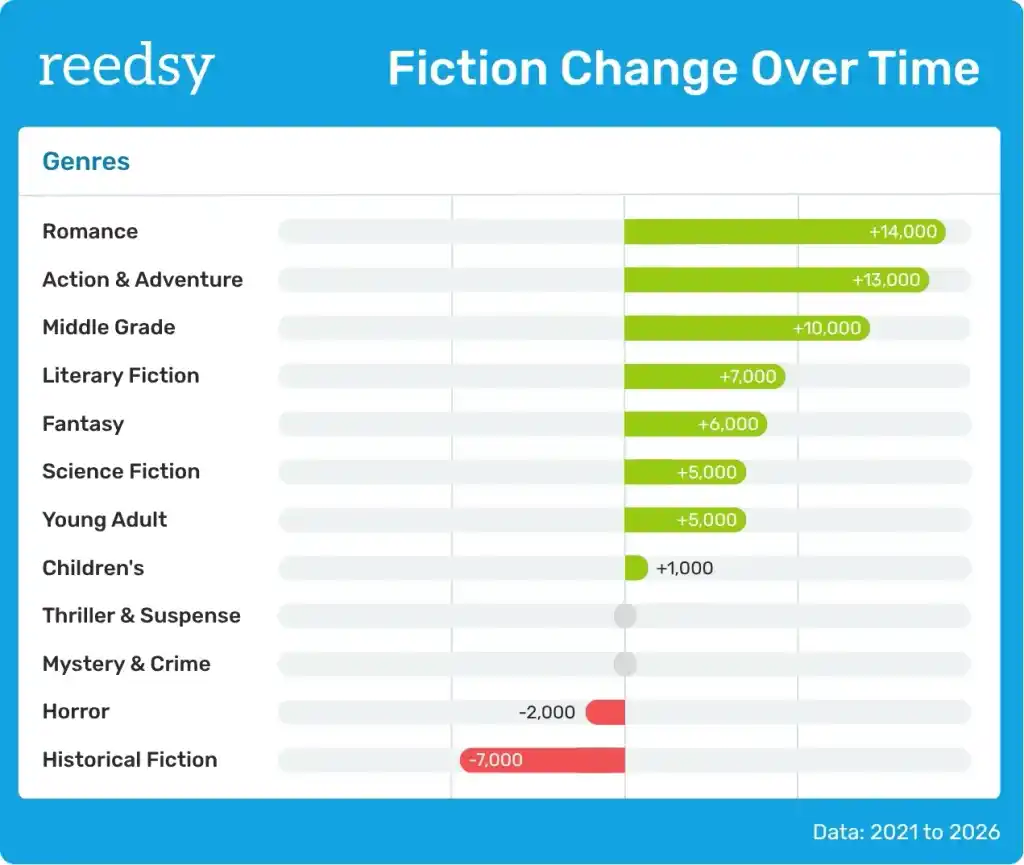
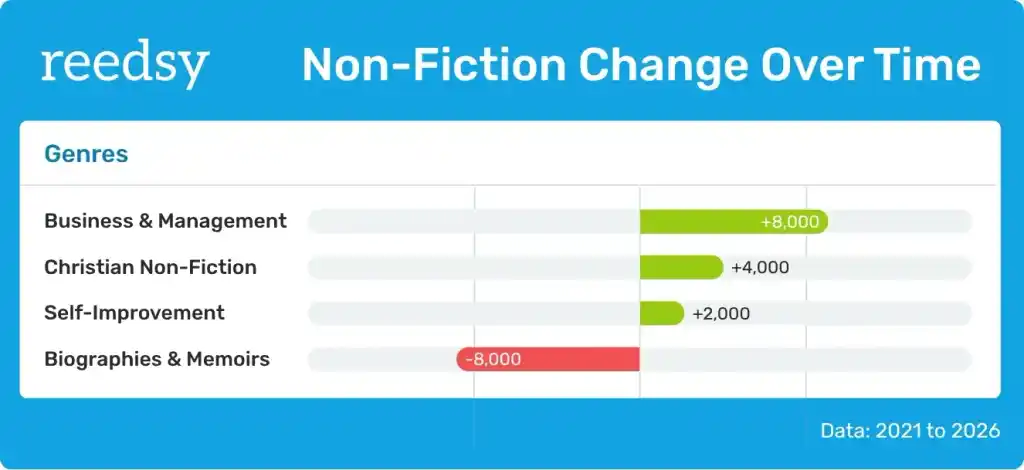
Surprisingly, though, our marketplace data contradicts this assumption. When we compare our sample from 2026 (8,890 books) to a sample from 2021 (6,446 books), we find that the vast majority of genres have actually increased in length.
Fiction trends
Among fiction genres, only two have decreased: horror and historical fiction. Romance novels changed the most. Since 2021, the average length of a romance book increased by 14,000 words — the equivalent of 47 pages.
Non-fiction trends
Among non-fiction genres, we see a similar trend: in general, the length went up. The exception is biographies & memoir, which dropped by 8,000 words — the equivalent of 27 pages.
So, are books getting longer?
Off the back of these results, we decided to dig into that widespread assumption that published books are getting shorter over time.
We compared our findings to another study by Friesen Press, which looked at the length of the bestselling books on Amazon year-on-year. Their findings aligned with our own: the length of Amazon’s bestselling books showed a gradual upward trend.
|
Year |
Average page count |
|
2020 |
378 |
|
2021 |
382 |
|
2022 |
360 |
|
2023 |
430 |
|
2024 |
442 |
Unfortunately, this study from Friesen Press lacks data from 2025 or 2026. But still, when paired with our own results, it raises an important question. Maybe it’s time to challenge the assumption that readers want shorter books?
As an author, it’s important to ask questions like this when thinking about your work. You don’t always need to follow industry trends, but you do need to understand them. The more you know about the current market, the better you’ll be able to strategically position your book.