Posted on Oct 12, 2026
Character Development: How to Write Characters Who Feel Real

Hugh Davies
Hugh Davies is a writer and editor with 7+ years of experience. He has written courses on fiction and storytelling for an app with more than a million users and has penned award-winning short stories.
View profile →Character development is the process of creating complex, compelling characters. As an author, you want to create fictional people who live, breathe, and change through a story — characters who feel so profoundly real that readers forget they’re not.
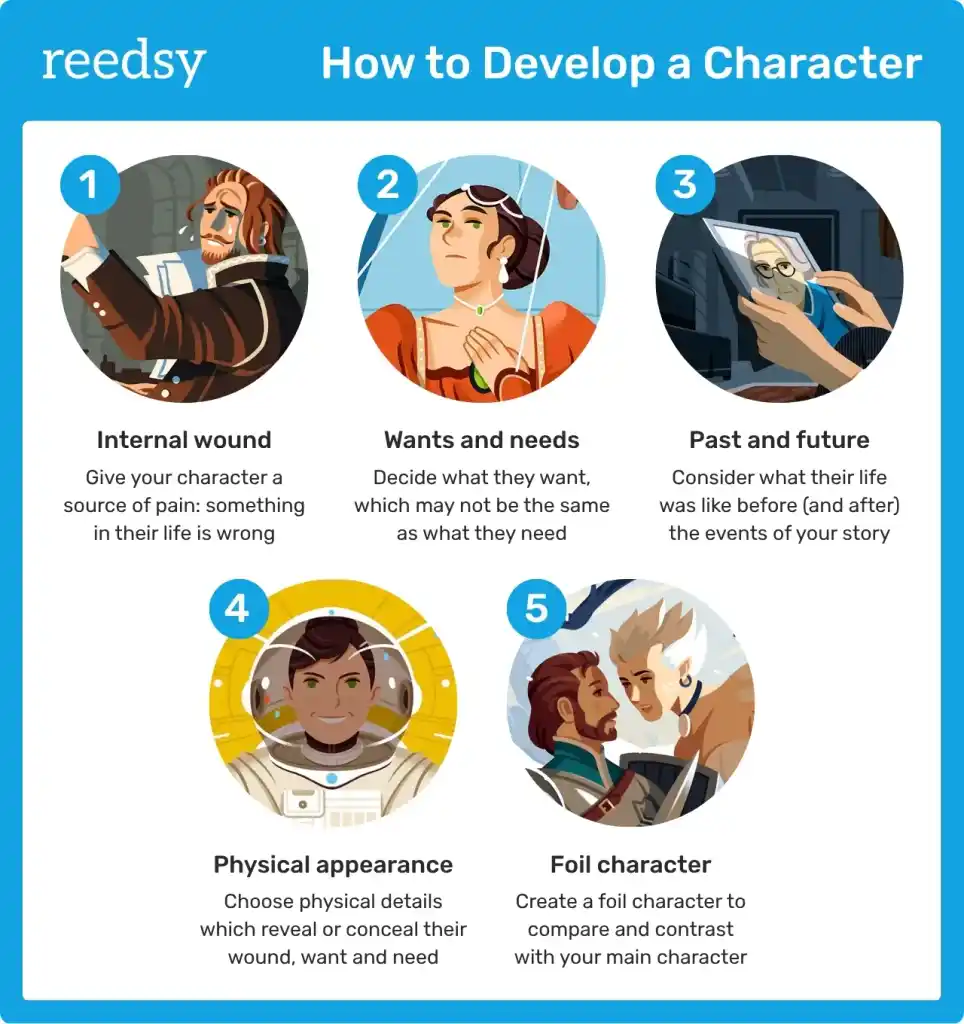
In this post, you’ll learn how to craft these characters with the help of some literary examples. Follow the five steps down below, and bring your characters to life.
1. Give your character a wound
What’s the number one rule for character development? Your characters need to bleed. They should carry a wound somewhere deep inside: something in their life feels wrong.
A pirate who’s scared of water. A robot who wishes he had skin. A mother who’s running from a secret past that will tear her family apart. Any of these “wounds” could be an excellent starting point for a rich, satisfying character.
Challenge: Can you describe your character in a similar way? “A [person] who [has a wound].” The wound can be subtle, but it needs to exist. Try a few options out.
The wound is important for two reasons. First, it’s a source of conflict. A good story will often prod at a wound and see how the character responds. What happens when that pirate falls overboard? Or the mother’s secret is spilled?
Second, a wound makes a character feel a lot more believable. Real-life people have fears and pains — it’s rare to be perfectly happy — and your characters need to reflect this. Without a wound, a character feels flat.
Example: Hamlet and the death of his father
Shakespeare was the master of character wounds, from Romeo and Juliet’s forbidden love to King Lear’s impending madness. In the case of Hamlet, he’s riddled by grief after the recent death of his father. To quote the play, “the clouds still hang on [him].”
The story proceeds to prod at that wound when his father’s ghost returns to him. The ghost sets Hamlet on a quest for revenge, driven by that wound in his chest.
Example: Bridget Jones and her taste in men
Bridget Jones has a long list of character wounds. On the very first page of Bridget Jones’s Diary, the character resolves to stop drinking as much, to stop spending as much, and to stop falling for “alcoholics, workaholics, commitment phobics, people with girlfriends or wives.”
This final wound drives much of the story, as Bridget stumbles through an ill-fated relationship with her toxic boss, and must eventually decide what she really wants from love.
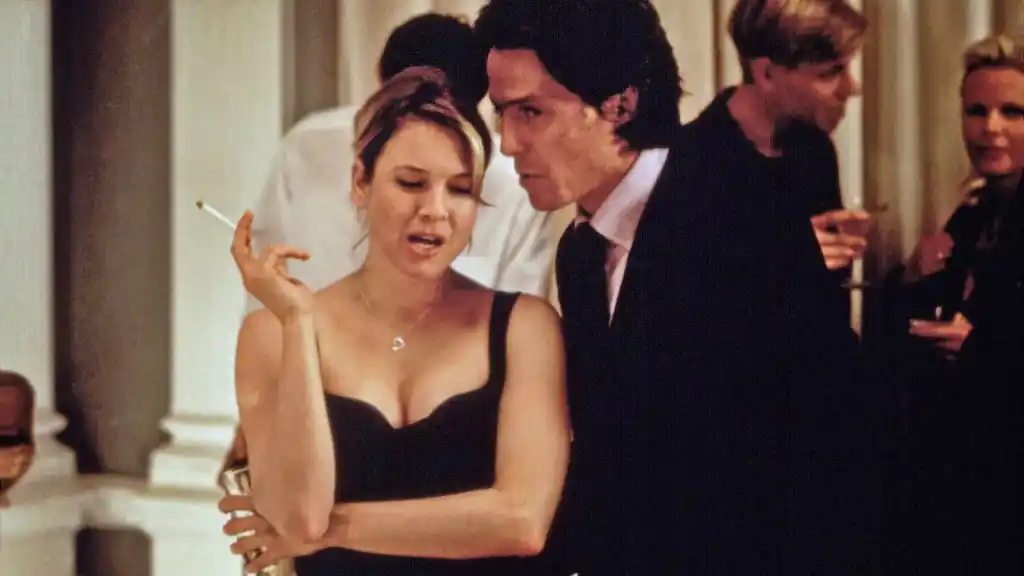
Renée Zellweger as Bridget Jones. Credit: Miramax
Q: What does it mean to create an “original” character in fiction?
Suggested answer

I think writing an original character just means that when a reader engages with that character, no other particular character comes to mind. Bit of a pithy answer, I know, but there you go. 😉
Brett is available to hire on Reedsy

Original characters are those who are subverted stereotypes, who have things about them which are conflicting, who go against the grain in some way and who speak, think and react in ways that are not predictable.
Vanessa is available to hire on Reedsy

I think that "original" is a tricky word, and it's not necessarily something you should aim for, at risk of getting too much in your own head or making up characteristics just to be different. But strong characterization techniques can be seen in books such as Fates & Furies and The Rabbit Hutch. One thing I picked up from these works is that specificity and contrast is your friend, especially when introducing a character. Give them characteristics that are highly particular, rather than trying to make a generalization ("he liked reading Revolutionary War–themed comic books" vs. "he liked reading"). And then put characteristics together that you might not find in just anyone. You might surprise yourself, and then the character blooms from there.
Erin l. is available to hire on Reedsy
2. Find their wants and needs
As Tom Bromley teaches in his course on novel writing, a want is something a character believes will heal them and make them happy. Imagine a child who hates their school — this is the wound they carry. To escape this pain, they want to run away and build a life in the woods.
But this isn’t always what they actually need. In the case of that child, they hate their school because they’re lonely and don’t fit in there. Living in the woods will make things worse — to heal that wound, what they need to do is find a group of friends.
This oft-seen contradiction between want and need makes a character rich and complex. At the start of the story, they might act on their want, like that child running to the woods. By the end of the story, they might change their mind: they’ll act on their need instead.
Challenge: What does your character believe will heal them? What do you believe will heal them? Make sure your answers are different. This gives you a want and need.
Example: Scrooge wants isolation, but needs love
As a child, Scrooge was lonely and unloved, and he carries this wound as an adult. To heal, he wants to isolate himself — he hoards money, shuts people out. But this act doesn’t help. It leaves him bitter and mean. What he actually needs is the opposite.
Over the course of the story, he lets go of his want and embraces his need. He learns to open his heart to the people around him. That’s what heals his wound.
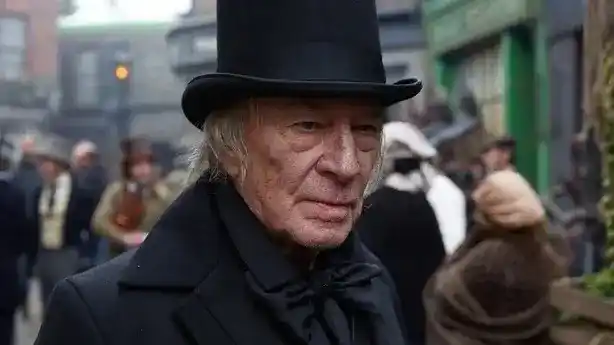
Christopher Plummer as Scrooge. Credit: Elevation Pictures
Example: Gatsby wants Daisy, but needs to move on
Gatsby’s wound is Daisy, his long-lost love, who’s married to another man. He wants to win her back by accumulating wealth and impressing her with lavish parties. But what he really needs is to stop living in the past — his wound might heal if he finds a way to move on.
Unlike Scrooge, Gatsby never makes that transition from want to actual need. His wound festers as opposed to healing, which sends him down a negative character arc.
3. Build their past (and future)
When you write your story, you won’t typically include the whole of your character’s life. Your story will cover one stretch of time, like a school year or a trip to the moon. It starts on one day, it ends on another — you don’t write the before or after.
But you do need to think about before and after. Strong characters need futures and pasts.
Without a past, they’ll feel like they’ve popped into being on the very first page of your book. If they’re a newborn baby, that’s believable. Otherwise, it won’t ring true. To learn how to write a character’s past, check our post on character backstory.
You may have already made a start on this when you came up with your character’s wound. Often (not always) a character suffers their wound before the story starts. From Scrooge’s lonely childhood to Gatsby’s romance with Daisy, these wounds come from a time before.
Unless they die at the end, your character will also have a future outside your story. To help you cook up this future life, you can use their want and need. Imagine two possible scenarios: Future A and Future B. Future A will take place if they get what they want, Future B if they get what they need.
Challenge: Write one sentence for each of the following: Past, Future A, Future B. To show you what we mean, let’s return to the examples of Scrooge and Gatsby (below).
Example: Scrooge’s past and possible futures
- Past: Scrooge had a lonely childhood, with a distant father who never showed him love.
- Future A: He becomes increasingly bitter and twisted, and ultimately dies alone.
- Future B: He opens up to the people around him, and finally experiences joy.
Example: Gatsby’s past and possible futures
- Past: Gatsby had a short-lived romance with Daisy, which he never moved on from.
- Future A: He tries so desperately to win her back that it leads to self-destruction.
- Future B: He moves on from Daisy, finds someone else, and enjoys a happy life.

Leonardo DiCaprio as Gatsby. Credit: Warner Bros.
It’s easy to get bogged down by your character’s past and future. Some writers end up writing detailed dossiers with hundreds of facts, but in most cases this isn’t necessary. You also don’t need to include all the facts in the pages of your actual story. Drop details where relevant, using devices like flashbacks, or conversations about future plans.
Q: What drawbacks are there to creating detailed dossiers on characters before the drafting stage?
Suggested answer

Writing is chemistry. It involves experiment and trial, and like every experiment there are occasionally unexpected results. With fiction especially, you may not have a full idea of a character until you begin writing them in different scenarios and relationships -- and I think this is an advantage when you begin your project. Having a fully detailed dossier on a character before you begin can limit your options or contribute to writer's block. After all, characters are not stagnant. They grow and evolve with you as the project forms. You may not realize an aspect of your character until you begin writing and imagining them, or until you have a rough draft. Remember, writing is revision and part of what may need revision are your characters. Having the flexibility to revise may involve leaving part of your characters with only small amounts of scaffolding.
This isn't to suggest you shouldn't have some idea of who your characters are and where they're going. Identifying some core attributes or principles can serve as handy rules for how your characters will act, think, and talk in different scenarios, which can ensure consistency while giving your characters the flexibility to grow into fully fledged personalities. What is their positionality? Their hopes and dreams? Their purpose? What end do you wish them to have? These are open ended questions to ask yourself about your characters that don't commit them to a full dossier.
Mitchell is available to hire on Reedsy

Absolutely! The main drawback is that creating dossiers can get in the way of writing the book. It's easy to get lost in the fun of research and imagining backstories and details (which may or may not matter). And it's even easier to feel like we're being productive while crafting character sketches or other support documents, when in fact, we're really procrastinating! I find it more helpful to jot down quick notes about the character as I'm writing. This helps me keep things straight while also forcing me to write the story not the sketch.
Caryn is available to hire on Reedsy

Like world building in any novel, creating detailed character profiles can be beneficial to some authors. They're a way to 'get a feel' for you characters before diving into the story. But going too detailed can lead to a few drawbacks:
- If you have too much on your character, when you actually start writing it might not feel as organic to explore who these characters are, since much of them has already been mapped out
- Sometimes you won't know everything there is to know about a character, and spending too much time pre-writing trying to figure it out keeps you from actually writing it
- Similarly, with any kind of plotting, worldbuilding, character building, and more, I sometimes see authors get so caught up in planning for the book they're going to write that they don't, you know, write the book.
Writing a book is a daunting task, so it's understandable that you want to have as much planned out as possible. But what I always recommend to authors I work with, and especially authors who are stuck on where to go next with their book or how to start, is to get just enough down to where they feel like they have a rough idea of where the book's going, and then to simply start writing. You might have a few hiccups, you will very likely have to edit some things or pause to redraft parts of your outline (if you use one), but once you start writing typically ideas start to flow and you're able to fill in more of the gaps that were empty before.
Sean is available to hire on Reedsy
4. Flesh out their appearance
As an author, when you’re choosing how your character looks, make sure to keep their wound and want at the forefront of your mind. Essentially, think of their physical description as an extension of everything inside.
There are two main ways to go about this.
First, you could choose some physical details which reveal their wound or want. For example, let’s return to the example of that mother who’s hiding a terrible secret. You could give this character darting eyes, or make her jump when she hears loud noises. She could wear too much makeup to hide her face. These details suggest paranoia.
Second, you could choose some physical details which conceal their wound and want. In this case, that mother might have perfect hair and beautifully manicured nails. She’s always smiling and laughing — she’s seemingly at ease. This time, the details of her physical appearance stem from this character’s tireless efforts to hide her wound from sight.
Challenge: Write one revealing description of your character, then one concealing description of your character. Compare them to each other. Which one excites you most?
Example: Miss Havisham’s wedding dress
In her youth, Miss Havisham was jilted at the altar. This left her humiliated and heartbroken. Years later, she still wears her wedding dress, though the cloth is ragged and yellow. Her face is “withered like the dress” and she has “no brightness left but the brightness of her sunken eyes.”
Every detail of this physical appearance tells the story of her inner wound. It outwardly reveals the pain she carries in her heart.
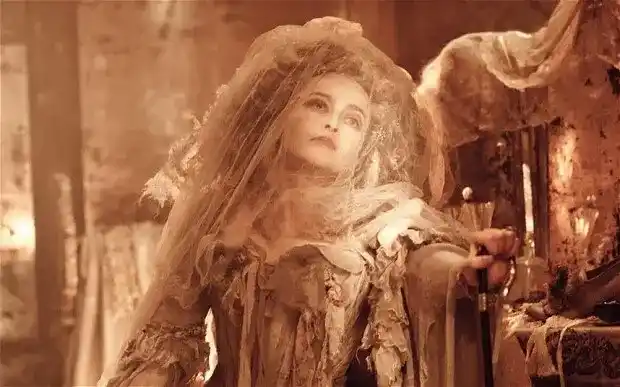
Helena Bonham Carter as Miss Havisham. Credit: Lionsgate
Example: Frankenstein’s monster
On the outside, Frankenstein’s monster is described as tall, strong, and horrifying. He has yellow skin, powerful limbs, and a “gigantic stature, that is to say, about eight feet in height.” But these details don’t match the wound inside: lonely and emotionally vulnerable.
His appearance doesn’t only conceal his wound. It actually makes things worse for him. When other characters recoil from his monstrous form, his loneliness only intensifies.
Q: What are effective adjectives for describing characters, and when should each be used?
Suggested answer

My favourite from my writing has been "etiolated." It's a word that describes a seedling starved of sunlight - thin and pale and reaching up. It contains a lot of layers of imagery which were useful for describing a character at their lowest point.
Mairi is available to hire on Reedsy

Characters are best described through body language and dialogue. Avoid overusing adjectives and let your readers do some of the interpreting. There is no need to spell everything out for them. The best way to convey a character's personality is through action, dialogue and body language.
Eva maria is available to hire on Reedsy

There can be no exact rule about what adjectives to use when describing characters, because the key is to capture a unique personality with great effect, in a way that supports your plot. Don't try to be clever; just think about the person you want to describe, as well as the situation they are in, and be as authentic as possible. You should, however, consider asonance, alliteration and rhythm - how these words will 'sound' in the head of the reader. A badly chosen collection of adjectives might read like a list, for example: 'enterprising, calculating, scintillating' (unless of course you were going for a rather hectoring style where this type of repetition was desirable). Obviously, you should also avoid adjectival groupings that are just too predictable - 'tall, dark, handsome'. Compare with this Jane Austen's description of Emma Woodhouse as 'handsome, clever, rich.' This tells us, in three words, something about the woman's appearance, something about her intellect, and something about her social status. Well-chosen adjectives combine in a harmonious unit, sound well when read aloud, convey a considerable amount of information succinctly, and produce a fresh image in the mind of the reader. For example, what might you think of a character when told, 'Phoebe stepped forward, blushing, rumpled, fearless'? This conjours up a great deal about what Phoebe has just been doing: perhaps falling in love, enjoying a forbidden clinch in a side room at a ball, getting caught in the act of social transgression, standing by her decision, feeling the enjoyment, coming forward to own up and defend herself, showing her defiance. Adjectives can be a very powerful and succinct way to move a plot forward, sweeping the reader along with you, because the information is intimately focused on an individual character, their behaviour, their motivations, and what they might do next.
Rachel ann horatia is available to hire on Reedsy
5. Come up with a compelling foil
Finally, remember that characters don’t exist in a vacuum. As John Truby writes in The Anatomy of Story, “[to] create great characters, think of all your characters as part of a web in which each helps define the others. To put it another way, a character is often defined by who he is not.”
This is where foil characters come in. A foil character is a secondary character who contrasts with your primary character. This contrast helps to emphasize things like your primary character’s wound. Take Scrooge, for example. He’s bitter and miserable. But he seems even more so when juxtaposed with his good-natured nephew, Fred.
Think of it like shining a light on your character; everything becomes more distinct. This is the final step in this process of making your character feel real. You’ve created someone with a wound, a want, a need, a past, a future. Now create another person to sit beside them — your main character will come to life.
Challenge: Remember when you laid out Future A and Future B as two possible paths for your character? While your character experiences one of these, create a foil who experiences the other.
Example: Sherlock and Watson
Sherlock Holmes is eccentric and brilliant, but also cold and detached. He struggles to form relationships with other human beings. By contrast, John Watson is more grounded and decidedly less brilliant, but he’s also warm and personable.
This is a classic example of a foil. Watson’s warmth makes Sherlock feel colder: it highlights his wounds and flaws. The balance of their two personality types also makes them a perfect team.
Example: Frodo and Gollum
Throughout The Lord of the Rings, Frodo struggles to resist the corruptive force of the Ring. Meanwhile, Gollum shows what will happen if Frodo ever gives in. Gollum is post-corruption: he’s been twisted into something dark.
While Frodo is striving for one future, Gollum is a glimpse of the alternative. The contrast between them makes Frodo’s predicament feel darker and a lot more real.
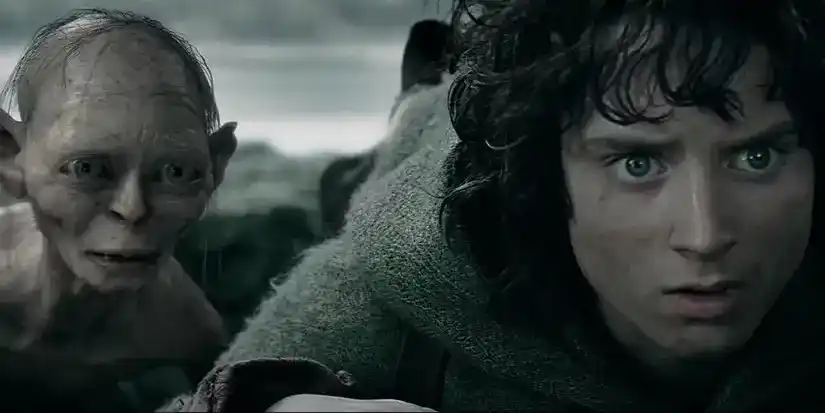
Andy Serkis as Gollum with Elijah Wood as Frodo. Credit: New Line Cinema
Q: How do I write dynamic and believable relationships between characters?
Suggested answer

By writing them as two people in relationship with one another, as opposed to simply two characters who come together to further the plot. Sure, a plucky best friend is a great narrative technique to nudge a shy main character into action, but why were they friends in the first place?
Abbie is available to hire on Reedsy
There you have it: a five-step guide to writing characters who feel real. As a bonus step, check out our entire range of character development templates. These templates help to strengthen your character by asking thought-provoking questions, like “What is their idea of perfect happiness?" and “What is their greatest regret?”
You never know where these questions will take you. We hope you enjoy the ride.




2 responses
Diane says:
07/06/2018 – 09:01
Indeed Indeed Indeed. Brilliant article. Everything is simple and difficult in the same time. But with this tips it is easier to create your full tutoriage character.
Nate says:
16/04/2020 – 19:50
clearly the writers of star wars episodes 7, 8, and 9 never read this article.