Last updated on Mar 19, 2026
What is a Plot Hole? 3 Common Types (With Examples)

Nick Bailey
Nick is a writer for Reedsy who covers all things related to writing and self-publishing. An avid fan of great storytelling, he specializes in story structure, genre tropes, and character work, and particularly enjoys sharing insights that spark creativity in fellow writers.
View profile →Picture this: you’re deep in a mystery novel, trying to identify the killer. At the eleventh hour, the detective cracks the case with a stray fingerprint. But you’re confused — the killer wears gloves in every scene. Where did the fingerprint come from?
This is a plot hole: an inconsistency that breaks the rules, logic, or timeline of a story. And once you've spotted one, it’s almost impossible to unsee.
We’re here to walk you through (or around?) the three major types of plot holes. We’ll also provide some examples from well-known books, movies, and TV to help you avoid digging any gaping plot holes of your own.
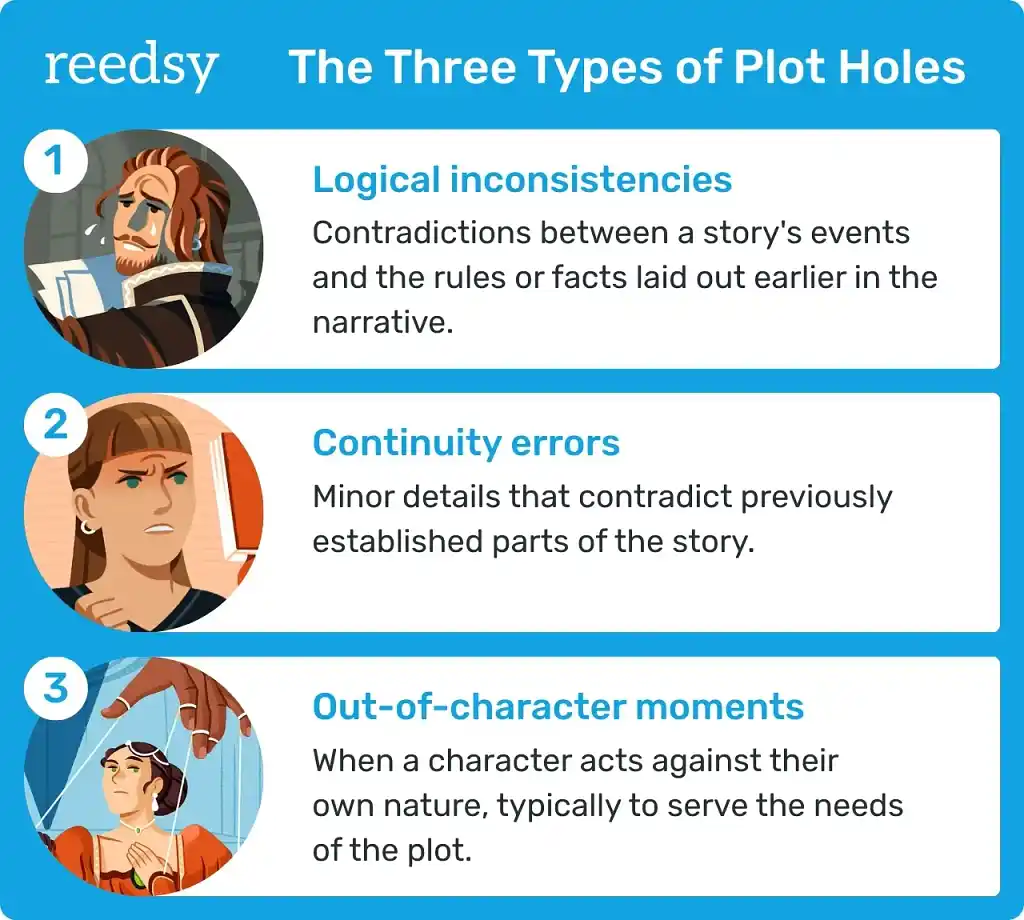
Logical inconsistencies
We’ll begin with the most prominent (and egregious) kind of plot hole: logical inconsistencies. These occur when something in a story clashes with rules or events that were presented earlier in the narrative.
Crucially, a logical inconsistency makes the plot unworkable in some way. A character’s eyes changing from blue to green between chapters can be frustrating (and it is a type of plot hole, as we’ll cover below) — but it doesn’t preclude the narrative from making sense.
Let’s look at some logical inconsistencies in action.
🧛 Example: The uninvited vampire in Salem’s Lot
Between their sheet-white skin, thirst for blood, and inability to enter a home uninvited, the vampires in Salem’s Lot tick all the major boxes of European folklore.
However, there is one instance where that last convention doesn’t apply. Partway through the book, vampire Kurt Barlow crashes through the window of the Petrie household, kills Mr and Mrs Petrie, then slinks off into the night. But no one had previously invited him in — so how was he able to enter? Fans have tried to come up with explanations, but the truth is clear. Even the great Stephen King occasionally stumbles into plot holes.
✍️ Writing tip: If you’re writing a story with an elaborate magic system or similar in-world rules, create a worldbuilding bible to avoid forgetting anything. Then once you’ve completed your first draft, compare it to these worldbuilding notes to catch any inconsistencies.
🧑⚖️ Example: Case law in Double Jeopardy
Logical inconsistencies are not exclusive to stories with fictional rules — real-world settings can suffer from frustrating fallacies too. Case in point: the 1999 film Double Jeopardy.
In the film’s opening act, protagonist Libby Parsons is arrested and imprisoned for the murder of her husband, Nick. However, Nick is still alive — and he was the one who framed Libby for his murder.
Enraged by her husband’s betrayal, Libby vows to get revenge. Fortunately for her, a legal precedent called the Double Jeopardy Clause means she can do so without consequence. Because Libby is already serving a sentence for Nick’s murder, she can get off scot-free for killing him without facing further charges.
This, of course, is complete nonsense. While the Double Jeopardy Clause does prevent defendants from being tried for the same crime twice, this only applies if it’s the exact same crime. If the circumstances of an offense change — e.g., the time, place, or method — then it’s classed as a separate crime in the eyes of the law. The entire premise for Libby’s vengeance-fueled crusade is built on a legal misunderstanding so fundamental that it undermines the entire film.
Q: What are the most common craft mistakes new authors make?
Suggested answer


Common craft mistakes among new authors include starting the story too early, relying on exposition instead of action, and neglecting character motivation.
Many also struggle with pacing, either rushing key moments or lingering too long on setup. Dialogue can feel unnatural when it explains too much or lacks subtext.
Another frequent issue is inconsistency in point of view, which can confuse readers. Most of these mistakes come from drafting before understanding the story’s focus. With revision and feedback, new writers quickly learn to tighten structure and trust their readers.
John is available to hire on Reedsy ⏺

One of the biggest mistakes I see from new authors is that they finish writing their manuscript and then they think they are done and ready for an editor to go through and review.
Writers need to be their own editors first. Because there are so many potential new authors every day, it's imperative that writers go back and edit their work thoroughly. That means reading, and rereading what they've written to understand how their characters develop through their novel, or how the topics that they brought up in chapter two are refined and built upon in chapter nine. Through that reading process, writers should be editing their work as they find pieces that aren't strong enough or need to be altered to make a better overall manuscript.
Matt is available to hire on Reedsy ⏺

The most common writing mistake I see from first-time authors is cramming too much into the first chapter. Your first chapter is a meet and greet, where you establish credibility, likability, and optimism that the book is worth the reader's time. Hook the reader, show your personality, but don't dump all your knowledge on them at the beginning of the book. Take them on an interesting, helpful journey,
Mike is available to hire on Reedsy ⏺
Continuity errors
Have you ever watched a film and noticed a strange discrepancy between two scenes? Perhaps a character is wearing a red tie in one shot and a blue one in the next, or a coffee cup that was empty in one shot is suddenly full again in the next.
If so, you’ve likely found a continuity error. These are minor details that contradict other established parts of the story. While continuity errors most often appear in films and on TV, written works are by no means immune to incongruities between pages, acts, or books.
As we alluded to earlier, continuity errors are rarely extreme enough to unravel a whole plot. But to the eagle-eyed reader, an inexplicable wardrobe oddity can be just as disconcerting as a vampiric break-and-entry — so take care to keep your story’s details consistent.
🏛️ Example: Pylaimenes’ revival in the Iliad
In Homer’s Iliad, the great King Menelaus slays a man named Pylaimenes in combat. When Pylaimenes’ son meets a similar fate later on in the poem, his father appears by his side in anguish, miraculously back from the dead. The inconsistency here is obvious: how can Pylaimenes mourn the death of his son when he, too, should be dead?
Fortunately, Pylaimenes doesn’t play any actual role in the Iliad following this nonsensical reanimation. One could easily ignore his brief post-mortem appearance and it would have no bearing on the plot. If, however, Pylaimenes went on to dethrone King Menelaus, then this detail would graduate from continuity error to logical inconsistency.
Perhaps it’s unfair to attribute Pylaimenes’ death (and rebirth) to Homer here. The original version of the Iliad has long been lost to time. The story we know today has been endlessly copied, translated, and reinterpreted for almost 3000 years, so a few eccentricities here and there are inevitable.
Still, it’s a good example of what not to do in modern literature. (That is, unless it’s a zombie apocalypse novel, don’t bring anyone back from the dead.)
✍️ Writing tip: Try reading your manuscript aloud before you submit it for editing — your ear will often catch inconsistencies that your eye skips over. For extra peace of mind, consider hiring a proofreader to help you catch any continuity errors you may have missed.
Hire a first class proofreader

Claire D.
Available to hire
Experienced editor with 25 years of experience specializing in health (particularly women's), self-help, relationships, and parenting.
Daina L.
Available to hire
I have enjoyed working as an editor, proofreader, and manuscript assessor for over twenty years.

Kenneth Z.
Available to hire
What do you get when you combine an MFA, a decade of professional editing experience, and way too many wings and donuts? This guy.
🚪 Example: Jerry’s front door in Seinfeld
One of Seinfeld’s most consistent gags involves Kramer, Jerry’s neighbor, bursting into his apartment at inopportune times. Considering how annoying Kramer can be, you might wonder: why doesn’t Jerry just keep his front door locked? Put simply: he does!
When any other character pays the comedian a visit, Jerry buzzes them into the building, then removes the bolt to his apartment door — implying that it’s normally locked. Yet whenever Kramer wants to make an entrance, Jerry’s door is always unlocked.
These kinds of discrepancies are fairly innocuous, especially in a sitcom. Maybe Jerry is just bad at remembering to lock his front door, and Kramer is the only character to routinely take advantage of his incompetence.
The curious case of Jerry’s door also makes sense for the genre. Seinfeld is a comedy — its writers will do whatever gets the biggest laugh in a scene. But the more serious your story, the more irksome a continuity error like this can be.
Q: How are human proofreaders different from proofreading tools like Grammarly?
Suggested answer

The problem with relying on any piece of editing software is twofold: 1) They tend to only address a fraction of issues in a piece of writing, and 2) The vast majority of what they suggest is flat-out wrong or misguided. When I used to double-check things by running them through Grammarly, I’d spend most of the time sifting through suggestions that would actually add errors and clunky language to a manuscript rather than fixing them. That’s why I recommend letting an editor figure out what’s useful and what’s not, rather than having to sort through it and figure it out yourself!
These days, of course, most people asking this question are asking more about generative AI tools than “traditional” editing software like Grammarly and ProWritingAid (and indeed, those tools have also become swamped in misadvertised AI features). The most important consideration for a writer using these AI models for any purpose is the legal and ethical consideration: there is no major generative AI language model that does not involve plagiarism and theft. They were built off of the copyrighted works of hundreds of thousands of published authors and tens of millions of other writers and internet users, taken without consent or compensation. They are facing dozens of increasingly successful lawsuits over that theft. Moreover, AI-generated material cannot be copyrighted, leaving even works that mix real writing and artificially generated text on legally shaky ground.
I have experimented with hundreds of editing prompts on the most up-to-date models (at the time of writing, the GPT-5 series, Gemini 3, and Claude 4.6) with very mixed results at best. While they can generally produce “grammatical” text on a short sample, without relation to the larger context, nuance, and style of a manuscript, the edited text is rarely what you asked for. Many times, the edits are even the opposite of what you requested, and they tend to result in new issues, including flattening tone, erasing your unique voice, and "same-ifying" text—I have encountered multiple human-written manuscripts that went through "AI editing" before coming to me with full-on identical sentences scattered throughout.
Right now, anything based on these models is likely to lead you farther astray from the manuscript you want, not to mention plagiarize while doing so.
At the end of the day, you’re hoping for people to read your book. Having an experienced, personal, human eye in the editing phase is essential.
Dylan is available to hire on Reedsy ⏺

Absolutely not! Proofreading tools like Grammarly are handy for quick checks, but they’re no substitute for a human proofreader or editor.
Tools like Grammarly can catch typos and basic grammar mistakes and even suggest some rewording. But at the end of the day, they’re just following rules and algorithms. They don’t understand your writing like a human does, and they may not break a rule if you want it to be broken.
A human proofreader gets the context, tone, and the subtleties in your words. They know when a sentence needs to break a rule for impact and when your unique style is intentional. Plus, humans spot the tricky stuff—like homonyms (think “your” vs. “you’re”), awkward phrasing, and shifts in voice or consistency. And let’s be honest, Grammarly might give you suggestions, but sometimes it makes things sound robotic or just… off.
Bottom line? Use the tools—they’re helpful! But for that final layer of polish, flow, and true understanding, a human touch makes all the difference.
Eilidh is available to hire on Reedsy ⏺

Regarding Grammarly and AI generally, I was recently in contact with someone doing a PhD on AI's potential affect on book editing. So naturally I asked her if AI will run me out of business.
Her response was: "I think for now AI will definitely not run you out of business. You have a wealth of knowledge and experience that can’t be trained by a data set."
The same goes for proofreading. There's no substitute for an experienced professional when it comes to complex and subjective things like proofreading and editing
John is available to hire on Reedsy ⏺
Out-of-character moments
The final type of plot hole we’ll cover is the out-of-character moment. This occurs when a character acts outside of their established nature, typically for the sake of moving the plot forward.
Unlike the previous two categories, character inconsistencies don’t compromise the integrity of the narrative itself; on the contrary, they’re often an attempt to invigorate it. Think about something exciting yet unexpected happening in a story — like a lifelong pacifist who suddenly loses their cool and punches someone. No real human being acts with perfect consistency 100% of the time… so of all our plot holes, this type is arguably the most forgivable.
However, when a character makes a decision that’s completely at odds with their personality — rather than a one-time, understandable blip — it can definitely make readers feel betrayed. Here are a few examples of characters who stray a little too far from their established traits.
🍎 Example: L in Death Note
In Death Note, the detective L is tasked with hunting down a vigilante named “Kira”. He’s convinced that student Light Yagami is the killer… and he's right. But in the process of proving it, L makes a blunder so glaring that it's hard to believe he’s the world’s greatest detective — spoilers ahead!
Partway through the series, L obtains irrefutable evidence that Light’s accomplice, Misa, was involved in the Kira crimes. She is imprisoned, and L is one step closer to solving the case. But in a truly baffling move, L releases Misa after only a short period of surveillance — allowing Light to regain the upper hand in their high stakes game of cat-and-mouse.
For someone whose main character trait is their intellect, releasing a confirmed accomplice feels particularly senseless — especially when the narrative makes no attempt to justify it. But in order for the plot to proceed, Misa needs to walk free. It just comes at the expense of L’s characterization.
✍️ Writing tip: Before beginning your story, create a character profile for each of your main characters. Note down their primary personality traits, and rank them in order of importance. The higher a trait is on your list, the more it should take to make your character act against it.
🧪 Example: Mike Ehrmantraut in Breaking Bad
Another spoiler alert, this time for Breaking Bad. Throughout his time on the show, Mike Ehrmantraut is a ruthless, no-nonsense enforcer who always keeps cool under pressure. The only time his tough-guy persona melts away is around his granddaughter Kaylee, where he becomes the quintessential caring grandfather. This makes one of Mike’s final scenes particularly frustrating.
After months of being tailed by the DEA, Mike notices a group of officers closing in on him while he’s watching Kaylee at a park. Despite always prioritizing her wellbeing above all else, Mike abandons Kaylee here, fleeing the DEA and leaving his beloved granddaughter alone on a park bench.
Again, character inconsistencies are the most defensible types of plot holes — everyone acts “out of character” occasionally. Still, Mike’s actions here have long been criticized by Breaking Bad fans (and actor Jonathan Banks himself) for feeling particularly inconsistent with his personality.
Q: What tools or techniques can authors use to develop detailed and effective character profiles?
Suggested answer
Writers can establish good character profiles by examining surface information and interior depth. Beyond physical description, notice personality, values, and contradictions—what the character wants vs. what the character fears. Techniques like freewriting as a character or writing the character's background can elicit subtleties that don't find their way into the main action but still affect behavior. Some authors use Q&A-type questions to explore motivations, habits, and relationships, and other authors create images of the character's past to observe how it affects present decisions. What is most important is consistency: when you know how your character thinks and behaves, their actions make sense, and readers feel that they are interacting with real people and not with plot devices.
John is available to hire on Reedsy ⏺

This is so important because the character will drive your story.. You reader has to be fascinated by your protagonist and be routing for him or her. I always interview my characters in depth. I don't just ask them about the basics of their lives and history. I ask them what they fear most in life, what makes them get up in the morning.
Joie is available to hire on Reedsy ⏺

I provide all my clients with a template that I devised myself for ensuring that every single character in a novel is fully fleshed-out, colourful and contrasting, both within themselves and to other characters.
Vanessa is available to hire on Reedsy ⏺
Inconsistencies are an inevitable part of the writing process — as we’ve said, even Homer and Stephen King have fallen into a plot hole or two in their time.
The best defense against them is preparation: a solid worldbuilding bible, detailed character profiles, and a fresh pair of editorial eyes will go a long way toward keeping your story airtight.