Posted on Nov 19, 2026
How to Write a Book Press Release: Complete Guide with Examples

Ricardo Fayet
Reedsy co-founder and Chief Marketing Officer, Ricardo Fayet has worked with hundreds of authors on their launches and marketing campaigns. He is the author of two bestselling guides on marketing for authors, and a regular presenter at the largest writers' conferences.
View profile →Book press releases are brief one-page statements, typically between 300-500 words, created to earn coverage for your book from media outlets. They’re an important part of a strong publicity and marketing plan.
In traditional publishing, your publisher’s publicity team typically drafts and distributes press releases. If you’re self-publishing and managing your own publicity, the key is to find an angle that makes your announcement newsworthy. Then present it in a clear, compelling way, so the press immediately knows how to share your news. A release that essentially states “Author Announces Book” won’t do you any favors in getting press attention.
In this guide, we’ll walk through how to create an eye-catching press release announcing a book’s publication. Each section includes an example based on Rocket Bride, a fictitious space opera by Crispin Fortune, whose press release is being sent to a local newspaper.
Here’s an overview of the elements of a book press release:
|
Element 🧩 |
Purpose 🎯 |
Word count 📊 |
|
Release status line |
Inform when a release can be published |
Fewer than 10 words |
|
Headline |
Grab attention to encourage reading the entire release |
Around 10 words |
|
Lead paragraph |
Provide necessary information about your book’s publication |
50-100 words |
|
Book synopsis |
Intrigue a target audience with a brief plot description |
50-100 words |
|
Self quote |
Provide media with an easy pull-quote |
Up to 50 words |
|
Editorial review |
Boost your credibility |
Up to 50 words |
|
CTA |
Let people know how they can interact with you and your work |
Up to 50 words |
|
Publication details |
Detail where to find and purchase your book |
Around 50 words |
|
Author boilerplate |
Describe your background and credentials |
40-80 words |
|
### |
Industry-standard signal of the end of a press release |
N/A |
|
Media contact information |
State how to reach you later |
Fewer than 10 words |
|
Cover photo and/or author headshot |
Provide an accompanying image option that leaves a lasting impression |
Fewer than 10 words (link to cover file) |
FREE RESOURCE
Reedsy’s Book Launch Checklist
Launch your book successfully with our tried-and-true strategies.
Let’s dive into each section in order.
1. Clearly state your release status
This beginning line, written in all caps, tells journalists and other promoters when they can share your release. Ideally, coverage should run when interested readers can immediately pre-order or buy your book.
Journalists and bloggers need lead time to schedule your press release, so we recommend reaching out to publications three to four months prior to your book’s launch date. Plan to open your pre-order window by then, so your release can begin:
FOR IMMEDIATE RELEASE
In special circumstances where news of your book can’t run until a specific date and time, you can embargo (delay) it instead:
EMBARGOED UNTIL 9:00 a.m. ET, Thursday, April 1, 2027
Note that an embargo is only binding if a journalist agrees to it before you send them your release; otherwise, it’s considered a request. For simplicity, we recommend immediate release whenever possible.
2. Hook readers with a catchy headline
A headline is a short statement that grabs the reader’s attention.
You don’t need to include your book’s title or your name — unless you have an established following. Instead, focus on why readers would be drawn to your book:
-
Does your book center on a timely topic?
-
E.g., “Dangers of AI Explored in New Cyberpunk YA Novel Set in AI-Run Dystopia”
-
Do you as the author bring credibility through industry experience?
-
E.g., “Retired Psychologist Reveals Little-Known Key to Improving Mental Health in New Book”
-
Is your story locally based (especially relevant when sending to local news outlets)?
-
E.g., “Stockbridge Local Pens New England Murder Mystery Inspired by Chilling Town History”
You can also include a one-sentence subheadline beneath the headline with additional details about your book.
Our space adventure’s headline highlights a popular science fiction trope while tying back to the author’s hometown:
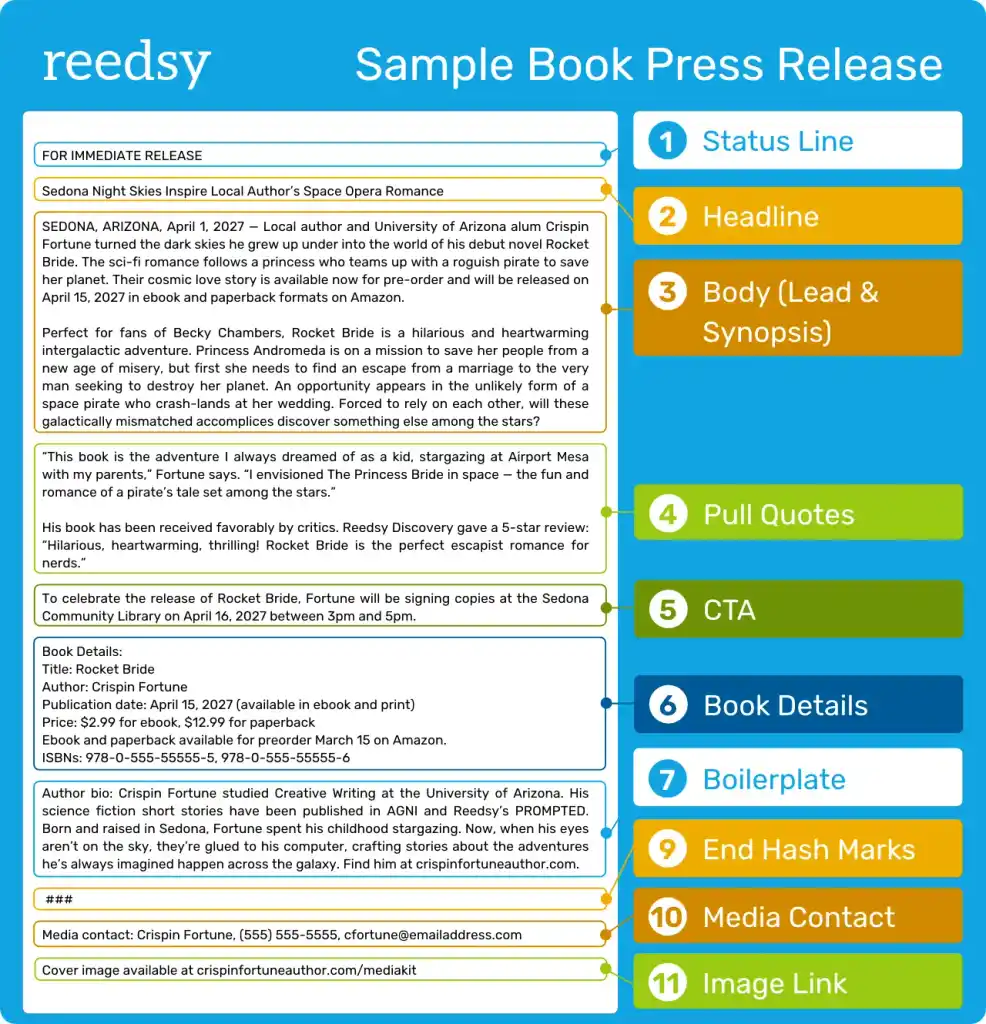
Sedona Night Skies Inspire Local Author’s Space Opera Romance
Q: How do book marketers identify an author’s audience and market positioning?
Suggested answer
A marketer helps an author find the market positioning for their book through a combination of industry knowledge and research.
There are two types of comparables I look for when doing a market positioning report. The first is popular titles in the traditionally published world that has an audience profile, genre, and style similar to my client's. The second is successful self-published authors with a decent readership.
The first is useful for figuring out how to communicate with the audience. The second is very useful for seeing what strategies are working. Often there are many unknown factors (such as the author's personal network or success in other series) but there's much you can learn by researching the strategies of a true comparable title in the indie publishing space.
Once the good competitors are identified, I look at their sales ranking, web presence, and do a little snooping to see how and where they advertise. This is also useful for pricing strategies. I can also identify additional competitors by looking at who those indies compare themselves to.
Robin is available to hire on Reedsy

I'm dealing with marketing, but I'm not a marketer. I'm an advertiser.
Market positioning? I don't even know what that means. It connotes with building a brand.
Amazon ads may be used for this, but it is a costly endeavor. Basically, you target the books you want your book to be connoted with and pay absurd bids for your ads to be displayed on this book's page.
The more popular is such a book, the bigger budget you need for it to work. And even the biggest budget is not a guarantee of success. The ad has to convert at a decent rate, otherwise Amazon will make you pay even more, or simply disregard your bidding because they will deem your book irrelevant.
Author’s audience
Hmm, author's audience... For me it is "People who, eventually, may read the book."
The intimate knowledge of the book is a key to success here. Nowadays, AI helps with it. I upload a manuscript to NotebookLM and ask it: What the book is about and what are similar popular books on the market?
Well, if an author themselves provides answers to this questions, it's even better.
Understanding the book, I explore a few angles on Amazon:
Category bestsellers - a list of bestselling books in a few relevant categories
"Others Who Bought" from similar books - the ones pointed out by AI or an author
Keywords - phrases used by readers to find books, e.g. 'space marine SF books' or ' romanfantasy about dwarves'
Exactly how?
For extraction of bestselling titles and 'Others Who Bought' section I use Also Boughts Downloader plugin for Chrome by Kindletrends.
I also reverse-engineer a few similar books using Publisher Rocket's reverse-ASIN functionality. It provides both other similar books and list of keywords for which those books are ranking well.
I also play with Publisher Rocket's 'Keyword Search' functionality to harvest some iterations of the most fitting search phrases. You can do the same playing with the Amazon's search bar manually, but Rocket saves me tons of time for the same output.
Michal is available to hire on Reedsy
3. Showcase your book in the lead paragraph
The opening paragraph of the release begins with “CITY, STATE, date.” For a publication announcement, you can list the city where you are based. The first two to five sentences of the body content should then answer the “5 W’s” essential to any press release:
-
Who are you? List your name and any notable credentials (e.g., best-selling author, job title in a field related to your book).
-
What is being announced? Include the name of your book and the categories it falls under.
-
Where is this happening? Detail where your book will be available to order.
-
When is it happening? State the date that your book will be available.
-
Why is it important? Explain why readers should be interested in your book; think back to the angle you used in the headline.
SEDONA, ARIZONA, April 1, 2027 — Local author and University of Arizona alum Crispin Fortune turned the dark skies he grew up under into the world of his debut novel Rocket Bride. The sci-fi romance follows a princess who teams up with a roguish pirate to save her planet. Their cosmic love story is available now for pre-order and will be released on April 15, 2027 in ebook and paperback formats on Amazon.
4. Include a brief synopsis
The synopsis should highlight the key points of your book and why it appeals to your target audience. Hannah Hargrave, an award-winning book publicist on Reedsy, says: “Make it clear why your book is unique and why it will appeal to your target audience. Also mention comparable authors and titles (preferably bestsellers), and make your copy as interesting as possible.”
Perfect for fans of Becky Chambers, Rocket Bride is a hilarious and heartwarming intergalactic adventure. Princess Andromeda is on a mission to save her people from a new age of misery, but first she must escape from a marriage to the very man seeking to destroy her planet. An opportunity appears in the unlikely form of a space pirate who crash-lands at her wedding. Forced to rely on each other, will these galactically mismatched accomplices discover something else among the stars?
5. Quote yourself
One purpose of a press release is to make it easy for a journalist to write about your story. So give them a quote to use! Keep it to one or two sentences. You can mention what inspired your book, why you felt it was important to write, or anything else that will appeal to readers and isn’t already included in the earlier overview of your book.
Remember to attribute the quote in third person:
“This book is the adventure I always dreamed of as a kid, stargazing at Airport Mesa with my parents,” Fortune says. “I envisioned The Princess Bride in space — the fun and romance of a pirate’s tale set among the stars.”
6. Highlight a positive review
Ideally, you’ll have obtained some positive reviews from ARC readers by the time you’re sending out press releases. Just as you would on your book’s jacket or your author website, it helps to feature a compelling review in your press release. Editorial reviews from industry professionals are best since they carry more credibility than reviews from casual readers.
His book has been received favorably by critics. Reedsy Discovery gave a 5-star review: “Hilarious, heartwarming, thrilling! Rocket Bride is the perfect escapist romance for nerds.”
Q: Can you share an example of a successful book marketing or publicity campaign you've run for an author, and what made it work?
Suggested answer
I hesitate to call them "marketing" campaigns because all I do is Amazon ads.
Also, "success" is a subjective term. It depends on an author's goals. I'll share a few examples to make a point.
"Dating Sucks"
This is a traditionally published book, a dating guide for men. We've spent over $37,000 selling slightly over 2,000 copies via ads. Traditionally published author gets maybe $1-2 per copy. Do the math. It doesn't make economic sense, does it?
Well, the author has also a coaching practice, and he got quite a few warm leads from among his book readers.
But his main objective was to sell 20,000 copies before the end of 2024, which we achieved (including organic sales; oh, and we sold plenty of his audiobooks - this is his most popular format - but that was invisible in the ads dashboard).
Why this goal? To sign a publishing deal for another book.
"Tom Keeler" series
The author of this series, Jack Lively, is a full-time self-published author. He makes a living from his royalties.
In the US in 2025, we've spent over $20k on his ads and brought him approximately 1,440 readers.
On paper, it looks pretty bad - almost $14 to get a reader. However, Amazon ads generated about 60% of his book #1 sales and about 33% of his pages read. That was more than enough to generate a fat 5-figure profit for him - from the sales of following books.
Jack's goal is to get new readers at a reasonable price, because in the long run they will be worth dozens of dollars for him.
Ancient Eastern spiritual scriptures
With this author, I have a profit-split deal. He has about 20 books - translations of ancient scrolls from Egypt, India and China.
When we had started several years ago, he was making about $185 a month from book royalties.
In 2025, he has been making about $310 a month. Not much, I admit. However, he did absolutely nothing to make this money. The service is totally hands-off for him, and this meets his goal - to not be involved in any marketing efforts at all.
Common Points
Running campaigns for hundreds of authors, I can point out a few common factors that make an advertising campaign (and any marketing venture) a successful endeavor:
- number of reviews - it is really hard to advertise a book with less than 100 reviews.
- cover - it has to fit the genre
- blurb - a sales page, not a synopsis.
The last point is especially important. For advertising, you need a good cover. But if your marketing efforts bring people to your book page, your cover is a detail.
Whether the potential readers will come from social media, a podcast appearance or via an endorsement from an influencer the first thing they will check is your book description.
When it comes to marketing, remember the adage:
"You confuse, you lose."
Michal is available to hire on Reedsy
7. Provide a CTA
A call to action is a strong addition to your release. If you have a book signing or are attending an author event, mention those touch points here.
To celebrate the release of Rocket Bride, Fortune will be signing copies at the Sedona Community Library on April 16, 2027.
8. Detail your publication information
Readers need to know how to find your book. In this section, list your book’s title, author, publication date, available formats, price, retailers/distribution platforms, and ISBN. You can also add a link to your book’s online storefront on Amazon or another retailer.
For example:
Book Details:
Title: Rocket Bride
Author: Crispin Fortune
Publication date: April 15, 2027 (available in ebook and print)
Price: $2.99 for ebook, $12.99 for paperback
Ebook and paperback available for preorder March 15, 2027 on Amazon.
ISBN: 978-0-555-55555-5, 978-0-555-55555-6
9. Feature an author boilerplate
Write a short section in third person detailing your background and other published work. For nonfiction, credibility is especially important, so emphasize any significant achievements and qualifications in your field.
Fiction authors should still include notable credentials but can also add details that resonate with their genre’s audience. A fantasy author might mention their lifelong interest in mythology, while a romcom writer could end with a witty line showcasing their humor.
Author bio: Crispin Fortune studied Creative Writing at the University of Arizona. His science fiction short stories have been published in AGNI and Reedsy’s PROMPTED. Born and raised in Sedona, Fortune spent his childhood stargazing. Now, when his eyes aren’t on the sky, they’re glued to his computer, crafting stories about the adventures he’s always imagined happen across the galaxy. Find him at crispinfortuneauthor.com.
For additional examples, head over to our full guide on how to write a killer author bio.
Q: What key elements should every author include on their homepage to engage visitors and build their brand?
Suggested answer

This depends on the goal of the author's homepage, their current marketing strategy and the overall size and structure of the whole website.
That said, if there is one single element you need on your homepage, for SEO it's an <h1> tag with either the author's name or the primary book.
If we're talking the best single element for visitors, it's a nice looking mockup of the primary book.
Chad is available to hire on Reedsy

If you think of a website like a book, it needs to follow some formula: outline, chapters, and plot.
In the case of an author's website, this could translate to a compelling banner image with an attention-grabbing and relevant headline that, at a glance, tells your visitors what your site is about. This is your H1.
Below that, write a few sentences that expand on the headline. This could be the perfect place to introduce yourself, your current book, or project. Depending on your comfort level, you might also want to include an image of yourself or your book cover, if not already above.
From here, you can get creative, depending on where you are in your career. These could include:
-- an excerpt from your book
-- reviews or quotes
-- a list or logos of outlets where people can purchase your book (Amazon, Barnes&Noble, etc.)
-- upcoming events, book readings or signings
-- latest blog posts
-- news and/or press
For the above, pick and choose what is most relevant, and if you don't have access to those yet, that's okay. Be where you are and add on as needed.
When possible, add links to other reputable websites. For example: news, press, reviews, or where to purchase. Links to external websites should always open in a new window so your website remains open, while links to other pages or sections on your site should open in the same window.
As you reach the bottom of your home page, be sure to include a sign-up form. Even if you are not ready to market your work or send emails, the time to start gathering emails is NOW! Pro tip: It's a nice touch to send a thank-you email when someone subscribes. This can be automated through most web builders.
Finally, make sure you include a way for people to reach you. This doesn't have to be on the home page, but should be clearly linked from it. And last but not least, be sure to include links to your social media, as followers can become buyers!
Good luck!
Sharon is available to hire on Reedsy
10. End with ###
Three hash marks are the standard signal that a press release has concluded. Write them below the last line of your press release, before the additional details that won’t be published.
11. List your contact information
To be easily reachable for any follow-up media requests, include your name, phone number, and email address after the hashes. If you’re working with a publicist who handles media outreach, their contact information should be listed here instead.
As a self-publishing author handling his own publicity, Fortune would write:
Media contact: Crispin Fortune, (555) 555-5555, cfortune@emailaddress.com
12. Include an image of yourself and/or your cover
If your expertise is your book’s selling point, it makes sense to offer a photo of yourself. Otherwise, your book cover can be a great way to display the tone of your book and leave a lasting impression on potential readers (and members of the press).
Attaching large image files to an email pitch can slow opening and download speeds. Instead, link to your media kit where recipients can download a high-resolution file of your cover.
Cover image available at crispinfortuneauthor.com/mediakit
Q: How does a professionally designed cover impact the success and sales of a self-published book?
Suggested answer

I think it determines in most cases whether or not the book gets sold. Either consciously or subconsciously. Part of my job as a designer is understanding marketing and trends. I look at book covers, LOTS of book covers. And take notes. Personally I don't think I'd buy a book with an unprofessional cover. If the author didn't take the cover seriously, then what's to say the story is any better? Is this project something they just typed up and published on a whim? Or is it something they really believe in and want to make the best product possible?
Michael is available to hire on Reedsy

A professional cover plays a huge role in the success of self-published books because it’s the first thing people notice. It gives your book credibility and helps it stand out, making it look just as polished as those from traditional publishers. A great cover not only grabs attention but also sets the tone for your story and appeals directly to your target audience. In a crowded market, it can be the difference between someone scrolling past or deciding to give your book a chance.
Robert is available to hire on Reedsy

It's an enormous impact. I would say it's the single biggest factor in whether your book sells. When I see a cover that looks amateurish, I subconsciously assume that the writing is probably going to be at an amateur level as well. It's as simple as that. I always judge a book by its cover. The book may be the greatest work of the new century but if it is packaged in a way that communicates carelessness or lack of attention, then that has huge repercussions for the reputation of the work and the respect that it needs in order to sell.
Just go into any book store. Look at the new released that are elegantly designed. You immediately assume that its worth reading because the author, the publishers, everyone deemed it worthwhile to invest time in producing. That assumption is critical in getting your work out to a new audience. Humans are visual creatures. Otherwise, art, advertising, TV, the internet, social media, none of that would need to exist.
Wayne is available to hire on Reedsy
14. Send out your press release
So you have your finalized press release ready, but who should you send it to? Especially if this is your debut novel and/or you’re still building an audience, look for publications that you or your book have a connection to, such as:
-
Local news outlets where you live currently or where you grew up
-
Publications from a school you graduated from
-
Websites, blogs, and podcasts that specialize in the topic or genre of your book
If you’re planning to reach out to more than one type of publication, you’ll need to adapt your copy to each. A press release sent to a genre-specific blog will likely need a different hook than your college’s alumni magazine.
As mentioned earlier, the general rule of thumb is to send your press release out three to four months before your launch date. This can vary based on publication; a blog might only require a month’s lead time, while a monthly magazine may need to receive your press release closer to six months in advance.
Check whether your target media outlets have any specific guidelines for inquiries, including whom to contact about press releases. Email is a common method for reaching out; just write a brief introduction, then paste your press release into the body of the email, and you’re ready to send!
If you don’t hear back after sending out your email, follow up once after a few days, but accept that you may not receive a response from everyone.
To perfect your promotional strategy, consider partnering with a book publicist. They can help refine your press release and connect you with relevant contacts and media outlets. A strong press release sent to the right people can give your book a welcome boost as it launches into the world.