Posted on August 08, 2025 19:57
How to Write a Killer Author Bio (With Template)
An author bio is a short, third-person paragraph that tells readers who you are, what you write, and why you’re worth reading. It appears in your book’s backmatter, on retail pages, in media kits, and anywhere else you need a quick, professional introduction.
Here is a quick copy-and-paste template you can use:
[Full name] is a [profession] and [genre] author of [Book Title]. Their work has [awards, bestseller lists, recognitions]. They have [qualifications, relevant expertise]. They live in [location] with [optional personal detail].
And here is a quick example:
Jane Poe is a professor and mystery writer, author of the novella The Clockmaker’s Widow and the forthcoming novel Dead Quiet from Black Lantern Press. Her short stories have appeared in Ellery Queen Mystery Magazine and The Crow. She teaches psychology at Pepperdine University and mystery writing online. She lives in Chicago with her husband and two turtles.
This kind of bio works because it introduces you clearly, establishes your credibility, and adds just enough personality to connect with the reader.
To help you craft yours, here’s a simple 3-step process you can follow:
1. Lead with your strongest credentials
2. Further establish your authority
3. Finish with a brief personal touch
1. Lead with your strongest credentials
Your bio's opening should establish who you are and what you've just published. Think of it as your professional elevator pitch compressed into a single sentence. If you've hit bestseller lists, won awards, or earned notable recognition, this is where you mention it.
Let's see some examples:
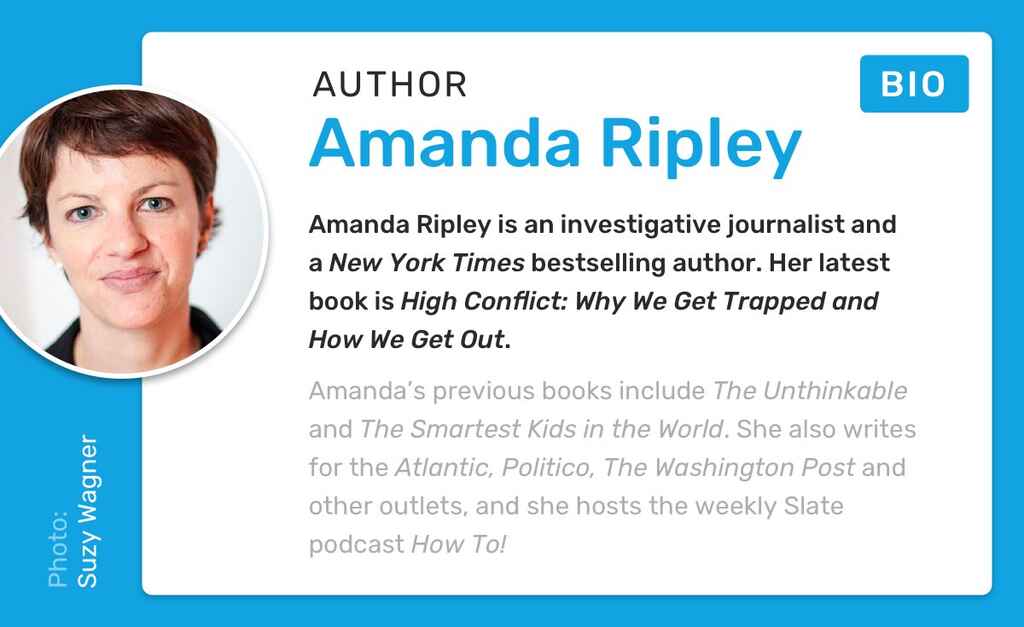
Non-fiction (Amanda Ripley):
Amanda Ripley is an investigative journalist and a New York Times bestselling author. Her latest book is High Conflict: Why We Get Trapped and How We Get Out.
Memoir (Tara Westover):
Tara Westover is an American historian and memoirist. Her first book, Educated, debuted at #1 on the New York Times bestseller list and remained on the list, in hardcover, for more than two years.
Mystery/Science Fiction (Blake Crouch):
Blake Crouch is a bestselling novelist and screenwriter. His novels include Upgrade, Recursion, Dark Matter, and the Wayward Pines trilogy, which was adapted into a television series for FOX.
All of these efficiently pack careers, key titles, and mainstream success into a compact couple of sentences. However, not every author is so accomplished...
What if you’re just starting out?
If you’re a debut author with no major awards yet, that’s totally fine. Just showcase what you do have and present yourself in the best light possible. For example:
Jane Doe is a poet, teacher, and author of the new novel We Were Already There.
Or
Jane Doe is a Professor of Anthropology at UCLA and author of Bloodlines: The Legacy of American Family Trauma.
Both examples establish professional credibility (poet/teacher, professor) before introducing the book. This gives readers a reason to trust you, even without any traditional publishing accolades.
Another option is to leverage endorsements from well-known outlets. For example:
[Famous author/literary outlet] says Jane Doe is "a unique new voice" in the thriller genre.
You can also mention any other wins you’ve had, like publishing short stories or online articles.
Her creative writing has featured in AGNI, The New England Review, and The Incandescent Review.
Once you've hooked readers with the essentials and some social proof, you can expand on your qualifications.
2. Further establish your authority
Here you want to double down, and highlight qualifications that explain why you're uniquely positioned to tell this story. This means relevant degrees, professional experience, or even life experiences.
For non-fiction authors, credentials are everything — readers need to trust that you're an authority worth listening to. For fiction writers, focus on what draws you to your genre or gives you special insight into your subject matter. For instance:
Non-fiction:
Jane is a historian at Yale University who has spent over a decade researching World War 2.
Fiction:
Jane has traveled extensively through Eastern Europe, walking the paths of her characters and immersing herself in the region's history.
Here are some more examples from published authors:
Children’s book (Laura Gehl):
I have a B.A. in psychology from Yale University and a Ph.D. in neuroscience from Georgetown University. Before becoming a full-time children’s book author, I taught high school, did research in a neurobiology lab, and worked as a science writer.
General fiction (Rebecca Van Laer)
I’m an alum of the New York State Summer Writers Institute, the Lighthouse Writers Workshop Lit Fest, and the Kenyon Review Writers Workshop. I hold a Ph.D. in English from Brown University, where I wrote a dissertation on queer and feminist autobiography.
Laura and Rebecca both keep the focus on achievements that are relevant to their literary work. The key here is pertinence over volume. Only include what’s relevant!
With your authority well established, it's time to let readers see the person behind the prose.
3. Finish with a personal touch
Adding a bit of color to your bio will make you more relatable to readers, which might be the final push they need to buy your book. This can be done subtly, like by referring to your location in your byline:
New-York based psychologist, Jane Doe…
Or you can include a brief illustration of your lifestyle:
Jane lives and works out of her home at the base of Mount Washington in New Hampshire, and spends her summers hiking and camping with her two children and husband.
Book marketing consultant Rob Eagar suggests closing out with a quippy-one liner that illustrates what kind of writer you are. “If your writing is known for its humor, let it show in your bio.” For example:
Jane hopes to write her next novel soon, if she can stop reading other people's novels instead.
Now that all the essential components are in place, let’s finish with a few final best practices to help you polish your author bio.
4 tips to keep in mind
There are a few considerations about POV, length, and structure that you should know about.
1. Write the bio in the third person
Even though you'll be the one writing or approving your own bio, stick with "they" rather than "I." This isn't just industry standard — it's much easier to highlight your achievements when you're not saying "I won three awards," but rather "She won three awards." Plus, it maintains professional distance when your bio appears in media kits, retailer pages, or press releases where first-person would sound oddly intimate.
2. Create multiple versions for different contexts
You'll need at least two versions: a one-liner (15-30 words) for social media profiles and brief mentions, and a standard version (50-200 words) for book covers, websites, and guest posts. The standard version is the one we unpacked in this article, and the one you’ll use the most.
Some authors also maintain a longer version (250+ words) for press kits and literary agent submissions, but this is optional. You can check J.T. Ellison’s about page for an example of a short, medium, and long bio.
3. The bio’s structure is flexible.
Our template isn’t meant to be followed to the letter 一 it’s simply a starting point. Some authors open with their hometown, others with their credentials. Some keep things purely professional, while others add a bit more personal flair.
Take Gina Sorell, for example:
After two decades of working as an actor, Gina Sorell returned to her first love—writing. A graduate with distinction of UCLA Extension Writers' Program, she is the author of Mothers and Other Strangers, and balances the solitary hours of fiction writing with work as a creative director and brand storyteller for her own agency, Words Make The Brand. Originally from Johannesburg, Gina has lived in New York and Los Angeles, and now lives in Toronto with her husband and son.
This doesn’t follow our template step by step, but it still hits the same key notes — background, credentials, publication, and a personal touch — and achieves the same goal: a compelling, well-rounded introduction.
4. Your bio is never truly complete
Refresh it every time you publish something new, earn an award, or reach a career milestone. The version you write as a debut author won’t serve you as well once you’ve released your third book. Keep updating it as your literary career progresses.
Every bio is unique to its author, but if you follow our three-step process and use the template as a guide, you’ll include everything you need to make a strong impression on new readers.