Guides • Perfecting your Craft
Last updated on Oct 28, 2026
The 7 Best NaNoWriMo Alternatives for 2026

Dario Villirilli
Dario Villirilli is a senior content marketer, editor, and SEO strategist with many years of experience in publishing. He is Managing Editor of the Reedsy Blog and has also written for IngramSpark, ProWritingAid, Written Word Media, and PublishDrive.
View profile →NaNoWriMo may no longer exist, but the concept of an annual November novel-writing challenge lives on. The best NaNoWriMo alternatives include the Reedsy Novel Sprint for big prizes and professional development; ProWritingAid’s Novel November for a large community feel; and Novlr’s Draftsgiving for a more casual, flexible challenge.
What Was NaNoWriMo?
Founded in 1999 by Chris Baty and friends, National Novel Writing Month, or NaNoWriMo, was an annual challenge in which participants aimed to write a 50,000-word novel during November. Popular for its free entry, inclusivity, and sense of community, it quickly grew into a global phenomenon with hundreds of thousands of writers joining in each year.
However, after years of mounting scandals, the organization announced its closure at the end of March 2025. Since then, various publishing companies and writing communities have launched their own spin on the challenge — maintaining these core elements while offering their own unique twists.
💬 Looking for a place to discuss NaNoWriMo?
Join other writers in our Discord community to discuss your novel writing journey.
Nanowrimo alternatives
Each NaNoWriMo alternative offers something slightly different. Here are our favorites at a glance.
|
✍️ Platform |
📆 Timeline |
📝 Goal |
🏆 Prize |
⭐️ Best for |
|
Reedsy Novel Sprint |
Nov 1-30 |
50,000 words in Studio |
$5,000 (1st), $2,500 (2nd), $1,000 (3rd) + agent call + partner prizes + 3-month Studio Premium for all finishers |
Writers seeking prizes, agent connections, and professional development |
|
ProWritingAid Novel November |
Nov 1-30 |
50,000 words |
Milestone badges and rewards |
Writers seeking a large community and daily sprints |
|
Order of The Written Word |
Nov 1-30 |
30,000 words (novel) or other creative goals |
Limited edition t-shirts available for purchase |
Writers wanting flexibility (poetry, shorts, editing) |
|
AutoCrit Novel 90 |
Oct 1 - Dec 31 |
50,000 words (full novel) |
Digital badge and certificate + wild card prizes |
Writers who need 90 days instead of 30 |
|
World Anvil NovelEmber |
Nov 1-30 |
Flexible (50,000 words or custom goal) |
Digital badge and certificate |
Writers working on worldbuilding, RPG content, or non-traditional projects |
|
NaNo 2.0 |
Nov 1-30 |
Flexible (50,000 words or custom goal) |
Winner status |
Former NaNoWriMos who miss the original community-led experience |
|
Novlr Draftsgiving |
Nov 1-30 |
10,000, 25,000, or 50,000 words in Novlr |
Goal celebrations |
Writers who want a low-pressure challenge with a smaller goal option |
Let's explore each alternative in detail.
1. The Reedsy Novel Sprint
Reedsy's Novel Sprint follows the same timeline and word count target of NaNoWriMo, while adding substantial prizes and support.
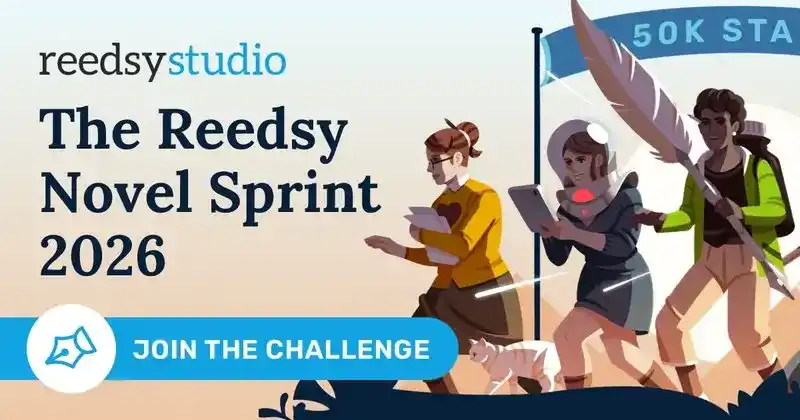
How it works: Write at least 50,000 words in Reedsy Studio throughout November. You can join anytime during the month, though we recommend starting early.
Throughout October, we’ll host Preptober events to help you get ready, followed by regular workshops and writing sprints in November to keep your momentum going. We've even got a Discord community with a dedicated Novel Sprint channel, so you can get that all-important community support (or peer pressure, depending on what motivates you!).
At the end of November, you can submit your first chapter, which will be judged by Reedsy’s internal panel. While the real prize of the event is to finish your novel draft, we will award:
- $5,000 to the first-place-winner,
- $2,500 to the second-place winner, and
- $1,000 to the third-place winner.
Each of these three winners will also receive a 30-minute consultation with a literary agent from our network, plus additional prizes from our 2026 partners, Barnes & Noble and Rakuten Kobo.
Additionally, every person who writes at least 50,000 words in Studio (no cheating — we’ll know if you copy/paste or use AI!) will receive, for free, three months’ access to our paid Craft + Outlining add-ons.
Writers under 18 are welcome to take on the challenge, but they can’t enter the contest. Contest submissions must be in English, although translations of your own work are accepted.
⭐️ Best for: Writers who want an experience similar to NaNoWriMo but with added incentives and professional development opportunities.
2. ProWritingAid: Novel November
ProWritingAid's Novel November is the largest NaNoWriMo alternative, with 70,000 writers taking part in 2025. Its structure is similar to the Reedsy Novel Sprint, but without the big prizes.

How it works: Register for a free ProWritingAid account and commit to writing 1,667 words per day throughout November. You can use any writing tool you prefer (Word, Google Docs, Scrivener, etc.) while tracking your progress via the Novel November dashboard.
During both October and November, you’ll get planning workshops to develop your story structure, as well as expert advice from top authors (Jessica Brody, Onyi Nwabineli, Troy Onyango, and many more) across 150+ live workshops.
In the Novel November forum, you can enjoy daily writing sprints, join a writer circle (e.g., Fantasy, Science Fiction, Romance, etc.), and receive badges as you progress through the challenge.
While there's no cash prize, participants earn badges and rewards for hitting milestones throughout the month.
⭐️ Best for: Writers seeking a large community vibe while also getting tips from bestselling authors and publishing pros.
3. Order of the Written Word: November Challenge
The Order of the Written Word (O2W) was founded by author Holly Rhiannon, who spent three years as one of Montreal’s Municipal Liaisons for NaNoWriMo. O2W emerged in response to NaNoWriMo’s stance on generative AI, offering a dedicated space for authors, poets, and storytellers who prioritize thoughtful, deliberate creativity. To this end, she started her own alternative event, the November Challenge. It’s completely free to join and is backed by her small press, The Stygian Society.

How it works: O2W offers three different challenges to suit your writing goals:
- The Novelist’s Initiation: Write 30,000 words of a novel or complete the first draft of a new one.
- The Trials of Verse & Vignette: Create 15 poems or 8 short stories (each between 1,000–10,000 words).
- The Refinement Ritual: Revise an existing manuscript, whether it’s a novel, story collection, or poetry collection.
To take part, you’ll need to join their Discord community, where you can track progress, connect with other writers, and access event resources like The Crafting Grounds (for Preptober prep) and Scrollwork Sessions (scheduled writing sprints).
A built-in WriterStats bot helps you log your word count or revision progress and share updates with the group.
If you take part, you’ll also have the chance to grab one of their limited-edition tees — custom designed by a different artist each year — and enjoy discounts from the event’s sponsors.
⭐️ Best for: Writers who want a more flexible approach to November writing challenges, with options for poetry, short fiction, or editing.
4. AutoCrit Novel: 90 Writing Challenge
AutoCrit's Novel 90 extends the 30-day sprint into a full 90-day writing process 一 from October to December — with a dedicated month each for planning, writing, and editing.
How it works: Register for free on their site (participants must be 18 or older) and choose your writing style "team":
- Planner: For writers who outline extensively before drafting
- Pantser: For writers who discover the story as they write
- Plantser: For writers who blend both approaches
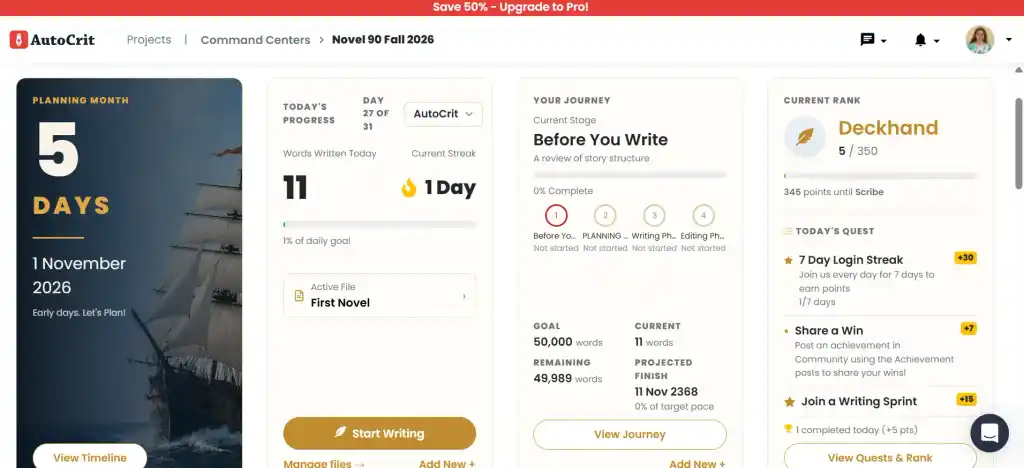
Each team is led by a USA Today bestselling author who provides guidance, coaching, and motivation throughout the challenge. In 2026, the whole challenge runs inside AutoCrit’s Command Center, where you track daily word counts and streaks, complete daily quests, and climb a leaderboard.
You can also submit your work for judging for the chance to win prizes such as merch and a 45-minute coaching session.
⭐️ Best for: Writers who prefer a longer timeframe with a dedicated editing month.
5. World Anvil: NovelEmber
World Anvil's NovelEmber is a flexible, community-driven alternative that welcomes writers working on novels, revisions, or creative projects of all kinds.

How it works: NovelEmber operates on an honor system — you set your own goal and decide whether you've achieved it. The traditional target is 50,000 words, but you can also participate as a "REBEL" with custom goals:
- Draft a novel, novella, or piece of serial fiction
- Turn your tabletop RPG campaign into a novel
- Write ten 5,000-word short stories set in your world
- Complete 50,000 words of worldbuilding content
- Etc.
World Anvil users can monitor their progress through a dashboard widget and create shareable graphics to update followers, connect with fellow "Anvilites," and claim a winner's certificate at the end.
⭐️ Best for: Writers who want a flexible November challenge without the pressure of competition or strict rules — especially those working on worldbuilding, RPG content, or non-traditional projects.
6. NaNo 2.0
NaNo 2.0 is a volunteer-led challenge run by longtime NaNoWriMo educators and enthusiasts, including NaNoWriMo founder Chris Baty, who came together to keep the spirit of National Novel Writing Month alive.
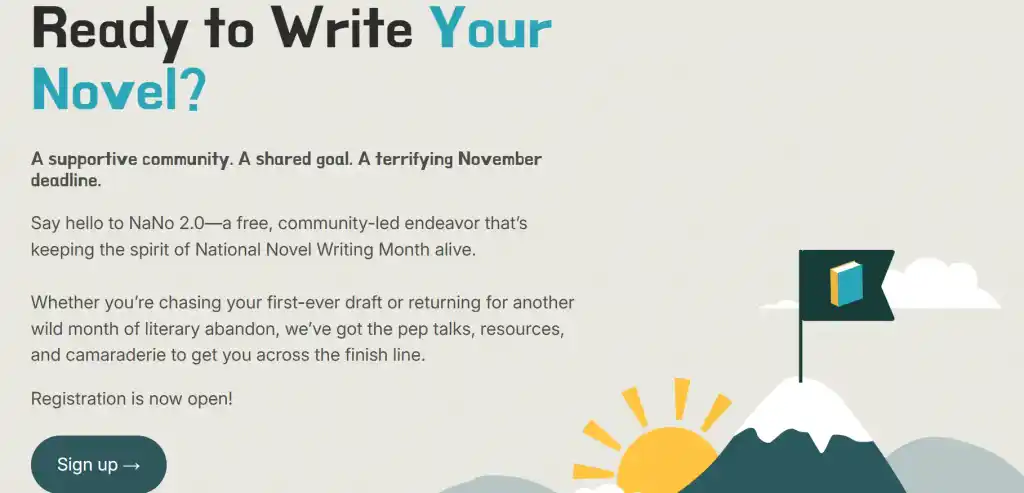
How it works: Create a free account on their site (you must be at least 16 years old) and set up an author profile.
The classic challenge is still 50,000 words from scratch in November, but you can also choose your own goal. To win, simply reach the goal you shared by November 30. You can write in any app you like, tracking your words in their brand-new word count tracker for 2026.
⭐️ Best for: Former NaNoWriMo enthusiasts who want a familiar, no-frills November challenge from the people who built NaNoWriMo.
7. Novlr: Draftsgiving
Novlr’s Draftsgiving is a November “writing feast” with different “portion sizes” that correspond to word count goals.
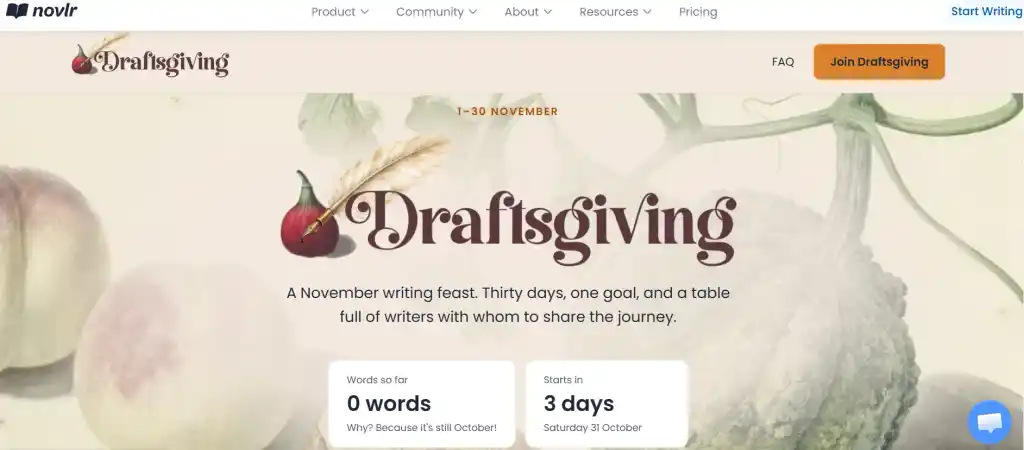
How it works: Create a free Novlr account, join the event, and pick your goal:
-
Small Plate: 10,000 words
-
Generous Portion: 25,000 words
-
All the Trimmings: 50,000 words
You can switch between goals at any time and your progress is tracked automatically within Novlr.
You’ll also have access to Novlr’s Discord community and regular in-app writing sprints.
⭐️ Best for: Writers who want a free, low-pressure November challenge with a realistic goal option below 50,000 words.
DIY approaches
Besides direct NaNoWriMo alternatives, there are some other sites that offer tools to track your progress and keep you accountable throughout your writing journey. Whether you're looking for gamification, community support, or simple progress tracking, these platforms can help you stay motivated at any time of the year:
- Shut Up & Write: A global community hosting both in-person and virtual writing sessions where you can write alongside other authors in focused, timed sprints. A free account now gives you a writing-practice dashboard to log sessions and set goals, and the site runs its own writing challenges.
- 4thewords: A gamified writing platform that turns your writing into an RPG adventure, where you battle monsters and complete quests by hitting daily word count goals. Its Write Fest 2026 event runs from November 1 to December 8, is free to join, and features quests and co-op battles, and the free desktop app now counts the words you write in Word, Scrivener, or Obsidian.
- Pacemaker: A flexible goal-setting tool that helps you create custom writing schedules and tracks your daily progress toward any word count target.
- TrackBear: A simple, visual word count tracker that displays your writing streaks, progress charts, and daily goals in a clean, motivating interface. It’s free, tracks words, pages, chapters, scenes, or time, and lets you set up leaderboards with friends.
- My Write Club: A free accountability platform offering writing sprints, goal tracking, and a supportive community of writers cheering each other on.
Once you’ve picked your November writing challenge, it’s time to get ready. Most of these alternatives include a “Preptober” phase for a reason: the writers who thrive in November are the ones who start Day 1 with a solid plan. Check out our next post for 8 essential tips to prepare for your November writing challenge.


2 responses
Sasha Anderson says:
31/05/2020 – 21:11
27. Don't write pages of lush prose when plain English will do“Serving the reader most often means telling your story in the clearest possible way. Plain English is beautiful, and ideas deserve to stand or fall on their own merits. Make your point and move on.”Doesn't this depend on your style? Surely some writers write for the prose, and some readers read for it. And most want the book to meet at least some minimum bar, rather than having a series of boring, repetitive sentences...
↪️ Martin Cavannagh replied:
03/06/2020 – 10:13
"Surely some writers write for the prose, and some readers read for it." I think some readers do relish an author who can craft beautiful prose, but I'd argue that this piece of advice is more for newer writers who might think that quality prose is made up for ornate metaphors and lush turns of phrase. In most cases, there's a lack of confidence in the reader's imagination. Often, the best writing has a way of sparking their readers' minds to fill in the blanks, which will often create a much more powerful effect than pages of description.