Welcome to Reedsy's villain name generator
The villain's name is one of the most technically difficult naming problems in fiction! It has to feel threatening without tipping into parody. It has to belong to a person — someone with a history, a psychology, a logic of their own — rather than an abstraction of evil. And it has to survive repeated use in prose, in dialogue, in the mouths of characters who fear or hate or are disturbingly loyal to this person. A villain name that works is doing a lot of quiet structural work.
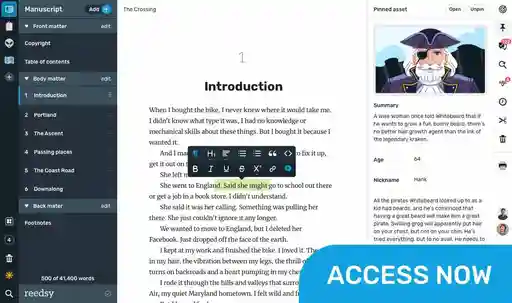
Our villain name generator asks you the right questions to aid you in finding the perfect villain name. Tell it your villain's personality, genre, setting, and any additional context that matters, and it returns ten names with individual reasoning — each one calibrated to the antagonist you're actually writing.
How to use this name generator
The personality dropdown is especially revealing for villain characters. The personality options here reflect the real range of what villainy looks like in fiction — and the difference between, say, a Charismatic / Magnetic villain and an Eccentric / Unconventional one is enormous. Get this right and the rest of the inputs will follow.
Select gender and book genre, then use Setting or world to anchor the results. The period and place of your story shape what a threatening name sounds like: a Victorian-era antagonist, a contemporary corporate villain, and a dark lord in a secondary world all call for completely different registers.
The Additional details field matters here more than anywhere else. Specify cultural background, the nature of the threat they pose, their relationship to the protagonist, and other characters' names (especially the hero's).
Each generation returns ten names with reasoning. Select the keepers and run up to four generations per session.
So you want a good villain name?
The failure mode for villain names is well known: something that sounds like evil rather than being it. A name assembled from dark phonemes and vaguely sinister associations announces itself as a villain's name before the character has done anything to earn that designation.
A few things worth knowing as you write:
The most frightening villain names often sound ordinary. Hannibal Lecter. Amy Dunne. Humbert Humbert. The mundanity is part of the point, for it suggests that the threat doesn't announce itself, that it walks around in ordinary clothes with an ordinary name. If your villain is the kind of threat that works through charm, normalcy, or concealment, consider whether a name that sounds unremarkable might be more unsettling than one that sounds sinister.
Phonetics work differently for villains than for heroes. The same hard consonants and clipped syllables that feel decisive in a hero can feel menacing in a villain — but this effect is so well understood that deploying it without awareness is a cliché. If you're going to use phonetics to signal threat, use them with intention and specificity, not as a default.
The villain's cultural and historical context should be specific. A villain whose name is generically "foreign-sounding" or assembled from exotic phonemes without cultural grounding is not just a craft failure — it's a representational one.
Consider what the villain's name means to other characters. Some villains are named openly, in dread or in hatred. Others are not named at all — referred to by title, by epithet, by fearful circumlocution. Still others have two names: the one that appears in official contexts and the one whispered in private. Deciding how your villain is named within the story is a separate question from what their actual name is, but the two decisions should inform each other.
Read the literature. The villains who have endured in the literary imagination tend to have names that reward study. Look at how Nabokov names Humbert Humbert — the doubled name, its dark comedy, what it tells you about his vanity and self-mythology. Consider what Cormac McCarthy does with the Judge in Blood Meridian, a figure so threatening he barely needs a name at all. Study how Gillian Flynn constructs Amy Dunne in Gone Girl, and how the normality of the name is part of the novel's central unease. Or go back to Shakespeare's Iago — a name that tells you almost nothing and somehow everything.
A note on our use of AI
We built this tool for writers, which means we thought carefully about what AI should and shouldn't do here. The generator uses AI to produce villain names that better fit your character's specific context and needs — personality, gender, genre, setting, and the particular nature of the threat they pose — while explaining its reasoning for each one.
Here's what it won't do for you: it won't write your story, name your character, or make creative decisions for you. It simply generates options for you.
More importantly, your inputs are not (and will never be) used to train any AI models. Treat whatever comes out as raw material: a starting point that belongs entirely to you. Every result is yours!