


 65 likes
 59 comments
Literary historical fiction, with dark atmospheric overtones.
I have drawn the face of countless murderers. Yet this was the only sketch that haunted me.
From the carriage window, the forest stretched endlessly, birch trees rising pearly-white from the earth — the very ribcage of Siberia sliding past. The hooves struck the sandy road in a steady rhythm, the carriage rattling softly beneath me.
I rested my satchel of charcoal and pencils across my lap, lost in thought. It was the country where I had grown up, roads I knew by heart.
Then a dark figure emerged. Our carriage was already rolling past as the man stepped out from the trees and seemed to look directly at me.
His face was framed by heavy dark hair, long and unkempt, and a beard left to grow wild. There was a feral gravity to him that I could not immediately account for — monk or peasant, it was impossible to say. Yet he carried a presence that seemed to swallow the light around him.
His eyes were pale and unsettling — washed out, yet piercing. They were not unfocused, nor wild with fever, but fixed — anchored by some unwavering conviction, a devotion without known bounds. When his gaze found me, I felt it settle with a weight that would not lift.
I realized, too late, that I could not look away.
His mouth was already moving as we approached, shaping words I could not hear. Just as we passed he lifted his voice, not quite like a chant, or a decree. I could not catch the meaning, yet the sound clung to me, settling over my skin and staying there.
The coachman caught the figure at the corner of his eye. With a sharp swish of his whip, he muttered something under his breath, and the horses quickened their pace. As we pulled away, I caught the smell of the carriage again — old leather from the harness, linseed oil sunk deep into the wood. My senses were only now returning to me. Whoever the man was, my coachman did not welcome his presence. I felt the same unease, though I could not have said why.
It was only then that I remembered the rumors whispered in these parts, of a man in rough cloth who walked the earth. Priest, monk or madman, no one who spoke of him ever agreed, and none claimed to know his purpose. Our carriage continued along the dusty, winding road that barely cut through the woods. By dusk the trees thinned, the road widened, and the first roofs of Krasnokamsk appeared.
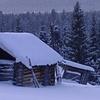
The old log-built cabins came into view, all stretched out in a row as we pulled in front of the village post-office. Each cabin was edged with carved heirloom window frames — nalichiniki — worked into flowers, birds, and intricate designs.
Still, I could not dislodge those eyes from my mind. His posture, his raised hand, gave the impression of a blessing — or a warning, but it was impossible to tell which.
For just a few rubles, they put me in a room for the night. It was not a pleasant place. The bedspread had mice droppings, and the dust made it clear no one had slept there in some time. Outside, the sky blazed orange, the cupolas of the orthodox church glowed red as the wind battered the wooden frame of the house.
I lit my tallow candle and began to draw.
That is what I do. I take words and faces and make them come alive: charcoal, graphite pencil, whatever the moment demands.
My hands and fingers moved on their own as I poured out my memory onto the paper. With each stroke, something I felt but could not name took shape. He looked like a man suspended between two worlds. I stared at the beginnings of his face.
And as I worked, I remembered his lips moving as we passed. What did he say? I thought I felt the weight of his words press into my skin, like little spirits, fastening themselves into my flesh.
Then the candle waxed out, plunging the room into darkness. I lit another. My fingers were stained black, and I set the charcoal aside.
The tribunal was why I had come, for there was other work waiting — a murderer's face needed rendering. Over the years, I had sketched more than a dozen such faces. I slipped the unfinished portrait in my satchel.
Sleep crept into me full of pale eyes with unwavering conviction. His mouth moved in the dark behind my eyelids, his words dissolving each time I reached for their meaning.
****
In the morning, I rose to a cup of tea. I grabbed my satchel and walked out into streets oblivious to the sorrow clinging inside the wooden cabin. I was shown to a small room where the family was waiting.
The tribunal was in a few days, and this morning I sat with the victim’s family. I let their words guide my hands — taking what lived in their memory and pulling it onto paper. A most unpleasant and awful thing had occurred, right outside the public bathhouse which we call a banya. Natasha had a hard time talking, as they often do. She described his face, his body, and his build. She would stop, gather herself, and press on.
I sketched, erased, and sketched again until the likeness of the man under the candle made them all scream. Her hands wrapped around her face in complete revulsion. “It is him,” she said with a trembling voice, fighting back terror. The captain nodded at me and gave me my wages. This is what I do and this is what I am. I bring words to life on any canvas you can give me.
I walked back to the post-office and made my way to my room. It was dingy and cold; yet I had only one thing in mind. I lit my remaining tallow candles and sat before the unfinished portrait.
It was as if I was sketching something that was not meant to be sketched. Releasing something that was not meant to be released. Did his words pierce my skin? Still, unheeding these things, I pressed on till the break of dawn. There he was on paper — his eyes, that once they settle on someone, do not let go easily. They seemed to look through rather than at, as though the present moment were only a thin veil. I was haunted. I put it in my satchel and walked out to get my carriage back.
I headed back, the forest moving with the carriage. I kept my head tilted toward the trees, half-expecting him to step out again.
We finally made it to Volkansk, to the cabin that served as our office.
Fedya took one look at me and placed his hands on my shoulders.
“Rodia, what is with you? You do not look well.”
“Nothing. Just something I saw. I’d rather not discuss it.”
Fedya leaned forward, tapping the satchel. “Show it.”
He reached for the oil lamp on the table and drew it closer. The soft glow thickened the air between us. I opened my satchel and placed the drawing on the table.
Fedya’s face tightened into something grave, almost repulsed. In the flickering of the lantern light, his gaze carried something untamed.
“You shouldn’t have drawn him,” he said.
My breath caught. “Why? You know me… I had to.”
Fedya’s eyes dropped to the portrait.
“Because he sees those who see him. Or so I am told. He walks these parts, and no one knows who — or what — he really is. There is something feral in him. No saintly purpose to it. He preaches that one must sin in order to repent… that darkness is the road to grace. He preys on the vulnerable — a man whom you should never let near your wife.”
His gaze flicked to the icon of St. Nicholas. He crossed himself quickly, as if needing to cleanse the thought. We sat in silence.
“I would get rid of that,” Fedya said quietly. "The man has a familiar spirit."
I stared at the portrait for a moment, then slid it back into my satchel. Fedya shrugged.
“Your choice. You have my warning... Rodia. Daria has been asking when you’ll return. She seemed anxious. You stayed an extra night,” he said, shifting the subject.
“Yes… I will cover that cost,” I said, my voice drifting. “I need to go home. Daria is waiting. I just need to drop off my wages, as we discussed.”
I gave a small nod, then walked out. The heavy wooden door snapped shut against the iron lock.
****
My home was a log-built izba, old by even most village memory. The wind was at my back as I approached. Our fence sagged along the yard, darkened with age, and beyond it white sheets snapped and flared on the line. Somewhere nearby, a chain scraped through a pulley as a man drew water from the well. Inside, Daria would be waiting.
For whatever reason, I hesitated to open the door.
We had never been able to have children — years of trying, years of bitter tears. She believed barrenness was a curse, a feeling her womb was forever sealed. I only knew how to carry her sorrow beside my own. Before I left, we had argued over this once again. I sighed, and pushed our wooden door open.
Daria turned from our wood-stove when she heard me. She came across the room and held me tightly, the way she always did when I had been away too long. When she pulled back, there was a strange excitement in her face.
“A man came by today, Rodia,” she said, that same strange excitement in her voice. Before I could answer, she went on. “I nearly missed him. I was at the clothesline, hanging a sheet. The wind was snapping them so loudly — lifting, falling, lifting again — I could scarcely hear a thing. And then I saw him, standing there, the white cloth rising and dropping, revealing him one moment and hiding him the next.”
I did not say anything, but my hands tightened into a grip.
“I was very unsettled at first,” she continued. “He only stood there, looking at me. Then he stepped forward, and I thought I might scream… but I couldn’t. He looked like a priest, but not of any kind I’ve ever known.”
“What did this man want?” I asked. My voice came out sharper than I intended.
Tears welled in her eyes. “He raised his hand, and before I understood what was happening, he placed it here.” She took my hand and pressed it to her stomach.
“He said the world was full of shadows — good and bad, beautiful and frightening. And then he said… that I will be with child.” She hesitated. “A son.” Her voice cracked.
I pulled my hand away — almost a feeling of repulsion. “And then?” I asked as tears began to form.
“After that, he closed his eyes. His hand never moved. He began to pray softly at first, then louder, as if the words were being pushed by something through him.”
She swallowed. “I became frightened, Rodia... I did not know what to do. He spoke such strange things... convincing things.”
“And what?” I asked. “What happened?”
“And then he stopped the chant. Horrible silence. His eyes opened suddenly. They were strange eyes — Rodia…” Then he said, ‘All things come to pass as they are written. It is and it will be.’”
“Is that all that happened?” I asked.
She looked full of shame, her eyes wide with confusion.
“I had wanted children — God forgive me — so badly that the wanting itself had to be wrong. It was his words... Rodia."
I knew I needed to say something. I didn’t. To this day I regret it. Instead, I went to fetch my satchel.
“Rodia… I—” she started.
I interrupted her. “I want you to see something.”
I lit a candle and motioned her over.
When I held it up to the light, she stepped back and looked away.
“It is him,” she whispered.
I told her then how I had seen the man in the forest, the eyes, the drawing I had not meant to finish. When I finished, she said nothing.
She then reached for my hand again — cautiously. “What will this child become?” she asked, pain on her face.
I did not answer. The question itself felt like the worst type of betrayal, and yet I could not deny that it had already been asked inside me.
That night, we lay awake listening to the wind slice through the walls of our izba. The drawing lay folded in my satchel, and neither of us spoke of it ever again.
****
The years passed and the seasons turned in our little izba. Daria and I never spoke of that figure again — not once — for he haunted us in a way we could not give words to.
We did indeed have a son. There were nights I sat by his cradle long after Daria had fallen asleep, watching him breathe, and wondering what he would become.
I watched Daria’s face change as she nursed him in her arms, as she mothered him the way she had always prayed and pleaded.
Mikhail and I traveled by train for several days to a larger district in Tyumen Province. Once more, I was summoned into the home of the unfortunate. I took their words and translated them into eyes and bone, into the particular set of a mouth, the angle of a chin. Mikhail watched me closely, seeing me as he never had before — at work. The detective was pleased. We were paid promptly, this time without much formality.
We were walking back toward the train station. Winter had already settled in. The ground was rock hard, the air sharp enough to burn my cheeks with every breath. Our boots squeaked over the newly laid snow, the only sound we seemed to make — until a voice carried through the cold.
A man was lifting his voice, repeating himself over and over. “Assassination! The Tsar’s fate foretold! Novoye Vremya! Just a few kopecks!”
I stopped, my body trembling in the cold. An assassination? The unraveling of our nation’s dynasty? I had completely forgotten the cold. I handed the man a few kopecks. He reached behind the cracked, frost-clouded glass of his kiosk and pulled out a copy.
Mikhail had wandered off, peering into an old pawnshop, while I stood there with the paper in my hands, a sudden rush running through me. What did it all mean?
The headline read — Bolshevik Revolution. Beneath it: Clergy arrested. Icons removed. Land seized. Ownership abolished. Tribunals suspended.
Then, in a smaller column half swallowed by the larger news, I saw it: the peasant-mystic who had once knelt at the Empress’s side had been shot and thrown off a bridge.
And there he was beside the words, the same eyes that pierced me so long ago — much older, but that was him.
These words under his photo: ‘If I die, they will all die within two years. All things come to pass as they are written.’
I folded the paper carefully and tucked it beneath my arm, hiding the image of the man who had walked these forests — the one I had not looked at since I put that portrait away in my satchel.
My son waited for me at the corner.
“Papa, hurry,” he said, hopping from foot to foot against the cold. “The wind hurts.”
I hastened my pace and looked at him — the only face I was afraid to render. He had his grandmother’s eyes, and I promised I would not look again.
Some things, once seen, are better carried in the dark.




You must sign up or log in to submit a comment.
The atmosphere in this was outstanding. You kept the tension really beautifully through the end.
Reply
Thank you so much for reading, it means a lot that the mood and setting connected with you. The stranger the artist sketches is based on a real historical figure from Russia, and I’m still deciding how overt to make that in the ending. I made a few adjustments to bring that thread forward more clearly; I think it was hidden a bit too deeply before. I truly appreciate your thoughtful feedback.
Reply