Guides • Perfecting your Craft
Posted on Nov 04, 2024
Man vs. Self: The Ultimate Inner Conflict in Literature

Dario Villirilli
Managing Editor of the Reedsy blog, Dario is a graduate of Mälardalen University. As a freelance writer, he has written for many esteemed outlets aimed at writers. A traveler at heart, he can be found roaming the world and working from his laptop.
View profile →
Linnea Gradin
The editor-in-chief of the Reedsy Freelancer blog, Linnea is a writer and marketer with a degree from the University of Cambridge. Her focus is to provide aspiring editors and book designers with the resources to further their careers.
View profile →We’ve all had moments of being our own worst enemy — whether it’s hesitating to ask someone out because of insecurities or abandoning a dream after convincing ourselves we’re not ready. This internal struggle, where our desires clash with beliefs that hold us back (or hubris that clouds our judgment), lies at the core of the man vs. self conflict (also known as character vs. self).
In this post, we'll explore the significance of man vs. self conflict in storytelling, look at some examples from popular books and movies, and share tips on how to make this type of conflict compelling for your readers.
 Click to tweet!
What is man vs. self conflict?
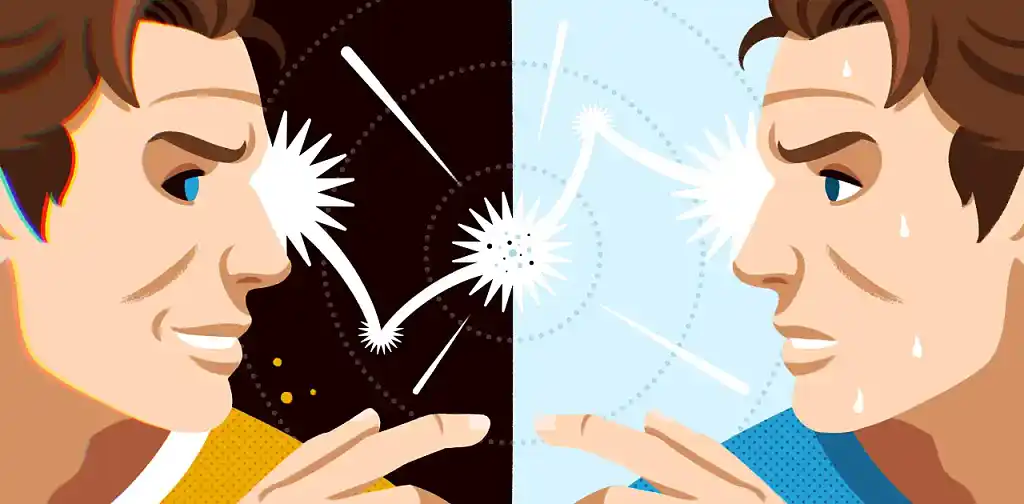
Man vs. self conflict (often known as "character vs. self") is one of the seven types of conflict in narrative. It’s a type of internal conflict in literature that refers to the struggle a character has to face with their own thoughts, beliefs, or moral predicaments, which stand in the way of achieving their goals. It usually forces characters to make difficult decisions in order to grow and change.
Q: Does a protagonist have to change over the course of their story?
Suggested answer


Great question! And as with so many answers when it comes to writing fiction, the answer is 'yes and no'. Let me elaborate...
Sometimes, a change in a character and how it happens is the entire point of a story. Look at 'A Christmas Carol' by Charles Dickens, for example: Scrooge must look into his past and understand how his life has brought him to this point. For him, if he doesn't change, he will die a lonely and unmourned death. For us, if he doesn't change, then all we really have is a book about a man shouting at Christmas.
And then sometimes there is a Katniss Everdeen. Her qualities of bravery and knowing what's right are there from the start - she wouldn't substitute for her sister otherwise. Those characteristics remain strong throughout. The change in the Hunger Games books are often about the changes Katniss brings to the world around her; her main job in the narrative is as an agent of change, as someone who is unafraid to stand up for what's right. We often see this in superheroes.
I'm also thinking about Harry Potter, who doesn't so much change as have knowledge revealed to him that changes the way he sees himself. Yes, he gains skills and knowledge as the books progress, but he is (literally) marked to be who he is from the beginning. The change here is in his understanding of who and what he is, and what happened to him and his parents - something that the reader discovers along with him.
So I'd say that there always has to be change - otherwise, why would we read a book at all?
And change will definitely occur around the protagonist.
But that doesn't necessarily mean that the character begins as 'a', goes through 'b' and becomes 'c'. This is what makes fiction so interesting, to read and to write.
Stephanie is available to hire on Reedsy ⏺

No. But in most cases, it's probably a good idea.
This criticism ("protagonist needs development/arc/change") is often shorthand for "this story doesn't have much craft to it" or "there's no arc to this thing." If the protagonist has no arc, good chance the story doesn't, either—but this isn't a hard-and-fast judgment.
The better question to ask is whether your protagonist should change. If not, you should have a firm idea why not, and so should your reader by the end. What would the character's not changing say, mean, or do? Is it a tale where everyone knows the protagonist needs to change, but he doesn't? Does he suffer the consequences? Get away with it? And so on.
Unless you can articulate why your character shouldn't change, then your editor is probably right: change would help the story along. But before you get rewriting, decide how this change will advance the story, what effects it will have.
In other words: Don't just change a character arc because an editor said you should. Change it because the story will be stronger for it.
Joey is available to hire on Reedsy ⏺

This is what is usually expected, especially in coming-of-age stories for teens. However, in some cases, the point of the story might be that the main character does NOT change. And if this scenario works best for the story you are trying to tell, then the protagonist does not have to change.
While growth in the protagonist by the end of the story is the "norm" for most books, sometimes the growth comes from getting what they wanted at the beginning. There are many ways for "growth" to occur. Whichever path is chosen must make sense for your story and feel organic to the narrative, not forced.
Example of a "stuck" adult character that doesn't change:
Archie Bunker from the TV show All in the Family - always a cynic and pessimist
Example of an adult character who is "stuck" at the outset, but grows by the end of the story:
Macon Leary from The Accidental Tourist - becomes "unstuck" and more independent
So, you have to do what works for your story and makes sense in the overall plot scheme.
Melody is available to hire on Reedsy ⏺

As they say, "change is the only evidence of life." So as a rough, general rule, it's a good idea to have character development.
As well as being an editor, I'm a screenwriter, and protagonist change is often stressed as essential in films to keep an audience interested.
But it depends on the type of story and character. If a character is interesting enough, and the point of the story includes that they don't change, then don't force them to.
There are no infallible rules about storytelling.
John is available to hire on Reedsy ⏺

A hero does not necessarily have to change, but must be tested. The audience expects some sort of movement, whether personal transformation, deepened belief, or a catastrophic refusal to move. Even a strong character requires challenges which reveal new aspects of what they are. Change does not necessarily have to be great, such as discovering a truth or paying a price to pay. It is that the journey alters the sense or meaning of their choices. A character without thought who remains static can turn into a two-dimensional figure, but a strong one who stands with conviction can be powerful.
John is available to hire on Reedsy ⏺
You’ll find this conflict at the core of many character arcs, adding depth and complexity to the protagonist. Readers love imperfect characters who wrestle with doubts and insecurities, which is why this conflict frequently appears in narratives. Sometimes it's the main focus, while other times it adds a secondary layer 一 the main struggle might be against nature, fate, or an antagonist, but the conflict usually also ties back to some internal battle that the protagonist has to wage.
But let’s get practical and look at some examples.
Man vs. self examples from literature and film
Great Expectation by Charles Dickens
Great Expectations by Dickens is a bildungsroman (or coming-of-age novel) in which the main character Pip is a poor, orphaned blacksmith’s boy with a kind heart who feels ashamed of his upbringing and fears doing anything that might worsen his situation, leading him to dream of a higher social status and overly idealize wealth.
After visiting the wealthy, eccentric Miss Havisham in her mansion, Pip falls in love with her adopted daughter, Estella. Driven by this infatuation, he becomes fixated on improving himself and climbing the social ladder, believing that a higher status will make him worthy of her love.
So when Pip receives a fortune from a mysterious benefactor, he eagerly transforms into a London gentleman and quickly starts to distance himself from his roots (for instance, he begins to feel embarrassed by Joe, the blacksmith who was once his loyal friend and protector).
His inner conflict lies in his struggle between achieving everything he’s ever wanted and staying true to his ideals. Will he devote himself to becoming a callous member of the upper-middle crust or remain loyal to his family and authentic self?
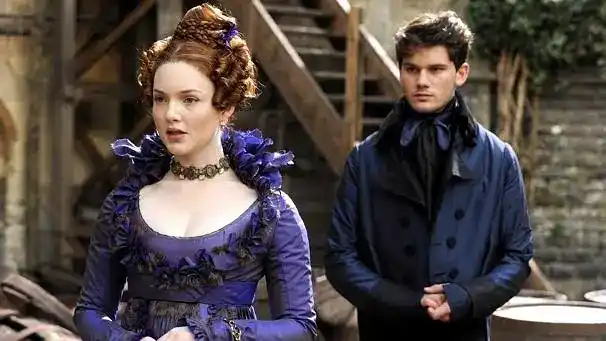
After losing himself in the idle luxury of high-class life and driving away those who loved him most — who remained loyal to him even after he became a gentleman — Pip ultimately learns that status doesn’t determine a person’s worth. He comes to realize that his kind heart had made him a true gentleman all along, and returns to his roots.
Black Swan (2010)
Black Swan is a psychological horror film starring Natalie Portman as Nina, a talented ballerina in the New York City Ballet. Nina is desperate to land the lead in Swan Lake, a role that demands she portray both the White Swan, embodying innocence and fragility, and the Black Swan, who is seductive and untamed. Nina effortlessly captures the White Swan’s delicate qualities — she lives under the constant pressure of her overbearing mother, a former (but ‘failed’) ballerina herself, who has drilled discipline and perfectionism into her daughter, so all Nina dreams of is to be the perfect dancer.
Q: Does every story need a clear-cut antagonist?
Suggested answer

Yes or there is nothing for the protagonist to push against or overcome. The story will just drift along on a happy cloud, which is nice for real life but not very interesting to read. However, an antagonist can be any number of things. It can be an aspect of the protagonist's personality. It can be a memory. It can the difficulty of reaching a goal. It can be society. It can be a pandemic. It can be the weather. It can be a whale.
Sophia is available to hire on Reedsy ⏺

It depends on your story. A clear-cut antagonist is one specific, highly effective way to personify opposition. A traditional villain can be a powerful tool for delivering a focused, action-oriented, and emotionally resonant narrative. But … not every story is like that. So, no, not every story needs this, exactly. Yet every compelling story needs an antagonistic force that creates conflict or represents an obstacle, getting in the way of the protagonist's goals.
You can have antagonism in various forms, such as inner demons, addictions or trauma. Nature, the environment, or illness. A corrupt system, prejudice, even machines, time! What about destiny?
They all pose nuanced conflicts without a central 'bad guy,' they're sometimes ambiguous, and they explore moral complexities. They all hold a different kind of mirror to your concept. Your antagonist challenges your protagonist, forcing them to grow, reveal true character and values. Whatever form they take, they ought to be the perfect day to your night, or vice versa. Clear-cut becomes a question of who or what is best suited to the challenge.
Agatha is available to hire on Reedsy ⏺

In some genres, readers may expect a clear antagonist (for instance, mysteries and thrillers generally have a clear antagonist, as does young adult SFF), but not every book will need one.
What's important, instead, is that every story needs to have tension, and that tension has to come from somewhere. Maybe it's a serial killer or a world-class villain, but maybe it's just the nerves of a young girl trying to figure out how to survive in the normal world, or the desire of a teenager to be a professional athlete even though the odds are stacked against them.
Another way to think about this is to consider that a story needs stakes. Why should the reader care about the story you're telling or the character centered on the page? Whether you're writing a plot-driven or character-driven story, or balancing the two drives, your reader needs a reason to keep turning pages. An antagonist--or, rather, the fight against such an antagonist--can serve that purpose, but depending on the type of book you're writing, you may simply not need one.
There are also books where, rather than having a single clear-cut antagonist, you'll have many! I just read a mystery graphic novel, the first in a series, where the young protagonist had many people in her life who served as antagonists. No one person/character was the primary antagonist, but it worked really well because the reader was connected to her thoughts/desires, her goals, and her attempts to unravel the world around her. In this case, having multiple antagonists--and even a few characters who were very definitively in gray territory, maybe on her side and maybe not--was exactly what fit the bill.
Jennifer is available to hire on Reedsy ⏺

Every story needs an antagonist, but I think that every writer's definition of an antagonist will differ a bit. For one character, they are fighting a literal dragon. For another, it's the "dragon" of addiction, a storm while climbing a mountain, or their relationship with their mother. I know that sounds cheesy, but the story has to have stakes for the reader to care. Usually, stakes come with a fight to victory, a pathway of challenges -- a hero's journey. And it's hard to be a hero without an antagonist.
But clear-cut? No, I don't think so.
Grace is available to hire on Reedsy ⏺
But to portray the Black Swan, she must tap into an intense, unrestrained side of herself she’s repressed her entire life. As her artistic director tells her, “The only one standing in your way is you. It’s time to let her go. Lose yourself.”
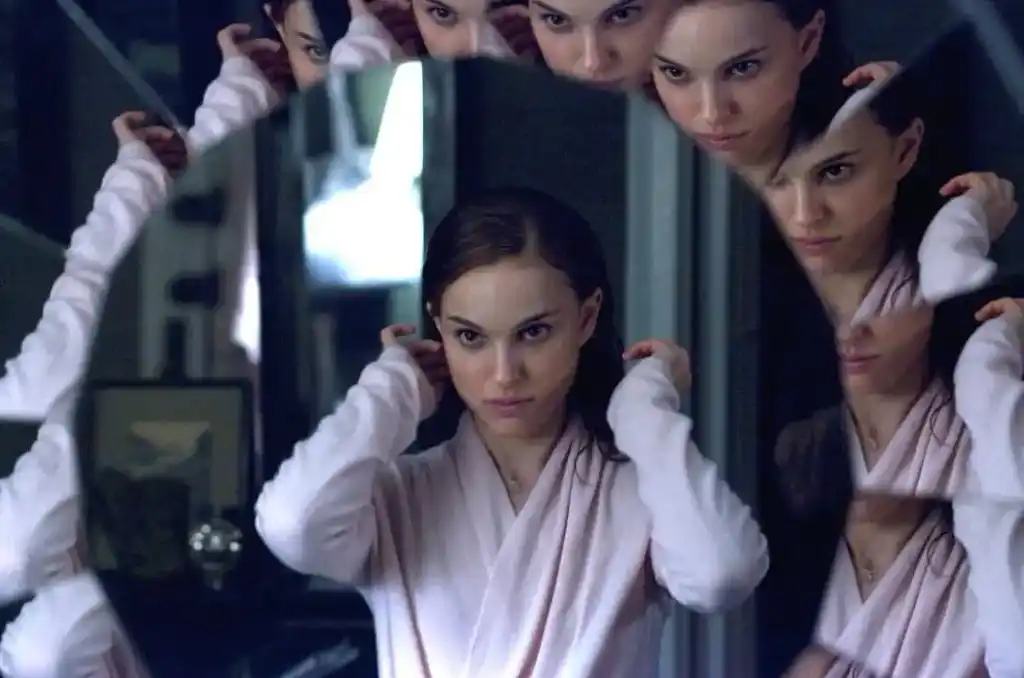
In the end Nina does manage to unleash her darker side and impress everyone at the opening night, but it comes at a cost: she injures herself in the process. As the director leans over her on stage, asking if she’s alright, she whispers, “I felt it. Perfect. It was perfect.” She got what she wanted, just not in the way she’d imagined.
Inside Out (2015)
In Inside Out, Riley is a young girl adjusting to life after her family’s move to San Francisco, and faces the pressures of fitting in at a new school. Her inner struggles come to life through personified emotions — Joy, Sadness, Anger, Fear, and Disgust — each shaping her actions as she tries to adapt.
The main conflict is between two emotions: Joy, the driving force in Riley’s mind, and Sadness. Joy is determined to keep Riley happy and sees Sadness as a hindrance, attempting to isolate her to preserve Riley’s memories as purely joyful.
But on Riley's first day at her new school, Sadness turns her core school memories from joyful to bittersweet, causing Riley to cry in front of her classmates. Joy’s panicked efforts to contain Sadness backfire, leading them both to be pulled away from Headquarters — Riley’s mind center. With both of them gone, Anger, Fear, and Disgust are left to manage Riley’s emotions, causing her to grow increasingly distant from her friends, family, and hobbies.
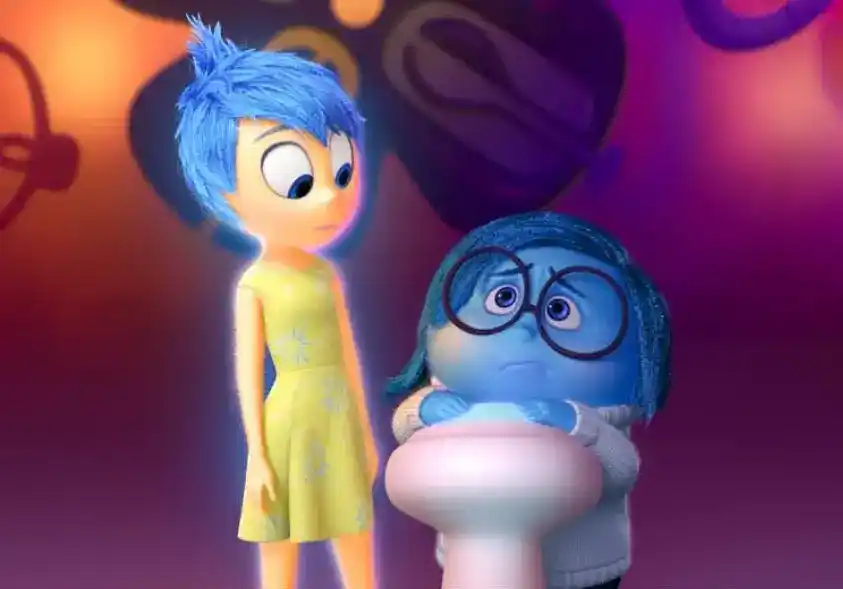
Meanwhile, Joy sees firsthand how Riley’s memories of sadness often led to moments of comfort and connection, like when her parents consoled her in the past. She gradually understands that Sadness is essential to Riley’s emotional balance. So when they return to Headquarters, she lets her take the lead. Riley tearfully confides in her parents about how difficult the move has been, expressing her sadness openly for the first time. This allows them to reconnect, and she begins to adapt to her new life.
By embracing Sadness instead of fighting it, Riley develops a balanced and resilient sense of self, recognizing that all emotions play an essential role in her inner landscape.
Now that you have a few examples of compelling man vs. self conflicts, let’s dive into how to create one just as powerful in your own novel. Here are some tips to get you started…
GET ACCOUNTABILITY
Meet writing coaches on Reedsy
Industry insiders can help you hone your craft, finish your draft, and get published.
3 tips for writing man vs. self conflict
1. Define the character arc first
A character’s arc is the transformation a character undergoes throughout the story. They start with one set of beliefs and develop a new one by the end. As author and editor Kirsten Bakis suggests, it’s helpful to define this arc while outlining your novel.
A character arc involves several key elements, which we dive into in a dedicated post, but in a nutshell: the character has a goal (the Want) and strives to achieve it, but an internal obstacle (the Lie) — often a belief about themselves or the world — blocks their path. To succeed, they must ultimately embrace the lesson they need (the Truth).
For example, in Inside Out, Joy’s Want is for Riley to feel loved and happy. She believes that Sadness is an obstacle to this, and tries to get rid of it (this is the Lie she must overcome). Her journey leads her to the Truth: real happiness and connection come when all emotions are allowed to play their part.
Having these building blocks of your character’s arc clear from the start should help you write a more compelling conflict.
FREE RESOURCE
Reedsy’s Character Development Template
A story is only as strong as its characters. Fill this out to develop yours.
2. Root it in the character’s background
If you think about it, why are we often our own worst enemy? It’s not something that we (or our characters) would choose consciously, right? The reason lies in our core beliefs, most of which form unconsciously as we grow up. Life experiences, especially difficult or traumatic ones, shape who we are and drive our behavior. And in the same way, these experiences must also shape our characters.
This is a key part of character development, defining both your protagonist’s profile and their backstory. In particular, it’s essential to understand how they came to believe the Lie that now blocks them from their goals and fuels their inner conflict.
Q: What is the most crucial piece of backstory an author should understand about their protagonist before beginning a novel?
Suggested answer
If you're around creatives on social media, you've probably heard someone say, 'This is my villain origin story'--in other words, whatever they're talking about is, at least speaking in hyperbole, the thing that has the potential to turn them into a villain. And while you may not be writing about villains, the point is that you want to think about origination.
Whoever your character is, how did they get to be that way? Try to think big picture items here--major formative memories, whether good or bad, tend to leave a heavy influence on us. It could be working hard to save money and finally being able to afford a dream bicycle or pet dog. It could be something traumatic, like the loss of a best friend to a cross-country move or being held back in school. Those major memories have the power to leave long-lasting effects on characters, and I think it's always worth thinking about the biggest moment(s) in a character's life if you truly want to know who they are (and then, once you figure out that moment, making sure you know how it affected them).
Another way to go about this is to think about your character's why. Why do they want what they want? What's their goal in life, and why? If you can answer that question--and get deep enough with your why to go beyond the superficial answers--you'll probably end up having a fairly strong understanding of your character that will naturally carry into your writing.
Jennifer is available to hire on Reedsy ⏺
Whether in the backstory or in the current action of the book, once the reader starts reading, the author should know what their character wants. It can be a long-held desire or something new, based on changed circumstances.
There has to be a motivation and drive in the character. Or if there isn't any, and that is sort of the point of the book, you want to let the reader know why and what in their past has made them the way they are. This sort of "motivation" is a good thing to search for in each character. What has shaped them to do what they do and behave the way they behave in the story? They must stay "in character" throughout the book unless some sort of inner or outer impetus has forced them or inspired them to change their ways.
So this most crucial piece of backstory might be why your protagonist behaves the way they do, what motivates them and why, and what they want.
Melody is available to hire on Reedsy ⏺
The key piece of history to understand is the core wound or formative experience that controls the hero's assumptions and phobias. This event controls the way they see themselves and the world and dictates all their decisions. Knowing this inner basis of understanding gives them depth to their motivations and establishes real conflict when the plot contradicts those assumptions. It does not necessarily have to be defined immediately to the reader but must be clear to the author. Keeping that in mind, the choices of the character seem authentic, and their path becomes more emotionally poignant.
John is available to hire on Reedsy ⏺
In Great Expectations, Pip’s belief that status and wealth define his worth stems from the shame and rejection he experiences as a poor orphan. At home, his sister treats him with harsh discipline, making him feel like a burden. Meanwhile, he’s continually reminded of his lower status, especially during visits to Miss Havisham’s mansion, where Estella mocks his “common” origins. Given this, it’s only natural that Pip wants to escape his circumstances by climbing the social ladder, even at the cost of compromising his true values.
3. Link it to an external conflict
Characters confront their beliefs by acting in the world. It’s only when an inciting incident sets them on a journey to achieve their goal and they clash with all kinds of obstacles that they are forced to introspect and face their own limitations. In this sense, you can bring out your protagonists’ inner conflict through other outer conflicts.
Take Black Swan, for example. Alongside her inner struggle, Nina faces an external rival: Lily (played by Mila Kunis). Lily is not the most precise dancer, but she’s wild and free — qualities that Nina lacks. Over the course of the story, Lily draws out Nina’s "Black Swan" side (Nina literally both makes love with her and kills her, though only in her imagination).
Q: What's your number one tip for authors dealing with burnout or writer’s block?
Suggested answer

Refill your creative well! Go watch TV, listen to your favorite songs, play a video game—do whatever you need to do to separate yourself from the book, even if only for a little bit. I've found that a small bit of distance can go a long way towards combating burnout/writer's block.
However, if the block is extremely pervasive (and you're not on deadline), it can also be helpful to briefly shelve a book and work on something that doesn't make you want to slam your head against the wall!
Chelsea is available to hire on Reedsy ⏺
My number-one tip to combat writer's block is to experiment.
Whatever routine you've built for yourself as a writer, try getting out of that routine and see how it affects your ability to write.
If you normally write on your desktop computer, try using a tablet or even writing longhand. Maybe the blank page is affecting you, and dictation will be something worth trying. If you normally write at night after everyone else in your family has gone to bed, try getting up early and writing then, or even snatching breaks during the day for writing time. If you write in longer chunks of time at home, try a coffee shop or restaurant, or if you like to write in coffee shops, try writing at home or in a local park. If you normally write in silence, try putting on music in the background.
Generally speaking, routine is a good thing for most writers, but some books/ideas demand a change of pace, and since we as writers change by virtue of changing as people and growing in our craft, that sometimes mean a routine will change.
Jennifer is available to hire on Reedsy ⏺
When writer's block or burnout arrives, move away from the page without shame. Creativity is not a faucet but a well that must be refilled. Do something that reminds you why you love about stories to begin with: Take a walk, read a treasured book, watch a film that moves you, or simply sleep. Inspiration has a way of returning once you stop trying to make it happen. Be kind to yourself in the process—writing is done most naturally when you permit your mind and spirit to gasp for air.
John is available to hire on Reedsy ⏺
Take a break from the project and do something relaxing that gives you pleasure, especially something physical like a long walk. Sometimes, if you stop thinking about a book, you'll find ideas pop into your head anyway. I'd also advise doing a rough plan of how you see the next part of your book progressing -- this will make the actual writing part easier and less stressful.
John is available to hire on Reedsy ⏺
4. Use symbolism to represent the conflict
One powerful way to bring a character’s inner conflict to life is through symbolism, recurring motifs, or metaphors. These techniques allow readers to feel the internal struggle in a more visceral, tangible way.
To stick with the Black Swan example, in the story Nina has a habit of badly scratching her back, which symbolizes the darker impulses trying to break through this suffocating idea of perfection her mother has imposed on her. When her mother (who still dresses her up) notices the scratches, she forces Nina to sit down while she trims her nails, literally trying to “cut away” Nina’s urges. As Nina gradually both fights against and embraces “the Black Swan within her”, the abrasions on her back grow worse, climaxing in a hallucination where she pulls a black feather from her skin, and her legs break in half, looking like those of a swan 一 a symbol that she has embraced that part of herself.
And there you have it — one of the most essential conflicts in storytelling. That wraps up our deep dive on the topic. If you’re ready to bring these conflicts to life on the page, head over to our Studio app and start writing!