Posted on September 28, 2026 07:25
How to Write Historical Fiction: From Inspiration to Final Draft
This post is written by Orna Ross, Irish novelist and poet and founder of the non-profit Alliance of Independent Authors (ALLi). Her twin-book After the Rising & Before the Fall won the Goethe Grand Prize for Historical Fiction. Her next novel, A Life Before, is about the English heiress turned Irish revolutionary Maud Gonne and the poet she inspired, W.B. Yeats. It is serializing now on her Substack.
For some reason I’ve never been able to fathom, my writerly imagination only works in the past with the characters dressed in uncomfortable clothing.
If your compass also swings backwards, my beginner's guide to historical fiction is for you. I'll cover how to write historical fiction in eight steps, from first itch to finished draft.
1. Find the question, not the era
Sometimes beginner authors say things to me like, “I'm choosing the Tudor period because it's so popular.” Or they ask me which sells better, Regency or the 1920s. I've found this tends to produce costume, not fiction. For me, the best way to choose a period or place is to have it choose you, with a question you can't put down. Something that is related to your own life.
G.K. Chesterton is supposed to have said that the trouble with the English is that they never remember and with the Irish that we never forget. Certainly, in the Ireland of my childhood, the past wasn't behind us; it was in the kitchen, in the things that could and could not be said. My first historical fiction novel grew out of one of those silences — what happened between neighbors and within families during our civil war — and the itch to understand it kept me at the desk through every difficulty. That's the test. A pretty era will sustain you for a fortnight. A question will sustain you for a book, a series, a lifetime.
So before you research anything, write a single sentence:
What I cannot stop wondering about is ______.
If you can't fill the blank, go to the library or a big bookstore and look at the historical fiction section, until something snags. The snag has a story idea in it, and may well give you your period… and maybe even your novel.
2. Create a contract with the facts
When it comes to facts, historical fiction sits on a spectrum. Decide early where your book sits.
- At one end of the spectrum: interiority. Real people, imagined from the inside — the territory Hilary Mantel claimed so completely with her Cromwell trilogy that she changed the genre. This is the contract I've signed up to for my current work in progress, based on the lives of Irish rebel Maud Gonne and the poet she inspired, W.B. Yeats. I feel Mantel at my shoulder — a demanding, inspiring, clarifying ghost.
- In the middle: invented characters moving through real events. Joseph O'Connor's Star of the Sea does this, as well as Min Jin Lee's Pachinko, Toni Morrison's Beloved, Yaa Gyasi's Homegoing, and my own Irish trilogy.
- At the far end: the past as a setting for an essentially invented world, where accuracy of texture matters more than fidelity to any documented life. Colson Whitehead's The Underground Railroad, for example, even bends the physical facts — turning the slave escape vehicle into an actual railway, with iron and steam — and magnificently gets away with it, because the emotional history is scrupulously true.
Wherever you settle, the contract is the same: readers forgive any invention, provided it is true to its world. Historical fiction isn't history and shouldn't try to be. You may move a battle by a decade if the story needs it, but you must know you've done it, and have a reason. The author's note is the historical novelist's confessional. Use it, and sin boldly.
What historical fiction readers don't forgive is carelessness. Let a wristwatch appear on a gentleman's arm in 1890 and the letters will arrive, often with footnotes, courteous and devastating. You can take it that your readers know the shipping routes, the hemlines, the price of bread in the year of your setting. Usually they've spent decades reading in that period. We are guests in a past they love. Get the emotion and most else right and they'll forgive a mislaid teacup. Get the hunting dog, the fashionable dances, and the distance from London wrong and they'll begin, quietly, to doubt the emotion.
3. Research like a lover, not a librarian
Historical fiction writers don't procrastinate. We just need to understand how … let's say, telegrams … worked. And who could afford them. And whether our heroine would have written the message in pencil or ink. But was that kind of pencil available in Paris in 1887? And would a respectable woman have entered a telegraph office alone? And who maintained the wires, and how were they chosen for the job? Oh, and the economic effects of the telegraph on international trade. And what's that — telegrams travelled by pneumatic tube? Obviously we need to understand pneumatic tubes.
The rabbit hole is both the hazard of the genre and its craft. You need to know the details so well that you can build a world — but only using the most telling of those details, the ones that carry story weight. Unfortunately, you can’t know which is which in advance.
For me, that translates into overdoing the research and the first draft, then cutting back, back, and back. (If you have found a less painful way, my inbox is open.)
It does help to do general research first to get hold of the period, then write your outline and first draft, focusing on character and plot and leaving gaps to be filled later (see step 6). That way you only research what you need.
The internet is a door that opens onto your period and never quite closes behind you. And with AI, the archive has never been more reachable. Digitized newspapers, searchable census records, AI assistants that can summarize a decade of scholarship while you're making your morning coffee.
The door to the rabbit hole now stands permanently open, which means the discipline matters more, not less. AI is both a superb guide to the archive and an unreliable witness: it can confidently describe a pneumatic tube system that never existed, so every detail that reaches the page needs to be verified. The single most useful habit I know is the square bracket: [CHECK: pneumatic tube?] — and on you go.
Where to look first
Go to primary sources before histories: letters, diaries, newspapers, court records, shop catalogues, railway timetables, household manuals. Biographies give you scaffolding but primary sources let you feel what it was like to live then: what things cost, what people feared, what they found funny. For my favorite period, the turn of the 20th century, I like to look at local newspapers.
4. Build a story bible
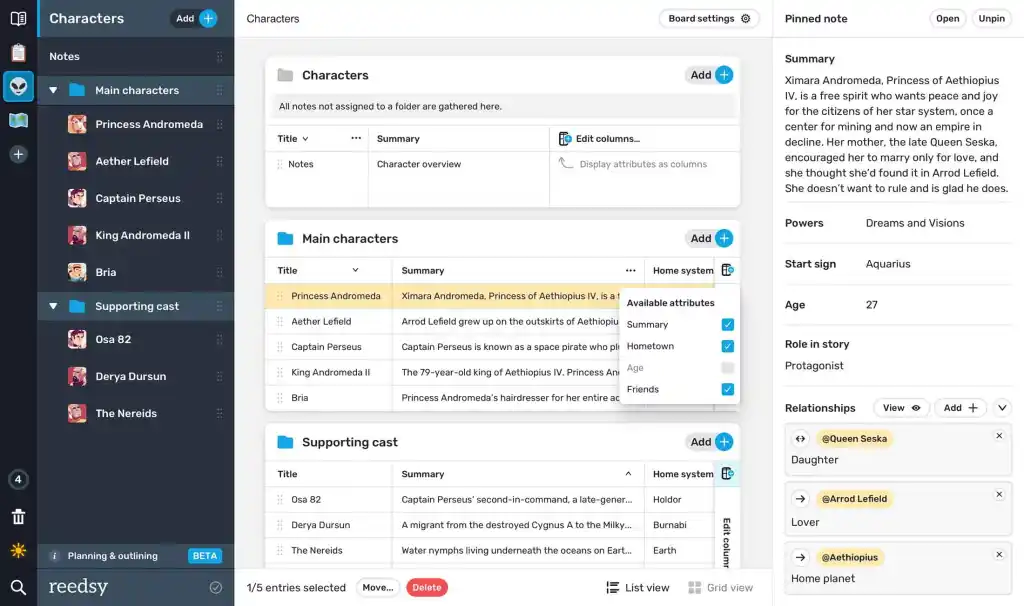
Your research needs somewhere to live that isn't your manuscript. Some authors I know have incredibly sophisticated systems. I keep it simple: a project bible with three parts.
- A timeline with documented events on one line and my invented ones threaded between them, so I can see at a glance where fact ends and fiction begins.
- A file for each character, real or imagined, recording what the record says if they are real-life folks and what I've decided about them.
- A one-page period info dump of anything that feels salient, with headings in alphabetical order: money and what it bought, distances and how long they took, forms of address, what light people read by, what they died of.
Whenever your book is set, the freckles of a period are what make it spring to life. And that's the one indispensable thing all readers want from historical fiction: to feel like they are there.
5. Find the voice that carries the period
Voice is the genre's trickiest craft problem, and the mistake beginners make is trying to solve it with vocabulary — prithees and forsooths. What actually carries a period — and the various classes of people who lived within — is rhythm: sentence length, formality of syntax, how contractions are rationed, and where the wit sits.
Write dialogue that suggests the era rather than transcribes it. With rhythm doing the heavy lifting, a handful of period-true words suffice. Modern idioms must be kept scrupulously out.
Your narrative voice is the other half of the challenge. A story told from inside the period feels different from one told by someone looking back across the years. The looking-back voice buys you license: the narrator can explain, judge, and grieve in ways a purely immersed viewpoint can't.
Here's the narrator of my current novel in progress, Rosy Cross, doing an aside that is true to the period she's discussing — the 1880s — and her Irish rural background.
There's a notion abroad these days that the past is behind us but no. Mr Darwin had the rights of it. We came up slow, from fish to frog, from fur to you and me. The past runs through us, blood, bone, and sinew. What humans have done to each other —t he long and the lopped, the low and the lofty, all of it — is held in our marrow and mould.
If you doubt me, think on. The salt of the old sea we crawled out of runs still in our tears. Our gill-slits show for a week in the womb before they close over. If a shadow raises the hair on your neck, deary, it's because that shadow once bared teeth, or carried an axe.
It wasn't until I found Rosy's voice that I was able to get into this novel series; she could say so many things that I could not.
There's always the danger of tipping into telling, instead of showing, when you have a narrator like her. Choose deliberately, edit robustly, and hold the choice.
6. Draft hot, verify cold
When the drafting starts, protect it as the most important thing in your life. Deadlines help more than willpower does. It gets hard, and falling off in the middle of the draft is a peril all authors face. You must find a way.
I'm currently serializing my next novel, A Life Before, a chapter a week on my Substack, with the book to launch in Spring 2027. The Friday deadline and readers who are taking notice helped me to get back into my groove after a bereavement, and now help me to stay true to the book in a busy life.
You needn't serialize publicly to borrow the principle. A chapter a week, promised to another author, or an accountability buddy, or a single reader, will do the same work. Find something that keeps you showing up.
Never leave the sentence to look something up. Drafting time is focused on the people, not the plumbing. You can verify everything later, with your bible open. Use those square brackets liberally as you concentrate on getting the words down.
7. Weave, don't dump
The first-draft sin of every historical novelist, beginner and experienced, is the information dump: three paragraphs on the telegraph network, delivered while the heroine stands frozen at the counter, message unsent. You suffered for that knowledge and by God the reader will too.
The fix, in revision, is a single test: details must serve character or plot, not the author. Your heroine doesn't observe the pneumatic tubes; she frets that her message, in its little brass carrier, is taking too long to hiss away below the city, because the answer it may bring will change her life. One working detail, freighted with her fear, outperforms a page of accurate machinery.
8. Revise for emotional truth, not just accuracy
Accuracy can be checked; truth has to be felt. In the final pass before editing — which I think of as the deepening pass — I murder so many darlings, but all the while keeping to the deeper work of that draft: asking, scene by scene, is this true?
True to how grief behaved then, how power moved, how a woman weighed a risk.
After that comes editing, and the more you can get the better. Developmental editors, copy editors, proofreaders, beta readers — each serves a different function, and for first-time authors, each is an education in itself. Good editing will make the book worthy of those exacting, loving readers we met earlier.
You, however, are the creative director. Only you can answer for why your book exists, what your aim was in writing it, and how you want it to live.
This, finally, is why the genre matters. Story is the medium through which the past stays inhabited rather than merely archived — and the novel is the largest expression of story's oldest gift: empathy.
The best historical fiction transports us, yes, but only to remind us that we stand here, at the edge of time, embodying our inheritance.
The past chose you for a reason. Go and find it.