Blog •
Posted on Jul 30, 2026
How to Create a Freelance Writing Portfolio in 2026

Linnea Gradin
Linnea is Editor-in-Chief of Reedsy’s Freelancer Blog, with 6+ years of experience collaborating with experts to create resources on writing, self-publishing, and publishing careers.
View profile →
Dario Villirilli
Dario Villirilli is a senior content marketer, editor, and SEO strategist with many years of experience in publishing. He is Managing Editor of the Reedsy Blog and has also written for IngramSpark, ProWritingAid, Written Word Media, and PublishDrive.
View profile →Whether you're a ghostwriter, a journalist, a content writer, or an author, you need a strong writing portfolio to showcase your skills. Most guides to building a writing portfolio assume you already have published work. In this post, we’ll give you tips that help wherever you are in your writing career — whether you’ve been published or not.
Psst… Check out these writing portfolio examples from working writers for inspiration.
1. Decide what kind of writer you are
The goal of your portfolio is to convince clients that you’re the right person for the job. So, before anything else, you need to get a sense of what type of writing you want to do and who your dream client would be.
Choose your market
If you don't already know what kind of writer you are or what type of content you want to write, you can generally pick from one of these broad lanes:
- Copywriting and content marketing
- Ghostwriting
- Journalism
- Essay and opinion writing
- Technical writing
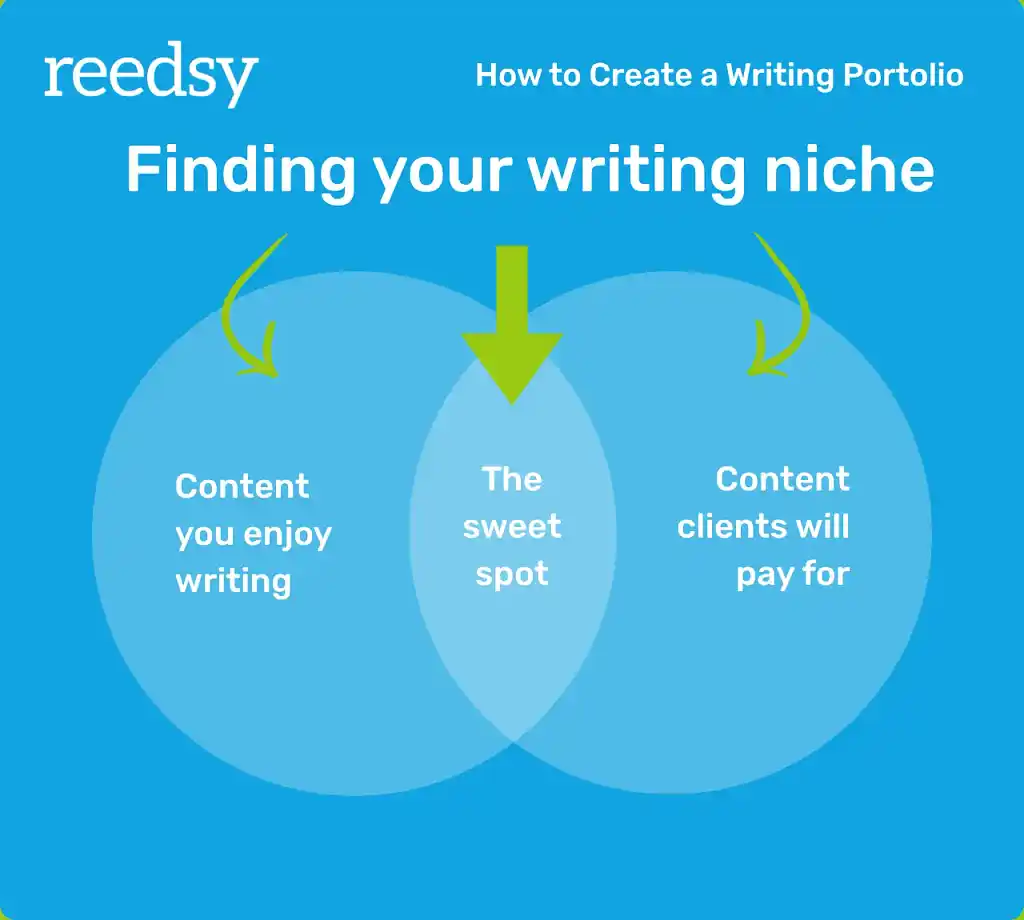
Ask what type of content you actually enjoy writing, then ask whether anyone is paying for it. Ideally, you'll find a sweet spot in the middle. Thinking in terms of industries can help as every broad lane has narrower streams you can tap into. A ghostwriter might specialize in finance, health and wellness, parenting, book publishing, or romance fiction.
Once you've picked a direction, spend some time looking at what other writers in that field are producing. This will show you understand the terrain.
Identify your ideal clients
Next, get specific about who you're targeting. Commissioning editors and marketing managers are often inundated with pitches, so your portfolio needs to quickly indicate what type of writing you do.
A ghostwriter aiming at romance novels would want a portfolio that emphasizes experience in:
-
Writing novel-length fiction
-
Writing for an adult, largely female readership
-
Writing successful romance titles
A copywriter going after real estate content would emphasize something else entirely:
-
Blog posts targeting high-volume search terms
-
Lead magnets and email capture
-
Industry specific online ad copy
The specialist beats the generalist nine times out of ten because clients want someone uniquely fitted to their needs, so don’t be afraid to lean into a niche.
JOIN OUR NETWORK
Supercharge your freelance career
Find projects, set your own rates, and get free resources for growing your business.
2. Get your first writing samples
If you already have published work, you can skip this step. If you don't, the good news is that you don’t need to be a published author to put together a portfolio. All you need is three to five solid pieces — published or not. This is how you get those:
Write spec pieces
A spec piece is any writing on a topic you've chosen that demonstrates your skill, even though nobody commissioned or published it.
One longer piece or two shorter ones is enough to start with. Choose subjects that match the work you actually want — a spec blog post for a SaaS company you'd like to write for shows you’ve done your research and knows the industry, even if no one has discovered you yet.
Then, optionally, you can add two or three sentences explaining why you wrote each piece: what brief you gave yourself, who you imagined reading it, and what drew you to the topic. A well-reasoned argument here shows you can take initiative, that you have an eye for choosing an interesting angle, and that you understand how to write to an audience.
Remember to clearly label these pieces as unpublished. Presenting spec work as though it were commissioned can seriously damage your credibility.
Q: What advice would you give to someone who wants to become a full-time writer?
Suggested answer

Go in with your eyes wide open to what that will actually mean for you, and know how difficult that path is.
Writing full-time sounds amazing, but it entails work. It means writing pretty much every day (if not absolutely every day), embracing roadblocks, and being ready for an income that can be uncertain at best. Success doesn't come overnight, particularly if you're looking to life off of your writing, and if you haven't prepared yourself for the realities of the journey, you're going to be disillusioned very quickly and lose your excitement for the journey you're setting out on.
Also, don't forget why you began writing in the first place. Holding on to those original hopes/plans/intentions, and what drove you toward writing, is incredibly important for staying motivated and committed to your own personal writing journey, whatever that entails.
Last, don't try to be a one-man-show. Embrace community and support your fellow writers. You'll learn from that community and they'll be there to support you, as well. This advice about not going it alone also extends to knowing when you need pro help, whether in the form of editing, cover design, or marketing.
Jennifer is available to hire on Reedsy

Write. Write every day. Work on your craft. Join a writers group and share your writing with others, get feedback, and provide feedback on their writing.
Writing is like exercise. You have to work on it consistently and build it up over time.
Maria is available to hire on Reedsy
Pitch guest posts
Another way to get your first pieces for your writing portfolio is to pitch guest posts to blogs in your area of interest. That’s how a large share of working freelance writers get their first published pieces.
Look for blogs and publications in your chosen niche that accept contributions — most that do have a "write for us" or "contribute" page with information on how to reach out. Then, read several of their recent posts before you pitch your idea. Give them your working title, your angle, and why it will be of interest to them. Don’t just ask whether they’re accepting submissions and expect them to tell you what to write about.
You might not hear back from most of the blogs you reach out to, and that’s normal, especially when you’re starting out. Eventually you’ll get that yes, and from there you can start to build momentum.
Use work you've already done
Writers routinely overlook material they already have. If you’re coming from a different industry, reports, company newsletters, grant applications, training documents, well-researched academic essays, or a long-running blog on a subject you know well can work as writing samples when you’re starting out.
However, there are two caveats. First, you may need to get permission before publishing anything produced for an employer. Second, while you could and should think creatively, don't include work unless it aligns with the niche you defined in step one or demonstrates a specific skill you want to get hired for. A strong academic essay on medieval literature most likely won’t help you land B2B content work, unless you’re trying to write ad copy for a Shakespearean theatre troupe.
What to avoid
Before we move on, a word to the wise: just because you’re starting out doesn’t mean you should accept any job. Avoid content mills, unpaid work for commercial businesses in exchange for “exposure,” and anything that doesn’t sit right with your gut.
3. Choose which samples to include
Once you have work to choose from, your focus should shift from gathering to cutting.
Essentially, there are two types of portfolios: the curated ones and the ones that offer a (more or less) complete record of everything you’ve ever written. In most cases, you want to aim for the former.
Include only your best and most relevant work. Ten to thirty pieces is plenty for an established writer. Three to five is enough when you're starting out — and below that threshold, the quality of each piece matters far more than the count.
Your portfolio answers whether you can research a subject, engage a reader, and present yourself professionally. Much like your writing, it should tell a story. If a client has to wade through a complete chronology to find the work relevant to them, you've wasted their time and they might start to question your ability to guide a reader from point A to point B.
The exception to this rule is if you’re a freelance journalist who wants to present a near complete record of all your professional writing. Note that I said “professional,” though. Even if you’re going for the full monty approach, you still shouldn’t include your undergrad dissertation or the essay you won a competition for in first grade. News outlets just want to see if you’ve got an extensive track record in your field.
Divide your portfolio into sections
If you have a couple of niches that you specialize in, grouping your work gives a client an immediate overview and lets them jump to what they need. Topic-based division works for some writers ("Food & Drink," "Travel"), while others do better splitting by format (Newspaper, Books, Blog articles, etc) or by publication.
Sectioning can be a good exercise too as you'll immediately see which categories are strong and which are thin.
4. Choose where to host your portfolio
When it comes to hosting, the right platform depends mostly on how much work you have and how much money you want to spend.
Portfolio platforms
Portfolio platforms are like LinkedIn, specifically for writers. You set up an account, add links to your published work, and the platform handles the design. Here are some of the major ones on the market:
|
Platform |
Best for |
Cost |
|
Reedsy |
Ghostwrites |
Free once you past the selection process |
|
MuckRack |
Journalists, PR |
Free |
|
Authory |
Journalists, automatic archiving |
Free tier exists, or $12/month when paid annually |
|
Contently |
Content writers and marketers |
Free to join |
|
Journo Portfolio |
All freelance writers |
Free to set up a domain with 10 portfolio items or $5/month for 50. |
|
|
All freelance writers |
Free |
Any of these platforms will serve the purpose of setting up at least a basic writing portfolio. But if you want something more custom, you can…
Q: What website builders and hosting services do you recommend for authors looking to create a professional author website?
Suggested answer

This is not a one-size-fits-all answer. Many factors go into choosing the right platform for your website. However, to answer the question straight:
- For complete control, I use and recommended WordPress + Avada on WP Engine. Alternatives to this could be WordPress + Elementor or WordPress + Divi on another host that specialized in WordPress, aka Managed WordPress hosting. (Avoid GoDaddy for anything but domain names.)
- If you want more out-of-the-box but less control, you can go with a DIY builder like Squarespace or WIX. These are capable of handle most features authors needs.
- I advise against Weebly, as they have fallen behind.
Every web designer has an opinion on this, but the truth is, if we're talking about standard author websites, most website/web design platforms and hosts are capable of achieving what's necessary. It comes down to the designer and their mastery of the platform chosen. The bottom line is:
- Is it mobile friendly?
- Is it SEO friendly?
- Does it load fast?
Besides that, deciding factors can include:
- How much customization do you require?
- How much of "web design basics" do you want to learn to maintain the content? Because no matter what, any DIY or drag-and-drop builder is going to have a learning curve for anyone unfamiliar with web design.
- How much do you want to pay monthly/annually?
This is a brief introduction on choose a website platform and host. There's a lot that goes into choosing, but don't over think it. They can all get the job done, as long as you have the right person at the helm.
Chad is available to hire on Reedsy

This all depends on what backend you're most comfortable with. Youtube has some great video tutorials for Wordpress/Squarespace/Wix, which will offer an overview of what it's like to create or update a page. That's where I'd start, as you want something that's easy for you to update.
Self-hosted Wordpress will give you the most control. This is especially important if you have 5+ books. Some designers can offer automation—meaning they can set the site up so you only have to add a new book page and the book's cover/info automatically appear everywhere it needs to across the site. (Double check with your designer to make sure they offer this.) Which is great if you have a long series or multiple books.
However, Wordpress doesn't have a default visual editor. (Some plugins/themes offer visual editing with mixed results.) Most hosting options are solid—look for free SSL, and if there's a limit on emails addresses or domain names/sites. Space is nice, but most sites don't hit 2gb (unless there are multiple sites and a separate store). 5gb is usually more than enough. It's nice to have the option for multiple sites, in case you want to have a separate store later (or a separate site for a pen name).
For specific host recommendations, I've had good luck with Hostgator, SiteGround, MDDHosting, and Inmotion. While Bluehost is often recommended online, it's been very slow this year (2024) especially for the price. I've heard good things about Cloudways, Hostinger, and A2 Hosting. Wordpress.com is also viable with their business plan, though it won't give you as much control as a standard host.
For page builders (visual editors), I tend to recommend Squarespace over Wix, as I find Squarespace more intuitive since Wix's update (introducing Studio) this past spring (2024). Page builders offer no automation, which means adding a new book can be a laborious process depending on where you want the book's info to appear. For example, if you only want the cover on the book page and the home page, that's only two pages to update. If you have a series and want each book in the series to have a "read more" section with the other books in the series, then you have to update the cover manually on each of the series' book pages. Not a big deal for a small library, but rather a pain for a larger one.
At baseline though, start with YouTube. Skim tutorials on what it's like to create/update a page on the platform you're interested in. This will give you a better sense of how the platforms operate. Whatever is easiest for you to operate is (almost) always the best option.
Tessa is available to hire on Reedsy

If you're starting a website—whether you're a first time author, prolific writer, entrepreneur, or creator—the first big decision is: what platform should you use to build and host it?
The short answer? Use Wix. And no, I’m not being paid to say that. In my opinion it’s the best all-in-one option for most creatives—especially those who want a professional-looking site without needing a full-time developer or a background in code. I know this because I have made 350 author sites on Wix. And NONE of the clients have swapped out to another platform. They love Wix.
Let’s break it down.
- Why Wix?
Wix is a drag-and-drop website builder, meaning you design your site by moving things around the screen—text, images, buttons, forms—without touching a single line of code. It’s intuitive, flexible, and surprisingly powerful.
Need a newsletter signup? Built in. Want to sell something? E-commerce tools are ready. Looking to blog, book appointments, take payments, or embed video? Check, check, check, and check.
It’s also strong on SEO (Search Engine Optimization), which is crucial if you want people to actually find your site. Wix gives you full control over metadata, image alt text, and URL structure—important features that many budget builders skip or limit.
Wix also has a huge suite of Ai tools not just to create your site, but tools to help you grow your business.
- Hosting? Covered.
One of the best things about Wix is that hosting is included. You don’t have to worry about servers, SSL certificates, or whether your site will crash when you get a spike in traffic. It’s all taken care of behind the scenes.
Their hosting is fast, secure, and globally distributed. And because everything is in one place—your domain, design, hosting, analytics—you’re not juggling between different services trying to stitch it all together. (Currently wix is £259 for THREE years)
- What About WordPress?
Great question. WordPress is flexible and widely used. But it’s also more technical. You’ll need to find your own hosting, install updates, manage plugins, and troubleshoot issues as they arise. You'll need to buy something like "Divi" to actually build your site ON, as Wordpress is just a framework.
If you enjoy that level of control and don't mind some backend tinkering, WordPress is a solid option. But if you'd rather spend your time creating content or building your business, Wix is much more straightforward.
- What About Squarespace?
Squarespace is slick and polished, and works well for simple sites. But in my experience, it's more restrictive when it comes to customization, third-party tools, and SEO settings. Their editor also isn’t as smooth or flexible as Wix’s.
- Final Verdict
If you’re looking to launch a professional, polished, easy-to-manage website that doesn’t eat up your time Wix is my top recommendation. It’s beginner-friendly, robust, and grows with you and your business.
And if you want to make sure your site not only looks great but also works hard for your brand or business—that’s where I come in.
Stuart is available to hire on Reedsy
Build your own site
A custom site gives you the most control of the format and design of your portfolio. You can use a domain-host like Clippings.me, Format, Squarespace, Wix, and WordPress, or you can build your own website from scratch.

The pro of using a domain host is that the set-up is relatively straight forward, even without design experience. Their templates and drag-and-drop editors do most of the work. But the trade-off is that you have to continue to pay for yearly subscriptions and you’re still limited in what you can do in terms of formatting.
If you'd like a custom website on a domain you’ve personally bought instead, you’ll need to build it from scratch. If you’d rather not build it yourself, commissioning a web designer is an option. Professionally built sites give you total freedom to design your portfolio in the way that best captures what type of writer you are.
5. Structure and design it
Design is where writers lose the most time for the least return. All you really need to do is keep it simple.
Your portfolio needs three things: a landing page that says who you are and what you write, a page showing your work, and a way to get in touch. Everything beyond that is optional.
Any web designer worth their salt will be able to advise you on how to achieve this but, in general, you want to minimize clicks — every extra click between a client and a writing sample is a chance to lose them — and use white space generously. The less there is competing for attention, the more people’s attention is drawn to the writing itself.
6. Add proof and contact details
As a writer, your work should be able to speak for itself. But what does that really mean?
Lead with recognizable clients
Nothing sells like evidence that someone has already paid for your writing. Even better if they’re well-known companies, publications, or individuals. Highlighting mastheads or client names near the top does more persuading than several paragraphs of self-description ever can.
Include testimonials and reviews
If you haven't worked with names a client would recognize, testimonials from previous clients do similar work. If you have reviews that showcase your professionality, writing chops, or quick turnaround, for instance, dedicate a page for that on your website or include them in your bio/overview on a portfolio page. For a client choosing between two writers whose samples both look good, that can be the deciding factor.
Q: What tools do you recommend for authors to capture and nurture leads on their websites?
Suggested answer

Let's start with the basics of a signup form. Most web builders have forms built in, but make sure it's connected to some email marketing tool. Squarespace and Wix have their own, or you may choose to add a third-party like Mailchimp.
I recommend setting up an automation so that when someone signs up for your list, they receive a welcome email. This could also include any related news or next steps. You may also want to create a "drip campaign" that sends additional emails every few days or weeks, but a warning only send emails that add value and are of interest. Don't email just for the sake of emailing.
Another way to nurture a list is by adding a value-add that is gated. For example, a PDF or link to preview your book, a guide for writers, etc. Something that encourages them to share their email in exchange for something that makes them feel like an insider.
And of course, make sure there is a way to get in touch with you either by listing your email and/or phone, or a contact form. Also make sure your social media is prominent.
Last tip, even if you aren't ready to start sending emails, the time to start building your list is ASAP. Some visitors may only visit your site once so make sure your CTA (call to action) is clear without being confrontational.
Good luck!
Sharon is available to hire on Reedsy
It's imperative to have, at the very least, a simple email subscribe form. You don't need an elaborate email marketing plan, just start collection. E-mail is still the most effective at reaching your total audience because it's direct connection, unlike social media which is unreliable and erratic when it comes to getting your message to the right people.
Chad is available to hire on Reedsy

These days it's important to think outside the box, here are some things I've seen work first hand:
- Integrate free memberships to your site that unlocks content such as behind the scenes, extras & blog posts. This can help create a sense of community.
- Create additional call-to-actions that are super simple, such as a countdown to your release and a 'notify me when available' action. This can also work for price discounts and competitions/giveaways.
- The 'SaaS whitepaper' method: Give some meaningful content upfront as a document, you don't need a fancy system, just a normal sign-up to trigger an email with a download link.
Tom is available to hire on Reedsy
Write a bio that faces the client
Wherever you host your portfolio, make sure to include a short piece about yourself, ideally with a professional headshot. If hyping yourself up makes you uncomfortable, Reedsy book designer Colleen Sheehan has a great way of reframing it:
"This is about your clients. What can you do for them? What have you done for other people like them in the past? What can they expect to receive if they hire you? Once you turn the focus away from yourself in this way, it gets a bit easier to write."
Make yourself contactable
If you’re custom building your portfolio website, don’t forget your contact details! Put it somewhere unmissable: in the banner, the header, the footer, or all three.
7. Keep it current
If a client lands on your page and the latest piece in your portfolio was published 2 years ago, they may start to wonder if you’re still active and looking for work. Likewise, as your career develops, you’ll have new samples and articles that better represent your skills to add, so always make time to reassess your portfolio and consider what you’re including.
And, as a reminder, online links often change — with some articles being removed altogether. You don’t want your clients to find dead or incorrect links on your portfolio, so when assessing your writing, also go through and check the links.
Q: How often do you update your portfolio?
Suggested answer

I update my portfolio depending on how many projects I complete in a year. Typically, I wait until I've finished at least two new projects before adding them. As for refreshing the overall look and feel, I do so whenever I feel the design no longer reflects my current style, which can range from once every three months to once a year. I also include personal work when appropriate to keep it dynamic and well-rounded.
Vittoria is available to hire on Reedsy
And there you have it: 6 simple steps to set up a writing portfolio, even if you have no published work in your catalogue yet. If you’re looking for inspiration, check out these writing portfolio examples.