Last updated on Mar 13, 2026
22 Proven Writing Strategies for Every Stage of the Process

Savannah Cordova
Savannah is a senior editor with Reedsy and a published writer whose work has appeared on Slate, Kirkus, and BookTrib. Her short fiction has appeared in the Owl Canyon Press anthology, "No Bars and a Dead Battery".
View profile →Writing strategies are techniques that writers use to solve story problems, revise their work, and get past the finish line. Unlike generic tips (such as “Write what you know”), good writing strategies give you something concrete to try when you're staring at a blank page.
Here, we’ve gathered proven strategies from bestselling and award-winning authors — covering everything from idea generation to revision to overcoming writer's block.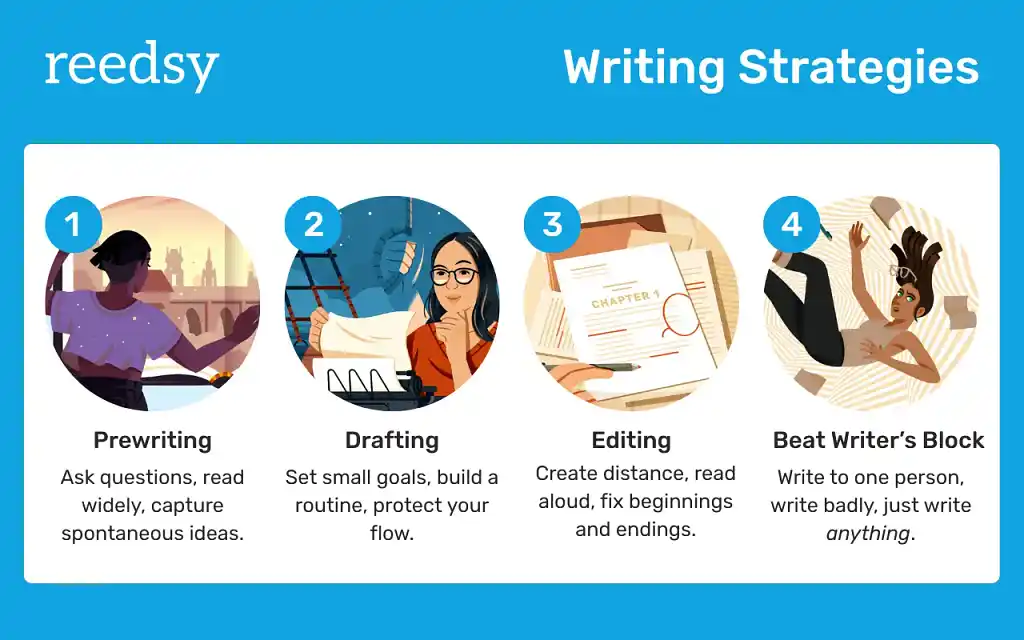
Prewriting: How to generate story ideas
Q: How can I tell if my story idea is strong enough to pursue?
Suggested answer

I think this idea/question comes from the idea that every story is incredibly unique, but the truth is that many stories are very similar. Think about the genre of romance, and the tropes that so many readers love. The same goes for any genre if you read enough. Many stories are very similar, so when you're thinking about whether an idea is itself strong enough, you're already putting up roadblocks to completion.
After all, what does 'strong enough' mean? 'Strong enough' to compete with every book out there? Or 'strong enough' for you to be interested and passionate enough to complete it? It's only this last question that you really have to ask yourself.
Writing is a process, and if an idea interests you enough that you want to write a full book based on that idea, you should write it. Then will come the editing, the revision and potentially rewriting, because writing is a process, and books come from multiple drafts.
Jennifer is available to hire on Reedsy ⏺

A story idea is typically sufficient when it continues to nag you in your mind, raising questions, emotions, or circumstances you just can't manage to eliminate. If you can identify clear stakes, a solid character who has something at stake, and a central conflict that really excites you, then it likely has the meat to support an entire story.
Question yourself whether you are hungry to explore it across months of writing—curiosity and excitement are excellent indicators. A concept does not need to be completely developed at first, but it should leave room for expansion, surprise, and emotional connection. If it keeps pulling you back, then it is worth exploring.
John is available to hire on Reedsy ⏺
1. Start with a question
Many great stories begin as an attempt to answer a single question. National Book Award winner Mary Lee Settle explained her process to The New York Times as simply:
“I start with a question. Then try to answer it.”
Questions create narrative momentum, and “What if?” is especially useful because it immediately introduces possibility and tension. What if someone could hear other people's thoughts? What if a town forgot one specific day in its history? No question is too strange to spark a good story.
2. Use online resources to ideate
For a modern approach, you can also leverage online tools and resources that are specifically designed for story brainstorming.
Here are a few of our favorites:
- Plot Generator – Over 1 million possible plot combinations to discover. Simply lock the plot elements you wish to keep and hit “generate” to keep experimenting with the others.
- Creative Writing Prompts – 2,500+ prompts across different genres. And for some powerful deadline-based motivation, sign up to our weekly short story contest. You’ll get 5 new prompts in your inbox each week, plus the chance to win $250!
- Writing Exercises – Or for more elaborate story inspiration, try our writing exercises. (Note: these may work better for stories that are already in progress, whereas the creative writing prompts above are better for initial ideation.)
3. Read widely to learn how stories work
Ray Bradbury famously educated himself at libraries, clocking at least a hundred books a year:
“When I graduated from high school I couldn’t go to college, so I went to the library 3 days a week for 10 years.”
Coincidentally, this was also William Faulkner’s writing strategy:
“Read, read, read. Read everything — trash, classics, good and bad, and see how they do it. Just like a carpenter who works as an apprentice and studies the master. Read!”
Reading actively means noticing how authors introduce characters, how scenes begin and end, and how tension is built across chapters. Over time, your observations will naturally feed your own writing and might even inspire an idea or two in your own work.
Q: How can I overcome the fear that my story idea isn’t original or good enough?
Suggested answer
It's easy to walk into a bookstore, pull a finished book off the shelf, read it, and think, "Oh no. I could never write a book like this. I'm not good enough to be a writer."
This kind of thinking is a trap! As an editor, I've read hundreds of early drafts. Even the most exciting, most polished manuscripts that passed my desk needed several rounds of intense editing before they were ready for publication. And I was often seeing manuscripts after they had been through a few revisions already. It's not fair to compare your first draft to a published book that's been through many rounds of professional editing. Everyone's first draft needs work. If you expect your first draft to be on the same level as a published book, then you're going to set yourself up for a lot of self-doubt and disappointment.
However, when you pick up a book and think I could never write this, that's actually true. Not because you're a bad writer, but because your voice is uniquely and distinctively yours. You won't be the next Rick Riordan or the next Angie Thomas--but that's because you're going to be the next you!
Camille is available to hire on Reedsy ⏺
Imposter syndrome can kill books before they're written, so I think the first step is to realize that most authors experience it. Next, accept the fact that no story is ever 'original or good enough' when it's first conceived. That's because an idea isn't itself a book. A book takes time, patience, drafting, and revision. That process, slow as it may be, is what will ultimately make your book a success.
All that said, I think it's also helpful to remember that any number of successful projects can be based off of very similar ideas.
How many movies and romance novels are based off of woman leaving the big city for a holiday at home and finding love with someone she hated in high school, or some man who's just moved to town? Dozens! How many movies and horror novels are based off of a group of strangers somehow being forced or convinced to spend a given amount of time in a bad or haunted house? Again, the answer is dozens! But readers love those stories, and it's the writers who tell them that make them unique and interesting to readers because no two writers are going to write the exact same story.
What it comes down to is that if you get caught in the trap of over-analyzing your idea before you've begun writing, you're hamstringing yourself before you even get started. If you really want to push yourself to write a high-concept novel, then you can start with an idea and push/prod at it until you've given it enough detail in form or development that it feels unique to you, and then start writing, but don't give up on the idea before seeing where it might take you.
Worse comes to worse, if you're at a stage where you're brainstorming many different ideas, give yourself a cut-off point. Allow yourself to come up with five or ten ideas, setting a limit on that number in advance, and then choose one to push forward with. Otherwise, you'll forever be coming up with ideas, and forever judging those ideas as failures, without ever getting a book written.
Jennifer is available to hire on Reedsy ⏺

Even seasoned authors struggle with imposter syndrome and doubt themselves. That said, doing your homework is not a bad idea. Find out what books are similar to yours and find out if there is a glut in the market for that topic or if there is a need or hole in the market, and your book might fill a need.
The reality is that good books are not written; they are rewritten. That's why it is so important to work with an editor who can help you revise the book and take it to the next level, so it can become the best it can be.
Melody is available to hire on Reedsy ⏺
4. Turn everyday observations into story seeds
Sometimes writers get so stuck in their own heads that they can't tell a great idea from a blob of words on the screen. If that sounds familiar, it’s probably time to step outside.
Ender’s Game author Orson Scott Card once said:
“Everyone walks past a thousand story ideas every day. The good writers are the ones who see five or six of them. Most people don’t see any.”
Often inspired by a stroll around her neighborhood, Agatha Christie developed one of her early mysteries, The Secret Adversary, after overhearing a conversation in a café:
“Two people were talking at a table nearby, discussing somebody called Jane Fish… That, I thought, would make a good beginning to a story — a name overheard at a tea shop — an unusual name, so that whoever heard it remembered it.”
While you’re out and about, look for details like a behavioral tic or a funny contradiction — anything that could become the seed of a larger story.
5. Capture ideas immediately
There’s nothing worse than realizing you’ve forgotten the great idea that occurred to you the previous night, all because you didn’t write it down.
Robert Louis Stevenson, author of The Strange Case of Dr. Jekyll and Mr. Hyde, had a simple solution:
“I kept always two books in my pocket: one to read, one to write in.”
Today, that’s more likely a notes app than a leather diary, but the principle holds. Have somewhere to catch fragments of overheard dialogue, character trait ideas, or potential story premises when inspiration strikes.
Drafting: How to keep writing
Q: Should I outline my book or just start writing?
Suggested answer
There's no wrong or right answer here. The trick to writing--and the beauty and headache of it, in so many cases--is that authors have to figure out the process that best works for them, and no two authors are quite the same.
My suggestion is always going to be that authors should try each method, simply so that they know what works best for their own process and success. Some writers find outlining to be fun, but then they aren't interested in writing the book afterward because all of the 'discovery' already happened, so outlining actually takes the fun out of the writing process for them. Others may or may not enjoy outlining, but it's what works best for them because they feel paralyzed without that guide, whether it's a detailed, chapter by chapter outline or a more general one-page summary.
I do think that for non-narrative nonfiction, outlining from the start is generally the best idea, as it can help you solidify the scope of the work, pick out gaps in research, and get a better idea of audience and market right from the start. But when it comes to fiction, anything goes, and you just have to figure out what best works for you.
Jennifer is available to hire on Reedsy ⏺
Both methods can be successful—it just hinges on how your imagination runs most smoothly. Outlining provides a clear guide and prevents plot holes, but jumping in can preserve raw emotion and spontaneity. Most writers do a mix: they create a loose outline and then allow the story to develop naturally as they write. The secret is to be flexible and willing to change—don't let planning kill your creativity, but don't be afraid of a little bit of planning either. What does work for you in terms of writing regularly is the key.
John is available to hire on Reedsy ⏺
6. Break the project into smaller tasks
Taking on a writing project can feel overwhelming, even for the most prolific writer. Mark Twain proposed a simple cure:
“The secret of getting ahead is getting started. The secret of getting started is breaking your complex overwhelming tasks into small manageable tasks, and then starting on the first one.”
In short, make a molehill out of the mountain. This might look like:
-
Setting a daily word count goal (even 200 words counts) with a writing tool like Reedsy Studio to track your progress.
-
Writing scene by scene rather than thinking in chapters.
-
Taking part in a writing challenge, or joining a community like the Reedsy Discord to write alongside other writers.
Progress feels much more achievable, and thus more motivating, with bite-sized goals.
7. Stay organized with planning tools
Speaking of breaking your project down, it may also be helpful keep your plot, characters, and worldbuilding elements organized using designated planning tools. You can use these in the brainstorming phase too, of course — but they may be extra helpful if you’re easily overwhelmed by drafting.
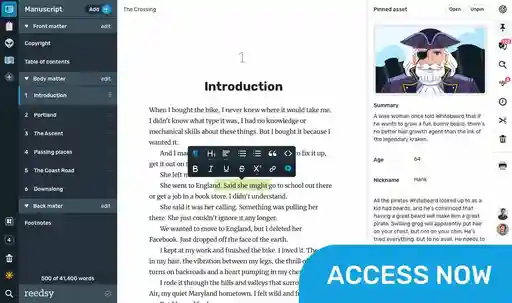
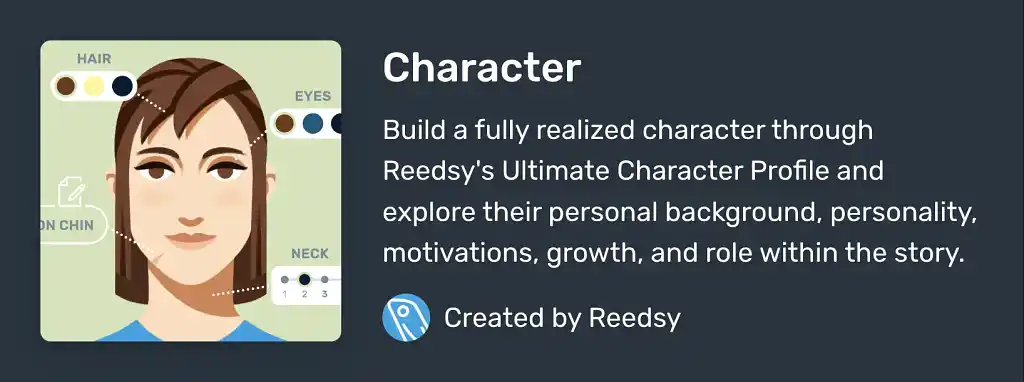 Check out our planning templates in Reedsy Studio to map out everything from your protagonist’s personality to the conflict and key themes you want to hit. To test these dynamic templates yourself, simply sign up to Studio and follow the instructions below:
- Create a new project
- Tap the "Planning" (📋) icon on the left-hand bar
- Select "Add → Browse templates" at the top
- Pick any template and start filling it out!
8. Find your window of productivity
It’s no secret that writing and procrastination often go hand in hand, but Norman Mailer had a simple antidote:
“If you tell yourself you are going to be at your desk tomorrow, you are by that declaration asking your unconscious to prepare the material. You are, in effect, contracting to pick up such valuables at a given time. Count on me, you are saying to a few forces below: I will be there to write.”
That said, there’s no universal “best time” to write. Benjamin Franklin supposedly sat at his desk to write at 6 AM. Then you have F. Scott Fitzgerald, who wouldn’t rise until just before midday to start his work. Find what time works for you, and stick to it.
Q: What daily writing routines can help authors maintain consistent productivity?
Suggested answer

There are four things that I consider before settling in to write.
What sounds are there? The best is silence, but in a city environment this is impossible. If there are specific loud that I want to block out, I listen to drone music. This consists mostly of long, sustained notes (no melodies) and comes from the American and German post-war experimental musical traditions. The texture of the sounds is often rich which works for this purpose quite well. It has a meditative effect. Failing this, music without lyrics is also good.
What is my phone doing? Just switch it off.
Social media. Along with my phone, this is designed to distract. What I do is log out of my social media accounts. If I automatically go back in, I'm then met by the login page. This doesn't sound like much of a difference, but is just enough to nudge myself into becoming mindful of what I'm doing and what my present purpose it. And mindfulness is key.
Lastly, I take a page of Hemingway's advice: "The first draft of anything is s**t." It's ok to produce bad writing. In fact, it's totally ok; actually it's great. Why? Because my ideas are now down on the page, even if it's absolutely horrible. Nobody ever simply writes a finished product straight off the bat. I'll make it better later and that is a different process.
Don is available to hire on Reedsy ⏺

Get all domestic and admin chores out the way first, so that there is nothing else on your mind when you sit down to write. Then just stick at it for as long as possible.
Andrew is available to hire on Reedsy ⏺
Honestly, I think what's key is simply establishing any writing routine. Whether you write in the morning or in the evening, at your desk or in a coffee shop, or longhand or on your computer, having some routine will help you get into that writing mode more easily when you're ready and thus be more productive.
It's also important to note that every writer has a different process, and you need to figure out the routine that works for you. For me personally, it's key that I have a glass of water at hand and that the dogs have just been taken out for a bathroom break so that they don't interrupt me at the very moment I've gotten into a groove! For one of my book coaching clients, we've discovered she absolutely has to have music on in the background and her husband out of the house; otherwise, she's distracted by every little sound, whereas music she can treat as white noise.
Once you start experimenting, you'll find out what works for you. If you pay attention to what you discover, you'll be able to set yourself up for daily success, whether that's getting up early or going to bed late, or simply doing the dishes while you think over your plans for the next chapter that needs to be written.
Jennifer is available to hire on Reedsy ⏺
9. Write regularly to build momentum
As difficult as it can be, many authors recommend writing at least once a day. Daily writing doesn't need to show dramatic progress, but it’s essential to maintain the habit.
As bestselling author Jane Yolen explains:
"Exercise the writing muscle every day, even if it is only a letter, notes, a title list, a character sketch, a journal entry. Writers are like dancers, like athletes. Without that exercise, the muscles seize up."
So, even if you can’t dedicate more than 15 minutes per day to writing, that’s completely fine! Some progress is better than no progress, and you’ll find that over time, your words will have significantly piled up.
10. Stop while you’re ahead
Maintaining momentum across a long project is one of the hardest parts of writing. Ernest Hemingway's solution might seem counterintuitive, but it worked for him (and plenty of others out there, we’re sure):
“The best way is always to stop when you are going good and when you know what will happen next. If you do that every day… you will never be stuck… don’t think about it or worry about it until you start to write the next day. That way your subconscious will work on it all the time.”
In practice, this means stopping mid-scene, mid-paragraph, maybe even mid-sentence. Roald Dahl swore by it:
"You make yourself stop and you walk away. And you can't wait to get back because you know what you want to say next."
If you're skeptical and wondering how you can stop worrying about halting at a midpoint, Hemingway addressed that too (in a sense):
"By not thinking about it. As soon as you start to think about it, stop it. Think about something else. You have to learn that."
Q: What tools or apps actually make a difference in streamlining the writing process?
Suggested answer
One of the things I love about working with writers is that I'm constantly seeing the different nuances in writing processes; in fact, one of the most fascinating challenges for a writing coach is trying to help a writer discover their personal ideal writing process. Why? Because it's different for everyone, and that means streamlining is going to look a bit different for everyone.
Some writers can easily write thousands of words in the morning, but stare at a blank page for hours at night. Some writers need perfect silence to get their ideas together, and others need the chaos of a coffee shop. And maybe most distinctively, some writers truly do need an outline to make real progress, whereas an outline of similar quality could completely paralyze another writer because they'll lose too much of the surprise involved in storytelling!
Streamlining the writing process is all about figuring out what works for you personally as a writer--and the truth is, it might even be a bit different for different projects. I recently worked with a writer who needed the chaos of a coffee shop to make progress on her memoir, but when it came to writing her novel, she needed complete silence at her desk. The beauty (and frustration) of this aspect of writing is the fact that it's different for everyone, and the only way to know what most works for you is going to be experimenting.
Try writing in longhand as well as on your computer. Try Scrivener or some other software that appeals to you. Write at different times of day to see how the experience feels, and in different places. Once you start experimenting, you'll start to figure out the process that most streamlines your own stories and helps you be as productive and powerful a writer as possible.
Jennifer is available to hire on Reedsy ⏺
Today we have a plethora of excellent software programs for writing, such as Reedsy Studio, Scrivener, and Grammarly. Some writers use ChatGPT, although I would not recommend using an AI generative language model to help writing. This is because it bypasses the process altogether, replacing the writer. What would be the point of that?
Even the oldest and best-known program, Microsoft Word is still excellent. But there is one older – far older – trick to helping the writing process. This is articulating your writing ideas out load. I'm sorry if it sounds mundane and less flashy!
It is surprising how difficult this can be sometimes. Often, a writer will have an idea or set of ideas but having never explained them aloud, might struggle with clarity at the detailed level. When reading over their work, they are reminded of the ideas; the writer is not merely reading here, they are remembering things that are not on the page!
So, trying to explain it to someone who does not know these ideas is crucial. This is why critique groups are an excellent way of improving one's writing. Often – after a deep explanation and perhaps some questions back and forth – I have heard the friend or other writer say, "ok, well write what you've just said!"
Don is available to hire on Reedsy ⏺
11. But don’t stop when you’re really in the flow
That said, if Hemingway’s strategy doesn’t suit you, there’s always Henry David Thoreau’s approach:
“Write while the heat is in you. The writer who postpones the recording of his thoughts uses an iron which has cooled to burn a hole with. He cannot inflame the minds of his audience.”
In other words, when the writing is going very well, follow it. A flow state is rare and worth protecting.
So before you sit down, do what you can to guard it. Put your phone in another room, close every tab you don't need, and let people around you know you're unavailable. The goal is to remove any friction that might pull you out before the heat runs out on its own.
And if inspiration strikes at an inconvenient moment — mid-shower or last thing at night — jot it down before it disappears. Some of the best ideas arrive uninvited, and you may even find that those written during moments of spontaneity often require the least revision.
12. Keep the tension taut between chapters
When it comes to narrative pacing, you can heed Raymond Chandler’s strategy for chapter-writing:
“When in doubt about how to end a chapter, bring in a man with a gun.”
Not something you’ll want to take literally, but rather as a reminder to keep the ante upped so that your story never becomes stale. In other words, end each chapter with a metaphorical bang so that the reader stays hooked.
Q: How can authors effectively build tension leading up to the climax?
Suggested answer

Think of "tension" as another word for "conflict." What would make the scenes in act 2 and 3 more emotionally stressful, or physically uncomfortable, or surprisingly worse for the main character? For instance, if a character is striving to do the right thing, it's harder for them to commit to that course of action if a dear friend, a lover, a mentor, etc., insists that they take a different action instead. Tension! Conflict! In another example, if a protagonist is fighting against a powerful enemy, it's more difficult for them to maintain a tactical advantage if they are injured in some fashion halfway through the battle. Tension! Conflict! The serpent that has its head cut off, now grows back three more in its place. Oh no! The point is that readers love to see characters work hard towards their goals, because it makes the victory in the end all the more delicious. So don't make the path too easy for the protagonist.
Alternatively, think of all the ways a protagonist could avoid facing their problem(s). Maybe in the current draft they have the option to run away, hide out of sight, choose to ignore their problem entirely, etc. To build more tension, strip away those options from the character one by one. Maybe the environment shifts into a smaller space, so it's now impossible to run away or hide. Perhaps the choice to ignore their problem has finally caught up with them, and the consequences of that choice now threaten to overwhelm them, in the form of five new problems falling into their lap at once. By refusing to give the character(s) an easy out, the tension immediately grows in such a way that the reader will want to see what happens next!
Hannah is available to hire on Reedsy ⏺

Well, the main method is to up the stakes as you go along. The more it matters emotionally to the characters and externally to their circumstances and the world around them, the more important that climax becomes. Every time you increase the stakes, the anticipation of readers goes up surrounding the climax and what might result. The final confrontation between hero(es) and villain becomes and edge-of-the-seat affair.
If you struggle with this, the technique I recommend is to examine the plot questions asked and answered. All plots are effectively a series of questions asked and answered. When you ask and how soon you answer is part of building tensions. Some questions carry over several scenes, some are answered right away. Some last whole chapters or several chapters. Some are asked at the beginning and not answered until the end, like the main driving core quest question of will good conquer evil? Will the protagonist get what he or she wants or needs? Will the villain prevail?
Make sure you are answering the questions you ask in appropriate places. Yes, you may want to set up a sequel and leave a few things hanging but the trick is to pick the right questions. The rest need to be answered, and figuring out which questions depend upon that climax and asking more and more of them as you lead up to it is a really great way to increase suspense and anticipation and lend that sense of urgency to the climax that keeps readers turning pages and dying to know what happens.
Bryan thomas is available to hire on Reedsy ⏺
Stakes need to be continually raised as the story builds to a climax. The problem[s] should be getting more and more difficult until the climax is reached.
Melody is available to hire on Reedsy ⏺
13. Write the ending early
Some writers find it easier to draft once they know where the story is heading. While writing, Pulitzer Prize winner Katherine Anne Porter reportedly started with the ending in mind:
“If I didn’t know the ending of a story, I wouldn’t begin. I always write my last line, my last paragraph, my last page first.”
Even if the details change later, getting the ending down early will give you something to write towards and the confidence that a finish line is in sight.
14. Seek a change of scenery
If you’ve ever gone through moments in which writing felt like pulling teeth, it could be time to switch up your writing environment. Here’s how a friend of Roald Dahl’s explained the author’s unique cocoon strategy:
“He steps into a sleeping bag, pulls it up to his waist and settles himself in a faded wing-backed armchair. His feet he rests on a battered travelling case full of logs. This is roped to the legs of the armchair so it’s always at a perfect distance.”
Q: What is your number one tip for staying motivated to finish a draft?
Suggested answer
Remember why you started, and remember that a first draft is called a 'draft' for a reason. As long as you hold onto the purpose you started with, and understand that everything in a draft can be fixed/tightened/revised/expanded on later, you'll be fine.
Jennifer is available to hire on Reedsy ⏺
Work your draft as a promise to yourself, not a show for others. Improvement, not perfection, is the goal at this level. Set tiny, attainable goals—just one page or paragraph—and triumph over each. When energy is dwindling, revisit the "why" for your story: the emotion, message, or character that originally excited you. Keep in mind that all great books started as a cluttered draft. Finishing isn't happening quickly—it's arriving until your story quite literally does come into shape.
John is available to hire on Reedsy ⏺
This strategy specifically hindered Dahl from gettting up to do something else. However, he wasn’t alone in finding unusual places to write. Gertrude Stein wrote in the driver’s seat of her Model T Ford, Marcel Proust refused to work anywhere but his bed. Edith Sitwell, despite her name, found that she wrote best lying down… in an open coffin (yes, really).
So whenever you’re in a slump, go to the place that helps you concentrate, whether that be at a quiet desk or in a busy café, and return to it consistently.
Editing: How to revise your work
FREE RESOURCE
Get our Book Editing Checklist
Resolve every error, from plot holes to misplaced punctuation.
15. Step away before editing
Distance is one of the most reliable editing tools. In his memoir On Writing, Stephen King recommends letting a finished manuscript sit in a drawer for at least six weeks before touching it again. Time away helps you return to your own work as a reader rather than a writer, making it easier to spot what isn’t working.
George Saunders also describes that readerly mindset in action:
“I try to base my revision on a re-reading of what I’ve done so far, imitating, so far as it’s possible, a first-time reader. That is, I try not to bring too many ideas about what the story is doing etc, etc. Just SEE what it’s doing.”
16. Revisit the beginning and ending first
Once you’re ready to return to your manuscript, check whether the opening begins too abruptly, whether the ending is satisfying, and whether either section carries exposition that doesn’t need to be there. Polishing these areas often improves the entire narrative.
As Anton Chekhov once observed:
“My own experience is that once a story has been written, one has to cross out the beginning and the end. It is there that we authors do most of our lying.”
While you don’t need to literally remove the entire beginning and end of your work, it's worth taking a close look at where your story actually starts (and ends), and where it should.
Q: What is the biggest mistake writers make in their opening chapters?
Suggested answer
The biggest mistakes I see in the opening chapters of new authors are:
- Spending too much time on backstory that is not needed in the present moment or in the opening situation the book starts with. Any backstory information that is crucial to the story should be woven into the narrative as the story goes along or introduced after the initial inciting incident. The reader needs to know enough about the character to care about what happens to them and to begin rooting for them, but they don't need to know their entire life's story or all of the characters that occupy their world.
- Not providing enough information to give the story a sense of place, especially in stories that do not take place in the present day. In historical, sci-fi, and fantasy, there needs to be some time spent in world-building by placing descriptive sentences here and there in the opening. For instance, stating that someone is traveling in a carriage denotes a historical novel. Traveling at light speed in a spaceship evokes images of sci-fi and perhaps another planet or world. So be sure to place your characters in this new world right away.
- Not starting to move quickly enough into the inciting incident or the catalyst of the story, and spending too much time on non-consequential details like gardening, eating, riding a bike, brushing teeth, etc. There needs to be some type of action and some sort of trouble within the first 12,000 - 13,000 words. This is a good benchmark to shoot for as far as having your inciting incident occur by this point in the story.
You may have to try a few ways and experiment with different points in time as far as where your book needs to start.
Melody is available to hire on Reedsy ⏺

Your first chapter has a lot of work to do. It needs to engage readers straight away, and by readers I mean everyone from a literary agent's assistant to a commissioning editor, a book marketer, or someone in a bookshop idly picking it up. That means something has to ignite in those first few thousand words, whether a plot, a question or a voice.
Susanna is available to hire on Reedsy ⏺
17. Read your draft aloud
There’s a reason writers have sworn by this technique for centuries. Rudyard Kipling, in Something of Myself, describes his own editing ritual in characteristically vivid terms:
“Read it aloud alone and at leisure. Maybe a shade more brushwork will then indicate or impose itself.”
As academic Peter Elbow explains, reading your work aloud helps you notice any friction between the outer physical experience of hearing the words and the inner experience of feeling the meaning. Let your ear catch what your eye may have skipped over, and edit accordingly.
18. Cut filler words and weak modifiers
Stephen King famously warned: “The road to hell is paved with adverbs.” The point isn’t to eliminate every modifier, but to ensure that you’re not using too many adverbs and slipping into telling rather than showing.
Mark Twain offered similar advice with characteristic humor:
“Substitute ‘damn’ every time you’re inclined to write ‘very’; your editor will delete it and the writing will be just as it should be.”
While you revise, be on the lookout for filler words — very, really, quite, things, stuff — and ask whether a stronger word (like “terrified” instead of “very afraid”) could replace them.
Q: When is a proofreader necessary after a copy edit, and how does this process differ from the editing phase?
Suggested answer

Proofreading doesn’t mean the copyeditor failed—it means the publishing process is working as it should.
At the Big Five publishers, where I’ve proofread re-releases of bestselling books that had already undergone professional editing and sold millions of copies, I’ve still found hundreds of errors—sometimes over 700 in a single manuscript. Even the most skilled editors miss things. That’s why industry-leading publishers invest in multiple rounds of editing—developmental, copyediting, slugging, proofreading, and cold reading.
For indie authors, budget often determines how many of these stages are possible. If you can only choose one, a solid copyedit can get your manuscript into excellent shape. But when feasible, combining copyediting and proofreading gives your book the clarity, consistency, and polish it needs to make a strong first impression.
Ian is available to hire on Reedsy ⏺

A copyeditor is there to look at the style and tone of the work. They're traditionally wrestling with a house style guide or an academic style guide so the writer's work fits the industry standard. This is the person who polishes the writer's work – using industry knowledge writer's can't be expected to have – and gets it ready to be turned into a book. When the copyeditor's focus is on the whole of the manuscript (to note the jokes you made before, the colour of the character's eyes, and the weather outside in chapter three) it's not always possible to focus on commas too.
Proofreading should be the very final safety net, there to catch the last typos and act as a different set of eyes. They're able to concentrate on the very final detail of the text because the copyeditor resolved the vast majority of the glaring issues.
The most important thing, though, is that the proofreader should be reading the proofs. They're the person who checks the book professionally just before it goes to print, and checking for all the potential problems that were created when your manuscript went from a Word document to a PDF. When you remove the proofreader from the process, you risk all kinds of gremlins impacting the final version of your book and the impression it makes.
Mairi is available to hire on Reedsy ⏺

A copy-editor often has to pay a lot of attention to wider issues, and hence may miss some small proofreading errors or inconsistencies. Also, in the publishing context, when a book has been typeset, the typesetting process often introduces errors into a book that weren't there before
John is available to hire on Reedsy ⏺
19. Proof like a reader
Even a strong piece can lose credibility when punctuation or spelling errors pull the reader out of the story. Walt Whitman boils it down into a very simple statement:
“I hate commas in the wrong places.”
Even after you’ve given your draft an edit to identify structural and flow issues, you’ll need to proofread it with a discerning eye to spot spelling errors, stray commas, and missing dialogue punctuation.
Writer’s block: How to get unstuck
Q: What’s the best way to overcome writer’s block?
Suggested answer
The harsh truth is that there's no one best/true method for overcoming writer's block because writer's block is so unique to each person experiencing it. The effect of it--not being able to write--may be the same for everyone, but the causes are as varied as the writers experiencing it. That said, here are some strategies.
1) Try to figure out what's driving your writer's block. Did it start when you began considering a particular scene/character, or when some new stressor came up in your personal life? If you can figure out the source of your block, that may give you the path toward overcoming it. For instance, I worked with a writer who suddenly hit major writer's block when she was approaching a fight between characters in her Romance novel. What felt like garden-variety writer's block at first didn't resolve after a few days like it normally would for her; after weeks, she still hadn't managed to write another word. Ultimately, we talked it over and she realized it was because she'd based the characters too much off of her own relationship, and approaching the fight was causing her serious anxiety in her personal life. The solution in her case? Tweak one of the characters and the source of the fight so that she no longer felt like she was projecting fiction onto her real future.
2) Sometimes writer's block happens because a writer needs time to think. If you're stuck--especially if this isn't your first project, and the writer's block is worse than usual--take some time out to think about your project. For many writers, daydreaming is a serious part of the writing process. It may be that you need to give your project/next scene some more time to percolate before you're ready to write it. Worse comes to worse, try taking a break and writing something else or reading outside your genre, and that may give your conscious mind to catch up to your project's needs.
3) If you're midway into a project and you suddenly get blocked, consider what's just happened and what's to come. If the block is happening because you're stressed about what's about to happen in the book, your only option may be to force yourself through it (this can especially happen if what's coming up in the plot is personally triggering for you and you're planning to write it anyway). On the other hand, writer's block often happens because a writer has made a misstep in plot or character development--a plot point happened earlier than it should have, a character did something out of character, etc. Sometimes, backing up a few scenes/chapters and rethinking those last few decisions can help you realize where you went wrong, and once you back up, the writer's block will take care of itself.
Jennifer is available to hire on Reedsy ⏺

The best answer here is the most common (and maybe annoying!) one: the best way to overcome writer's block is to write.
If you're struggling to put more words on the page, the only way to truly get through that is to keep writing. Even if you need to open up a separate document to write a completely different scene with the character, the act of writing, the consistency of it is the best way to not only motivate yourself to keep writing, but also to keep the ideas and creativity flowing.
Matt is available to hire on Reedsy ⏺
20. Write anything
When writer’s block sets in, the simplest solution is often the most effective. From Maya Angelou:
“I may just write for two weeks something like, ‘The cat sat on the mat, that is that, not a rat.’ And it might be just the most boring and awful stuff. But I try. When I’m writing, I write. And then it’s as if the muse is convinced that I’m serious and says, ‘Okay. Okay. I’ll come.’”
So take it from Angelou, who was nominated for a Pulitzer Prize in 1971: keep writing, even badly, and eventually the momentum returns.
21. Write to one person
Sometimes, writer’s block comes from imagining an agent or thousands of strangers in the audience. To help curb this, here is John Steinbeck’s fix — as successfully tested and passed along by George Plimpton:
“Pretend that you’re writing not to your editor or to an audience or to a readership, but to someone close, like your sister, or your mother, or someone that you like.”
As Steinbeck himself explained:
“This removes the vague terror of addressing the large and faceless audience and it also, you will find, will give a sense of freedom and a lack of self-consciousness.”
Q: What's your number one tip for authors dealing with burnout or writer’s block?
Suggested answer

Refill your creative well! Go watch TV, listen to your favorite songs, play a video game—do whatever you need to do to separate yourself from the book, even if only for a little bit. I've found that a small bit of distance can go a long way towards combating burnout/writer's block.
However, if the block is extremely pervasive (and you're not on deadline), it can also be helpful to briefly shelve a book and work on something that doesn't make you want to slam your head against the wall!
Chelsea is available to hire on Reedsy ⏺
My number-one tip to combat writer's block is to experiment.
Whatever routine you've built for yourself as a writer, try getting out of that routine and see how it affects your ability to write.
If you normally write on your desktop computer, try using a tablet or even writing longhand. Maybe the blank page is affecting you, and dictation will be something worth trying. If you normally write at night after everyone else in your family has gone to bed, try getting up early and writing then, or even snatching breaks during the day for writing time. If you write in longer chunks of time at home, try a coffee shop or restaurant, or if you like to write in coffee shops, try writing at home or in a local park. If you normally write in silence, try putting on music in the background.
Generally speaking, routine is a good thing for most writers, but some books/ideas demand a change of pace, and since we as writers change by virtue of changing as people and growing in our craft, that sometimes mean a routine will change.
Jennifer is available to hire on Reedsy ⏺
When writer's block or burnout arrives, move away from the page without shame. Creativity is not a faucet but a well that must be refilled. Do something that reminds you why you love about stories to begin with: Take a walk, read a treasured book, watch a film that moves you, or simply sleep. Inspiration has a way of returning once you stop trying to make it happen. Be kind to yourself in the process—writing is done most naturally when you permit your mind and spirit to gasp for air.
John is available to hire on Reedsy ⏺
22. Step away for a while
Then again, sometimes the best strategy is to stop writing entirely for a little while — a more extreme version of the “change of scenery” advice. Hilary Mantel once said:
“If you get stuck, get away from your desk. Take a walk, take a bath, go to sleep, make a pie, draw, listen to music, meditate, exercise; whatever you do, don’t just stick there scowling at the problem.
“But don’t make telephone calls or go to a party; if you do, other people’s words will pour in where your lost words should be. Open a gap for them, create a space. Be patient.”
The brain continues working on creative problems in the background, and many writers find solutions once they return with a clearer mind.
If you’ve come this far and all else has failed, know that you can always resort to P.G. Wodehouse’s tried, true, and completely professional advice:
“I just sit at my typewriter and curse a bit.”
Different strategies help with different challenges. If you’re struggling with ideas, start with questions or observations. If you’re struggling with productivity, focus on routine and breaking your project into smaller goals. If revision feels impossible, create some distance before you begin to edit. If writer’s block has you stuck, lower the stakes and just write anything.
Most writers end up combining several of these strategies over time. It’s less about checking every box on the list and more about finding the balance that helps you write better. Good luck!




1 response
Glen Barrington says:
23/10/2018 – 14:16
Hmmm! So the survey says! Nobody knows for sure!