Last updated on Mar 13, 2026
Social Media for Writers: A Beginner’s Guide

Savannah Cordova
Savannah is a senior editor with Reedsy and a published writer whose work has appeared on Slate, Kirkus, and BookTrib. Her short fiction has appeared in the Owl Canyon Press anthology, "No Bars and a Dead Battery".
View profile →As an author, you can use social media to expand your market reach and sell more books. In this guide to the best social media for writers, we’ll show you around the most popular platforms to help you pick the best ones for yourself, tailor your strategy to them, and ultimately grow your following and engagement.
Here’s a summary of the best social media for writers:
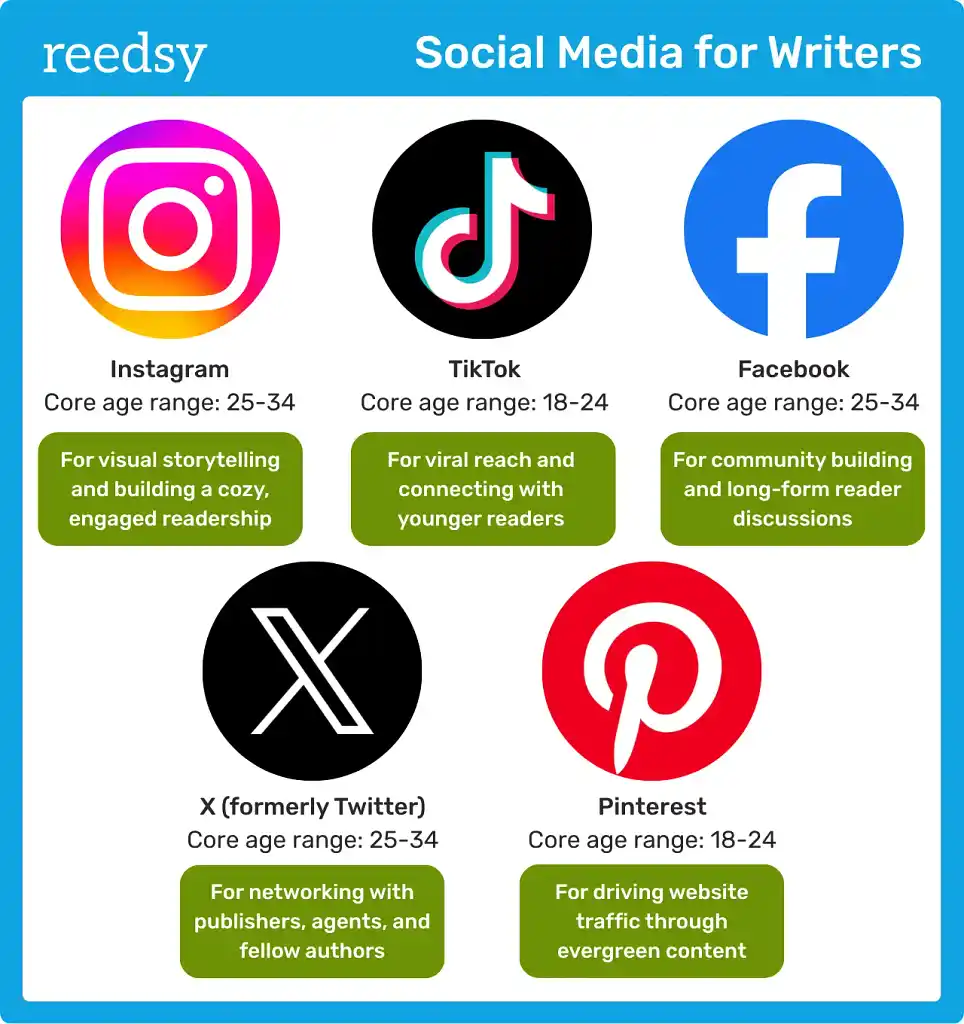
Now, let’s take a deeper dive into each platform.
Instagram for authors
Everyone knows Instagram, right? At over 170 million active users in the US, it’s one of the biggest social media platforms. The audience skews younger (60% of US users are under 35), with a fairly even split among gender lines, but most importantly: engagement on Instagram is through the roof compared to other platforms.
⚡ Fast facts for authors on Instagram:
Instagram’s bookish community: “Bookstagram”
Popular subgenres: Thriller, romance, YA, fantasy, book club fiction
Known for: Polished and “aesthetic” content; deep dives into bookish topics
As you can probably guess, Instagram focuses on visually appealing content — and you may find the vibe a bit “cozier” compared to other faster-paced platforms. The trade-off is that the chances of suddenly going explosively viral are lower on Instagram than, say, TikTok.
So if you’re not comfortable creating authentic, visually engaging and conversational content (in the form of photos and videos), you may need to look elsewhere. But if you are, read on! To market your book on Instagram, it’s not just genre that’s important — it’s also a deep familiarity with Instagram’s tone, community, and algorithm.
Research trends on Instagram for your genre
Once you’ve gotten a handle on the Instagram ecosystem, drill down into your specific genre’s content. For example, fantasy readers might be posting elaborate fanart of their favorite characters, while lit fic posters might be more inclined toward critical analysis in their captions.
Try to create content that will appeal to your target readers. This goes for all social media, of course, but especially on Instagram. With such a wide range of content types (Reels, Posts, Stories etc.), it’s important to study up.
Q: How do you leverage social media to gain commissions from fans of your work?
Suggested answer


My social media strategy revolves around creating valuable, educational content that showcases both my process and expertise. I regularly share time-lapse videos of my design process, before-and-after comparisons, and detailed breakdowns of successful book covers. This behind-the-scenes content helps potential clients understand the value of professional illustration while building trust in my capabilities.
Engagement is key to my social media presence. I host regular Q&A sessions about book cover design and illustration, participate in relevant Twitter chats, and create Instagram stories that feature quick design tips. I've found that sharing knowledge freely and engaging authentically with the writing community naturally leads to professional opportunities.
I also maintain a consistent posting schedule that includes both finished projects and works-in-progress, giving followers insight into the evolution of each design. By tagging clients and engaging with their book launch activities, I've built a supportive network that generates referrals and creates opportunities for new commissions.
Sergey is available to hire on Reedsy ⏺
Reach out to Bookstagram influencers
Bookstagram is full of micro-influencers who love to read, and they’ll often review new books on their platforms. To find them, simply type “Bookstagram” or “[your genre] books” into Instagram’s search bar, and take a look through the most popular videos.
When you’re just starting out, aim for influencers with ~10k followers or less to maximize your chances of receiving a response. And spend some time on organic engagement — follow them, comment on their posts and share their content on your story. This will put you on their radar naturally, without the need for a cold email.
Expand your reach
Once you’ve built up your Instagram presence, you can grow your profile using Instagram’s various content options:
Reels
Instagram favors video content, so if you’re comfortable in front of a camera, it doesn’t hurt to post Reels. They can be anything from a "Storytime" anecdote from your main character's POV (less involved) to a book teaser trailer (extremely involved). Again, we recommend doing a deep dive into your specific subgenre to get an idea of what your fellow authors are doing.
Stories
Stories are excellent for engagement because, unlike with grid posts, you can a) add interactive elements and b) create a more “individualized” experience by allowing people to reply. Post a few Stories per week to keep people engaged, with dynamic content like Q&As, polls, links to interviews or articles about you, and more.
Don't forget to create Story templates to give your Stories an immediately recognizable brand, and save your best ones as Story Highlights.
Instagram case study: Coco Mellors
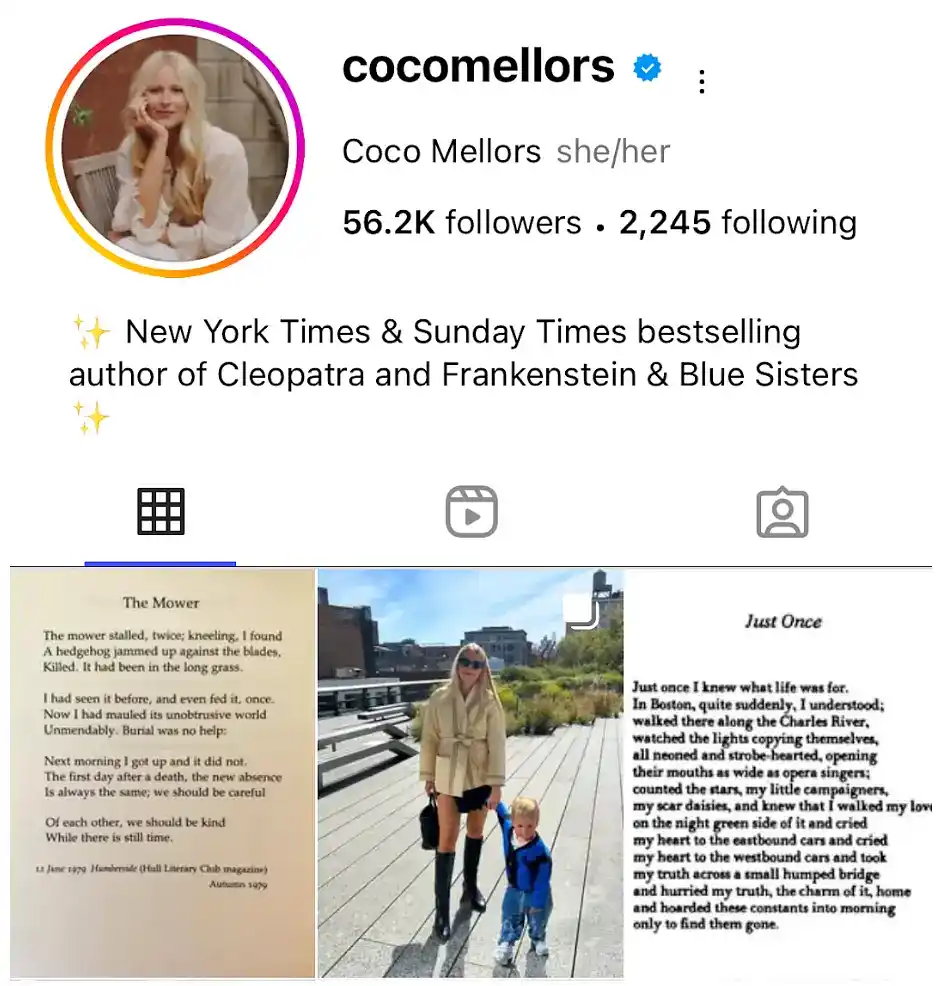
Coco Mellors, author of Cleopatra and Frankenstein and Blue Sisters, runs a vibrant author Instagram well-aligned with the upmarket vibes of her books. And while not just anyone can post about meeting Sarah Jessica Parker after she’s read your book (!), here are a few content ideas you can borrow:
-
Posting evocative or inspiring excerpts of other writers’ work (Mellors seems especially fond of poetry);
-
Day-to-day descriptions of the writing life — your own process, how you deal with writer’s block, and so on;
-
Drawing parallels between your book and the outside world — for example, in a recent caption about moving, Mellors wrote “From Blue Sisters to a blue front door 💙”
Not to be forgotten: she also posts frequently and maintains an authentic tone, going so far as to discuss her experiences promoting her book while pregnant. Her posts are not overly revealing, but they definitely foster a personal connection with her as a writer and a person — just the right balance to strike on IG.
FREE COURSE
Book Marketing 101
Learn seven tried-and-true strategies for boosting book sales.
TikTok for authors
Tied with Instagram as the main social media used by Gen Z (30% of its users are aged 18-24), TikTok draws 183 million monthly active users in the US alone. It’s particularly famous for its ability to send backlist titles soaring up bestseller charts.
⚡ Fast facts for authors on TikTok:
TikTok’s bookish community: “BookTok”
Popular subgenres: Fantasy, YA, romance
Known for: Authentic and relatable video content, passionate fans, and viral trends
The temptation of virality aside, TikTok may not suit every author out there. If, for instance, the thought of venting your innermost thoughts on-screen doesn’t appeal, TikTok may not be for you. But if the downdressed nature of the platform sounds pretty good to you, here are some tips to help you ‘Tik’ all the right boxes… sorry, not sorry:
Authenticity is king
TikTok’s algorithm rewards “realness” over polish. The best-performing BookTok videos feature genuine emotion: readers crying over a plot twist, authors sharing their writing process, or quick, funny takes about the highs and lows of publishing.
All of that to say, don’t be afraid to lean into personality and storytelling in your content. And definitely don’t be shy about voicing your opinion. Speak your mind (within reason — don’t alienate your readers or fellow authors!) and you’ll attract fans who value your honesty.
Apply for a business account
On TikTok, business accounts are trickier to apply for than most other social media platforms. But it’s worth it: with a business account, you can access account analytics, putting you in the driver’s seat of your own marketing strategy. TikTok also only allows you to put links (such as your author website) in your bio if you have one (or over 1,000 followers).
To apply, you’ll need to be a registered business owner. Go to your account settings, and tap ‘Switch to Business Account’. Then, you’ll need to enter the following details:
-
Legal business name (usually just your pen name)
-
Business license ID
-
Valid documentation, such as a certificate of incorporation, tax certificate, or extract from the commercial register
The verification process should take a few business days, but once you’re verified, you can start directing TikTok traffic straight to your website!
Keep it short
Under 30 seconds often works best, especially when starting out. The TikTok audience is a notoriously fickle one, with the average user only spending 14-17 seconds watching each video. Here are some tips for snagging an audience in the first 3 seconds of a video:
-
Don’t use a generic greeting — get straight into the meat of the video.
-
Pose a question of some kind (e.g. “Did you know if you ‘pants’ your whole novel, you might have no idea how to end it?” or “Can you believe what happens in chapter 13 of [new book]?”
-
Give only half of the story at the start to encourage users to watch until the end (e.g. “I tried to write a book in a day — here’s how it went”).
-
Use trending sounds to your advantage. You can check out what other authors are doing with specific examples.
-
Show the end result, e.g. a book cover, then go into more detail about how you got there after engaging the viewer.
TikTok case study: Alex Aster
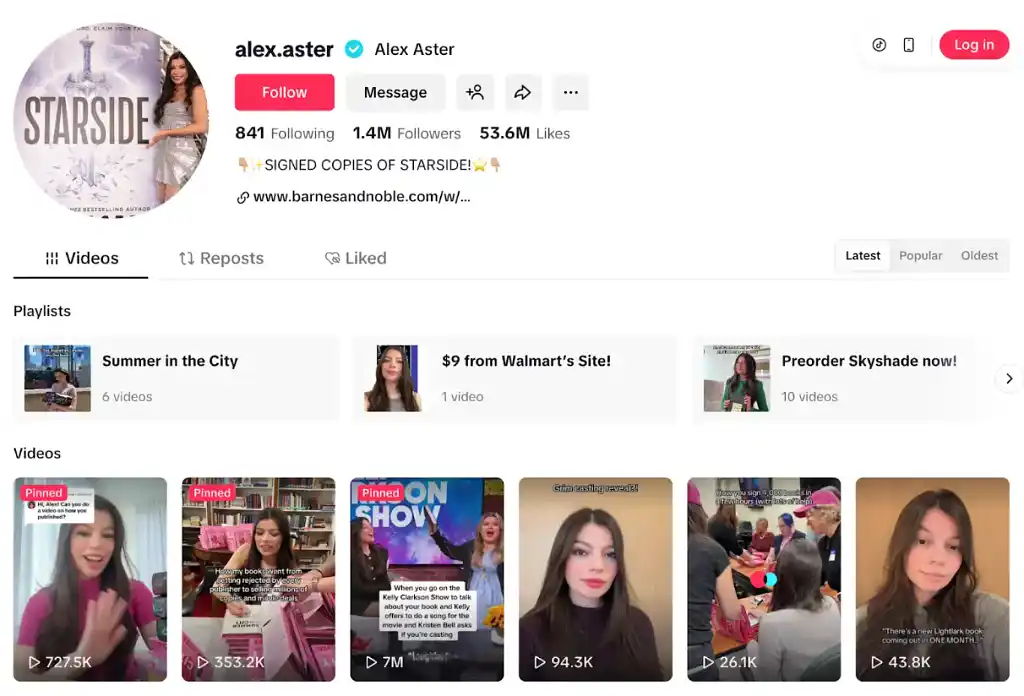 Alex Aster is the New York Times-bestselling author of the Lightlark series, which is set to be adapted into a movie by Universal. Yet despite Aster’s enormous success, she keeps it real over on her TikTok. Her videos are full of down-to-earth moments where she reflects on being starstruck after meeting Kelly Clarkson, acknowledges her (insanely) weird way of eating cereal, and offers up authentic anecdotes of her struggle to be published.
Her TikTok is a great place to be, and serves as a perfect example of how the platform can be used to build a community of friends first, readers second. It only takes a few short interactions with her posts to really feel like you’ve known Aster for years!
Q: Should I follow current trends or write the story I’m most passionate about?
Suggested answer

The issue with following current trends is that the trend may be over before you get your book completed and out to the world. If you write what you are passionate about, the story will usually end up being stronger because you are writing a story that means a lot to you, as opposed to writing something just because you think it might sell.
However, you want to be sure the story you are passionate about still has a strong possibility of selling by avoiding cliches and plots that have been overworked and overdone.
Strong stories that readers can relate to will have a good chance of finding an audience no matter the genre.
Melody is available to hire on Reedsy ⏺
If you're planning on publishing traditionally, you need to write the story you're passionate about. The publishing industry is slow slow slow. If you're planning on submitting a query to agents and try for a deal with a big-publisher, it's likely that years will pass between when you start writing and when that book hits shelves. That's the simple truth. Even if you write your book in six months, chances are that it will take at least that, if not a few years, to get an agent, and then the agent will still need to sell that book, the publisher will need to see it edited, etc. etc. Even if you're planning on submitting your book to small publishers who work more quickly, it's likely that a few years will pass because they get so many manuscripts to review that you'll be one of many. Once they accept your work, it may well be a year or two before it's published.
The balancing act comes if you're a self-publisher writing to market in order to make a living. This happens for a rare few writers, but it does happen. Some of my clients make their livings off of books they self-publish, and they often publish 3-5 books per year. They write fast enough that they are able to write to market and follow trends, and it helps them make a living, but it really is a balancing act. You don't want to get so caught up in writing to trends that you lose your passion for writing and get bored or start putting out sub-par work, so it's important that you know who you are and what you want to write, and then you can focus on the trends/markets that relate to your own writing interests without getting needlessly sidetracked. (Note that making a living off of writing in this fashion also depends on you being not only fast and good, but planning ahead--editors, cover artists, etc. all book ahead, so you need to plan in advance in order for everyone to be on the same page and able to accommodate your timeline and catch that trend before it disappears.)
Jennifer is available to hire on Reedsy ⏺

If you write a book inspired by 2025 trends you might find that by the time it's ready for submission and even publication the trend has moved on to something new. It takes a long time to write a book: you have a better chance of sustaining momentum and enthusiasm if you stick to your passion project. I rather believe that readers pick up on that passion too.
Susanna is available to hire on Reedsy ⏺
Facebook for authors
Facebook remains the most popular social network in the world, with over 270 million active users in the US and a user base aged 25-34. Instead of one defined space, Facebook’s bookish activity lives in its many engaged Facebook Groups that thrive on long-form conversations and recommendations. It’s also one of the best platforms for author ads.
⚡ Fast facts for authors on Facebook:
Facebook’s bookish community: Primarily active in Facebook Groups
Popular subgenres: Nonfiction, women’s fiction, thrillers, crime, mystery, romance
Known for: A strong recommendation culture and in-depth discussions
Facebook, more so than other platforms, is a slow burn. Authors succeed by being personable and community-minded — not by going for the viral moment or the hard sell.
Here are some tips on how to foster a great Facebook presence:
Create a Page, not a Profile
What’s the difference, you ask? Well, a Facebook Profile is what you create as an individual — with information like your real name, education, etc. A Facebook Page, meanwhile, is meant for businesses — aka your writing career. You’ll be able to use a pen name, even if it’s wholly unrealistic (Lemony Snicket, we’re looking at you!) and you’ll gain access to business tools, such as content scheduling and insights.
To create a Page, simply click the grid symbol in the upper-right corner of Facebook (next to the messenger symbol) and select “Page”. Here’s the kicker, though — before you create an Author Page, you’ll need a personal profile (for which you can simply sign up).
Once you've got your Page, remember to use it! You can share general updates, do book cover reveals, film a reading event or your writing routine, create Q&A videos, or simply post updates on your own work. Think of it as a “home base” where your fans can find you.
💬 Not quite sure how to approach writing for social media? Perhaps these tips on how to write better can give you a head start.
Explore the world of Facebook Groups
Facebook Groups set Facebook apart from many other social media platforms, and they’re a great way for new authors to network. By joining author Groups, you can learn more about what’s going on in your sphere and meet others in your industry. And if you keep showing up, people will start to remember you! Then it’s time to direct them to your own Page or, potentially, your own Group (while honoring any rules about self-promotion, of course).
Another tip: while it might sound counterintuitive, the best time to create a Group for your book is before it’s published — this way, you’ll have time to build up your following and generate hype. You’ll have to post pretty often to ensure your members stay active, and don’t only talk about your book — you can (and should!) weave in some day-to-day life updates as well.
Overall, we’d still recommend creating an Author Page, but feel free to try a Group if your followers are engaged enough to keep it active (and if you have time to moderate it). To create a Facebook Group, click the grid symbol in the top right of Facebook and click “Group”.
Use Meta Ads
Facebook also has its own built-in advertising tool called Meta Ads, which allows you to post tailored ads for your target readers. You can use these ads to grow your mailing list, drive your book sales, or even get more members in your Facebook Group.
Meta Ads allows you to target people based on age, location and interests — ensuring your campaigns reach the right audience. You can also specifically target readers of similar authors, meaning if you play your cards right, you could piggyback off of a pre-built audience.
🧠 Want to learn more about Meta Ads? Check out our free email lesson on Facebook Ads for Authors.
Facebook case study: Jodi Picoult
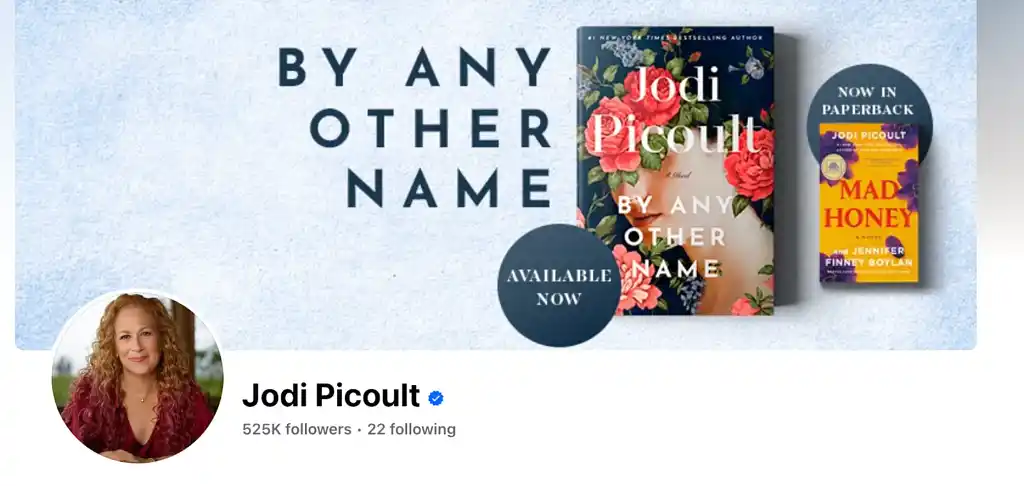
Jodi Picoult’s Author Page features a colorful, professional profile and cover photos that promote her latest releases. She posts feed content on a regular basis — a mix of interviews, personal updates, and reshared videos — and does a great job creating vlog-style videos about her personal and professional pursuits.
Picoult also posts frequently about her author events and giveaways, and asks questions to keep fans engaged. Two more clever touches on her Author Page are the reviews in the sidebar (showing she is “90% recommended”, with over 500 reviews vouching for her) and her social media handles — they’re all the same, which makes it super easy to find her anywhere.

FREE COURSE
Facebook Ads for Authors
In 10 days, learn to boost book sales with targeted Facebook ads.
X for authors
X (formerly Twitter) has undergone more than a mere domain name change recently. Elon Musk’s takeover of the platform in 2024 meant drastic consequences for its bookish community. It’s since fractured significantly, resulting in a 10% decrease in active users year-over-year since Musk acquired the platform.
⚡ Fast facts for authors on X:
X’s bookish community: #amwriting
Popular subgenres: YA, science fiction, horror, romance, fantasy, thriller
Known for: Micro-content and stronger networking potential within publishing
Today, while marketing your book on X alone might not be enough anymore if you want strong sales, many authors still use it alongside other platforms. If you do, too, read on for more X tips!
Find a community
The good news is that Book Twitter, while somewhat depleted, does still exist — if you know where to look. Of course, this will be more true for certain authors than others; some genres and subgenres will naturally have a more active community.
To check the state of your subgenre on X, simply look up some fellow authors and see whether they have active accounts. If so, follow them and start posting!
Once you’re ready to commit to X, it’s a good idea to use relevant hashtags if you’re planning on participating in a certain active community (forget about using them for increased visibility — it won’t work, and even Elon Musk warned against it). Here are a few author-specific ones you can try:
-
#BookTwitter
-
#WritingCommunity
-
#WritersLift
-
#AMWriting
-
#AMQuerying
On top of these, of course, you can add specific hashtags for things like your genre or tropes.
If not X, then…
If X isn’t your shtick, try out other text-based platforms such as Bluesky or Threads. Because they’re all quite similar, your X marketing strategy will be cross-compatible!
Bluesky is a still-small but growing pond, with around 3.5 million daily active users (no data available on monthly active users). Though it’s a nice alternative place to chat, swap book recommendations, and maybe even make a few professional connections with other writers and publishing folks, it’s not (yet) a major platform for book marketing.
You can also check out Threads — since launching in July 2023, it’s scaled quickly, reaching over 33 million monthly active users by mid-2025. For authors, this means there’s a large (and growing!) built-in audience. Also, because Threads is integrated with Instagram, authors can cross-leverage their IG profiles to get a leg up.
X case study: Victoria Chang
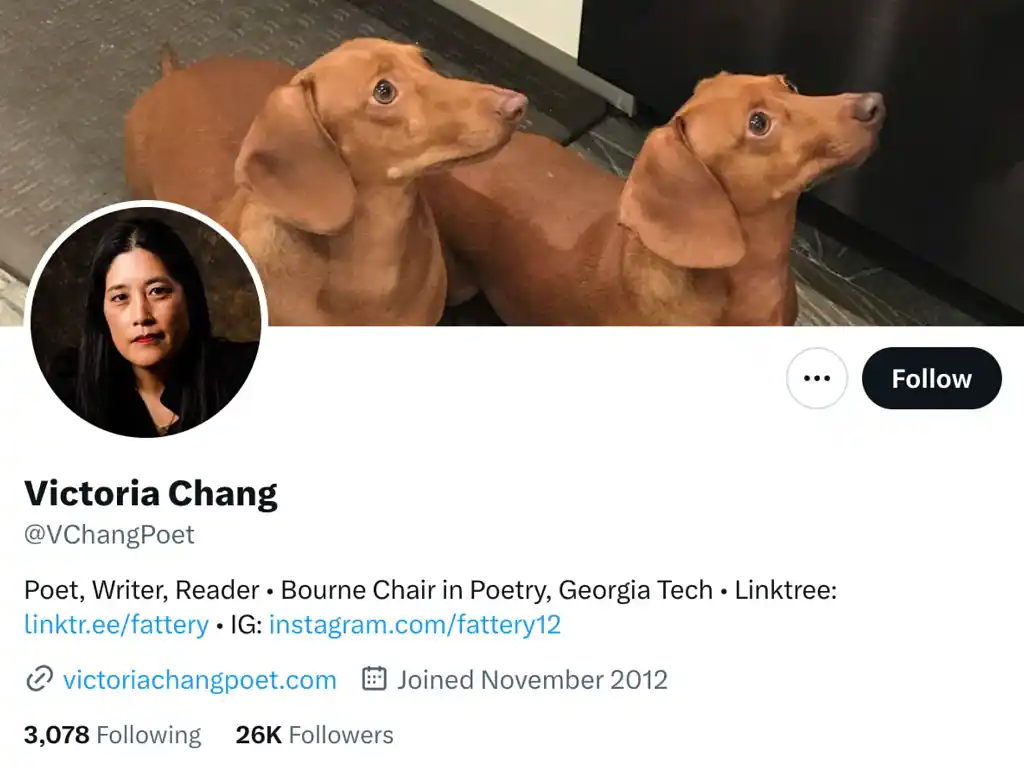 Victoria Chang, renowned poet and winner of the 2020 Los Angeles Times Book Prize, does a fantastic job promoting her work and engaging with her followers on X. Her content is perfectly suited to the platform; instead of purely advertising her work, Chang posts poetry snippets that she finds inspiring, and updates her followers with musings on her day-to-day life.
Chang’s profile header also manages a nice balance of personal and professional. Her cover photo features her two dogs, immediately conveying a dash (or should we say dachshund) of personality. However, she also has a concise, professional bio with all her important links up top — as well as a high-quality professional headshot for her profile picture.
The result is an X profile that takes itself just seriously enough, drawing in readers while impressing them with all that Chang has to offer.
Pinterest for authors
Ah, Pinterest: the “non-social social network” with 87 million users in the U.S., a whopping 20% of whom are women aged 18-24. This platform, which allows you to create your own themed virtual corkboards, is ideal for authors who want to focus on visual content — but without the pressure of needing to constantly engage (as you might on Instagram).
⚡ Fast facts for authors on Pinterest:
No specific bookish community, but users can easily look up their favorite authors
Popular subgenres: Fantasy, sci-fi, romance
Known for: Sharing distinctive aesthetics without the need for heavy social interaction
As you might expect, Pinterest works best for writers in “aesthetic” or atmospheric genres, such as fantasy, science fiction, and romance. And because Pinterest is essentially a search engine, it can be easier for authors to bypass fickle social media algorithms. In fact, author Melissa Bourbon credits Pinterest as her main source of traffic to her author website.
If that sounds right up your alley, here are some tips to give you the Pinterest assist!
Schedule your Pins
Pinterest allows you to bulk-schedule your Pins automatically. This might be a bit time-consuming, but it’s worth the hassle — especially because it gives you more concentrated time for your writing!
Also, crucially, the age of content matters less on Pinterest than on other platforms. A Pin doesn’t need to be topical in order to drive engagement; if anything, for some types of content, longevity is an advantage. Keep this in mind and aim to schedule “evergreen” Pins in advance, rather than trying to respond to what’s trending.
Group your Pins into keyword-rich boards
Instead of throwing new Pins into the void and hoping for the best, create boards (Pins grouped into one place) with “keyword-rich descriptions” to maximize your chances of being seen.
For example, you could group a few different book cover Pins into a Board with a title like “Magical books to read” or “Enemies-to-lovers romance books”. This should significantly increase the chances of your Pins actually showing up in search results.
Use Rich Pins for products and articles
Rich Pins are Pins with data attached that click through to an external page — like the sales page for your book, your author website, or a blog post you’ve written. They’re great for previewing content you’ve posted elsewhere, and many authors use them to promote their free and discounted books.
Get a Business account
Lastly, it’s free to convert your regular Pinterest account into a Business account, and it offers many useful features: analytics, ad management, and more. Even if you only use Pinterest casually, it’s still worth getting the free Business account, as it allows you to have a cover photo.
Pinterest case study: Melissa Bourbon
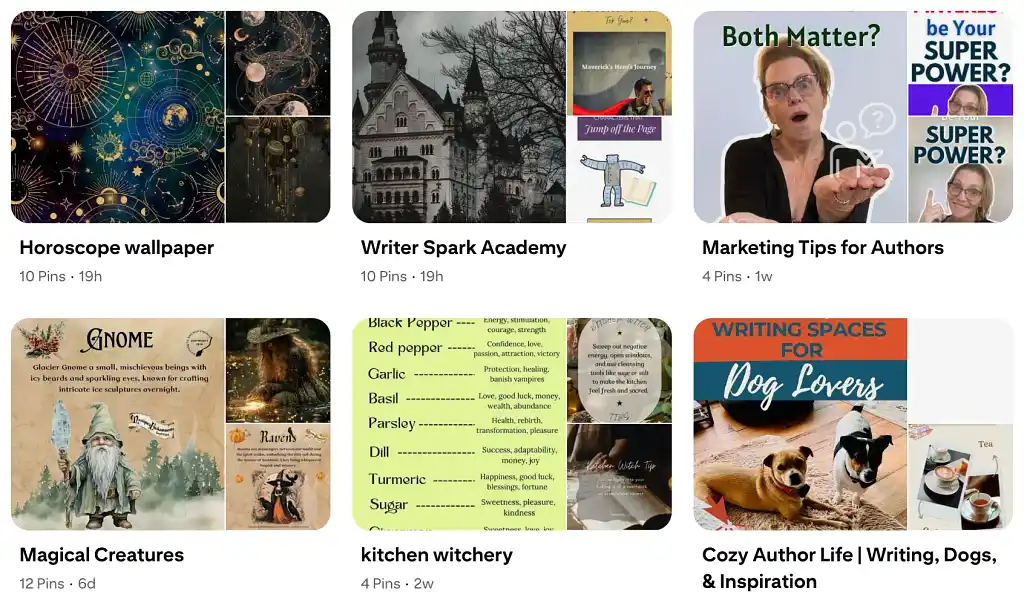 As well as being a successful author, Melissa Bourbon has carved out a career for herself using her Pinterest page, and even educates other authors on how to use the platform. Her page is keyword focused, and each of her (many!) Pinterest Boards feature Rich Pins that link directly back to her Instagram page and author website.
Specifically, Melissa will create Pins for blog posts on her website that she’d like to push — driving traffic to her blog in the hopes of attracting new readers. As well as this, she creates Pins for her book covers, increasing visibility of her work. But it’s not just self-promotion — Melissa makes sure to litter her Pinterest with content from other users that works with her aesthetic. This combination of authentic interaction and efficient marketing means, as we mentioned previously, that Pinterest is responsible for the lion’s share of Melissa’s blog traffic!
Q: What aspects of book marketing should authors focus on learning and handling themselves to save money while promoting their work?
Suggested answer
Social media activity can be a key part of most marketing plans, but many authors struggle to find time for it, or worry that they aren't handling it correctly. It can be really tempting to outsource this. However, if you are working with a book marketer who has experience in the publishing industry, creating both content and social media strategies for author accounts, then for authors early in their career the cost of this service could outweigh the benefits of long-term content creation. Instead, I'd suggest learning a little more about social media strategies for authors, perhaps from those very marketers who you were considering to run the accounts for you.
Although social media can take up a lot of time, it doesn't have to: even spending 30 minutes one day a week to pre-plan your content can give you plenty of posts, and there are free scheduling tools available so that you don't need to come back to the platforms later in the week to post.
Once you've had a go at using social media in your marketing by yourself for a little while, I'd suggest having another check in with a professional to get an audit of your channels, where they can then recommend ways for you to improve in future, to keep you on the right track and keep increasing your sales.
Ailsa is available to hire on Reedsy ⏺

Marketing a children’s book doesn’t have to require a huge budget. Being selective with where you are focusing your efforts, time, and budget will help maximize your return on investment. This can be getting testimonials from an author's own network, mazimizing your discoverability on Amazon through precise categories and keywords, and targeting special interest group for endorsements or bulk buys. For instance, if a picture book is about aviation, contacting aviation museums, organizations, and stores would be a great start. For kids books, reaching educators and librarians is important for word of mouth and for in-person event opportunities. Positive feedback from a teacher or librarians gives a book credibility and validation and lets families know this book is vetted, so to speak, and worth purchasing.
Tara is available to hire on Reedsy ⏺

All of it. If you execute a proper runway to launch program you don't need to spend any money on marketing. The key is to start early. Include people in the creation of the book. Everyone in an author's circles of friends/family/followers should know the book is coming. Once a book has been published, the promotional activities come across as selling. Before a book comes out, all of your promotion is "sharing", and your audience will be far more receptive to that.
Chris is available to hire on Reedsy ⏺
If you’re overwhelmed by all these social strategies (who could blame you?) you might consider hiring a marketing expert to help out. But once you find the right platform(s), get situated within your niche, and start making some friends, you’ll find that using social media as an author is not so much a drag as an exciting new challenge. Here’s to you and your book going viral!