Posted on Mar 23, 2026
Powerful Personification Examples That Bring Stories to Life

Linnea Gradin
The editor-in-chief of the Reedsy Freelancer blog, Linnea is a writer and marketer with a degree from the University of Cambridge. Her focus is to provide aspiring editors and book designers with the resources to further their careers.
View profile →Personification is a figure of speech that gives human qualities — like a personality — to things that aren’t human. Through personification, we can depict something non-human as having free will and independent thought: the wind whispers, the sun smiles, time marches on, and so on.
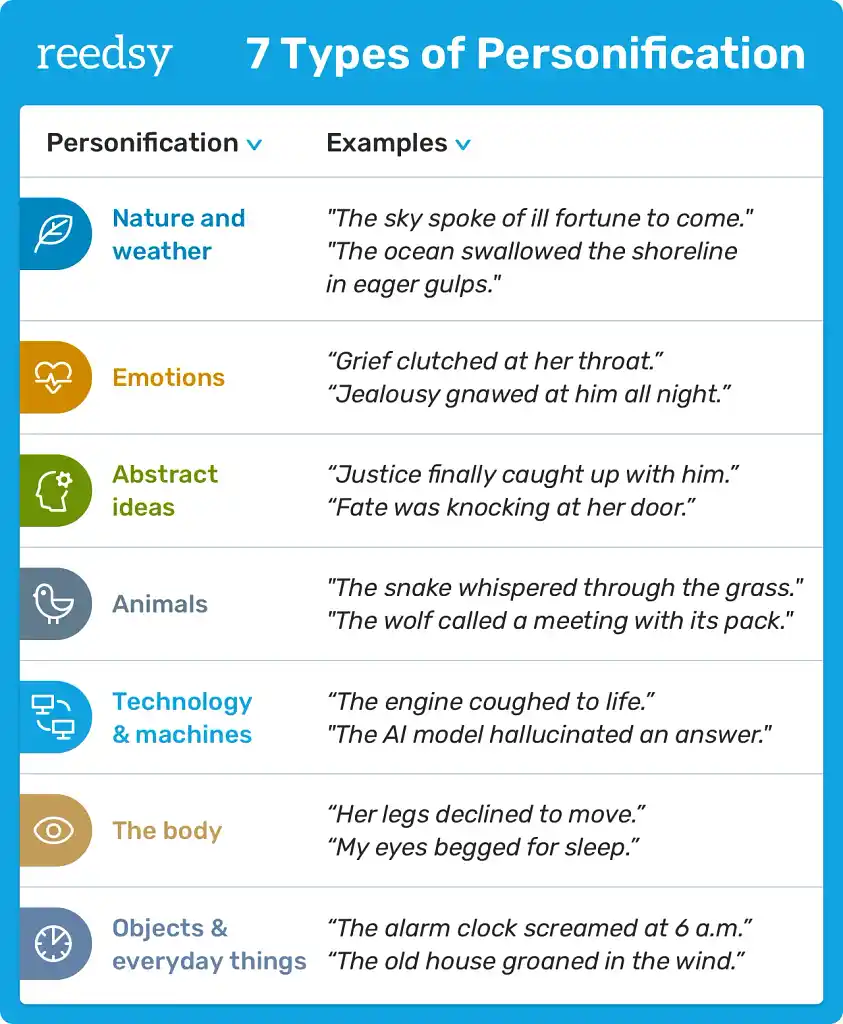
In this article, we’ll go through 7 common types of personification with plenty of examples. Let’s get started: time waits for no one.
Personification of nature and weather
Nature is one of the most common things we personify, especially in literature. For instance, the thunder might roar in the night, or a tree branch might knock on your window.
By using verbs that imply agency and emotion when describing natural objects and forces, authors can make scenes feel more vivid and atmospheric. This adds symbolism and sometimes even foreshadowing to the writing.
Compare this to more passive verbs that lack intent or active choice:
Passive: The ocean waves lap the shore.
Active: The ocean swallowed the shoreline in eager gulps.
In the first sentence, the ocean waves have no particular personality or will, they simply move. In the second sentence, on the other hand, it’s implied that the ocean has an appetite and desire of its own.
Nature as a mirror to inner conflict 🪞
Personified nature often reflects the inner turmoil of characters. This is also known as pathetic fallacy (so called because John Ruskin, who coined the term, considered it a weak form of descriptive writing).
Instead of writing “her grief was terrible,” for example, an author might use the character's surroundings to capture the nature of her emotions (see what I did there?):
As she tried to process what had just happened, the sky tore open and the wind howled through the underpass.
Without explicitly linking the character’s feelings to the weather, destructive verbs like tore and howled help establish the mood of the scene. It’s as if the weather is responding to and mirroring what is happening in the story and inside the character. Nothing pathetic about that.
Nature as a symbol of external conflict 🪨
Similarly, a writer might personify nature to symbolize the external conflicts in a story. Take Wuthering Heights, for example. The wild moorland partly reflects the emotional intensity of the characters. At the same time, it also nods to the circumstances — or external conflict — that threaten their happiness.
For example, during storms, the environment seems almost alive:
"The storm came rattling over the Heights in full fury."
The wind and weather feel aggressive and volatile, mirroring both Cathy’s inner turmoil and the societal restrictions that prevent her from marrying Heathcliff. Through their experiences of poverty, abuse, and oppression, Catherine and Heathcliff are shaped by the hostile emotional and physical landscape in which they grow up.

Nature as a witness to human folly 🤡
Serving as a backdrop to human life, nature can easily slip from passive observer to active participant. There are countless examples of this literary device in action. Take the following lyrics:
Will the wind ever remember?
The names it has blown in the past
And with its crutch, its old age and its wisdom
It whispers "No, this will be the last"
And the wind cries Mary
— 'The Wind Cries Mary' by Jimi Hendrix
Here, the wind is given memory, age, and wisdom. Most strikingly, in the last verse, it whispers a response: “No, this will be the last.” This personification reinforces the song’s wistful tone, while highlighting how petty and small human beings are in the grand scheme of things.
Q: What techniques can authors use to personify nature and make it feel like an active character in their story?
Suggested answer


Write it so it feels like it has agency of its own—not like it actually does, but just so it feels like if it wanted to exert some form of will on the human characters, it could. That's a little nebulous, I know, but it's neither an easy thing to do nor describe. 🙂
Brett is available to hire on Reedsy ⏺
Personification of emotions
Another thing that writers frequently personify is emotion. Feelings like fear, hope, love, or regret don’t have a physical form, so personification can help readers understand them better.
As with personifying nature, the trick lies in choosing verbs that feel intentional and evocative. Fear might creep, and anger might rage, to name just two examples.
Emotions as characters 🎭
Writers often personify emotions by turning them into characters in their own right. This allows abstract ideas to interact with other figures as if they, the ideas, were flesh and blood.
Here’s an example from the poem ‘“Hope” is the thing with feathers’ by Emily Dickinson:
“Hope” is the thing with feathers –
That perches in the soul –
And sings the tune without the words –
And never stops – at all –
Here, Dickinson depicts hope as a feathery thing (which technically makes it zoomorphism) that lives inside the speaker and keeps singing despite hardship. While not exactly human, it becomes a creature that acts independently — arguably against the better judgment of the person experiencing it.
Need help making bringing your poems to life through personification? A copy editor who specializes in poetry can help you.
Hire an expert

Angela Yuriko S.
Available to hire
Publishing coach, multi Bram Stoker Awards® Winner+, publisher of Space & Time and Authortunities on Substack.

Michael M.
Available to hire
Editor and consultant. Theology, spirituality, philosophy, and literary works (poetry, fiction, sci-fi/fantasy). Worked with Angelico Press.

Dakota R.
Available to hire
Seasoned editor & published writer with a passion for literature & language—in particular: poetry, essay collections, & children's books
In the Bible, love is also given human characteristics:
1 Corinthians 13:4-7
Love is patient, love is kind.
It does not envy, it does not boast, it is not proud.
It does not dishonor others, it is not self-seeking, it is not easily angered, it keeps no record of wrongs.
Of course, the implied message is that lovers are patient and kind, do not envy or boast, and so on. But by ascribing these traits to love itself, this popular wedding verse reminds us that the institution of marriage — and love itself — is bigger than any individual.
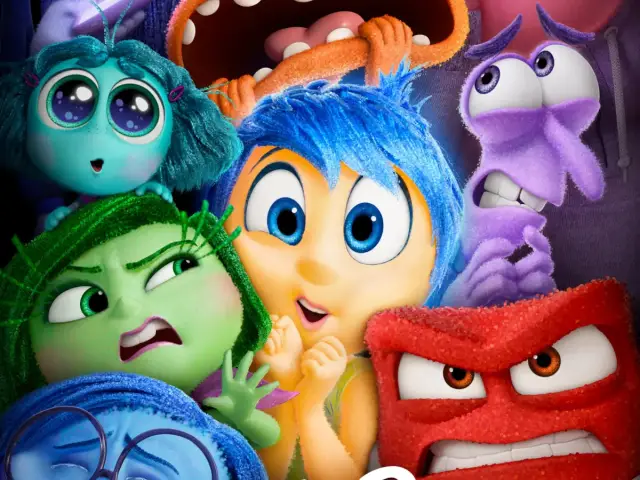
For an even more overt example, take the Disney Pixar movie Inside Out. In this film, human emotions like joy, anger, and sadness have been turned into literal characters that live inside the young protagonist’s head. From there, they influence all of her decisions and reactions to the outside world.
Emotions as physical forces and sensations 💥
Writers also sometimes personify emotions to make them feel yet more powerful and overwhelming — again, similar to natural forces. It might sound something like this:
Grief clutched at her throat.
Jealousy gnawed at him all night.
Fear arrested her where she stood.
These verbs (clutched, gnawed, assaulted) turn emotions into active, tangible outer forces that directly impact a character’s behavior.
Another emotion that often manifests (in literature and life) as a physical sensation is guilt. In Act 5, Scene 1 of Macbeth, for instance:
Out, damned spot! out, I say!
…
What, will these hands ne'er be clean?
In this now-famous depiction of guilt, Lady Macbeth imagines blood stains that she simply cannot scrub away. It is the bloodstains that haunt her, not her conscience. But of course, the former is a representation of the latter. Guilt thus manifests as a physical sensation, making her feel dirty and deeply unsettled by what she’s done.
Personification of abstract ideas
Personification is also a great way to make other abstract ideas, not just emotions, more tangible. Some of the most common concepts to be personified include time, death, justice, fate, and fortune:
Justice finally caught up with him.
Fortune smiled on the young inventor.
Fate was knocking at her door.
Among all these concepts, time and death are perhaps the most frequently personified. Let’s take a closer look at time, specifically.
Time as an unstoppable force ⏳
Time is one of the most personified ideas in literature, and beyond. We have probably all used personification to describe the feeling of time slipping through our fingers. It marches on relentlessly, steals, and ravages; it has no mercy and knows no respite.
The Rolling Stones capture this idea well in 'Time Waits for No One':
Time can tear down a building or destroy a woman's face
Hours are like diamonds, don't let them waste
Time waits for no one, no favors has he
Time waits for no one, and he won't wait for me
Here, time is a maleficent actor, destroying everything it comes across. In other words, it is acting independently of human interests.
Another famous example appears in Alice’s Adventures in Wonderland by Lewis Carroll. During the Mad Hatter’s tea party, the Hatter explains that time is someone to interact and work with, rather than against:
Alice sighed wearily. "I think you might do something better with the time," she said, "than wasting it in asking riddles that have no answers."
“If you knew Time as well as I do," said the Hatter, "you wouldn't talk about wasting it. It's him."
“I don't know what you mean," said Alice.
“Of course you don't!" the Hatter said, tossing his head contemptuously. "I dare say you never even spoke to Time!"
“Perhaps not," Alice cautiously replied: "but I know I have to beat time when I learn music."
“Ah! That accounts for it," said the Hatter. "He won't stand beating. Now, if you only kept on good terms with him, he'd do almost anything you liked with the clock.”
In this scene, time is treated as a temperamental acquaintance. The Hatter claims that because he quarreled with Time, the clock is permanently stuck at six o’clock — hence the endless tea party. This playful personification reinforces the surreal logic that defines Wonderland.
Similarly, death is frequently given a human face throughout literature and media, which leads us to…
Death with a human face 💀
Instead of describing death as a biological event, authors and artists frequently portray death as a character who arrives, waits, or guides people into the afterlife. This makes death seem simultaneously more eerie and understandable. For example:
Death knocked quietly at the door.
Death waited patiently in the shadows.
Death came for him in the night.
Two well-known, contemporary examples of this appear in The Book Thief by Markus Zusak and the Arc of a Scythe trilogy by Neal Shusterman.
In the former, Death serves as the narrator, reflecting on the lives he witnesses during World War II. By giving Death a voice and perspective, Zusak transforms a frightening concept into a contemplative observer of human failure and triumph.
In Arc of a Scythe, meanwhile, death is personified through the institution of Scythes: humans tasked with ending lives in a society where natural death has been eliminated.
Here is another famous example from Emily Dickinson:
Because I could not stop for Death –
He kindly stopped for me –
The Carriage held but just Ourselves –
And Immortality.
— ‘Because I could not stop for Death’
In this poem, Death is a chivalrous gentleman who arrives in a carriage and ushers the speaker into it. This personification softens the subject, while also making it more haunting.
Q: What's the best piece of writing advice for an author who wants to improve their craft?
Suggested answer

Join critique groups! These were invaluable to me when it I started writing and even taught me how to edit! Reading books will become dated with old advice, so stay up to date with blogs, trends, audiences, and read, read, read!
Stephanie is available to hire on Reedsy ⏺

Practice and read!
In the same way that you need to practice a musical instrument to get better, you need to do the same with writing too. Very few writers will publish the first book they ever write!
The other thing that will help you to improve your writing craft is reading. Read the books that are selling well in your genre right now, not just the bestsellers from a decade ago. Study them. Look at the reviews for these books and listen to what readers are saying.
There are loads of brilliant books that will help you to write an effective novel as well (Into the Woods by John Yorke, The Science of Storytelling by Will Storr, Story Genius by Lisa Cron and Save the Cat Writes a Novel by Jessica Brody are a few of my favourites). Even if you don't agree with everything they say (I don't necessarily agree with every piece of advice in the above!) it's so helpful to see a range of different perspectives. You'll also quickly be able to see the patterns and advice from these books in the bestsellers you read. There are also loads of podcasts, blog posts, YouTube videos and audiobooks out there too, as well as Reedsy's own masterclasses!
Siân is available to hire on Reedsy ⏺

Read, read, read. Whatever you're reading, it will help you improve your craft, and you'll grow more discerning as you keep writing and reading. Make sure, though, that at least some of what you're reading is contemporary--if all you're taking in was written in the 18th century, your prose/style is going to end up sounding dated and out of place to readers.
After reading, you just have to keep writing, 'Practice makes perfect' may not be entirely true when it comes to any art form (because perfection is, arguably, impossible in these areas), including writing, but practice does make for consistent improvement.
When you feel you're ready, finding a critique partner and exchanging feedback, or even slush reading for a journal or magazine, can also be incredible experiences that will improve your craft. These experiences take even more time and commitment to your craft, but they're a great way to see what other people are doing and learn more about your craft.
Jennifer is available to hire on Reedsy ⏺
Personification of animals
Personifying animals is another standard form of personification. This is also often referred to as anthropomorphism or zoomorphism: the act of ascribing human traits to non-human objects and creatures. And indeed, because animals are already animate, you only need to give them a little more agency. If you’re a pet owner, chances are (not to call you out) you do this on a daily basis already whenever you talk to your beloved furry friend or attribute human emotions to them.
In literature, however, anthropomorphism is a way to explore human behavior from a new perspective. It’s even common to see whole books or stories center around animals as stand-ins for humans. Take Watership Down by Richard Adams or Animal Farm by George Orwell, for example. In these books, the animals are developed just as human characters would be.
FREE COURSE
How to Develop Characters
In 10 days, learn to develop complex characters readers will love.
Let’s look at a few other examples of animal personification.
Animals as stand-ins for human traits 🦊
Some of the oldest instances of animal personification appear in fables. In Aesop's Fables, animals regularly talk, boast, argue, and scheme like humans. In fact, the whole point is to display human traits in funny and digestible ways.
In The Tortoise and the Hare, the hare becomes overconfident and arrogant while the tortoise patiently perseveres and wins the race. The moral of the story is that we shouldn’t overestimate our own abilities. The animals act like human characters, allowing Aesop to communicate this lesson in a simple and memorable way.
Animals to convey social and political allegories 🐖
As we touched on, another common use for animal personification is to deliver more serious messaging. In Animal Farm, farm animals take on human roles to represent different political ideologies.
The pigs organize a revolution, write laws, and gradually become the same type of authoritarian rulers they originally overthrew. By personifying animals this way, Orwell creates a powerful allegory for the corruption of political power, while keeping the story accessible.
Animals in children’s stories 🎬
Of course, personified animals also appear frequently in modern films and children’s literature. Movies like Zootopia and The Lion King obviously feature animals that speak, reason, and form societies much like humans do.

Authors often use animal characters to write children’s stories, exploring themes such as prejudice, leadership, and responsibility. Because animals are slightly removed from real-world social groups, they allow writers and filmmakers to tackle complex topics in a way that feels innovative rather than heavy-handed.
By personifying animals in this way, storytellers can reflect human strengths, flaws, and social dynamics — sometimes more clearly than if they used human characters alone.
Q: How do I write characters that children can relate to?
Suggested answer

Child readers are just like adult readers – they want to read about characters that seem alive and three-dimensional. Make sure when telling your story that you aren’t just describing what happens to the characters, but showing their thoughts and feelings throughout the events that take place.
It’s always good to think about the specific age range you are writing for when considering what emotions your characters might be experiencing and what problems they would encounter. Younger children might be thinking more about their family and new experiences, whereas older kids and teens could be navigating relationships with friends or struggling with issues at school.
Even when the setting is more fantastical, it doesn’t stop you from finding things a reader might relate to. Perhaps a character discovers they have magical powers or is the heir to an ancient kingdom. They might still be worried about learning how to use a sword, excited to explore a new world, or afraid of a villain hurting those close to them.
Another tip is to be wary of making your characters too perfect! Especially when writing for older children, remember that kids can:
- Be jealous of others
- Make impulsive decisions
- Get angry or grumpy
- Crack jokes and poke fun at things
Relatable characters won’t always do the right thing in every situation, and having them learn, grow, and make mistakes is part of telling a captivating story.
Humour is also a great tool for showing personality and making your characters seem more well-rounded. Think about what a child might find funny when placed in a new situation. What are the things that would make your characters laugh?
Overall, always remember to treat each character as a unique individual with their own quirks and flaws, just like you would with adult characters.
Vicky is available to hire on Reedsy ⏺
Personification of technology and machines
Anyone who’s ever read sci-fi will know that personified technology is a staple of the genre. But it’s not just a quirk of sci-fi; personified technology is embedded in everyday expressions too:
The engine coughed to life.
The algorithm decided what we should see.
The AI generator hallucinated an answer.
In each case, machines appear to choose, resist, or react as if they were human.
Machines with personalities 🤖
Science fiction often portrays technology as having its own personality or intentions — sometimes in direct opposition to actual humans.
A famous example can be found in 2001: A Space Odyssey, where the onboard computer HAL 9000 calmly speaks to astronauts and ultimately acts according to its own logic. The story treats the computer as if it were a thinking, feeling entity.
This kind of personification of technology raises questions about control, responsibility, and trust in machinery, often culminating in dystopic visions of society.
Everyday speech and modern language 📱
Personification of objects is also extremely common in everyday language, especially when it comes to modern technology. We will say things like:
My phone is refusing to cooperate.
The computer decided to crash today.
The printer is being stubborn.
These expressions show how naturally we attribute human qualities to the objects around us. Even outside of literature, personifying everyday things helps us express frustration, humor, or familiarity in an instantly coherent way.
Personification of the body
We also frequently personify parts of the human body to describe emotions, instincts, and physical reactions more vividly. Instead of simply stating how we feel, we give body parts their own intentions or behaviors. For example:
His stomach protested loudly.
Her legs declined to move.
My eyes begged for sleep.
This kind of body personification conveys internal experiences in a way that feels much more immediate and descriptively colorful.
The body reacting to emotion ❤️
Many expressions that personify the body relate to emotional responses. From hearts leaping with joy to minds racing, these descriptions create an immediate link between physical and emotional experiences.
In Jane Eyre by Charlotte Brontë, Jane frequently describes her heart as reacting of its own accord: jumping, trembling, or shrinking in moments of fear and passion. This allows readers to feel what she is going through, rather than simply being told about it.
Personification of objects & everyday things
Lastly, not all personification in literature involves grand forces like nature or death. Writers frequently personify ordinary objects and everyday things, too:
The alarm clock screamed at 6 a.m.
The old house groaned in the wind.
The car complained as it climbed the hill.
This technique brings familiar settings to life and makes descriptions more vivid. It can be just a passing sentence, or an extended metaphor across a longer story. You can even find stories that centre around inanimate objects come to life, like in Beauty and the Beast, where we encounter talking clocks and teapots.
Objects fostering atmosphere 🏚️
Personified objects are often used to reinforce the mood of a setting. When used effectively, a building or room can feel truly alive.
In The Haunting of Hill House by Shirley Jackson, for instance, the house itself seems to possess a disturbing presence. The opening famously describes Hill House as a place where even the architecture feels watchful and oppressive.
Through descriptions of creaking doors, shifting shadows, and walls that seem to lean inward, the house takes on the personality of something hostile — amplifying the story’s psychological tension.
FREE COURSE
Show, Don't Tell
Master the golden rule of writing in 10 five-minute lessons.
Objects as companions or witnesses 🪑
Objects can also be personified more subtly, acting as gentle companions to human life.
In The Old Man and the Sea, the old fisherman frequently speaks to the objects around him — his fishing lines, the boat, and the sea itself — as if they were partners in his struggle. By giving these everyday things a kind of implied personality, the narrative emphasizes the fisherman’s isolation and resilience.
By giving human traits to emotions, ideas, animals, or even machines, personification helps writers turn the abstract, the distant, and the ordinary into something vivid and relatable. Once you start noticing it, you’ll see personification everywhere — from classic literature to everyday conversation.