
Blog • Understanding Publishing
Last updated on Mar 06, 2026
How To Write a Book Synopsis: Complete Guide & Examples

Dario Villirilli
Managing Editor of the Reedsy blog, Dario is a graduate of Mälardalen University. As a freelance writer, he has written for many esteemed outlets aimed at writers. A traveler at heart, he can be found roaming the world and working from his laptop.
View profile →A synopsis is a 1–2 page document that lays out your book’s full narrative arc from opening to ending. It introduces the setting and main characters, then guides the reader through every major plot turn — from the inciting incident to the climax and resolution — spoilers included.
Literary agents and publishers use it to quickly assess whether your manuscript is structurally sound, coherent, and ready for the market.
In this guide, we’ll walk you through how to write a strong synopsis step by step, with a practical example. But first, let’s cover a few best practices to keep in mind.
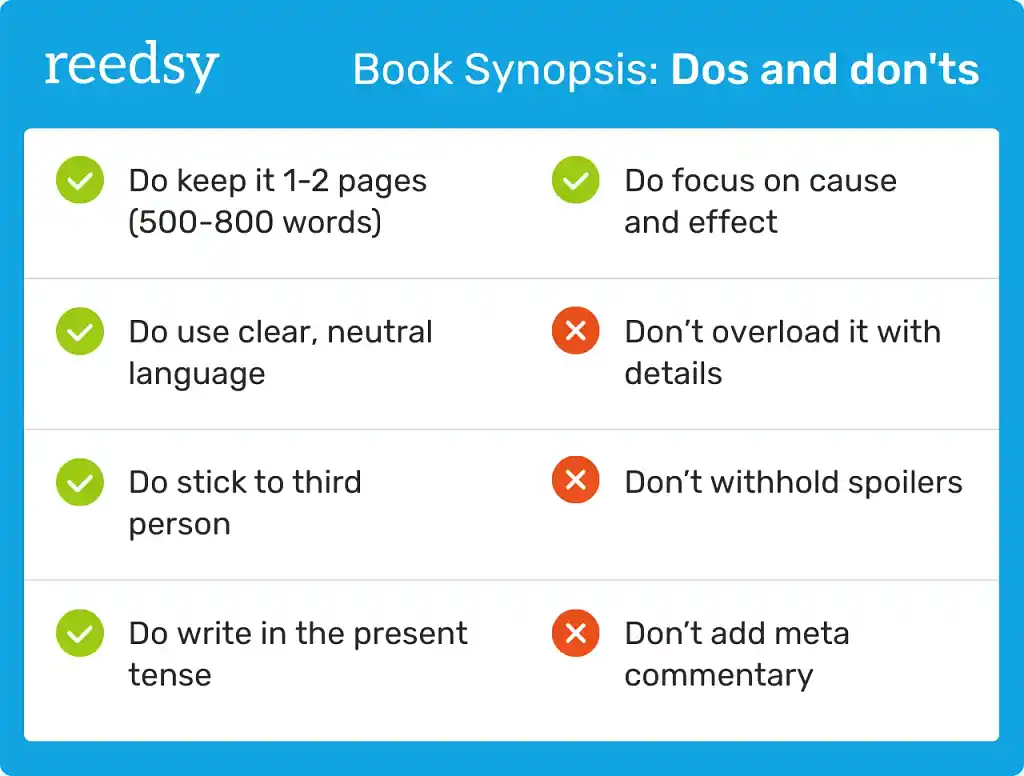
Keep in mind that the synopsis we’re discussing here is the longer version typically sent alongside your query letter — which usually also contains a mini-synopsis of around 250 words. Depending on the agent's submission guidelines, you may be asked for the full synopsis as part of the “query package” or later on in the process.
Now that we’ve defined what a synopsis should (and shouldn’t) do, let’s dive into how to write a compelling one.
Q: What genres are most in demand by agents and publishers right now?
Suggested answer


Publishers and agents are especially drawn to genres that combine commercial appeal and emotional resonance at the moment. Contemporary romance and romantasy are hot thanks to dedicated reader bases and BookTok buzz. Psychological thrillers and domestic suspense continue to be top sellers, providing maximum suspense with relatable stakes.
On the nonfiction front, memoirs with a strong hook or new voice, and self-help that is accessible and drawn from lived experience, are in demand. Upmarket fiction, such as, novels with literary merit and page-turning plots, remains in demand too since it sells to book clubs and readers in the mainstream. Ultimately, publishers want strong voices and new spins on familiar categories, so a market-aware idea with a strong concept is needed regardless of genre.
John is available to hire on Reedsy ⏺
How to write a synopsis
Condensing an entire novel into a page or two is tough (even for seasoned writers!), and there’s no single formula to follow. But since a synopsis is all about conveying your main narrative arc, your story structure can do much of the heavy lifting. Anchor your summary to your key plot points, and the whole process becomes far more manageable.
For this example, we’ll break down Gillian Flynn’s Gone Girl by tracing its plot through the key beats of the classic three-act structure. Take inspiration from it when composing yours. (Beware: major spoiler alert!)
1. Opening Image/Hook
Start with a compelling image that conveys the premise and tone. This isn’t a full story beat yet 一 just a way to orient the reader before you move into a more formal, step-by-step account of the plot. Many writers set this line apart in italics to clearly mark it as the opening snapshot.
On the morning of Nick and Amy Dunne’s fifth wedding anniversary in small-town Missouri, the picture of domestic life curdles fast. Amy is missing, the house shows signs of a struggle, and the town’s curiosity starts turning into a hungry, public spectacle.
This opening quickly grounds us in the setting and introduces central characters, while simultaneously planting the core mystery that drives the story.
2. Exposition
Once you’ve set the scene, lay some groundwork using exposition. This establishes the world and relationships before conflict disrupts them. Your goal is to clearly show who the characters are, where they stand at the outset, and what they want.
After losing their New York jobs in the recession, Nick and Amy Dunne move to Carthage, Missouri, to manage financial strain and care for Nick’s ailing mother. Nick runs a bar with his sister while trying to project the image of a reliable husband. Amy — the real-life inspiration for her parents’ “Amazing Amy” books — resents her new life as a housewife in the suburbs. Though their marriage is strained, both remain committed to maintaining the appearance of a happy, intact couple.

3. Inciting Incident
Next comes the disruption that demands action — the moment that pushes your protagonist out of their normal life and into the central conflict.
The day Nick returns home to find Amy missing, the police quickly suspect foul play. Media swarms in and Nick is pushed from a private crisis into public scrutiny. Amy’s parents arrive and reinforce the image of Amy as a flawless, beloved daughter. Nick mentions Amy’s annual anniversary “treasure hunt,” a ritual that soon becomes central to the case as detectives follow the clues she left behind.
4. Plot Point One
This is the turning point where your protagonist can no longer remain passive. Something shifts, and they are forced to actively engage with the central conflict rather than simply react to it.
The investigation turns sharply toward Nick. Amy's diary, discovered by police, chronicles a marriage marked by fear and escalating abuse. A neighbor reports that Amy was pregnant. Financial records reveal massive credit card debt in Nick’s name, and traces of blood are found in the house. Nick needs to fight back.
5. Rising Action
Next, focus on the rising action — a chain of complications that intensify the conflict and raise the stakes. Each new development should make your protagonist’s goal harder to reach and the consequences of failure more severe.
When Nick's affair with a twenty-three-year-old former student becomes public, the court of public opinion delivers its verdict. Nick is no longer a concerned husband; he is the prime suspect in what the world now treats as a murder.
Nick hires Tanner Bolt, a defense attorney famous for saving guilty-looking husbands. But evidence keeps mounting: a staged crime scene, cleaned blood traces, a recently increased life insurance policy. Amy's parents withdraw their support. The media tightens its grip. Nick appears to be losing on every front.
6. Midpoint
The midpoint usually delivers a major revelation or reversal that reframes everything the reader thought they knew. This is often where the story’s direction shifts, either through a shocking discovery, a false victory, or a major setback.
Amy is alive. She has orchestrated everything — the crime scene, the diary, the planted evidence, the faked pregnancy — to frame Nick for her murder. Her plan: watch him get convicted, then drown herself so her body is never found, sealing his fate. Her motive is revenge — for his infidelity, for years of being taken for granted, and for realizing he never loved her, only the perfect-wife performance she had exhausted herself maintaining.

7. Plot Point Two
Next is the story’s point of no return — often called the “dark night of the soul.” Events spiral beyond your protagonist’s control and drive the narrative toward its emotional peak.
Amy's plan unravels when she's robbed at the cabin where she's hiding. Desperate, she contacts Desi Collings, a wealthy ex-boyfriend still obsessed with her. Desi hides her in his lake house but becomes possessive and controlling, trapping her in a different kind of cage.
Meanwhile, Nick realizes he has been framed and begins working with his lawyer to manipulate media perception. On a national talk show, he performs contrition and devotion so convincingly that Amy, watching from Desi's house, decides to return — not to destroy him, but to reclaim him.
8. Pre-Climax
This stage builds even more tension and leads directly into the final confrontation.
Amy murders Desi and stages evidence that he kidnapped and assaulted her. She returns to Carthage with a compelling story of survival that satisfies the media and public. Although the police suspect inconsistencies, they lack proof to challenge her account.
9. Climax
Finally, you reach the climax: the story’s most intense moment, where the central conflict reaches its peak and your main dramatic question is answered (even if the answer is unsettling, like in this case).
Amy collapses into Nick's arms before the cameras, presenting herself as a woman who fought her way home. Nick is cleared. But he knows the truth, and he has no proof. Amy’s planning is meticulous and her story airtight.

10. Denouement
To conclude, the denouement establishes the new normal. Here you show how your characters lives with the consequences of everything that has happened.
Nick privately begins writing an exposé of Amy's deceptions. Amy uses Nick's semen, which they had saved at a fertility clinic, to inseminate herself, and forces him to delete his book by threatening to keep him from their unborn child. Nick complies, dedicating himself to the role of a perfect husband. Publicly, the Dunnes become a story of love and survival. Privately, their marriage — and their future — looks bleaker than ever.
Why this synopsis works
This synopsis clearly lays out the story’s narrative arc: it establishes what the main characters want (to be the Cool Girl and the Good Guy, locked in a perfect marriage), then traces the key steps that lead them there (or don’t) by the end. In this story, they technically succeed, but at a devastating cost and with a chilling prospect ahead, making this a classic negative character arc.
The synopsis also stays focused on the main narrative spine. Details like the fact that Amy funded the move and Nick’s bar with her trust fund, or side characters such as Detective Rhonda Boney, are left out because they don’t directly affect the story’s final outcome. The same goes for smaller, flavorful elements, like Nick’s unpublished book about Amy titled Psycho Bitch. Funny, but not essential to the core arc.
At around 640 words, this synopsis fits comfortably within industry norms. In practice, it’s often useful to have more than one version on hand — a slightly longer one with extra texture, and a tighter one for situations where space is limited.
It’s also worth noting that not every story will slot neatly into a textbook Three-Act structure. You might find that some of these plot points blur together, arrive earlier or later than expected, or don’t exist as clearly defined “moments” at all. That’s completely fine. What matters most is that your synopsis flows logically, that each event grows naturally out of the last, and that it faithfully represents the main narrative spine of your story.
Q: What are the most common mistakes authors make in their query letters, and how can they improve them?
Suggested answer

One of the most common issues I see in query letters is the tendency to skip over who your main character is as the book starts. You want to show the agent who they’re going to be reading about and give the agent a reason to care about what happens to them. That’s your first paragraph (not including personalization or comp titles if you choose to put those at the top). Spend two to three sentences describing your character, their personality, their future plans, their desires, etc. That way, when the agent gets to the second paragraph and you throw chaos into the picture, they’re already thinking, Wow. How’re they going to deal with that?
Example:
Sixteen-year-old farm boy Luke Skywalker would do anything to leave his uncle’s dinky desert farm and attend fighter school with his friends. The evil empire is rising, and he wants to do his part to make the galaxy safe. But until his uncle agrees to foot the bill, Luke’s stuck cleaning the farm’s droids, a far cry from the adventure he seeks.
With an opening like this, you’ve established who we’re rooting for, his desires, and his ultimate goal. In the next paragraph, you can then drop the inciting incident, i.e. the thing that gets the story rolling.
Example:
Mary Collins is free of her wretched husband, their divorce finalized after a grueling three years where he fought her on every detail. Finally, Mary can leave the city where it was so important they live and return to her hometown. Helping her mom run the corner store while catching up with friends and family is the bliss she seeks as she starts over, now free of the myriad of obligations that came with being the governor's wife.
My guess is that Mary's going to find she's not so free of her past life once that second paragraph comes around. But because we know that's her desire/goal, it makes it that much more meaningful when the query then continues to throw havoc her way.
Giving us info about the character is important no matter your genre and age category.
If your book features a police officer, give us a bit of their background so we understand their current situation. That way, when chaos reigns, we know why that particular wrench is so bothersome. If a cop is trying to get promoted, being thrown into a big case is a dream/chance to show off. If a cop is near retirement, the last thing they want is to be trapped in a big case. Without knowing the main character’s background, your query is all about plot and you’re losing the character.
Agents, like readers, want to root for someone. They want to become invested in your character—so give it to them. Show them who they’ll be reading about and make them care. Then in the rest of the query, you can weave in those plot details and stakes.
Kim is available to hire on Reedsy ⏺

I like seeing the title, genre and comp titles at the top. Often, writers hide this info in the final paragraph. I want to know immediately what this book is and what it's about, along with where it could sit in the market. It quickly tells me if this book is for me and if the author even knows what their book is about.
Another misstep is writing far too much in your plot paragraph. It really should only be 1-2 short paragraphs. Think plot/premise/payoff. This is probably the hardest part for writers. You are very close to your own work and might feel overwhelmed by condensing the entire narrative into a handful of sentences. When I receive a query, I'm looking for your main character, their world, what has changed in their world, twists or turns along the way, and even a question you might have for the reader.
For bonus points, add a logline before your plot paragraph(s). It's an efficient way to hook the person you're querying.A query letter should be no more than one page. Finally, look up the agent or editor's name and address it to them with the correct spelling. First names are preferred. It feels old-fashioned to address a query with Mr, Mrs, Ms, etc.
Ariell is available to hire on Reedsy ⏺

A lot of query letters are too long. An agent will spend perhaps one minute scanning through your query letter, so make it easy for them to find the important stuff. And don't spend too much of your word count on the summary! The goal isn't to tell the agent everything that happens in the book; the goal is to mention enough selling points and hooks that the agent is intrigued and starts reading your sample pages. This means one, maybe two paragraphs of summary, in the basic format: "[Protagonist] wants [motivation], but [obstacle] gets in the way. They'll have to [challenge] if they're ever going to achieve [stakes]."
Nora is available to hire on Reedsy ⏺
Polish your synopsis with the help of editors
Your synopsis is a key part of your querying efforts, so it’s worth making it as clean and airtight as possible. If you’re unsure about tone, flow, or what level of detail to include, working with a professional editor can make a real difference. Pay close attention to the kinds of suggestions they offer — word choices, transitions, and which details to emphasize or cut. Those are often the same things agents will notice when they read.
Hire an expert

Helen L.
Available to hire
Literary Agent and Developmental Editor. I represent incredible authors at Ki Agency. My editorial focus is on Fantasy, Sci Fi and Romance.

Kesia L.
Available to hire
YA fiction Commissioning Editor (Macmillan UK) with 9 years of in-house middle-grade/YA fiction editorial experience. Author, former agent.

Joe P.
Available to hire
Thorough. Friendly. Experienced. Punctual. I'm here to help you take your writing to the next level. Free sample edits available.
With a strong story and a clear structure to guide you, your synopsis becomes less of a chore and more of a tool: a concise, confident proof that your novel delivers on its promise. Happy querying!







2 responses
Elizabeth Westra says:
12/09/2018 – 22:10
This looks interesting, and I will read every word, but this would be different for a picture book. You only get one page to query for many children's books.
Dorothy Potter Snyder says:
14/10/2018 – 20:11
I am curious if anyone has ideas on how translators can write a synopsis for agents / publishers of works in translation? Might there be something about why this author is important in his/her country of origin and literary tradition? Which authors more known to English language readers might relate to this author (they've never heard of before)?