Blog • Understanding Publishing
Last updated on Jul 02, 2026
How to Get a Book Deal in 2026: Agents, Advances & More

Martin Cavannagh
Martin Cavannagh is a publishing professional with 10+ years of experience in content strategy, editorial development, and author education within the indie publishing space.
View profile →
Linnea Gradin
Linnea is Editor-in-Chief of Reedsy’s Freelancer Blog, with 6+ years of experience collaborating with experts to create resources on writing, self-publishing, and publishing careers.
View profile →From polishing your manuscript to negotiating the final contract, getting a book deal takes work, but is far from impossible. To prove it, this post delves into the publishing journey of Fiza Saeed McLynn: a Reedsy author who landed an agent and a six-figure contract with Penguin for her debut novel, The Midnight Carousel.
In this post, we'll look at how Fiza made it happen, explain what a "book deal" actually involves, and walk through the practical steps you can take to land one yourself.
Note: This post focuses on fiction writers. If you’re writing nonfiction, you’ll need a book proposal. Check out our dedicated guide to learn more about that.
1. Know what a book deal entails
In traditional publishing, a book deal isn’t just a publisher liking your book and agreeing to print it. It’s a formal contract that outlines how your book will be produced, sold, and paid for, as well as how the earnings will be divided.
A book deal typically includes three key elements:
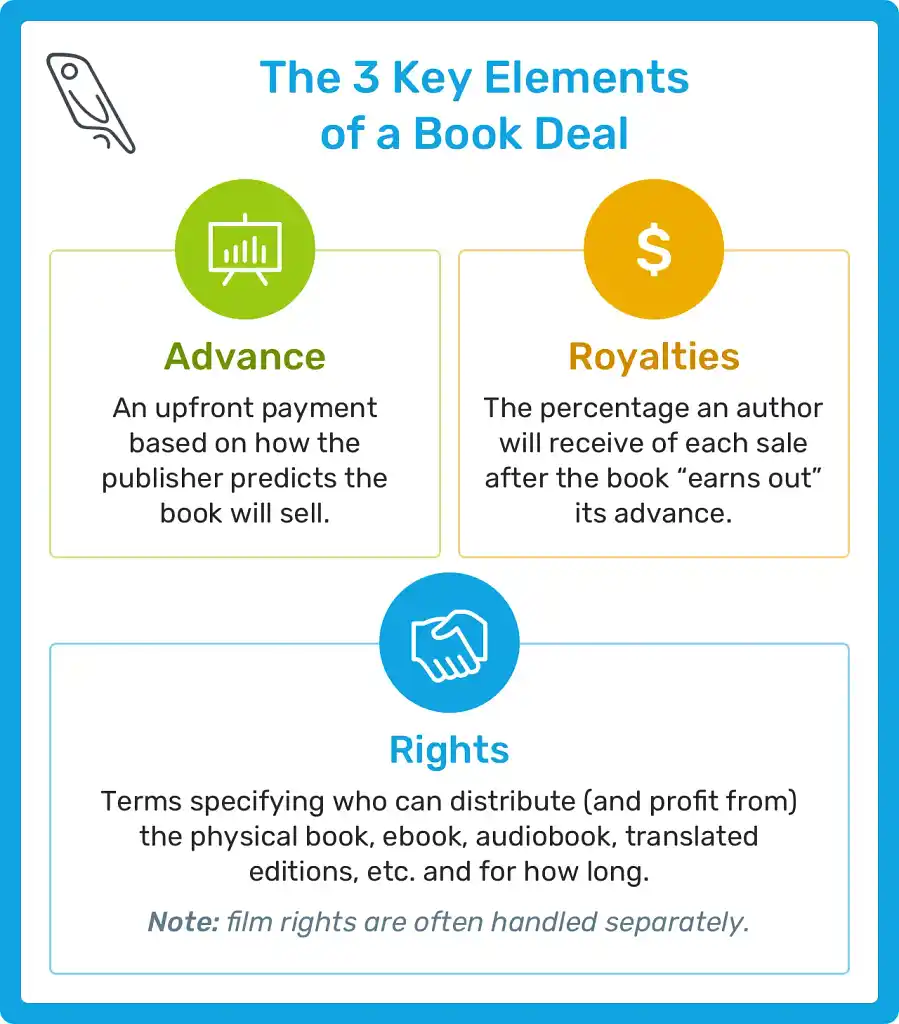
- Advance: an upfront payment, based on how the publisher predicts the book will sell. The advance is usually split into installments (for example, one payment upon signing, one upon manuscript delivery, and one upon publication). This is what we mean when we say Fiza got a “six-figure book deal”: she was paid six figures total over the course of her advance for The Midnight Carousel and its upcoming sequel.
- Royalties: after the book “earns out” its advance in sales, the author receives royalties, or a percentage of each sale. Royalty rates vary based mainly on format (hardcover, paperback, or ebook). Learn more about how much authors usually make here.
- Rights: lastly, a book deal specifies which party (author or publisher) owns what. Who will handle — and profit from — the ebook, audiobook, translated editions, etc.? The contract may also specify how long an author licenses those rights to the publisher, and when (if ever) they revert back to the author. Film rights are often handled separately.
Next up, let’s discuss expectations for the process of querying agents.
2. Figure out where your book sits in the market
Publishing is an investment, and agents and publishers are ultimately looking for books they can sell. That doesn’t mean you should chase trends or imitate other authors wholesale — but you should think about how to position your idea before you start querying.
Whatever your concept, you have to demonstrate that:
-
There’s an existing audience for your book; and
-
Your take brings something new to the table.
Considering these factors may influence the final form of your book. For example, The Midnight Carousel didn’t begin as a novel. Fiza originally set out to write a grief workbook — drawing on her background as a therapist — but later switched formats:
“I was about halfway through writing it when I realized that the workbook came across as dull and preachy. So I switched to a novel format, because people connect to stories — and always have.”
Fiza also knew she wanted her book to sit in the genre-blending, upmarket, book-club space, because those were the novels she loved most herself. She already had a number of comparative titles in mind (The Night Circus meets Sarah Waters), and her agent later added more (Cold Millions, for the setting).
Pro tip: At this stage, identify 2-3 recent “comp titles” for your book, and try to articulate how it’s similar vs. how it differs from these titles. This will help agents understand where you’d fit on their list and how they’d pitch your work to publishers.
3. Polish your manuscript

Of course, even the strongest concept won’t go far if the writing isn’t solid. Yes, agents and publishers will typically put your manuscript through their own rounds of edits, but they aren't in the business of teaching you how to write. To that end, polish your manuscript as much as possible before seeking representation.
Here’s what you need to do before you submit your work anywhere:
- Format your book to industry standards: Stick to standard, readable manuscript formatting rather than trying to get creative. Agents expect this formatting and may even reject your work automatically if it doesn’t adhere.
- Self-edit thoroughly: Ensure your story works on every level by reviewing character development, plot arcs, and individual scenes in detail. Once you’ve fixed big-picture issues, give your manuscript a spelling/grammar check, as well as a final proofread. For more information, check out our articles on 9 Types of Editing and How to Edit Your Own Book.
- Get feedback from early readers: You can also share your work with beta readers to get feedback on issues you might have missed. They’ll approach your book with fresh eyes, honesty, and a useful perspective on your target audience. If you don’t have a personal network of friends or fellow writers, look into beta reader forums or join a critique circle (online or in-person).
- Consider hiring a professional: If your beta readers indicate your manuscript needs a lot more work — or if you just want a sense-check from an industry expert — you can always hire a professional editor. They’ll be able to give even more detailed, market-oriented feedback on your manuscript to maximize its chances of success.
This is exactly what Fiza did. After an initial round of querying (in which she only received rejections), she decided to bring in a freelance editor. Working with Reedsy editor Lauren Hughes reshaped not only the manuscript, but Fiza’s understanding of the whole industry:
“Lauren allowed me to see where the story sagged, where characters fell flat, and where the plot lost its way. And she went far beyond just editing my book. She also imparted wisdom about key writing skills and the publishing industry, helping me grasp important rules I’d never learned. The difference to my book after working with Lauren was quite literally life-changing.”
Hire a professional

Sean L.
Proofreader/editor for 14+ years, reader for 40+, and as a lifelong fan, horror is my go-to genre.
Request a quote
Lisa S.
Book indexer with over 20 years' experience at major publishing houses including Routledge and Cisco Press
Request a quote
Lisa M.
UK-based fiction and non-fiction editor/proofer with a decade of book publishing experience.
Request a quote4. Research literary agents
Most book deals are negotiated by literary agents, not authors themselves, so the next step is finding the right literary agents to reach out to.
We wrote a full guide on how and where to find agents, but in a nutshell, aim to build a shortlist of agents who:
-
Represent your genre (ideally your subgenre);
-
Are open to submissions (pay attention, as this can change anytime);
-
Have a track record of recent deals and/or active clients; and
-
Are legitimate (remember, reputable agents don’t charge upfront fees — they earn a commission instead).
Sites like QueryTracker and Reedsy’s literary agent directory are strong starting points. You can also look at the acknowledgements pages of books similar to yours, since authors often thank their agents by name.
For Fiza’s first round of querying, she scoured QueryTracker, selecting agents by the genres they represented. For her second round, she worked with Lauren to create a far more targeted list and decide on a specific order for querying. With this deliberate approach, Fiza’s second round involved only around 20 handpicked agents.
Pro tip: Many agents share what they're looking for through interviews, social media (especially X or Threads), or requests on the Manuscript Wish List ® site.
What makes an agent a good fit?
In addition to the minimum qualifications we set out above, look for an agent with experience representing similar titles and a clear interest in your genre or category.
Keep in mind that response times can be long, as most agents juggle heavy workloads. A slow reply isn't necessarily a red flag, but once you're in touch, you want someone who's genuinely excited about your manuscript, communicates in a way that works for you, and is committed to championing your book.
5. Write irresistible query letters

FREE COURSE
How to Write a Query Letter
Learn to grab agents’ attention with 10 five-minute lessons.
After shortlisting agents, you’ll need a query letter built around a short “elevator pitch”: a description punchy enough to deliver in 30 seconds, yet compelling enough to land. Our full guide to query letters walks you through writing one step-by-step, but the essentials are simple.
The “hook” and synopsis
Your pitch and synopsis needs to establish three things fast — who your protagonist is and their normal world, the event that upends it, and what’s at stake. Lead with whatever makes your book distinctive, match the tone to your genre (don't pitch literary fiction like a thriller), and cut every word that isn't earning its place.
Almost nobody nails this on the first try. Fiza was refreshingly candid about her first attempt:
"Embarrassingly weak! I actually can't find the original pitch letter, probably because I deleted it from existence, but I do remember it being overly long, and for some reason I mentioned my age. Basically, it was obvious I was an amateur."
When she rewrote the book with her editor, they also rebuilt her query from scratch. The difference shows in the single line that came to anchor it:
“The Midnight Carousel is a sweeping work of magical realism that, at its heart, is about how love is a force more powerful than anything, even death.”
That's the whole book in one sentence, which is exactly what a good hook should do.
Q: What are the most common mistakes authors make in their query letters, and how can they improve them?
Suggested answer

One of the most common issues I see in query letters is the tendency to skip over who your main character is as the book starts. You want to show the agent who they’re going to be reading about and give the agent a reason to care about what happens to them. That’s your first paragraph (not including personalization or comp titles if you choose to put those at the top). Spend two to three sentences describing your character, their personality, their future plans, their desires, etc. That way, when the agent gets to the second paragraph and you throw chaos into the picture, they’re already thinking, Wow. How’re they going to deal with that?
Example:
Sixteen-year-old farm boy Luke Skywalker would do anything to leave his uncle’s dinky desert farm and attend fighter school with his friends. The evil empire is rising, and he wants to do his part to make the galaxy safe. But until his uncle agrees to foot the bill, Luke’s stuck cleaning the farm’s droids, a far cry from the adventure he seeks.
With an opening like this, you’ve established who we’re rooting for, his desires, and his ultimate goal. In the next paragraph, you can then drop the inciting incident, i.e. the thing that gets the story rolling.
Example:
Mary Collins is free of her wretched husband, their divorce finalized after a grueling three years where he fought her on every detail. Finally, Mary can leave the city where it was so important they live and return to her hometown. Helping her mom run the corner store while catching up with friends and family is the bliss she seeks as she starts over, now free of the myriad of obligations that came with being the governor's wife.
My guess is that Mary's going to find she's not so free of her past life once that second paragraph comes around. But because we know that's her desire/goal, it makes it that much more meaningful when the query then continues to throw havoc her way.
Giving us info about the character is important no matter your genre and age category.
If your book features a police officer, give us a bit of their background so we understand their current situation. That way, when chaos reigns, we know why that particular wrench is so bothersome. If a cop is trying to get promoted, being thrown into a big case is a dream/chance to show off. If a cop is near retirement, the last thing they want is to be trapped in a big case. Without knowing the main character’s background, your query is all about plot and you’re losing the character.
Agents, like readers, want to root for someone. They want to become invested in your character—so give it to them. Show them who they’ll be reading about and make them care. Then in the rest of the query, you can weave in those plot details and stakes.
Kim is available to hire on Reedsy

Three words: be more specific.
The standard advice used to be: look to a book's back jacket description for an example of how to describe your book in a query letter. The truth is, over time, the trends in queries have evolved AWAY from what's used on the back cover of books. Book jacket descriptions tend to be more vague, and focus on general claims like, "a thrilling coming of age story." Also, book jacket descriptions often end with rhetorical questions like, "Will Eva find love before it's too late?" but rhetorical questions in a query tend to be an agent pet peeve.
Most of all, agents don't want to hear that you have a "sweeping love story." They have 50 other sweeping love stories in their inbox right this instant. They want to hear the SPECIFICS of your setup, conflict and stakes to know how your love story stands out from the others, or they'll be getting out the broom to sweep your query right back out of their inbox!
Michelle is available to hire on Reedsy

A couple of the most common areas I see authors make mistakes in their query letters include:
- Not using proper query format
- Making the Book section (what your book is about) section either too long or too short.
While there is some variation on a query format, the one I like to use is the Hook, Book, Cook method.
- Paragraph 1 is your Book. What the title of the book is, the word count, why you decided to pitch the agent, comparable titles, etc
- Paragraph 2-3 is the Book. Think of this like the blurb on the back of a book or on Amazon. You want to give agents just enough information that they want to know more, but not give the ending away. That's for the synopsis, as is going into greater detail about the character and story. For the query, focus on the primary characters with their primary goals and motivations, the overarching conflict and villains, and set up the stakes of what the heroes will lose if they fail
- Paragraph 3-4 is the Cook. You as the author! If you don't have any prior writing credits, that's okay. Include a short paragraph about what you like to do, or what you enjoyed about writing the book. If you do have prior writing credits, try to only include those that are most relevant to what you're pitching (example, it's likely not applicable to share that you had an article in a cooking magazine if you're pitching urban fantasy, unless that ties in some way).
When writing the Book section of the query, I often recommend to authors to go into their local bookstore and seek out books in your genre with descriptions you like. See how they introduce characters, conflict, what details they do (or don't) include. Emulate them with your own story. Queries can be difficult, but with practice they do get easier!
Sean is available to hire on Reedsy

There are a few common mistakes you can avoid when writing your query letters. Here are some "do's" and "don'ts."
- Include only your first and last name in the query. The agent has your email address, and that is the address they will use if they wish to contact you. Do not include any other contact information (unless requested).
- Address the query letter as the agent stipulates on their website. If they do not specify their preferred salutation, use their first name and last name, e.g., "Dear Jane Doe."
- Make your first sentence about what you and the agent have in common (e.g., "Dear Ms. Smith, On your website, you say you like working with authors who (fill in the phrases the agent used), so I'm excited to present my (state your word count, genre, and BOOK TITLE IN CAPS)."
- State your comps (competitive or comparative titles) in your first paragraph. With your comps, try to use one book that this agent represented. Don't use best sellers as comps. Don't use books published over 2 years ago (and not over 3 years) as comps. Be current. Do your research. If you can't find recent comps, do more research. Read every book you use as a comp. (As you read your comps, make notes about how each comp is like your book, and how it is not like your book. You'll need this information for your book proposal (for nonfiction), and you'll need to talk about this with the agent when they call you.)
- Make your query letter 300 words. Why? Because a 300 word count is industry standard. Because 300 words is what many agents allow for their online submission forms. Because 300 words (single-spaced) will fit on one printed page, in case the agent prints out your query. Because if you can write an interesting query letter in 300 words, the agent will know you're a pro.
- Format your query according to industry standards: single-spaced, left justified, 2 spaces between paragraphs. No tabs or indents. No bold or underlining. Put your book title in CAPITAL LETTERS.
- When emailing your query, always drop your letter into the body of the email. Never send it as an attachment, unless requested. Don't send a query snail mail unless requested. Write in the email Subject line as directed (e.g., "Query - Title of Book - Name of Author.")
- Don't follow up on your query letter (unless an agent has invited you to submit to them). If you have sent an unsolicited query, if an agent says on their website their response time is four to eight weeks, and at eight weeks you haven't heard from them, query other agents (but not in the same agency). No response from an agent is a "No." Don't take it personally ... just move on. Your perfect agent is out there, waiting for your query letter!
I wish you every success with querying.
Michael is available to hire on Reedsy

One big mistake is querying the wrong agent. Sending your 90,000 word adult fantasy to an agent who specializes in literary nonfiction will only result in a rejection. This does not mean that you do not have an amazing story, but rather that that particular agent cannot best service that particular story. As a writer, make sure to do your research to find the best agent for your work.
Hope this helps!
Samantha is available to hire on Reedsy

I like seeing the title, genre and comp titles at the top. Often, writers hide this info in the final paragraph. I want to know immediately what this book is and what it's about, along with where it could sit in the market. It quickly tells me if this book is for me and if the author even knows what their book is about.
Another misstep is writing far too much in your plot paragraph. It really should only be 1-2 short paragraphs. Think plot/premise/payoff. This is probably the hardest part for writers. You are very close to your own work and might feel overwhelmed by condensing the entire narrative into a handful of sentences. When I receive a query, I'm looking for your main character, their world, what has changed in their world, twists or turns along the way, and even a question you might have for the reader.
For bonus points, add a logline before your plot paragraph(s). It's an efficient way to hook the person you're querying.A query letter should be no more than one page. Finally, look up the agent or editor's name and address it to them with the correct spelling. First names are preferred. It feels old-fashioned to address a query with Mr, Mrs, Ms, etc.
Ariell is available to hire on Reedsy

A lot of query letters are too long. An agent will spend perhaps one minute scanning through your query letter, so make it easy for them to find the important stuff. And don't spend too much of your word count on the summary! The goal isn't to tell the agent everything that happens in the book; the goal is to mention enough selling points and hooks that the agent is intrigued and starts reading your sample pages. This means one, maybe two paragraphs of summary, in the basic format: "[Protagonist] wants [motivation], but [obstacle] gets in the way. They'll have to [challenge] if they're ever going to achieve [stakes]."
Nora is available to hire on Reedsy

I think that authors are sometimes so keen to get on board with a particular agent that they forget to keep their letters concise and professional and often volunteer personal information and background information that doesn't have a place in a query letter. The other thing I often see is authors including what almost amounts to a full synopsis of their book, whereas this should be presented in a separate document.
Vanessa is available to hire on Reedsy

Common mistakes in query letters:
- Not saying what your book is about and why your target audience will love it.
- Remaining a secret writer by not sharing who you are, your background, and your writing experience.
- Giving away too much of the story: Mr. A hates Mr. B and winds up killing him.
- Making assumptions about the publisher, the books it publishes, and those it doesn't.
- Making unrealistic promises: This book is going to be a best seller with 500,000 books sold this year.
Barbara is available to hire on Reedsy

One of the biggest mistakes I see in query letters is using super comparison titles. Sure, your romantasy book series could be similar to Sarah J. Maas or Rebecca Yaros! Your thriller is the next Frieda McFadden or Gillian Flynn; however, so is everyone else's. You need to show that you can think beyond the obvious and that you read the genre.
And if those books are published within the last five years (which they should be), it also shows you're current and making an effort to stay up to date on trends and what readers are looking for!
It's important to note that I don't necessarily mean to stay away from list bestsellers or social media sensations. This doesn't always equate to sales numbers (we still have no idea why some books hit the NYT list and others don't). But be deliberate and realistic!
Grace is available to hire on Reedsy
Query personalization
Finally, personalize every letter. Show each agent why you're querying them, as Fiza did:
“All my query letters began with 'Dear X, I am reaching out to you because...' and then I stated the reason I’d picked that particular agent. Sometimes it was the other clients they represented, or their wishlists, or something they’d said on their agent page or on social media that struck a chord with me.”
Q: How does personalizing a query letter improve request rates, and what should be tailored?
Suggested answer

I am going to be a voice of one disagreeing with all the other comments. Don't waste time telling the agent why you picked them – spend it selling your book idea. They'll know you've done your homework on the agency because of the appropriateness of the offering – no need to tell them what is already obvious (they want YA fantasy, you're pitching YA fantasy).
I also think word counts belong at the end of a letter as a technical specification – no one sells the movie with how long it is, they sell it with a strong elevator pitch.
Lisa is available to hire on Reedsy

Personalizing a query is a great way of letting agents know that you've researched their tastes and interests, which also conveys that you're taking a professional, well-considered approach to querying and the industry itself. When you let an agent know that you've chosen them specifically because of the clients and/or books they represent, because of their online presence, or because of an interview they've given, it shows them you've taken the time to learn who they are--which also means it's likelier that you're sending them a manuscript suited to their tastes.
Salima is available to hire on Reedsy
While some advisors might suggest that one generic query letter is appropriate for all agents, my best advice is that you personalize every query you send. This means researching every agent, finding out what authors and books they have represented, and then using at least one "comp" (comparative title" / "competitive title") on that agent's (or their agency's) roster. When you do this, the agent knows that:
- you are querying them because you're familiar with their work and you know your book is a fit for them,
- your book suits their agency's roster, and
- you have done your homework.
When writing a query letter, follow the agent's submission guidelines precisely. For example, an agent named Jane Smith might request on her submissions page that she be addressed as "Ms. Jane Smith." So, if in your salutation, you write, "Dear Jane" or "Dear Ms. Smith," that is instant notification to the agent that you haven't read (or haven't followed) her submission guidelines. Will that mean you won't follow her directions if she signs with you? Agents get literally hundreds of queries every month. Don't give an agent a single reason to reject your query.
Some agents care a lot about personalized query letters, and other agents accept that some authors prefer to send out generic letters. Since you don't know which agents have which preferences, it makes sense to personalize all your query letters.
Happy querying!
Michael is available to hire on Reedsy
In my experience, personalizing a query letter shows a few things:
- Your interest in working with that particular agent. This increases their interest in your project and your agent-author relationship.
- Your knowledge of the market and targeted marketing. As a writer you don’t need to be a pro at this, but showing your ability to promote yourself displays valuable skills that can be used later for things like author events.
- Your research skills. Showing that you are good at finding the right agent showcases your research skills which may come in handy for your work, particularly if it’s nonfiction.
Hope this helps!
Samantha is available to hire on Reedsy

It shows you've done the hard work of doing research and aren't submitting to just anybody. It adds a personal touch and hopefully will make you stand out from the rest of the crowd. If you can reference a book or two represented by the agent, and compare it to the book you have written, you will bolster your argument for approaching this particular agent. This research takes time, but I believe that, in the end, it can make a difference in helping your query stand out.
Ken is available to hire on Reedsy
6. Set realistic expectations
Before you send your letters off, now is a good time to adjust your expectations for when (and from how many agents) you might hear back.
Query volume
You may have heard famous (or infamous) stories about authors sending hundreds of queries — basically, pitches to agents — before gaining representation. To give you a sense of realistic query volume today, authors through the grapevine frequently report having queried anywhere from 30-70 literary agents before landing one.
On the plus side, once you have an agent, your chances of getting a book deal improve dramatically. While you’ll still have to find the right publisher and acquiring editor, that hurdle is often less significant than the querying itself (a process we’ll cover in more detail below).
Timeline
For most authors, querying itself takes a few months, and so does finding a publisher afterward. Publication is usually at least another 6 months down the road.
Fiza's journey is a good illustration of how unpredictable this process can be. When asked to trace her path from first idea to publication, here’s how she summed it up:
“I had the idea for the book in early 2015 and started writing it straight away. However, I gave up after a year because writing was so tough, and only picked it back up again in 2020 — at the beginning of the Covid lockdown — when I had nothing else to do. I completed the book, then got my agent in January 2023 and my book deal in October 2023. The book was finally published in April 2025."
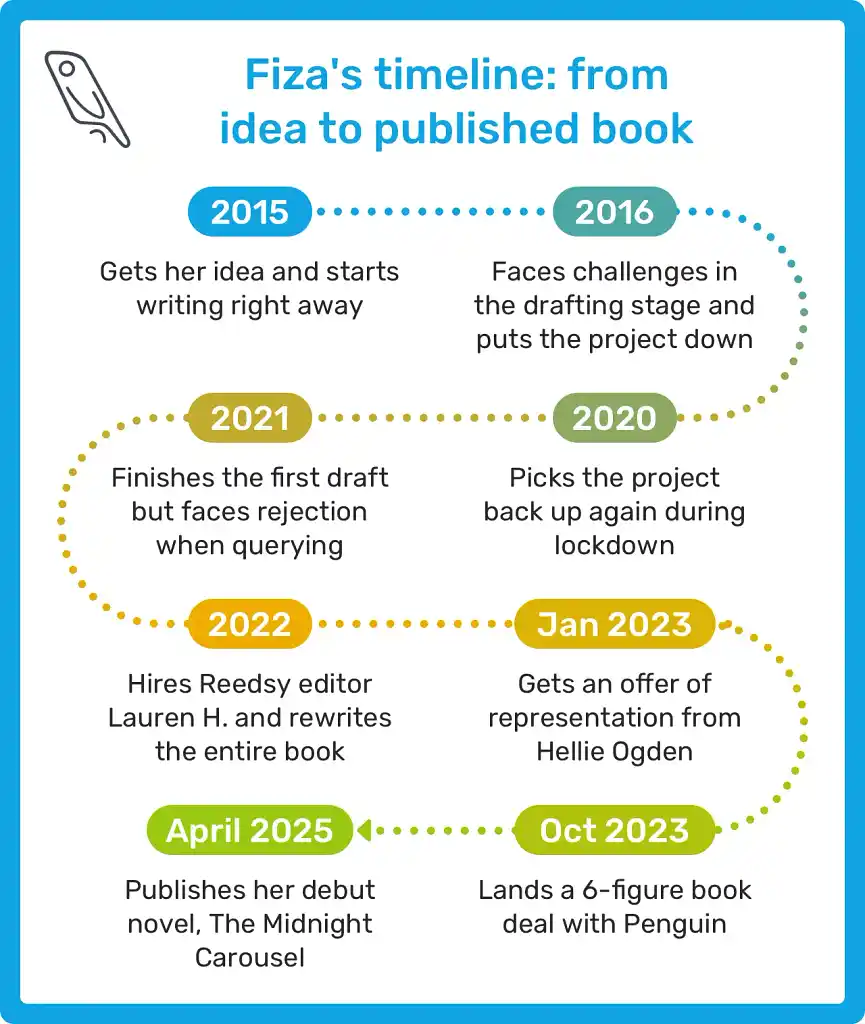
That’s the better part of a decade from idea to finished book. Of course, not every author will need this much time… but if you’re embarking on this process, brace yourself for delays and roadblocks along the way.
7. Submit and track agent queries
With your queries written, it’s time to send them out in batches. Start with the agents at the top of your list, then work your way down if you don’t hear back or get rejected.
As you wait, remain patient, yet proactive. You can send a polite reminder if you haven’t heard back in four to six weeks (or within the timeframe their website specifies). We advise setting up a tracking sheet or scheduled reminders to stay on top of this.
For Fiza, her spreadsheet was the backbone of the whole campaign:
“I had a massive spreadsheet with names of the agents, their agency, any information that would be useful in my query, date of query, date of response (if any). It was the only way to keep on top of things.”
If you receive rejections with constructive feedback, try to treat it as a win. Feedback means an agent was interested enough to keep reading, but something else held the book back — sometimes just minor mechanical issues, or the unlucky coincidence of the agent having just acquired a very similar book. Take this feedback seriously and make any changes that seem useful before re-submitting elsewhere.
Q: Is it appropriate to follow up on a query letter, and how long should an author wait before doing so?
Suggested answer

Sure, there's no harm in following up, as long as you aren't being a pest about it.
Most agents have set response times, and may say something along the lines of "expect a response in 6-8 weeks". It's not appropriate to follow up before that window, and it also doesn't help to follow up more than once.
If an agent's website or query page say that it's an automatic rejection after that time frame, then you should take them for their word and consider your query rejected if it goes past that window.
Matt is available to hire on Reedsy
I believe it's perfectly appropriate to follow-up to a query letter, but keep the following in mind:
Read the agent's submission requirements on their website or social media account. Often, they will tell you their turnaround time or any special considerations. "If you don't hear back from me within two months, email again."
They also might say, "If you don't hear back within two months, it's a no from me." In which case, don't follow-up.
If there isn't a time listed, I would recommend nudging in four to six weeks.
And remember: be polite! Agents are human beings with *feelings* and receive hundreds of submissions. They will consider each one of them in due time.
Grace is available to hire on Reedsy

It depends on the agent. Many of them will post their specific guidelines on their websites—some will say that you can follow up in <x> weeks, and others will say that, if you haven't heard back from them in <x> weeks, to consider it a pass. If such information isn't on their website, it's a bit up to you, but I've heard ~3-4 months can be a good guideline to follow for query follow-ups. But definitely make sure that the agent doesn't have their specific timelines posted anywhere!
Chelsea is available to hire on Reedsy
It also helps to know what a normal rejection actually sounds like, so you don’t read too much into it. Most of Fiza’s were either silence or some version of the standard form letter, like this:
“Unfortunately, after careful review, we have decided to pass on this submission. This industry is incredibly subjective, and there are many agencies out there with many different tastes.”
That said, if you don’t get any manuscript requests at all, it’s a sign your query letter isn’t working. If this happens, consider a query rewrite before your next batch.
Alternatively, if you get plenty of requests (more on this below) but no offers, your manuscript itself likely needs work. If you haven’t consulted a professional editor yet, now might be the time.
Hire an expert to review your query letter

Julia F.
Award-winning 5x traditionally published novelist with 10ys editorial experience in historical, literary and speculative fiction
Request a quote
Elinor D.
Enthusiastic and supportive editor and author mentor. Previously Associate Literary Agent at Madeleine Milburn Literary Agency.
Request a quote
Jas P.
Children’s & graphic novel editor (PB, MG, YA, comics/manga for all ages). Literary agent. Author. Editorial at Scholastic & Levine Querido.
Request a quote8. Get offers of representation and sign
If your query and sample pages resonate, agents will request more material, and eventually you may be invited to “the call.” This is where an agent offers to represent you. Typically, the process goes like this:
- Partial or full manuscript request: the agent asks to read more of your manuscript.
- Follow-up questions (usually via email): the agent asks about your project, future ideas, and/or background.
- The call: the agent invites you to discuss working together.
What is “the call”?
“The call” is usually a 20-to-60-minute conversation in which the agent:
-
Shares their vision for your book;
-
Suggests possible edits or positioning;
-
Explains how they’d submit your work to publishers; and
-
Outlines how they work with clients.
Remember, this is also your chance to ask questions. Think of “the call” as a two-way fit check — the dynamic has to work for both of you. Some useful questions to ask:
-
What revisions would you suggest before submission?
-
Which publishers or editors do you have in mind?
-
How do you typically communicate with clients?
-
What happens if the book doesn’t sell?
Their answers will help you understand how the agent works and whether they're the right partner for you.
For Fiza, genre fit and communication style were the deciding factors. She landed on Hellie Ogden's agency website, read through the agent profiles, and felt an immediate connection.
"Her taste in books is very broad, from commercial through to literary, and she enjoys all sorts of genres, which was great since I was querying a genre-blending novel. I also really loved her friendly tone. It was important to me to genuinely like the agent I would potentially be working with, because it's such a close relationship. This is why the query process isn't just about an agent picking you, but YOU picking an agent. They are cheerleader, advisor, negotiator and guide, fighting your corner and steering your career."
Signing with an agent
If all goes well and you decide on a literary agent, you’ll sign an agency agreement. This grants the agent the right to represent your work in exchange for a commission (usually around 15%).
From here, your agent should become your biggest advocate. Expect further editing under their guidance to meet publisher guidelines. In Fiza's case, signing with Hellie kicked off yet another round of editing before the book was ready to go out.
Then it’s time to pitch publishers.
9. Pitch your book to publishing houses
At this point, your book enters the submission phase. Your agent will pitch it directly to acquiring editors at publishing houses — typically 8 to 12 they believe are the best fit.
They will usually send:
-
A pitch email (positioning your book in the market — not unlike your original query);
-
Your manuscript (or selected chapters); and
-
Supporting materials (synopsis, comps, author bio).
Because agents have established relationships with editors, your manuscript arrives with context and credibility, rather than as part of the publisher’s “slush pile.”
Note that submissions also run on the publishing calendar, which your agent will plan around. Fiza signed with Hellie in early 2023, and Hellie’s goal was to have the book ready to go out by the London Book Fair that October — a deadline they just managed to hit.
Acquiring editors at each publisher will then read your materials and decide whether to take on your book. This may lead to internal discussions, second reads, or editorial meetings within the publishing house. But with any luck, these discussions will lead to what you’ve been chasing all along: the coveted book deal.
Q: Assuming a book deal, how long can an author assume the process will take from querying to seeing their book on the shelf?
Suggested answer

Having been an acquisitions editor for a division of Random House, I can tell you publishing is a marathon, not a sprint. On average, the journey from query to bookstore shelves is about two years. That might sound like forever, but every step along the way has its own milestone worth celebrating.
Here’s what it looks like:
- A Spark. An editor loves your query! Cue the happy dance. They’ll ask for more—maybe a full proposal, sample chapters, or even the whole manuscript if it’s fiction.
- The Back-and-Forth. This is the “let’s make it even better” stage. You might be asked for clarifications or revisions before your project goes to the publication board. Think of it as a friendly brainstorming session with high stakes.
- The Green Light! Once the pub board approves, a contract is drawn up. Negotiations and signatures can take 2–3 months. Then it's official and you can make announcements in public.
- The Writing Zone. You’ll usually get around six months to deliver your manuscript. This is when the real writing (or rewriting) magic happens.
- The Editorial Polish. Once you submit your manuscript, your editor helps refine your work. Developmental edits, line edits, copyedits… it’s like giving your manuscript a deep massage. This adds another 2–3 months.
- The Final Stretch. Your book is typeset, proofread, and sent to print. Depending on where it’s printed, this can take another couple of months.
- Meanwhile, the sales and marketing teams are busy building buzz, and you are stirring up excitement with pre-sales posts.
So yes—it’s a two-year adventure. But the good news? That “long runway” gives publishers time to rally booksellers, reviewers, and readers, so when your book finally launches, it’s not just quietly slipping onto a shelf or into the Amazon masses, it’s arriving with fanfare. Publishing is a process of patience, persistence, and plenty of celebratory moments along the way.
Alice is available to hire on Reedsy

Allow a publisher's editorial board 30 - 60 days to finalize an offer and negotiate details. After that, expect 8 to 16 months before your cover sees the light of day. Why so long? Legitimate publishers allocate marketing and trade sales resources on their calendar. They also sometime like to schedule titles based on best selling seasons for a particular genre.
Mike is available to hire on Reedsy

Querying is the first step of a journey through traditional publishing. After you've sent out your queries, the next steps might look something like this:
- Full requests: Literary agents who are interested in your query will request the full manuscript from you so they can read the whole book and decide whether to offer representation.
- Offer of representation: After reading your book, the literary agent has decided they would like to represent you and take you on as a client, so they send you an offer of representation. This is a good time to follow up with any other pending queries and let them know that you've received an offer of representation. Generally, you should give other agents 2 weeks to get back to you after you've let them know you've received a competing offer of representation.
- Submissions: Once you've signed with a literary agent, your agent goes out with your manuscript on submission. This might happen right away (if your agent believes your manuscript is ready) or after a round or two of revisions. The amount of time this might take varies greatly.
- Editor interest: Editors who are interested in your book may have to drum up internal support at their publishing house before they can make an offer. This could look like the editor bringing the project to their editorial meeting, then presenting it at an acquisitions meeting. This could take up to 2 weeks depending on the process at that particular publishing house. You may have a call with the editor as well to make sure your visions are compatible.
- Book deal offer: Your prospective editor will send an offer to your agent, and they will negotiate.
- Editing begins: Once you've come to an agreement on the book deal, you will begin working with your editor. All in all, it generally takes about 2 years between a book deal and the book's publication date. This looks like about 1 year of editing and revising, and then 6 months of the book moving through different stages of production, and then it goes out to the printer, is physically produced, and ships to distributors, who then sell to booksellers, who then stock the book.
Of course, the timelines for the items I've listed here vary greatly. But generally speaking, it's safe to assume at least 2 years between book deal and publication...plus the amount of time you've had between querying and getting that book deal. This is part of the reason I encourage authors not to chase trends and instead to focus on writing compelling characters—traditional publishing is slow, so write from the heart. Strong character work and a good command of craft will appeal regardless of the shifting trend cycles.
Christine is available to hire on Reedsy
10. Negotiate your book deal
In an ideal world, you'll receive multiple offers from publishers. When that happens, the book is sold at “auction” (really just a series of emails and phone calls from publishers to your agent). The upside is that when publishers know they’re competing, you can expect larger advances as they try to out-bid each other.
The Midnight Carousel, for example, went to auction. Fiza describes the experience as both thrilling and stressful:.
“It all happened very quickly, with the first offer coming through within a few days. A week later, I’d spoken to several editors at several publishing houses, and (with Hellie's help) picked the best fit for both my book and me: Penguin.”
Remember, money is not everything
If your book does go to auction, don’t just automatically go with the highest bidder. Money may indicate the budget of a publishing house rather than its true level of investment. A smaller, passionate publisher offering a more modest advance might work much harder to promote your book, giving you a better chance to earn back the difference in royalties.
The publisher’s marketing plan is crucial here, and weighed heavily in Fiza's own decision:
“A key factor was the acquiring editor. It's such a close working relationship that feeling a connection and sharing the same vision for the story was super important to me. I was also swayed by the publisher's ambitions and marketing ideas, because visibility — especially for a debut — plays a huge part in a book’s reach.”
When asked how much Hellie's advice shaped the final deal, her answer was unequivocal: “Totally, because I was clueless about how the publishing industry worked back then.” Throughout the process, Fiza says she was kept in the loop on everything: the aims, the feedback, the decisions, with her questions answered quickly.
So check in with your gut, trust your agent, and go with someone who understands your vision.
Don’t lose hope
Even once you’ve got agent representation, you won’t necessarily get a book deal, or get one quickly. Editors and agents are sometimes forced to reject perfectly good books due to limited budgets, timing, or because their lists are full.
Rejections don’t always reflect the quality of your work, so cut yourself some slack. And if you only get one good offer, remember you're still in the lucky minority. Not all great books start their lives with a bidding war: Douglas Stuart's Shuggie Bain, winner of the 2020 Booker Prize, received only a single offer for a book deal, and Stephen King famously collected 30 rejections for his debut novel Carrie. (Find more inspiring stories here.)
When we asked Fiza what she might do differently if she had to start over, her answer was simple: “I would have sought help sooner, because it would have saved me so much time.” And for anyone in the thick of the querying process, she’ll leave you with this:
“Don’t be downcast or think the number of rejections is indicative of your future writing career. Every author, including the huge names, has faced multiple rejections. Keep writing, keep querying, and enjoy telling your stories.”
Again, plenty of successful authors sent dozens of queries or submissions before getting accepted; still others may not have had their first novels published, but they got a deal for their second. In other words, never let rejection define you. No matter what, the intrinsic value and joy of writing doesn’t change — and your work will only improve with each new book you write. Good luck!
Q: Do you have any words of encouragement for authors struggling in the querying trenches?
Suggested answer
Querying is so tough these days! There's more agents than ever before, but yet imprints are folding, combining, etc. so the number of projects being sold hasn't increased, making it harder to catch an agent's eye.
There may be any number of reasons you're not getting full requests--your query letter doesn't capture the unique quality of your book making it stand out, your first pages fall flat and don't pique the agent's interest, or, quite simply, the agent isn't interested in your characters or plot. And there's nothing you can do about that last one. Every book isn't for every person. Every agent has meh topics they rather not read about. If an agent isn't into mermaids, they're unlikely to request a full from a query that describes a book about mermaids. That query was never going to land a full, and there was absolutely nothing about the query or your writing that could have changed that.
So, concentrate on what you can control and push aside the rest. Querying is not a comment on your worth as a human or as a writer. Publishing is a fiesty marathon. If your current project isn't getting bites, write the next thing. You'll improve with each project. Trust that the stars will eventually align when your idea and words will pack a punch. How can you make your project stand out as unique? What tropes can you put a spin on? Create characters we can't help but root for. Lean into what you--your background, your hobbies, your experience, can bring to a project that springs it to life in a way that can't be replicated.
But above all, know that it's not just you--the struggle is real for many, and the only thing you can do is simply keep writing.
Kim is available to hire on Reedsy

Don't lose faith!
I know that's easier said than done but try not to let rejections get you too demoralized. Most best-selling authors had the same struggle and likely went through many rejections before securing a deal. Unfortunately, it's all part of the process.
If you are getting form rejections then it is likely you are either choosing the wrong agents or there are issues with your query pack, so make sure you put as much work as possible into researching who you want to pitch to and refining your documents. Don't rush into querying. This is your one shot to catch the attention of that agent, so you want to get it right.
If you are getting requests for your full manuscript then you are likely on the right track and have a good submission pack. Don't be afraid to ask for feedback, but agents are very busy so you may not always get it.
I would also encourage you to keep writing while querying. Authors often get their second or third book picked up instead of the first one they queried, so don't lose hope. If you are tired of the rejections then use any feedback you have been given to write something new. There are no guarantees, but keep working at it and hopefully you will find your perfect agent eventually.
Finally, be kind to yourself. A rejection doesn't mean your book is rubbish - it just means that the agent can't see a place for it at this point in time. Many, many, many brilliant books have been turned down initially and then had great success when they found the right home. Don't give up hope.
Amy is available to hire on Reedsy
First of all: don’t give up. Rejection isn’t the end of the story—it’s part of it. Every “no” is simply a redirection toward the right “yes.”
Publishing is absolutely a business, but it’s also deeply relational. Editors and agents love working with people they genuinely like and trust. That means: go to writers’ conferences. Join a critique group or hire an author coach. Get to know professionals in the industry, not just for what they can do for you, but for how you can show up as generous, authentic, and collaborative. You never know when a writer friend might one day endorse your book, or when a connection you make over coffee might become a career breakthrough.
And here’s the bigger truth: querying is more than chasing contracts. It’s also a personal growth journey. You’ll discover your resilience, refine your craft, and grow into the writer you’re meant to be. One author I know literally turned her pile of rejection letters into a lampshade and said they helped light her way to publishing three novels.
Need more inspiration? Catherine Stockett, author of The Help, was rejected by 50 agents before one finally said yes. That “yes” led to a book deal, a bestseller, and eventually, a movie.
So hold fast to your dream. If you feel called to write, you probably are. Keep writing. Keep connecting. Keep becoming the kind of author people want to root for. The path may be long, but you’ll be stronger, wiser, and more yourself because of it.
Alice is available to hire on Reedsy