Blog • Understanding Publishing
Posted on Mar 10, 2026
How to Find a Ghostwriter For Hire in 2026

Dario Villirilli
Managing Editor of the Reedsy blog, Dario is a graduate of Mälardalen University. As a freelance writer, he has written for many esteemed outlets aimed at writers. A traveler at heart, he can be found roaming the world and working from his laptop.
View profile →So, you have a book idea and want to hire a professional ghostwriter to bring it to life. Where do you start?
In this post, we'll show you exactly where to find a great ghostwriter and what to look for to ensure a successful collaboration.
1. Browse marketplaces and agencies
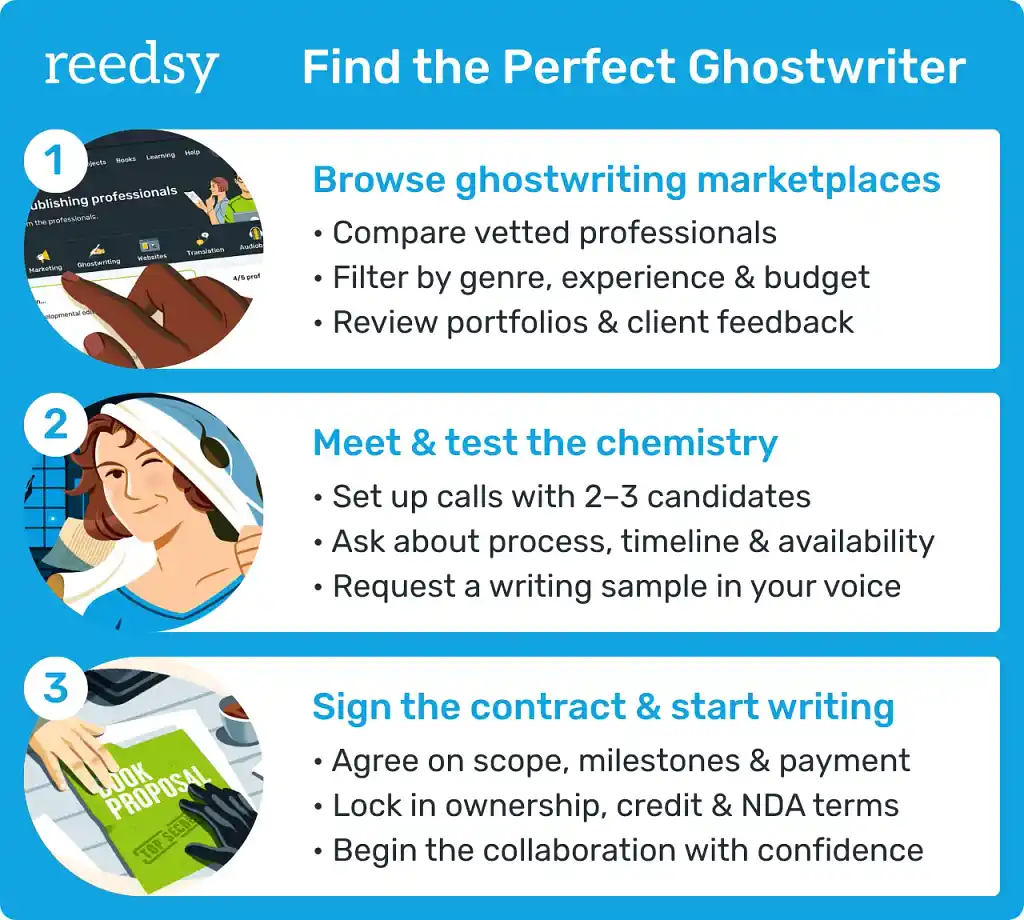
There are two main places to hire a ghostwriter: freelance marketplaces and ghostwriting agencies. Below are some of the most legitimate services and companies in the business.
Reedsy Marketplace
We’re biased, but Reedsy is a great place to start. Since 2014, the Reedsy marketplace has connected thousands of authors with ghostwriters thanks to the high quality of our professional network and the platform’s ease of use.
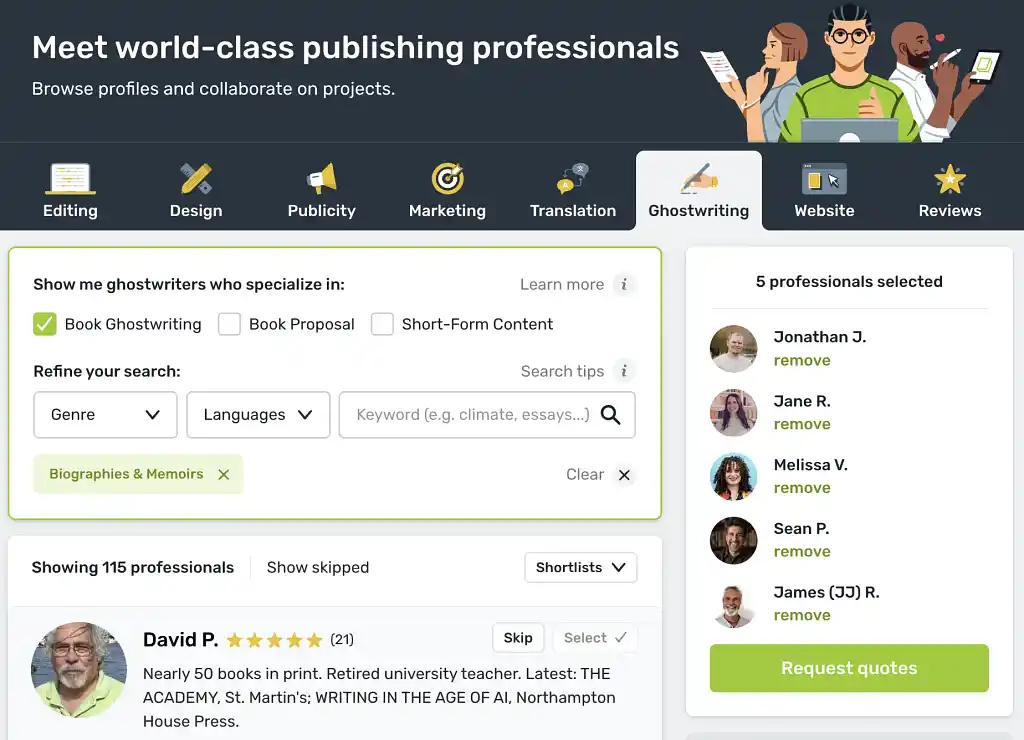
On Reedsy, you can filter by genre and specialty (e.g.,, “sports memoir”), and rest assured that every writer listed has been vetted for quality — with a minimum of three years’ professional experience and at least five well-reviewed published books.
Collectively, these ghostwriters have been Pulitzer finalists, written NYT and WSJ bestsellers, worked with publishers like HarperCollins, Simon & Schuster, and Penguin Random House, and collaborated with everyone from star athletes to business thought leaders to Hollywood celebrities.

Once you identify some candidates, you can request quotes and chat with ghostwriters to find the perfect fit. In terms of costs, here are the average rates you can expect based on our internal data:
- Biographies and memoirs: $12,000–$42,000
- Business and nonfiction: $6,500–$32,000
- Fiction and novels: $3,500–$16,000
- Children's and picture books: $1,500–$5,000
The final price will depend on several factors, like the scope of your project and the ghost’s experience.
Hire a top-tier ghost

David P.
Available to hire
Nearly 50 books in print. Retired university teacher. Latest: THE ACADEMY, St. Martin's; WRITING IN THE AGE OF AI, Northampton House Press.

Doug W.
Available to hire
Simply put, I connect authors and audiences. Nothing's more important than the emotional connection that makes a story unforgettable.

Seth M.
Available to hire
I have extensive experience finding new and creative ways to tell a story, especially when using humor to engage with young readers.
Reedsy also offers secure milestone-based payments, built-in collaboration tools, and mediation services if a project goes sideways. If there are any disputes, we mediate and resolve them fairly — something you wouldn't have if you were dealing with the ghost directly.
It's an ideal platform if you want to hire experienced professionals at competitive rates without worrying about contract logistics.
Other ghostwriting services
Of course, Reedsy is not your only option. If you want to cast a wider net, there are other reputable companies and directories — each with different levels of vetting and specialization.
|
Name |
Type |
Vetting |
Best For |
Cost |
|
Association of Ghostwriters (AOG) |
Professional association |
Membership-based directory; profiles are self-submitted |
Clients looking for experienced independent ghostwriters across nonfiction, memoir, and business books |
Varies by writer |
|
Authors Guild Ghostwriters Marketplace |
Professional directory |
Listings generally consist of professional writers, many of whom are Authors Guild members; profiles are self-submitted |
Authors seeking experienced writers for full-length books, often with traditional publishing backgrounds |
Varies by writer |
|
Editorial Freelancers Association (EFA) |
Professional directory |
Membership-based directory; profiles are self-submitted |
Authors who want to browse and hire independent ghostwriters directly |
Varies by writer |
|
StoryTerrace |
Agency |
Curated agency network that matches ghostwriters with clients |
Clients who want a full-service memoir, life-story, or business book package |
Packages from about $1,200 to $21,000+ |
|
Gotham Ghostwriters |
Agency |
Curated agency network that matches ghostwriters with clients |
High-profile clients such as executives, public figures, and organizations seeking full-service ghostwriting |
Packages from $30,000–$300,000 |
|
Kevin Anderson & Associates |
Agency |
Curated agency network that matches ghostwriters with clients |
Authors pursuing traditional publishing deals, memoirs, and business books |
Packages from $50,000–$250,000 |
|
Scribe Media |
Publishing service |
Curated agency network that matches ghostwriters with clients |
Entrepreneurs, consultants, and professionals producing nonfiction books with a guided publishing process |
Packages from $44,000–$135,000+ |
For a more in-depth insight into some of these ghostwriting companies, check out our comprehensive review.
After identifying your ideal platform(s) for hiring a ghost, consider what kind of background and experience you want (more on this below). This will enable you to compile a shortlist of potential candidates.
2. Evaluate their credentials
There are a few key things you need to consider when evaluating potential ghostwriters, starting with their experience.
Professional background and portfolio
Look for ghostwriters with a strong track record of published work and demonstrable results.
Some come from inside the publishing industry — former editors at companies like HarperCollins or Penguin Random House, for instance — which means they understand what publishers look for in a manuscript. Others come from journalism, screenwriting, or business backgrounds, bringing different but equally valuable skills: an ear for voice, an instinct for narrative structure, or a deep understanding of how books can serve strategic goals.
Some also specialize in particular fields, such as sport, mental health, or tech, which can be especially valuable if your book requires subject-matter familiarity.
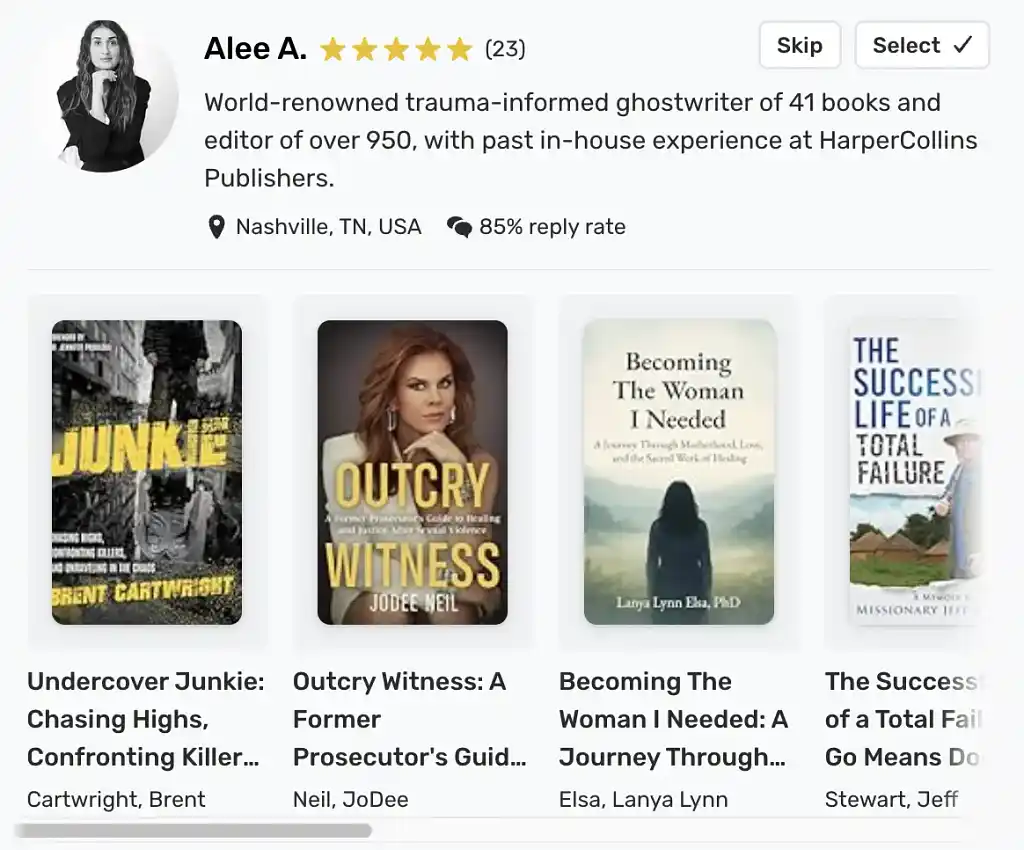
Evaluate their previous books. Most ghostwriters will share a few samples of their previous work. Leaf through them (or at least read the previews on Amazon) and think about the style of writing. Does it read like someone you want to work with?
Also note which specific publishers they've worked with, as this is usually a reliable indicator of quality. If they list books published by an imprint you’ve never heard of, make sure to look it up and confirm it’s legitimate — not a scam or vanity press.
All that said, don't be alarmed if a ghostwriter can't name every client. Non-disclosure agreements are common in this line of work, and discretion is a good sign rather than a red flag.
Client reviews
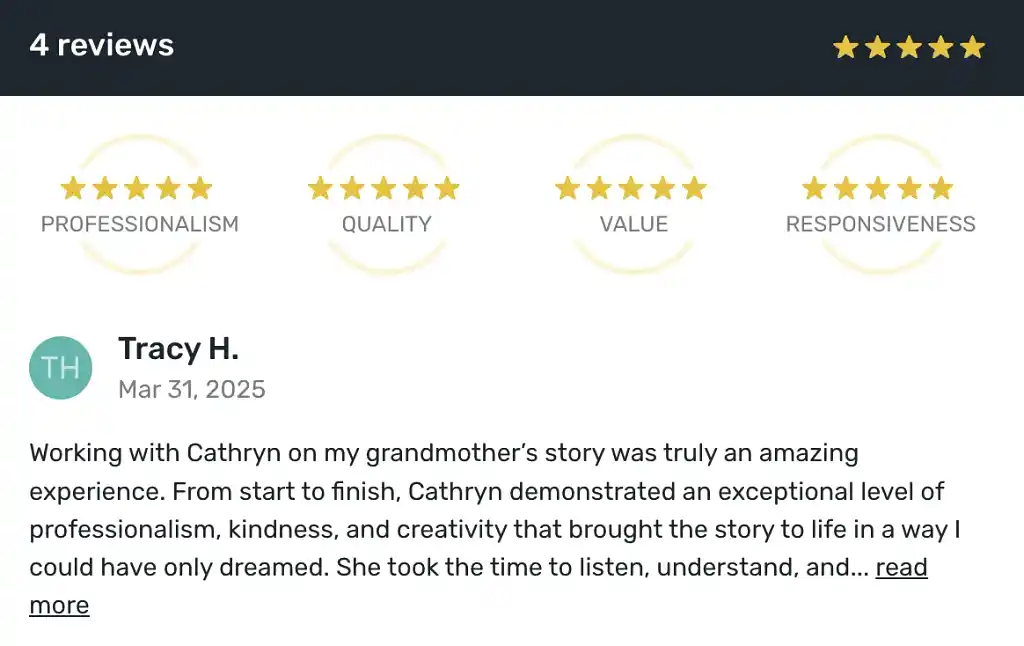
Another important trust signal is testimony about what it’s like to work with this ghost. After all, ghostwriting is an unusually personal collaboration. If you're writing a memoir, you'll be sharing sensitive, sometimes painful material. If you're writing a self-help book, you'll be trusting someone to articulate your ideas with precision and clarity.
Reviews from past clients will tell you what kind of environment this person fosters, giving you a sense of whether you could open up to them.
Once you have a shortlist of potential candidates, it's time to pitch them your idea.
Q: What advice do you have for first-time memoir writers?
Suggested answer


Can you ID one facet of your life that reflects a broader societal issue? If so, utilize that to transform your personal tale -- which might only interest a narrow demographic -- into a book with wider marketing appeal. (My fellow journalists call it a "news peg.") I handled Developmental Editing for a TV sports producer who achieved success in many aspects of the industry. But I urged him to use his memoir's subtitle to spotlight his experience with gender-equity issues. This helped push his book to being an Amazon #1 national bestseller. So milk your subtitle for all it's worth.
Joseph is available to hire on Reedsy ⏺

Listen carefully and ask all the questions that you think the eventual readers would ask.
Andrew is available to hire on Reedsy ⏺

In writing your memoir, my best advice for first steps is to zoom out and look at the end result as a "product." That's tough to do, especially with your life story. But if you start with a blank screen, the writing/drafting process can become overwhelming. Instead, create an outline that shows the chapters, and what stories/takeaways you want to share, and in what order. Don't do any "writing" at this stage, take on the role of architect, and develop a detailed plan for your book. When new ideas come, and they will, simply place them in the appropriate chapter for later expansion. Bonus tip: Use your voice recorder on your phone to talk out your book, then transcribe with free tools.
Michael is available to hire on Reedsy ⏺
3. Reach out and meet a few ghosts
This is arguably the most important step in the whole process. Since ghostwriting is an intimate collaboration where you're sharing very personal stories over weeks or months, the chemistry needs to be right.
Set up a call or even a face-to-face meeting with two or three candidates. Come prepared with questions like:
- How much time can you dedicate to my project?
- What's your estimated timeline for each stage?
- How involved do you expect me to be?
Pay attention to how they respond. Do they sound genuinely curious about your book, or are they just going through the motions?
Trust your gut. If the connection doesn't feel right, move on. There should be no hard feelings on either side — it's simply part of the process.
Get a writing sample
Before you commit, ask for one final proof: a short sample in the scope of your actual project. This is where you'll see whether the ghostwriter can capture your voice on the page. They might be impressive in conversation, but the real test is whether their writing sounds like you.
Depending on your preference, you can request a couple of pages or a full sample chapter. You may need to pay for this trial, but it's well worth it. It'll either confirm your instinct from the initial meeting or signal that you need to revisit your shortlist.
If all goes well, the only thing remaining is to sign the papers.
Q: What are the most effective ways for prospective clients to assess whether a ghostwriter can capture their unique voice?
Suggested answer

Great question – I have to answer it in a roundabout way. I always say this to my authors: ‘Look, the relationship between ghost and author is really important. We’ve got to get it right. The only way to see if it’s going to work is to give a shot. I’ll sit with you, I’ll do a couple of interviews. If you feel things aren’t right, or if I feel things aren’t right, we’re both free to walk away at any time.’
That freedom creates trust, and that trust allows the author to talk freely about the things they’re most passionate about, the things that made them want to write a book in the first place. And from my point of view, listening to someone talk freely about the things that they’re most passionate about is always so compelling, so absorbing. The words they use, the idioms they use, the way they express themselves start to sink in, and when it comes time to write their story, what emerges is their story in their words. Get the relationship right and the voice will come.
It’s also important to point out that this is an iterative process. A first draft is just that – it’s designed to be pulled apart and redone, and redone again until we arrive at a text that the author can be proud of. Say: ‘Don’t censor yourself. Talk freely. You’ll have plenty of time to review what I write. Nothing will end up in the final draft that you’re not happy with.’
So you can’t really demonstrate that you can get their voice at the beginning of a project. You can offer referees of course – I always do, but really getting the voice right begins with trust and flows from that.
For the record, I’ve never had anyone walk away. A couple of interviews in and they’re starting to really enjoy the process. That’s another thing – authors love the process after a while. It’s such a rewarding thing to talk freely about things you’ve done, the things you feel most passionate about.
John is available to hire on Reedsy ⏺

Ooh, that is such a good question!
One of the hardest parts of choosing an editor is trusting that they’ll get you – your tone, your rhythm, your way of telling a story-that’s what “voice” is, after all, the thing that makes your writing yours.
So how do you know if an editor can capture it rather than flatten it?
A few practical ways can help.
First, ask for a sample edit. Even a page or two will tell you a lot. Do their suggested changes make your writing clearer and sharper without stripping away your personality? If you read it back and it still sounds like you – just a more polished version – that’s a good sign.
Secondly, pay attention to how they listen-and, for me, listening comes first as a ghostwriter. A good editor doesn’t just correct or 'get technical'; they ask questions about your intent, your audience, and the effect you want to create.
If they’re interested in what lies behind your words, they’re far more likely to respect your voice on the page.
Thirdly, read their testimonials or portfolio. Past clients will often mention whether an editor was sensitive to style and tone. If you see repeated praise for “keeping my voice intact,” that’s worth noting.
Finally, trust your instincts after a conversation. If you feel heard and understood in person, that relationship usually translates well into the editing process. This is your book and you will be telling your story from your heart-your writer needs to be able to understand and absolutely empathise with that fact.
In the end, the right editor won’t make your work sound like theirs. They’ll make sure it sounds like you – at your very best.
YOUR voice.
Edward is available to hire on Reedsy ⏺

Having failed the Vulcan mind-meld certification course, I know only one way to capture an author’s voice. Interviews. Lots of them. Here’s what I tell every prospect … As a ghostwriter, I will spend lots of time interviewing you. And thanks to these interviews, I’ll acquire much of the book's content, as well as your unique point of view, key messages, and ways of speaking. Every interview is recorded and transcribed, so when it comes time to write the manuscript, I can simply copy, paste, and edit/rewrite large portions of the transcripts. The book’s voice will match yours for the simple reason that much of the book is your actual voice, answering questions and telling stories. I’ll probably spend as much time (or more time) planning the interviews, crafting interview questions, and listening intently as I’ll spend writing the book. In short, I capture authors' voices by recording and using many of their own words. That’s my “trick.” Which really isn’t a trick.
Peter is available to hire on Reedsy ⏺
4. Sign the contract and start the collaboration
Before a single word is typed, you need to establish what’s essentially a “living” contract — one that goes well beyond the price tag. Think of a professional ghostwriting agreement as the manual for how you and your ghostwriter will work together.
🗺️ Scope: At minimum, the contract should define the scope of work: not just word count, but the depth of research involved, the number of interview hours required, and a clear definition of what constitutes a “revision round” (polishing existing prose is very different from a full structural rewrite, and you want that distinction in writing).
💰 Payment: Most professional ghostwriters operate on a milestone basis, with payments tied to deliverables like the outline, sample chapters, and the final manuscript. But a well-structured contract goes a couple of steps further.
First, expect a commencement deposit — a non-refundable upfront fee that “locks” the writer’s calendar and signals your commitment. Second, look for a termination clause, sometimes called a “kill fee.” Life happens, and if either party needs to walk away mid-project, this provision ensures the writer is fairly compensated for the time they blocked off, while you retain the rights to whatever work was completed up to that point. It’s not a sign of pessimism; it’s good planning.
🖋️ Credit: Your contract should also address copyright and credit. In most ghostwriting arrangements, full ownership of the manuscript transfers to you upon completion, but this needs to be stated explicitly. If the ghostwriter will receive any acknowledgment — an "as told to" credit, a mention in the acknowledgments — spell that out too.
📝 NDA: Finally, include a confidentiality clause or NDA which ensures the ghostwriter won't disclose their involvement without your permission, giving you the freedom to present the book as entirely your own.
Q: What steps do publishing professionals take to ensure client confidentiality and discretion in an author's work?
Suggested answer

First of all, it is common that your agreement with the subject will include language concerning confidentiality. Second, your reputation should speak for itself.
Tom is available to hire on Reedsy ⏺
For me, confidentiality isn’t just a professional obligation, it’s a matter of personal integrity.
When someone entrusts me with their story, I see it as exactly that: a gift of trust.
The first step I take is always to make it clear that everything we discuss, whether written down or spoken, stays between us-that includes, surprising as this may seem, given someone is telling me their story that when they say something is 'off the record' (ie) is not to be included in the book, then not only do you acede to their request, you never make use of that information elsewhere-however 'juicy' it might be!
On a practical level, that means keeping files secure, not sharing material without permission, and, where appropriate, putting formal agreements in place.
But beyond the paperwork, it’s about how I conduct myself.
I listen without judgment, respect what’s private, and never forget that I’m being trusted with someone else’s voice, memories, and experiences.
Writers need to feel safe if they’re to be honest on the page. My role is to protect that space & with discretion, care, and the quiet understanding that what’s shared with me is theirs until they decide otherwise.
Edward is available to hire on Reedsy ⏺
Once everything is signed, the real work begins. If you've followed the steps above, you should be starting this collaboration with confidence — and with a ghostwriter who's genuinely excited to help you tell your story.