Guides • Perfecting your Craft
Last updated on Oct 14, 2025
The Ultimate Guide to Third Person Point of View (+ Examples)
Dario Villirilli
Managing Editor of the Reedsy blog, Dario is a graduate of Mälardalen University. As a freelance writer, he has written for many esteemed outlets aimed at writers. A traveler at heart, he can be found roaming the world and working from his laptop.
View profile →Third person POV uses a distinct narrator who is not a character in the story. This narrator is privy to the thoughts and feelings of characters and can relate as much — or as little! — information to the reader as the author desires.
As perhaps the most enduring point of view in literature, it offers a unique set of advantages to authors who use it, along with challenges. Here, we’ll simply cover everything you need to know about third person as a whole, and why writers might choose to use it over first or second person perspectives.
FREE COURSE
Understanding Point of View
Learn to master different POVs and choose the best for your story.
What is third person point of view?
Third person point of view is a narrative style in which the narrator refers to all characters using the pronouns he, she, or they. An example of a sentence written in third person would be:
She waited for her food to arrive. “What's taking so long?” she thought.
Alongside first person POV, it’s one of the most popular and flexible viewpoints you’ll find in literature, in part because there are three types of ways in which authors can use it.
The three types of third person point of view
Third person POV is usually broken down into three categories:
- Third person limited. Third person limited tells a story using one character’s perspective at a time. Therefore, the reader is “limited” to that character’s mind. Read our full guide on it here.
- Third person omniscient. A third-person omniscient narrator is an all-knowing figure that can narrate a story through the thoughts, emotions, and experiences of multiple characters. Read our full guide on it here.
- Third person objective. This POV presents an unbiased, neutral narrator that simply describes events and isn’t privy to a character’s feelings.
Q: Do publishers favor certain points of view over others when considering novels for publication?
Suggested answer


Publishers never want one POV in general, but they do want consistency, clarity, and narrative authority. Immediacy and intimacy are given by first-person, and third-person—especially limited—is still favored because it is so versatile. Trends wax and wane, with first-person present, for example, having been the norm in YA and contemporary fiction. It matters less than POV itself is how well it serves the story. A good voice, a strong command of point of view, and a narrative that sounds real will be more persuasive than any particular choice of perspective. Use the point of view best suited to engage readers fully in your characters' world.
John is available to hire on Reedsy ⏺
Third-person is the point of view that gives authors the power of a movie camera: you can pan over to any character or situation, adjust for any angle, and zoom in and out of the scene depending on what you need. Speaking of which…
What are the advantages of third person POV?
Third person is no one-trick pony, and it’s common not just for its versatility. It offers many benefits to authors using it.
Let’s dissect it.
Third person stories often have a wider scope
First and second person stories can be restrictive if you want readers to see the bigger picture. Of course, one could argue that it’s possible to write a sprawling novel written from multiple first-person perspectives. But having an enormous cast all narrating in first person can be confusing, and would put a lot of pressure on the writer to sustain multiple convincing character voices.
That’s when third person comes to the rescue. Complex stories with a large primary cast often benefit from a narrator who can swiftly move between characters and locations, instead of being tethered to your viewpoint character.
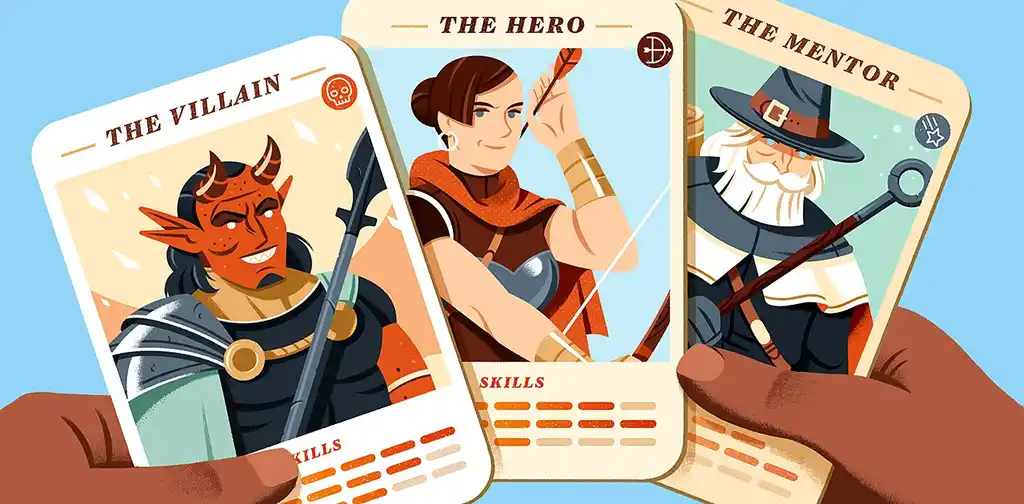
Psst! For more help with characterization when dealing with a large chorus of characters, you can check out our free character profile resource below.
FREE RESOURCE
Reedsy’s Character Profile Template
A story is only as strong as its characters. Fill this out to develop yours.
It’s great for intrigue and suspense
One challenge of writing in first person is knowing how to toe the line between what your narrator knows and what they should reveal. Third person adds a little more distance, making it easier to flesh out main characters or move the story along without divulging information you wish to reveal later on.
Q: What's your number one tip for authors dealing with burnout or writer’s block?
Suggested answer

Refill your creative well! Go watch TV, listen to your favorite songs, play a video game—do whatever you need to do to separate yourself from the book, even if only for a little bit. I've found that a small bit of distance can go a long way towards combating burnout/writer's block.
However, if the block is extremely pervasive (and you're not on deadline), it can also be helpful to briefly shelve a book and work on something that doesn't make you want to slam your head against the wall!
Chelsea is available to hire on Reedsy ⏺
My number-one tip to combat writer's block is to experiment.
Whatever routine you've built for yourself as a writer, try getting out of that routine and see how it affects your ability to write.
If you normally write on your desktop computer, try using a tablet or even writing longhand. Maybe the blank page is affecting you, and dictation will be something worth trying. If you normally write at night after everyone else in your family has gone to bed, try getting up early and writing then, or even snatching breaks during the day for writing time. If you write in longer chunks of time at home, try a coffee shop or restaurant, or if you like to write in coffee shops, try writing at home or in a local park. If you normally write in silence, try putting on music in the background.
Generally speaking, routine is a good thing for most writers, but some books/ideas demand a change of pace, and since we as writers change by virtue of changing as people and growing in our craft, that sometimes mean a routine will change.
Jennifer is available to hire on Reedsy ⏺
When writer's block or burnout arrives, move away from the page without shame. Creativity is not a faucet but a well that must be refilled. Do something that reminds you why you love about stories to begin with: Take a walk, read a treasured book, watch a film that moves you, or simply sleep. Inspiration has a way of returning once you stop trying to make it happen. Be kind to yourself in the process—writing is done most naturally when you permit your mind and spirit to gasp for air.
John is available to hire on Reedsy ⏺

Take a break from the project and do something relaxing that gives you pleasure, especially something physical like a long walk. Sometimes, if you stop thinking about a book, you'll find ideas pop into your head anyway. I'd also advise doing a rough plan of how you see the next part of your book progressing -- this will make the actual writing part easier and less stressful.
John is available to hire on Reedsy ⏺
This lends itself particularly well to thriller and mystery novels, where some holding back certain bits of exposition is essential to heightening the suspense. It can also be useful when writing any kind of novel that wants to deploy backstory or character history at a time when it can have maximum impact.
On the other hand, the third person isn’t just great for characters keeping secrets from the reader. An all-knowing narrator can also be useful for creating dramatic irony, revealing details that the characters don’t know themselves.
GET ACCOUNTABILITY
Meet writing coaches on Reedsy
Industry insiders can help you hone your craft, finish your draft, and get published.
Third person point of view can help you build up your world
A third person point of view can be a great choice when your story requires a certain amount of descriptive worldbuilding. Whilst first and second person narrators certainly talk about their environment, third person narratives can offer a more natural way to include worldbuilding exposition, especially when extended passages of description might be required.
A first person narrator probably might not take the time to intricately describe something they’ve seen a thousand times. If you live in a world where society is ruled by a giant brain from outer space, you probably wouldn’t pause your story to arbitrarily explain the backstory of ‘President Lobularr the Cruel.' But a third person narrator will have no limits to what they might want to zero in on at any point in the story.
Third person POV is a viewpoint that doesn’t distract from the narrative
In its enduring popularity, third person narratives have become the default mode of storytelling around the world, pre-dating even thelikes of Homer (the epic poet, not the animated nuclear engineer). As a result of its long and impressive history, this viewpoint has the benefit of instant familiarity.
Q: How do I know what the best point of view (POV) is for my novel?
Suggested answer
I think it's paramount to keep one thing in mind first: There's nothing wrong with being most comfortable with a given POV and gravitating naturally to one or the other for all or most of your works. If you're primarily comfortable in close third, the story will read more smoothly in close third. That's not to say that you shouldn't ever push yourself beyond your comfort zone, but if you're torn 50/50 and not sure which POV is best for a book, just do what comes most naturally, and chances are readers will feel it's natural to the story.
If you're still not sure what POV to adopt for your novel, though, you have two main options:
The first option is to research your genre a bit more and try to find out if there's a favored POV. Some readers will always prefer first and some will always prefer third--ignore the ones that say their chosen POV is the only one they'll read because you can't please everyone. Instead, look for articles or resources that talk about genre/subgenre conventions and audience preferences. You can also take a glance at recent top-selling books in the genre, and if they're all in close third or all in first, that may answer the question for you.
The second option at your disposal is to experiment. Take a scene that's going to be key to your novel--the climax, a moment of realization for your main character, etc.--and try writing in both first person and third person. Compare the two scenes and see which reads more naturally and/or which one feels more natural to the story and character. Whenever I've been about to write a book and POV didn't feel clear either way, this was the method that ultimately pointed me in the right direction.
Jennifer is available to hire on Reedsy ⏺
Starting a story in third person helps readers settle in right away, rather than asking them to adjust to the particular voice of a first-person narrator or the unusual directness of second person. Ever found a story’s first chapter hard to settle into? This may be because of an unconventional narrative style or unanswered questions about who is doing the talking distracting you. Third person narratives are relatively easy to get into the swing of.
While many writers are keen to develop an utterly unique way of writing, most of the time, readers aren’t looking for something particularly experimental or opaque. In that way, the third person can be a writer’s best friend — a straightforward, versatile, and easily digestible narrative perspective that has stood the test of time.
Examples of third person point of view in action
Now that you know what third person point of view can offer, let’s see a few examples of it in literature. We use a mix of omniscient and limited in the below instances — see if you can identify which is which!
1. Song of Ice and Fire by George R.R. Martin
The morning had dawned clear and cold, with a crispness that hinted at the end of summer. They set forth at daybreak to see a man beheaded, twenty in all, and Bran rode among them, nervous with excitement. This was the first time he had been deemed old enough to go with his lord father and his brothers to see the king's justice fine. It was the ninth year of summer, and the seventh of Bran's life.
The man had been taken outside a small holdfast in the hills. Robb thought he was a wildling, his sword sworn to Mance Rayder, King-beyond-the-Wall. It made Bran's skill prickle to think of it.
Because of its sprawling cast, George R.R. Martin uses third person POV to great effect in his Song of Ice and Fire series. With each chapter break, Martin shifts to a new viewpoint character (while staying in third person), allowing him to span vast gaps in the geography of his world and give insight into each character’s personality.
In this particular scene, Martin’s third person narrator has the flexibility to play this scene through the eyes of a nervously excited seven-year-old while also revealing useful expositional details like the idea of a “King-beyond-the-Wall” and Westeros’s decade-long gaps between winters.
Q: How important is it for first-time authors to adhere to standard word counts, and what flexibility do they have based on genre or target audience?
Suggested answer
In a very loose way, it's important to adhere to genre standards in word count simply because they've developed over time in response to what works best in the market. There are always exceptions, but those are usually backed up by an established author or sweeping support from retailers, librarians, or the media backing the book.
BUT FIRST: write the book you want! This is your book, and you can always edit it down or beef it up. It's important to write for yourself first, because the best story will come out of that. And if you change it later, so be it. Don't let market expectations stop your drafting or creative process!
Grace is available to hire on Reedsy ⏺

It's incredibly important, not because authors shouldn't be able to bend or break the rules, but because these "standard word counts" are systemic. It isn't agents insisting on word counts for no reason; it filters from book buyers to internal publishing salespeople, then to editors and agents.
Having too few words can be worse than having too many. Think about the end goal: you want readers to buy your book. If they feel like they're getting less than they paid for then they won't buy the book. For example, if you wrote 30,000 words when most books in your genre are more like 60,000-70,000 words, then readers looking at your book compared to a competitor might be inclined to think the book that has more words has more heft and therefore is more worth their money.
When it comes to too-high word counts, then you run into a different issue and that's with publishing costs. it costs money to print pages, and if you've written 500,000 words, then that book is going to cost even more to produce (not only the paper in such an extreme case, but also in the binding of that book to make sure it holds up). If it costs more to create, then that can negatively impact publishers' profits. If a publisher is evaluating your work that's 500,000 words versus a similar work that's only 125,000 words, why wouldn't they choose the shorter book? It also takes up less physical space on a bookshelf, so bookstores might be able to keep more copies on the shelf.
Genre and target age range here are the great determining factors. Epic Fantasy, for example, which takes place in a world not our own, usually requires a higher word count for the simple fact that the world has to be built. Nonfiction business books, on the other hand, are usually around 60,000 words, as those readers don't need to be transported to another world, but instead need to have points clearly articulated.
Matt is available to hire on Reedsy ⏺
If you're planning on querying agents and going the traditional route, then adhering to standard word count expectations is essential. Are there exceptions to the rules? Sure, but you never want to plan on being the exception to the rule when you're already going up against long odds.
Querying is incredibly competitive, and an agent seeing that your manuscript is already in the target word count range for your genre tells them that you're probably aware of market expectations and have given real thought to your project's development. On the other hand, if they see a word count that's 20k outside the realm of expectations, that tells them they're either going to have to work with you to get the word count down/up, or potentially have a more difficult time selling your project to publishers.
On the other hand, if you're planning on self-publishing, word count isn't all that important. You don't want to write something the length of a short story and call it a novel, but the important thing in the self-publishing world is to tell a good story. Whether your mystery novel is 30k words, 60k words, 90k words, or even 130k words, your readers won't care as long as the story is great, whereas an agent would likely say no immediately if they saw a query for a 30k or 130k mystery novel, without even getting past that first sentence of your query where they'd see the word count.
If you don't know whether or not you plan to publish traditionally, the best way to set yourself up for success is to research the target word count range for your genre/audience, and then adhere to that expectation as closely as possible. Do be aware that word count expectations can change over time, so you want to make sure that your source for target word count is fairly recent.
That said, if you don't want to put extra pressure on yourself to meet industry standards before you're even done drafting, then there's no reason to focus on anything other than writing the best story you can; then, once you're done, you can take a look at word count expectations, hire a developmental editor to get expert eyes on your novel, and decide from there what makes the most sense for a publication plan.
Jennifer is available to hire on Reedsy ⏺
2. The Vanishing Half by Brit Bennett
The morning Early Jones arrived, the sky hung heavy and hot with rain. From the edge of the couch, Desiree listened to the spring storm as she braided Jude’s hair, remembering those first weeks in new Orleans, duckin with Stella under eaves when the showers caught them unaware. She eventually grew used to the capricious rain, but back then she’d shrieked at every sudden storm, laughing with Stella as they pressed against the side of a building, water splattering against their ankles.
In this passage from The Vanishing Half, author Brit Bennett describes a humid Louisiana rainstorm from the perspective of her protagonist, Desiree.
Instead of telling the reader that “it was a hot, rainy day,” this passage employs several “showing” devices, including strong verbs and sensory descriptions (“the sky hung heavy and hot,” “water splattering against their ankles”). Bennett evokes one of Desiree’s memories packed with specificity — the girls duck under “eaves” rather than just roofs, and the word “shrieked” conjures a very particular sound. The result practically drops the reader next to Desiree as she braids her daughter’s hair, half-lost in a ripple of nostalgia.
Written in third person, this passage is just as intimate and personal as it would have been were being narrated directly by Desiree, once again showing the versatility of this viewpoint.
3. 1984 by George Orwell
In its second minute the Hate rose to a frenzy. People were leaping up and down in their places and shouting at the tops of their voices in an effort to drown the maddening bleating voice that came from the screen. The little sandy-haired woman had turned bright pink, and her mouth was opening and shutting like that of a landed fish. Even O’Brien’s heavy face was flushed. He was sitting very straight in his chair, his powerful chest swelling and quivering as though he were standing up to the assault of a wave.
Like we mentioned earlier, writers who use third person point of view can control “camera angles,” so to speak. Unlike first person and second person, you’re not obligated to remain inside one character’s head. George Orwell takes full advantage of this: he zooms out to give us a snapshot of the entire setting, before zooming back in to focus in on O’Brien in this scene from 1984.
4. Romeo and Juliet by Shakespeare
Come, bitter conduct, come, unsavoury guide!
Thou desperate pilot, now at once run on
The dashing rocks thy sea-sick weary bark!
Here’s to my love. O true apothecary,
Thy drugs are quick. Thus with a kiss I die.
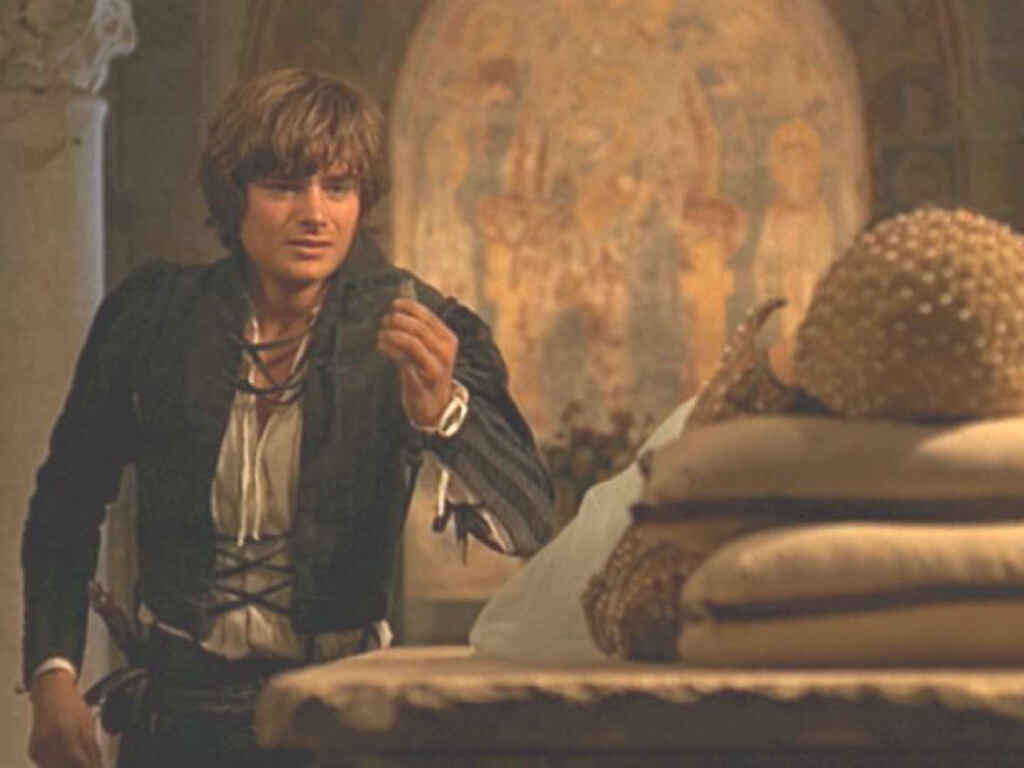
This scene from Shakespeare’s Romeo and Juliet is an effective instance of the dramatic irony that third person POV can offer. Romeo’s just discovered Juliet’s body. Unwilling to live in a world without the girl he has loved (for all of five days), he downs a vial of poison.
At this point, the audience knows that Juliet is not dead — but merely sedated in a ploy to escape her family. The gulf between what the audience or reader knows and what the character knows creates an almost unbearable tension, bringing the story to its climax as Juliet awakens to discover her beloved’s corpse beside her.
When should you use third person point of view?
That brings us to the ultimate question: should you use third person point of view in your own writing?
Q: Should I follow current trends or write the story I’m most passionate about?
Suggested answer

The issue with following current trends is that the trend may be over before you get your book completed and out to the world. If you write what you are passionate about, the story will usually end up being stronger because you are writing a story that means a lot to you, as opposed to writing something just because you think it might sell.
However, you want to be sure the story you are passionate about still has a strong possibility of selling by avoiding cliches and plots that have been overworked and overdone.
Strong stories that readers can relate to will have a good chance of finding an audience no matter the genre.
Melody is available to hire on Reedsy ⏺
If you're planning on publishing traditionally, you need to write the story you're passionate about. The publishing industry is slow slow slow. If you're planning on submitting a query to agents and try for a deal with a big-publisher, it's likely that years will pass between when you start writing and when that book hits shelves. That's the simple truth. Even if you write your book in six months, chances are that it will take at least that, if not a few years, to get an agent, and then the agent will still need to sell that book, the publisher will need to see it edited, etc. etc. Even if you're planning on submitting your book to small publishers who work more quickly, it's likely that a few years will pass because they get so many manuscripts to review that you'll be one of many. Once they accept your work, it may well be a year or two before it's published.
The balancing act comes if you're a self-publisher writing to market in order to make a living. This happens for a rare few writers, but it does happen. Some of my clients make their livings off of books they self-publish, and they often publish 3-5 books per year. They write fast enough that they are able to write to market and follow trends, and it helps them make a living, but it really is a balancing act. You don't want to get so caught up in writing to trends that you lose your passion for writing and get bored or start putting out sub-par work, so it's important that you know who you are and what you want to write, and then you can focus on the trends/markets that relate to your own writing interests without getting needlessly sidetracked. (Note that making a living off of writing in this fashion also depends on you being not only fast and good, but planning ahead--editors, cover artists, etc. all book ahead, so you need to plan in advance in order for everyone to be on the same page and able to accommodate your timeline and catch that trend before it disappears.)
Jennifer is available to hire on Reedsy ⏺

If you write a book inspired by 2025 trends you might find that by the time it's ready for submission and even publication the trend has moved on to something new. It takes a long time to write a book: you have a better chance of sustaining momentum and enthusiasm if you stick to your passion project. I rather believe that readers pick up on that passion too.
Susanna is available to hire on Reedsy ⏺
As always, it depends on your book, and the story that you’re trying to tell. Before committing to third person POV, we recommend asking yourself these questions:
- How ‘close’ to you want to be to your characters? The flip side of third person POV’s flexibility is that it, by nature, keep the characters at an arm’s length. This means it’s not quite as intimate as first person, and you’ll sacrifice some immediacy for freedom.
- How will you reveal plot turns and secrets? In third person limited, the narrator sees and knows everything the main character does, and can reveal things about the protagonist that would not otherwise come out in the first person. Third person omniscient narrators are all-knowing and all-seeing — but they can choose not to reveal details.
- Which genre do you write in? Third person is so versatile that you’ll find it in almost all genres — but some genres may be even better suited for it than others. It’s a prevailing trend, for instance, in mysteries, thrillers, and epic fantasies.
If you’ve decided that you want to try it out, your next question may be which type of third person point of view is right for you. Head on to the next two posts in this series and take our quiz below for the answer.
🖊️
Which POV is right for your book?
Take our quiz to find out! Takes only 1 minute.
In the following posts, you’ll learn even more about which type of third person would best suit your own project, and get tips on how to write in third person to help you create a story that will be enjoyed by many more than three people, as it were.