Guides • Perfecting your Craft
Last updated on Oct 15, 2025
Dialogue Tags: Definition, Tips, and Examples

Martin Cavannagh
Head of Content at Reedsy, Martin has spent over eight years helping writers turn their ambitions into reality. As a voice in the indie publishing space, he has written for a number of outlets and spoken at conferences, including the 2024 Writers Summit at the London Book Fair.
View profile →Dialogue tags are the words that frame dialogue in a piece of writing. These tags help readers identify the speaker, and can convey the emotion, tone, and context of a conversation. For example: in ‘“Thank God,” Alexandra said,’ the dialogue tag is ‘Alexandra said.’
We’ve already discussed how dialogue punctuation works in English, but we’re using this post to look at how you can use dialogue tags effectively:
 Click to tweet!
1. The simplest dialogue tags are often the best
Bestselling crime writer Elmore Leonard stated in his 10 Rules for Writing that a writer must “never use a verb other than ‘said’ to carry dialogue.” While never may be a little extreme, it’s true that, in most cases, said is a sufficient tag.
Even though there are tons of colorful verbs at your disposal, the truth is that you should use unusual dialogue tags very sparingly. While using an alternative, like she called or he muttered, might sometimes be illustrative, it can also be distracting and pull readers out of the conversation. Said blends easily into the dialogue, allowing the actual talking to — well, do the talking.
For example, the two following lines convey pretty much the same thing — though one has a much more conspicuous dialogue tag:
“Have fun at the party!” Sheila said.
vs
“Have fun at the party!” Sheila trilled.
I explain more about why, when in doubt, simple tags are the way to go in the video below. The video also contains a whole host of other tips for improving your dialogue, so be sure to check it out.

Having said that, once in a while, you might want to shake things up. So read on for more dialogue tag fun!
👀
Which dialogue tag are YOU?
Find out in just a minute.
2. You can make ‘said’ more interesting
If you’re bored of plain old said, one of the best ways to balance your use of alternative tags is to simply use said — but make it pop and put a little garnish on it.
On occasion, why not spice things up by adding some extra description in the form of an adjective or adverb.
Q: What common dialogue pitfalls do you often encounter in fiction, and how can writers avoid them?
Suggested answer


I wouldn't say I get frustrated as much as these are things I try to fix or encourage authors to think about.
Not considering how people speak in real life. In real conversation, people use contractions, incomplete sentences, half-baked thoughts, casual grammar. Read your dialog aloud. Does it feel natural to say or is it stiff? Sometimes using a contraction, letting a sentences trail off, or cutting an overexplaining word or two can make a difference. Also, is the vocabulary the character is using appropriate for who they are? A fifteen-year-old girl and her mother will use different words .
Working too hard to avoid said. The word "said" tends to fade into the background in well-crafted dialog, but some writers turn themselves inside out to avoid it with awkward results. While I'm sometimes (just sometimes) okay when a character laughs something or sighs something, at least those are sounds. I draw the line when a character smiles something or nods something, Those are actions, not sounds. You say it nodding or with a smile.
Relying too heavily on dialogue to impart information/overexplaining. Unless there's a specific plot-related reason, a character should not explain or probably even mention something the characters to which they are speaking are likely to already know. You need to figure out other ways to get that information across to your reader.
Using adverbs instead of language, sentence structure, or verbs to impart the emotion behind words. Can you come up with a way to impart anger that doesn't use the word angrily? How about, "he snapped," or "he said, his mouth twisting into a sneer."
Not considering the rhythm of conversation and inserting beats. Conversation isn't always a seamless back and forth. Inserting pauses with small bits of action slows things things down, gives characters time to think, and creates a more natural rhythm. It also allows time to elapse over the course of a conversation so that the cup of coffee the character pours at the beginning of the conversation might be believably finished by the end.
Sophia is available to hire on Reedsy ⏺

I think there are two: overtagging/interruptions, and on-the-nose dialogue.
Overtagging is less about the dialogue itself and more about what's going on around the dialogue. This includes tagging every line with a verbal tag (said, shouted, whispered, asked, etc.) or action/detail, and interrupting dialogue scenes with longer passages of perspective work, action, setting descriptions, and so forth. This can disrupt the pacing and make the dialogue feel choppy, even to the point that the reader can lose track of the conversation. Allow the dialogue to do the work - don't tag every line with a said, don't keep interrupting your characters' conversations. Trust in the reader's ability to follow along, and your own to write good dialogue that drives the plot forward.
On-the-nose dialogue is harder to address as an editor, because it's about how characters speak to each other, but I do come across many writers who will write in therapy-speak or have characters who say exactly what they are thinking or feeling in that moment, without filters. This flattens out the dialogue and makes the characters sound the same, as well as just being unrealistic. I think it's always worth considering how people speak to each other and how this is often dependent on personalities, personal relationships (we won't tell strangers the same things we tell our friends, for instance), and the goals of the conversation itself (speaking to a boss about a project is very different than speaking to a friend about dinner plans). People will use different modes of speech - formal, informal, slang, dialect, etc. - depending on the circumstances. I think the best thing to remember is that characters are people, with pasts and futures, fears and desires, conflicts, differences, similarities, emotional barriers, psychological problems. Let them speak for themselves, and like themselves.
Lauren is available to hire on Reedsy ⏺

I think the biggest issue I see in dialogue is having everyone speak in the same voice/style. Having every person, or even just more than one person, speak similarly makes it feel as if the author's own voice is simply being translated into multiple people, and this is most obvious when it comes to slang or catch-phrases. For instance, there's nothing wrong with the slang/informal word 'anyways' or with a sentence in dialogue starting out with the word 'anyway', but when multiple characters are using that word regularly, or even just using it close together, it all of a sudden starts to feel like everyone is speaking with the same voice.
Now, you might argue that people who live together and know each other well may likely use some of the same phrases, and that's true. I've certainly inherited some phrases/slang from my husband after more than twenty years together! But in fiction, those similarities often come across as making it feel as if a voice is being replicated, so when a character uses any distinct phrase/aphorism/uncommon slang term, it's a good idea to make sure they're the only character in your book using that phrase/term, no matter how rarely or often they use it. The 'search' function in Word is priceless when it comes to safeguarding against issues like this.
Similarly, if you know you have a tendency in dialogue to have a character change the subject or start/end casual sentences with a phrase like 'you know' or 'anyway', try to keep that phrase/word to just that character. Again, the 'search' function is your friend when it comes to issues like this!
Note that this same issue is something you want to safeguard against if you're writing dual or multi-POV works where you're using close third or first person for multiple voices, as the same issue can make it feel like everyone is speaking/thinking with the same voice even outside of dialogue.
Jennifer is available to hire on Reedsy ⏺

Two dialogue pitfalls I usually highlight for revision are:
- Using overly formal language for everyday people in contemporary settings. Most people speak using contractions (can't, won't, you'd, it'll, etc.) – even very posh ones! And I don't think it sounds right when their speech is too stiff and proper. Of course some characters may speak like this - but then you want that to be a noticeable thing about their character!
- I always urge writers to reconsider trying to emulate accents in dialogue, and rather describe how a character speaks and mention they have a particular accent if they do (whether that be a national accent or a social-class accent). Trying to phonetically portray an accent is very difficult to do accurately and I think it can make a character seem like a caricature, which is best avoided. (It also runs the risk of offending your readers, which you also don't want to do!)
Lauren is available to hire on Reedsy ⏺

Perhaps the most frequent trap is dialogue that reads as though people aren't speaking at all—too formal and stiff, or so riddled with affected slang.
Another is when two characters spell out things they both already know for the reader's sake, which reads unreal. Dialogue tags are distracting when they're too numerous or too flowery; typically "said" is everywhere and works best.
Finally, dialogue without subtext—characters expressing themselves exactly as they feel—can flatten a scene. To avoid these traps, read your dialogue out loud for unnatural phrasing, incorporate exposition into action or narration instead of speeches, and leave half the conversation to silence, body language, or what isn't said. Deliberate, natural dialogue moves the story forward without pointing out the machinery.
John is available to hire on Reedsy ⏺
Here are a few examples of said with a common descriptor::
- “I’m in,” she said with a smile.
- “Let’s go,” he said with a sigh.
- “What a great movie!” they said, laughing.
- “I’ll see you later,” he said as he walked away.
- “Same ol’ Billy,” she said, shaking her head.
- “Fine,” he said in an [adjective] way.
Of course, you have endless possibilities and options when it comes to accesorizing said:
- ...he said with a salacious wink;
- ...she said as she crossed her arms;
- ...he said in a forlorn voice;
- ...she said with profound concentration.
You could also try out some adverbs for size, like happily and quickly. However, many writers consider adverbs a mark of purple prose, so keep them to a reasonable minimum. You might use an adverb to modify said in a particularly dramatic situation ("How could you keep this from me?" she said furiously). But otherwise, verbs and adjectives tend to do the trick.

FREE COURSE
How to Write Believable Dialogue
Master the art of dialogue in 10 five-minute lessons.
3. Shake things up with action beats
Another strategy to make more interesting tags work is to break them up with action beats, or descriptions of what characters are doing in the scene.
If you're not familiar with action beats, they’re just phrases that indicate what a character’s doing as they speak. They can be used in conjunction with a said dialogue tag, or be used alone. This is because readers can pick up that the action beat is attached to the dialogue due to its proximity, and therefore that the actor is probably the speaker. For example:
Alice stepped out from the shadows. “Did you forget about me?”
Alice stepped out from the shadows is an action beat that shows the character's movement as she speaks, to signal that she's the one talking.
An action beat may appear before or after a line of dialogue, or even in the middle — just make sure to punctuate it properly. Here are a few more examples of action beats:
Murphy approached the stand and took a deep breath. "The defendant pleads not guilty, Your Honor."
"I was just trying—" I said through clenched teeth, trying to control my frustration, "—to help you out, for once in your miserable life."
"When are we going to the beach?" Sophie looked up at her mother expectantly.
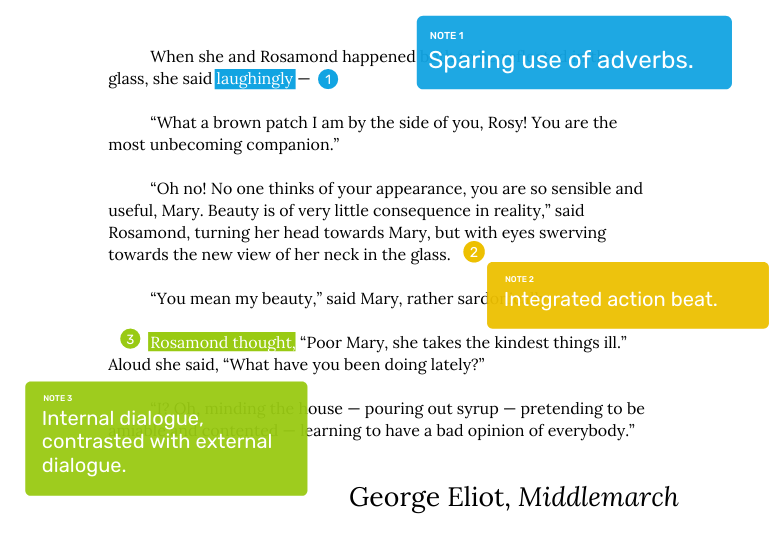
Action beats are a useful alternative to bona fide dialogue tags, and a great way to mix up your scenes. That said, as with other dialogue indicators, you want to keep action beats to a minimum. In a typical scene, you might have one extra-descriptive tag and a couple of action beats. The rest should all be he said/she said and implied speech, to keep the pace moving along nicely. Check out a real-life example below of dialogue from George Eliot's Middlemarch.
4. Not every line requires a tag
Dialogue tags are a bit like chocolate truffles: they’re great but you shouldn’t have one every time you open your mouth. In much the same way, you don't need a tag with every line of dialogue, especially if you've already established who's speaking!
Q: How much dialogue is too much dialogue?
Suggested answer
The exact answer here is going to depend on your style and the tone you're going for, but there are a couple of things to keep in mind if you're worried a scene is getting too dialogue-heavy.
1) A reader needs to be able to keep track of who's talking. If they're losing track of who's talking in a scene, especially if characters have relatively similar voices/speaking styles, that's a sign that you need to cut down on dialogue or build out the scene with more description, action, or narrative/POV.
2) If your dialogue isn't communicating much more than what a film or play script would communicate, that's a sign you're probably relying too much on dialogue. If a reader wanted to read a play or a movie script, that's what they would have picked up! Even if your characters are talking on the phone, there's still room for the character's thoughts and actions.
3) There are rare cases where it's okay for a reader to forget that a character is telling a story, but generally speaking, if dialogue is going on for so long and with so little interruption that a reader can forget it's dialogue to begin with, that might be a sign you want to re-examine how dialogue-heavy the scene is.
No matter how much dialogue you have, remember that readers are going to be more engaged if your characters speak with different voices. Distinguishing them from each other, making sure that no two are using the same rare phrasing, and paying attention to different characters' level of formality/informality will make a big difference in keeping your readers engaged, no matter how much dialogue ends up on the page.
Jennifer is available to hire on Reedsy ⏺
There is no magical number of words that constitutes "too much" dialogue—it's a matter of whether it's serving its purpose for the story or not. Dialogue works best when it's exposing character, moving plot along, or increasing tension. When the dialogue begins to go around in circles and not reveal anything new, or characters are saying what can be shown by action or description, the balance is tipped.
Too much dialogue slows a scene, yet too little renders characters flat or distant. Balance is the key: a blend of dialogue with narrative beats, interior reflection, and sensory detail keeps natural rhythm and flow. Readers should never feel as if they're listening in on filler. When every dialogue earns its place on the page, there's no such thing as "too much."
John is available to hire on Reedsy ⏺
To see why you shouldn't use too many tags, descriptive or otherwise, take a look at the following dialogue sample:
“What are you doing here?” he demanded.
“What do you think I’m doing here?” she inquired.
“You know this isn’t going to work,” he sneered.
"I think you're underestimating me," she retorted.
The descriptive tags here are clearly overkill — you can easily deduce the tone of the conversation without them. But even using he said/she said four times in a row would be unnecessary in this case, as it's only two people speaking. A much-improved revision would be to keep just one tag, and identify the second speaker in a more indirect way:
“What are you doing here?” he demanded.
She stepped across the threshold. “What do you think I’m doing here?”
“You know this isn’t going to work."
"I think you're underestimating me."
The reader doesn't need many tags to see that this conversation is between two people. It's only in lengthy conversations of more than two that you may need to use said multiple times. And even then, you should still keep your "alternative" tags to a minimum, as they distract from the dialogue itself.
5. Try out an interesting synonym for size
If on the odd occasion you do want to get more experimental with your dialogue tags, then we’ve got just the resource for you. Our list of 250+ other words for said contains pretty much every synonym you could ever need, handily categorized by mood and tone.
Some of our favorites include:
Hypothesized
Maintained
Quipped
Chortled
Blubbered
Whatever you’re trying to express with your dialogue, you’ll find an appropriate tag in there.

FREE RESOURCE
Get our Dialogue Tag Cheatsheet
Upgrade your dialogue with our list of 270 alternatives to “said.”
6. Don’t force a word that doesn’t fit
You might be raring to use all the exciting new tags you pick up from our “words for said” post (and who can blame you? Vociferated is a great word). But it’s important to not only be sparing with their use, but also to make sure that, when you do use one, it’s perfectly chosen.
Q: What habits separate professional writers from aspiring ones?
Suggested answer
Professional writers treat their craft as both art and discipline. They write even when inspiration isn’t there, revising and refining instead of waiting for the perfect idea or mood. They finish what they start, pushing through doubt and distraction to deliver polished work on a schedule. They also seek and accept feedback, understanding that growth comes through critique, not avoidance. Instead of clinging to every word, they prioritize clarity, impact, and the reader’s experience. Above all, they build consistency—showing up at the page day after day—turning passion into practice. Aspiring writers dream; professionals do.
John is available to hire on Reedsy ⏺
Nothing is more distracting to readers than when a word just seems off. This is why, when you do use a descriptive dialogue tag, it needs to fit the situation perfectly.
While this tip might sound obvious, editors can attest that odd verbs in dialogue tags are all too common. For example:
“I never want to see you again!” he exclaimed.
That might seem like a good place to use the word exclaim, since we know it means to say something loudly. However, the underlying connotations of exclaim are a bit different — an exclamation is usually a positive shout of surprise, not a negative one. Better tags for the dialogue above might be:
- “I never want to see you again!” he bellowed.
- “I never want to see you again!” he roared.
- “I never want to see you again!” he snarled.
All of these depict the tone more accurately than exclaimed. And again, you don't even really need such a descriptive tag, as the message here is pretty clear.
But if you do decide to use one, make sure you know what it actually means! This is where our list comes in handy — you know exactly which words are associated with which emotions and scenarios.
Reedsy editors are dialogue masters. Meet them here:

Marie O.
Available to hire
Award-winning UK author/editor with over twenty years' experience , working with many of the top names in the SF/F/H/crime genres.

Aaron L.
Available to hire
I am Editor in Chief of a literary publication and former English professor who loves all forms of creative writing—both poetry and prose.

Katie B.
Available to hire
As both a Pitch Wars mentor and a freelance editor, I combine a knowledge of the publishing industry with expertise in the writing craft.
“We hope you’ve enjoyed this how-to on dialogue tags,” the mysterious writer concluded. “If you’re looking for examples of dialogue tags in action, you can check out 15 examples of great dialogue analyzed, to see how the pros do it!”