
Guides • Understanding Publishing
Last updated on Jan 19, 2026
How to Write a Query Letter [+ Free Template]

Rebecca van Laer
Rebecca van Laer is a writer, editor, and the author of two books, including the novella How to Adjust to the Dark. Her work has been featured in literary magazines such as AGNI, Breadcrumbs, and TriQuarterly.
View profile →
Isabella Peralta
A writer and editor, Isabella coordinates "Prompts," Reedsy's weekly short story competition. Originally from the Philippines, she is a graduate of the University of Cambridge.
View profile →A query letter is a formal letter sent to a literary agent to gauge their interest in representing your book for publication.
In this guide, we'll break down exactly how to write a query letter that gets results. You'll learn the essential components of a query letter, see excerpts from real letters written by successful authors, and get templates you can adapt for your own book.
Here’s what a successful query letter should include:
| Element 🧩 | Purpose 🎯 | Word count 📊 |
| The Hook | To grab the agent’s attention | 2 sentences (up to 40 words) |
| The Synopsis | To quickly pitch your book’s story | 2 to 3 paragraphs (up to 250 words) |
| The Proof | To show why they should want to work with you | 2 sentences to 1 paragraph (up to 100 words) |
Now, let's dive into each element and see how to craft a query letter that stands out.
1. Craft a compelling hook
Start your letter with a basic salutation (“Dear [Insert Agent’s First Name]” is perfectly fine!). Following that, you’ll want to pique the agent’s interest right away. That’s what your hook is for.
The hook sets up your book's essential information and premise in a couple of punchy sentences. It should include:
-
Your book's title (in ALL CAPS or italics)
-
Total word count (rounded to the nearest thousand)
-
Genre (be specific: "psychological thriller," not just "thriller")
-
One-sentence premise and/or comp titles to contextualize your book in the wider market
Every agency reader wants to know these details right away. Most importantly, they need to understand whether your genre/subject matter fits with the projects they’re currently looking for. In that vein, they will also want to see if your word count aligns with market expectations.
Q: How should writers research literary agents ethically and effectively before querying?
Suggested answer


Doing a deep Google search on target agents is actually a smart process, assuming the search relates to their professional endeavors not their private life. On platforms where agents are listed by genre, it's usually a database dump that doesn't highlight the specific interests of a given agent. Websites are professional, but also not terribly deep. Publisher's Marketplace often demands a fee to obtain significantly useful information. Social media highlights perspectives, which gives you a feel of the agent's personality or position on current events within and outside of publishing.
A deep Google search can reveal very useful things: interviews with agents on blogs, articles agents may have provided to organizations, positive and negative remarks on given experiences with agents, occasional deals they've worked out that are unique or exemplary, tips and tricks they've offered to beginning authors, and so forth.
Choosing an agent, or agreeing to work with an agent who has offered, is a very personal choice. Ideally it is a long-term choice viewed as a mutual partnership for success. Any and all information you can find about how their views on publishing, their views on the author-agent relationship, helps to better evaluate whether they align with you. You may find that the "Number One Agent Ever" simple isn't a personality match with you, via remarks they've made in an interview, or he/she feels very different than you on certain publishing subjects. Sometimes even value statements might make a difference. Working with a stranger can be awkward and difficult in the beginning, and anything you can glean to better understand who you're about to work with is beneficial. You, and the agent, want to enjoy working together. Weeding out people who just don't "click" keeps everybody happy.
Claire is available to hire on Reedsy ⏺

Professional research is absolutely necessary to determine whether an agent is a strong fit. What authors do they already represent? What books have they landed successful deals with recently? If they have a professional social media account, they are likely posting the types of books they like to read or advice about how to reach out to them. This is all healthy, necessary background research to ensure you're not wasting your time or theirs. They likely receive hundreds if not thousands of manuscripts, so if they're talking about how to stand out from the crowd, you should be listening.
But boundaries certainly exist and people will establish them intentionally; if their social media account is private, for example, it's likely wise that you don't request to follow if you don't know them personally!
Holly is available to hire on Reedsy ⏺
💡 Real-life excerpt
Author Lynn D. Jung — whose debut novel, Mothsblood, will be published in fall 2026 following a five-way publisher auction — mentioned popular books Babel and Ninth House at the start of her successful query letter: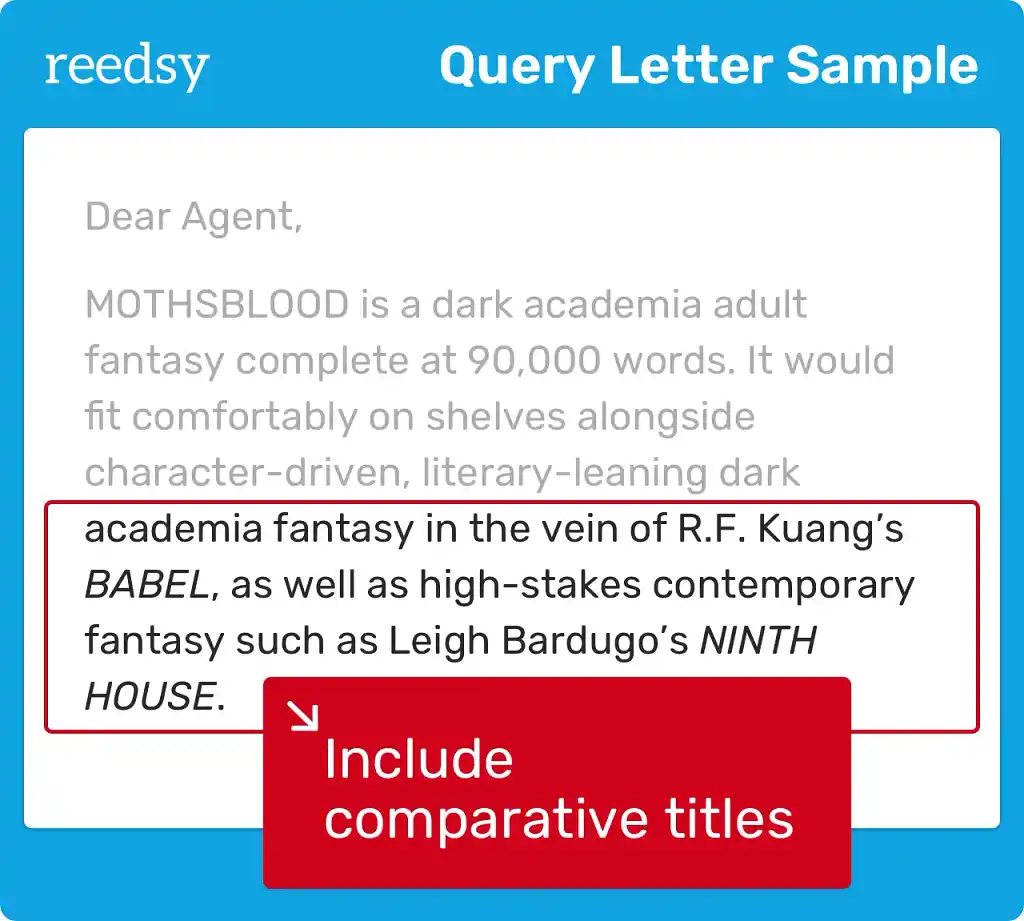
This hook works because it:
-
Gives the essential info (title, word count, genre)
-
Positions the book as both character-driven and plot-driven
-
Shows the author has done her research on the market
Q: What’s your number one tip for choosing effective comp titles?
Suggested answer

There are two kinds of comp titles: sales comps and editorial comps. An editorial comp is meant to convey the spirit of your book. It can be recent or old, it can be in the same genre as your book or not, it can be in another age range, it can even be a movie or a TV show instead of another book! An example might be starting your query letter by saying "Anne of Green Gables meets Star Trek in this contemporary middle grade novel about a girl adopted by the crew of a spaceship." Editorial comps are meant to tell agents and editors what they can expect from the content and tone of your book.
In contrast, sales comps are meant to show where your book fits in the current market. Your goal is to convince agents and editors that readers will want to buy your book by pointing them to similar books that have sold well. Sales comp titles should be recent (published in at least the last five years, but two years is better!). They should be in the same genre (if you write horror, only comp to other horror books. If you write romance, only comp to other romances). They should also be in the same age range (this is especially important if you write middle grade or young adult books. Always check the listed age range for a book: if it says it's for readers in the 8 to 12 range, then it's middle grade. If it says it's for readers in their teens, then it's YA).
When you write a query letter to agents, always try to include two or three sales comp titles. It's a great way to show agents that you pay attention to the market and read widely, and it's a chance to show agents that your book has a good chance of selling.
Camille is available to hire on Reedsy ⏺
🪝 Alternative hook ideas
However, you don't have to follow that exact formula. Here are two other approaches:
The high-concept hook
Lead with a “what if” premise that makes your book unique. Here’s one for C.S. Lewis’ The Lion, the Witch and the Wardrobe:
THE LION, THE WITCH AND THE WARDROBE is a children’s fantasy novel complete at 38,000 words. What if stepping through an ordinary wardrobe could transport you to a world trapped in eternal winter — where your arrival has been prophesied for a hundred years?
You have a magical world and hints of an ancient prophecy fulfilled. It's certainly an exciting concept worth reading more about.
The character-first hook
Start with your main characters and why we should care. Let’s look at a potential hook for Taylor Jenkins Reid’s bestselling novel Daisy Jones & The Six:
DAISY JONES & THE SIX is a 90,000-word historical fiction novel about the whirlwind rise of an iconic 1970s rock group and their beautiful lead singer, revealing the mystery behind their infamous break up.
Right away, you have a cocktail of fame and power that begs the question: why did the band decide to split at the peak of their career?
Now that you’ve “hooked” the agent, it’s time to reel them in with your book synopsis.
Q: What are the key elements of an irresistible query letter hook?
Suggested answer

Hooks should always include:
- Stakes. What is on the line here? In quieter or more character-driven stories, this is still important. The stakes might not be life and death, but they need to feel emotionally powerful.
- Main character: a sense of who this story is about
- The hero’s / heroine’s journey: Our protagonist is on a mission. What is it?
- The story world: What is the context for this journey? In SFF, the author has to be careful not to get too into the weeds here; it’s about broad strokes.
- Antagonist or antagonistic forces: What obstructs the protagonist from easily completing their mission?
- Voice: Any time we write a logline, query, build a hook, or write a synopsis, we have to make sure our unique authorial voice shines through.
Happy writing!
Wendy is available to hire on Reedsy ⏺
2. Build a powerful synopsis
The synopsis is where you tell your story in 2-3 tight paragraphs (up to 250 words). Consider this a strategic reveal of your book’s strongest elements: show Acts 1 and 2, then tease Act 3.
🖼️ The 3-paragraph framework
Here's how to structure your synopsis:
| Paragraph 1: Setup + Inciting Incident | Paragraph 2: Rising Conflict | Paragraph 3: Climax Teaser |
|
|
|
💡 Real-life excerpt
Let’s see how this works in RJ Valldeperas’ query letter for her debut novel. RJ secured a six-figure deal with HarperCollins for her Inca-inspired YA fantasy, Their Will Undone, which will be published in summer 2026.
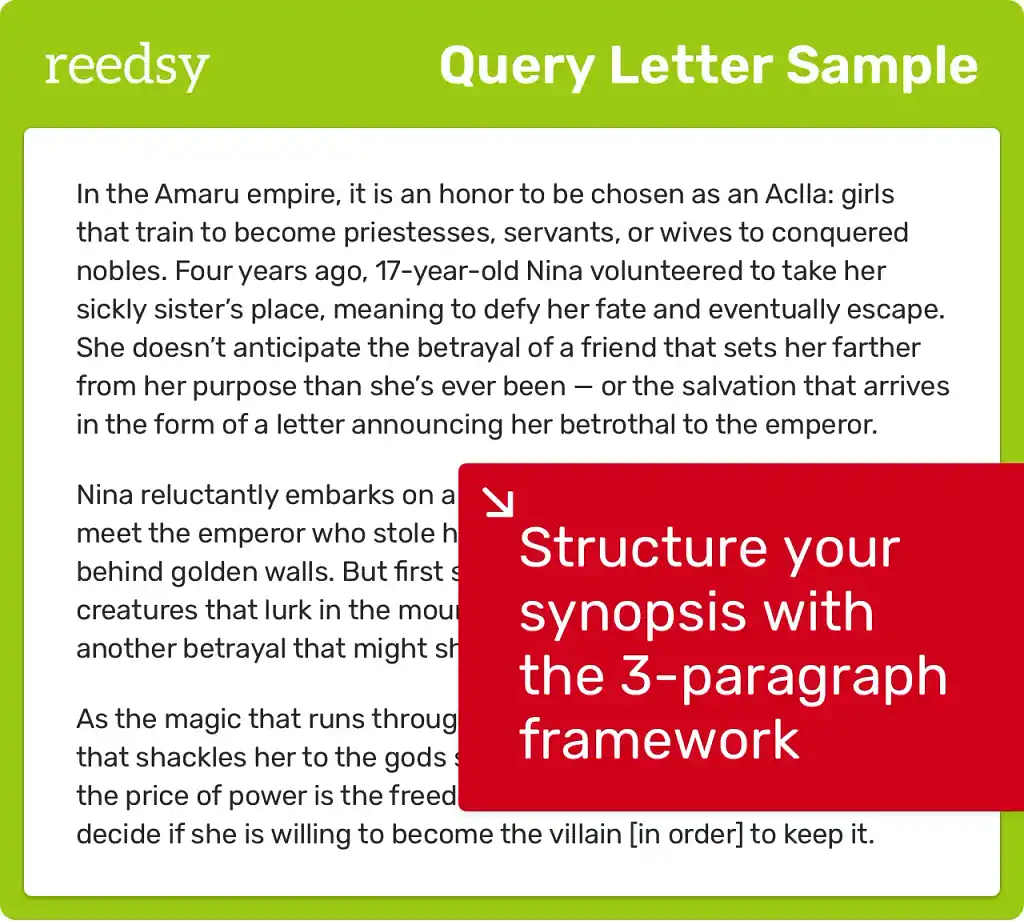
Note how this synopsis:
-
Establishes the setting, protagonist, and world quickly
-
Has a clear inciting incident that changes the protagonist’s life forever
-
Raises the stakes (terrible creatures, unexpected betrayal, etc.)
-
Ends on a cryptic note to make the reader curious about Nina’s decision
Q: What are the most common mistakes authors make in their query letters, and how can they improve them?
Suggested answer

One of the most common issues I see in query letters is the tendency to skip over who your main character is as the book starts. You want to show the agent who they’re going to be reading about and give the agent a reason to care about what happens to them. That’s your first paragraph (not including personalization or comp titles if you choose to put those at the top). Spend two to three sentences describing your character, their personality, their future plans, their desires, etc. That way, when the agent gets to the second paragraph and you throw chaos into the picture, they’re already thinking, Wow. How’re they going to deal with that?
Example:
Sixteen-year-old farm boy Luke Skywalker would do anything to leave his uncle’s dinky desert farm and attend fighter school with his friends. The evil empire is rising, and he wants to do his part to make the galaxy safe. But until his uncle agrees to foot the bill, Luke’s stuck cleaning the farm’s droids, a far cry from the adventure he seeks.
With an opening like this, you’ve established who we’re rooting for, his desires, and his ultimate goal. In the next paragraph, you can then drop the inciting incident, i.e. the thing that gets the story rolling.
Example:
Mary Collins is free of her wretched husband, their divorce finalized after a grueling three years where he fought her on every detail. Finally, Mary can leave the city where it was so important they live and return to her hometown. Helping her mom run the corner store while catching up with friends and family is the bliss she seeks as she starts over, now free of the myriad of obligations that came with being the governor's wife.
My guess is that Mary's going to find she's not so free of her past life once that second paragraph comes around. But because we know that's her desire/goal, it makes it that much more meaningful when the query then continues to throw havoc her way.
Giving us info about the character is important no matter your genre and age category.
If your book features a police officer, give us a bit of their background so we understand their current situation. That way, when chaos reigns, we know why that particular wrench is so bothersome. If a cop is trying to get promoted, being thrown into a big case is a dream/chance to show off. If a cop is near retirement, the last thing they want is to be trapped in a big case. Without knowing the main character’s background, your query is all about plot and you’re losing the character.
Agents, like readers, want to root for someone. They want to become invested in your character—so give it to them. Show them who they’ll be reading about and make them care. Then in the rest of the query, you can weave in those plot details and stakes.
Kim is available to hire on Reedsy ⏺

I like seeing the title, genre and comp titles at the top. Often, writers hide this info in the final paragraph. I want to know immediately what this book is and what it's about, along with where it could sit in the market. It quickly tells me if this book is for me and if the author even knows what their book is about.
Another misstep is writing far too much in your plot paragraph. It really should only be 1-2 short paragraphs. Think plot/premise/payoff. This is probably the hardest part for writers. You are very close to your own work and might feel overwhelmed by condensing the entire narrative into a handful of sentences. When I receive a query, I'm looking for your main character, their world, what has changed in their world, twists or turns along the way, and even a question you might have for the reader.
For bonus points, add a logline before your plot paragraph(s). It's an efficient way to hook the person you're querying.A query letter should be no more than one page. Finally, look up the agent or editor's name and address it to them with the correct spelling. First names are preferred. It feels old-fashioned to address a query with Mr, Mrs, Ms, etc.
Ariell is available to hire on Reedsy ⏺

A lot of query letters are too long. An agent will spend perhaps one minute scanning through your query letter, so make it easy for them to find the important stuff. And don't spend too much of your word count on the summary! The goal isn't to tell the agent everything that happens in the book; the goal is to mention enough selling points and hooks that the agent is intrigued and starts reading your sample pages. This means one, maybe two paragraphs of summary, in the basic format: "[Protagonist] wants [motivation], but [obstacle] gets in the way. They'll have to [challenge] if they're ever going to achieve [stakes]."
Nora is available to hire on Reedsy ⏺

I think that authors are sometimes so keen to get on board with a particular agent that they forget to keep their letters concise and professional and often volunteer personal information and background information that doesn't have a place in a query letter. The other thing I often see is authors including what almost amounts to a full synopsis of their book, whereas this should be presented in a separate document.
Vanessa is available to hire on Reedsy ⏺

Three words: be more specific.
The standard advice used to be: look to a book's back jacket description for an example of how to describe your book in a query letter. The truth is, over time, the trends in queries have evolved AWAY from what's used on the back cover of books. Book jacket descriptions tend to be more vague, and focus on general claims like, "a thrilling coming of age story." Also, book jacket descriptions often end with rhetorical questions like, "Will Eva find love before it's too late?" but rhetorical questions in a query tend to be an agent pet peeve.
Most of all, agents don't want to hear that you have a "sweeping love story." They have 50 other sweeping love stories in their inbox right this instant. They want to hear the SPECIFICS of your setup, conflict and stakes to know how your love story stands out from the others, or they'll be getting out the broom to sweep your query right back out of their inbox!
Michelle is available to hire on Reedsy ⏺

A couple of the most common areas I see authors make mistakes in their query letters include:
- Not using proper query format
- Making the Book section (what your book is about) section either too long or too short.
While there is some variation on a query format, the one I like to use is the Hook, Book, Cook method.
- Paragraph 1 is your Book. What the title of the book is, the word count, why you decided to pitch the agent, comparable titles, etc
- Paragraph 2-3 is the Book. Think of this like the blurb on the back of a book or on Amazon. You want to give agents just enough information that they want to know more, but not give the ending away. That's for the synopsis, as is going into greater detail about the character and story. For the query, focus on the primary characters with their primary goals and motivations, the overarching conflict and villains, and set up the stakes of what the heroes will lose if they fail
- Paragraph 3-4 is the Cook. You as the author! If you don't have any prior writing credits, that's okay. Include a short paragraph about what you like to do, or what you enjoyed about writing the book. If you do have prior writing credits, try to only include those that are most relevant to what you're pitching (example, it's likely not applicable to share that you had an article in a cooking magazine if you're pitching urban fantasy, unless that ties in some way).
When writing the Book section of the query, I often recommend to authors to go into their local bookstore and seek out books in your genre with descriptions you like. See how they introduce characters, conflict, what details they do (or don't) include. Emulate them with your own story. Queries can be difficult, but with practice they do get easier!
Sean is available to hire on Reedsy ⏺

Common mistakes in query letters:
- Not saying what your book is about and why your target audience will love it.
- Remaining a secret writer by not sharing who you are, your background, and your writing experience.
- Giving away too much of the story: Mr. A hates Mr. B and winds up killing him.
- Making assumptions about the publisher, the books it publishes, and those it doesn't.
- Making unrealistic promises: This book is going to be a best seller with 500,000 books sold this year.
Barbara is available to hire on Reedsy ⏺

There are a few common mistakes you can avoid when writing your query letters. Here are some "do's" and "don'ts."
- Include only your first and last name in the query. The agent has your email address, and that is the address they will use if they wish to contact you. Do not include any other contact information (unless requested).
- Address the query letter as the agent stipulates on their website. If they do not specify their preferred salutation, use their first name and last name, e.g., "Dear Jane Doe."
- Make your first sentence about what you and the agent have in common (e.g., "Dear Ms. Smith, On your website, you say you like working with authors who (fill in the phrases the agent used), so I'm excited to present my (state your word count, genre, and BOOK TITLE IN CAPS)."
- State your comps (competitive or comparative titles) in your first paragraph. With your comps, try to use one book that this agent represented. Don't use best sellers as comps. Don't use books published over 2 years ago (and not over 3 years) as comps. Be current. Do your research. If you can't find recent comps, do more research. Read every book you use as a comp. (As you read your comps, make notes about how each comp is like your book, and how it is not like your book. You'll need this information for your book proposal (for nonfiction), and you'll need to talk about this with the agent when they call you.)
- Make your query letter 300 words. Why? Because a 300 word count is industry standard. Because 300 words is what many agents allow for their online submission forms. Because 300 words (single-spaced) will fit on one printed page, in case the agent prints out your query. Because if you can write an interesting query letter in 300 words, the agent will know you're a pro.
- Format your query according to industry standards: single-spaced, left justified, 2 spaces between paragraphs. No tabs or indents. No bold or underlining. Put your book title in CAPITAL LETTERS.
- When emailing your query, always drop your letter into the body of the email. Never send it as an attachment, unless requested. Don't send a query snail mail unless requested. Write in the email Subject line as directed (e.g., "Query - Title of Book - Name of Author.")
- Don't follow up on your query letter (unless an agent has invited you to submit to them). If you have sent an unsolicited query, if an agent says on their website their response time is four to eight weeks, and at eight weeks you haven't heard from them, query other agents (but not in the same agency). No response from an agent is a "No." Don't take it personally ... just move on. Your perfect agent is out there, waiting for your query letter!
I wish you every success with querying.
Michael is available to hire on Reedsy ⏺

One big mistake is querying the wrong agent. Sending your 90,000 word adult fantasy to an agent who specializes in literary nonfiction will only result in a rejection. This does not mean that you do not have an amazing story, but rather that that particular agent cannot best service that particular story. As a writer, make sure to do your research to find the best agent for your work.
Hope this helps!
Samantha is available to hire on Reedsy ⏺
You've sold them on your story. Now it's time to prove that you — the author — are worth the investment.
3. Mention your qualifications
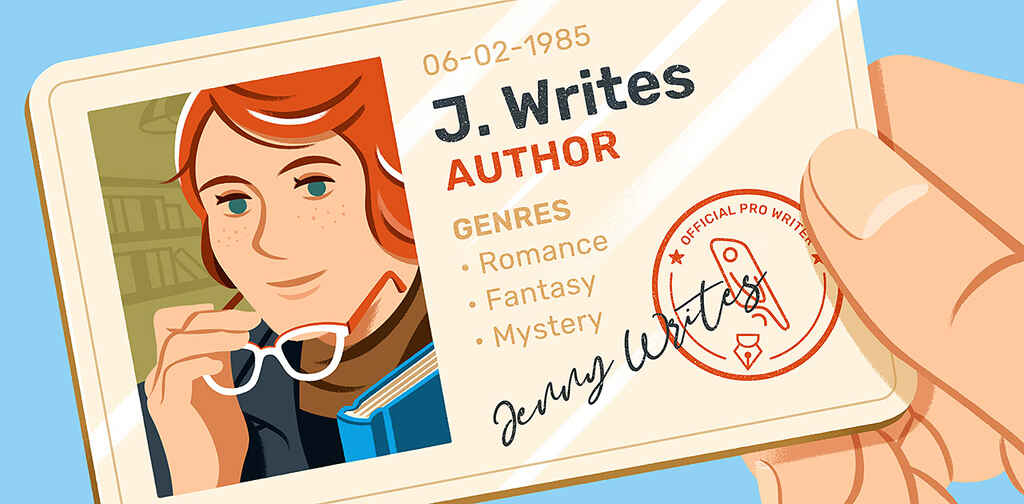
After your synopsis, write a short author bio to show what you’ve accomplished as a writer. This will give the agent a little bit more context about your publishing experience and potential.
Q: Do agents and publishers consider publications in literary magazines or awards from writing contests when evaluating an author?
Suggested answer

Yes, they absolutely do! One of my friends recently got a publishing offer for her picture book from a relatively informal online contest. So, it happens! Contests with a large online community aspect also help writers connect with each other, and this is so important for a writer in the long term.
Short story publications in prestigious magazines are an important part of how writers in the literary genre build their careers. This also goes for publications in magazines or newspapers that carry prestige in any genre. The New York Times' Modern Love column has launched a couple memoirs. I would say, though, that these magazines are struggling to survive amid the noise of the internet.
For non-fiction and memoir writers, getting published in outlets that are relevant to your target audience can help build your "platform"--your authority on a topic, and how big of an audience you can tap into. You can often take chapters or excerpts of your book and send them out as essays to various publications. Even if an agent or publisher doesn't see these articles, listing those publishing credits in your proposal will help prove your authority on the topic.
Tracy is available to hire on Reedsy ⏺
📋 What to include in your bio
Relevant publications and awards
-
Literary magazines, journals, anthologies
-
Self-published books (only if they sold well — mention sales figures)
-
Essays, articles, or columns related to your book's subject
-
Nationally recognized awards or contests with thousands of entries
Writing credentials
-
MFA or writing-related degrees
-
Major writing workshops or retreats (Tin House, Bread Loaf, etc.)
-
Membership in professional organizations (RWA, MWA, SCBWI)
Professional expertise relevant to your book
-
If you're a therapist writing a psychological thriller, mention it
-
If you're a lawyer writing a legal drama, mention it
-
If you spent 10 years in the restaurant industry and wrote a novel about it, mention it
Platform (if substantial)
-
10,000+ social media followers
-
Popular newsletter or podcast
-
Significant speaking engagements
Besides your accomplishments, you can share some relevant info about your background and why you’re the right person to write your book.
❤️ Reveal a personal connection
Finally, while not mandatory (and not always applicable), you might reveal a personal connection to your subject. For example, here’s what Sonora Reyes said in her query letter for The Lesbiana's Guide to Catholic School:
I've written largely from my own experience as a queer first-generation immigrant who attended a Catholic high school.
Agents are often looking for unique and culturally relevant perspectives, so you can leverage yours as a selling point.
✏️ But a simple bio is fine
At the end of the day, if you’re just starting out, it’s perfectly okay to write: “I live in Poughkeepsie with my wife and three kids. This is my first novel.” Many agents are open to debut authors and will mainly judge your letter on the story premise.
💡 Real-life excerpt
RJ Valldeperas’ compelling bio mentions not just her background, but also the inspiration behind her highly anticipated book.
I’m a Peruvian/Venezuelan writer born and living in South Florida with my husband and children. This book was inspired by my Peruvian ancestry and the Maiden of Llullaillaco, a girl who was sacrificed in the name of her gods. I couldn’t help but imagine a different story for her, one in which she has the power to change her fate and destroy her enemies.
Now that you have all the essential ingredients of your query letter, let’s customize it and perfect the finer details.
4. Personalize your query
Querying is a numbers game, and so you’ll likely have to send dozens of letters before finding representation. While you might be tempted to blast agents with a one-size-fits-all letter, a bit of personalization can help you stand out.
🤝 Make your personalization meaningful
Personalization only helps if it shows you've done your homework and aren't querying indiscriminately. The key word here is meaningful. It should be something specific that only applies to the particular agent who will receive this query.
✅ Meaningful personalization looks like:
-
Referencing their client list
I am a huge fan of your client, Michael Chabon. The setting of The Yiddish Policemen’s Union was a major influence on my novel.
-
Citing their (specific!) wish list
I saw on your website that you’re looking for cozy mysteries geared towards millennial readers. For this reason, I thought that Murders and Avocado Toasts might fit well on your list.
-
Mentioning something they’ve said in public
I saw your presentation at the Literary Writers Conference last year, and your comments on the dearth of female protagonists in fantasy really resonated with me. My book attempts to redress that.
❌ Weak personalization (skip these):
-
"I saw on your website that you represent thrillers."
-
"QueryTracker says you're accepting queries."
These statements could apply to dozens of agents and add very little value. If you can't think of something truly specific and meaningful, skip personalization entirely.
📍 Where to include it in your query
If you have a strong referral or a conference meeting to mention, lead with it right after your salutation:
Dear Carrie,
Your client, Anna Park, suggested I reach out after reading an early draft of my manuscript.
OPERATION KILL is a 92,000-word crime thriller about...
You could also include a brief personalization note after your bio:
...This is my debut novel.
I read your interview on the Ploughshares blog, in which you discuss wanting to represent more psychological thrillers with strong female leads. I thought my manuscript might fit the bill.
If you have a legitimate connection to mention (referral, conference meeting, specific wish list match), absolutely include it. But don't waste time inventing connections or reading everything an agent has ever written to manufacture personalization. Remember, your story premise matters far more than anything else.
The finish line is in sight now. Let’s bring it home with some final tips on formatting, signing off, and submitting your query letter.
Q: How does personalizing a query letter improve request rates, and what should be tailored?
Suggested answer
I'm more concerned with whether your query letter hooks me: I want your title, genre, word count and comp titles at the front. I am even curious to know why you are the exact person to write this book (e.g., 'I'm an arctic research scientist so I set my locked room mystery in a research base', etc). You can put info about yourself in a very short about section in your sign-off paragraph. That said, it doesn't hurt to include something specific to me. For example, suppose you listened to an interview where I said I'm interested in finding a particular type of novel that yours fits with, or you connected with something I posted on social media. In that case, it's good to include this. It makes me think you are keen to work with me and aren't just randomly querying. But with that said, as long as you address the letter to me and then write a strong, gripping query and telling me a small amount about yourself and what that means to you as a writer, I'm less concerned about you including extra personalisation directed at me.
Ariell is available to hire on Reedsy ⏺
The baseline requirement is that you need to address your query to the agent's name; "Dear agent" letters sent out as shotgun emails to five hundred agents will get rejected quickly. Beyond that...my usual suggestion is to offer one or two sentences at the beginning of the query letter showing that you've done your homework. This can be as simple as "I saw on MSWL that you're looking for more multi-POV novels," or "I saw on your agency website that you're interested in cozy fantasy." This shows that you're respecting the agent's time by making sure that what you're sending is aligned with their tastes at the most basic level. Agents know that you're probably querying about ten people at once, and they're receiving perhaps hundreds of queries a day, but the personalization makes it a little more likely they'll spend some extra time looking at yours.
Nora is available to hire on Reedsy ⏺

I think a personalized query letter achieves the same aim as a piece of handwritten, personalized mail: it shows the sender has put thought and intention into what's enclosed.
As a small-press publisher, I certainly understand that manuscript submitting is a numbers game. Authors have every right to query their manuscripts to dozens of publishers and agents simultaneously. But no one wants to be treated like a row on a query tracking spreadsheet! Dear Sir/Madam, to whom it may concern, generic language about the submission's fit within my company's catalog of publications: these tactics suggest the author is taking a slapdash approach to submitting.
Conversely, when a submitting author can demonstrate their familiarity with my press, it comes as a huge relief to me. Of course, I don't expect every submitting author to buy a copy of book I've published before firing off their manuscript. But if an author can reference a title from my manuscript wish list, or if they address me by name, or if they can say in 1-2 sentences how their book aligns with my company's mission statement, then that goes a long way!
Kevin is available to hire on Reedsy ⏺
Because many authors want to increase their chances of representation, most send out lots and lots of queries letters all at once using some form of template (Dear Agent, I'm seeking representation...). While using a template like this does cut down on time, some agents get hundreds, if not thousands, of query letters a month! What's a way you can stand out from that? Personalize the query.
Agents want to know that you, the author, not only have a good book worth pitching, in the genre the agent works in, but that you have put in the time and effort to learn why they specifically would be a good fit for your work. An author-agent partnership is not a one and done thing, but ideally and ever-growing relationship that starts by being a good fit for one another. And so, showing that you researched them by personalizing a query expresses that:
- You have done your research for that particular agent, and so take your craft seriously
- You know what they represent so are pitching them in a genre they actually represent
- Have likely researched their other clients so you have a reasonable idea of whether you might fit well with them.
On top of this, if you meet an agent at a conference or writing-related event, mention that! Again, agents get many, many queries, so if they ask you to send them stuff, or you spoke to them, remind them where you met them, and any relevant details related to your work you might have discussed. This will hopefully set you off on the right foot and be the start of a wonderful author-agent relationship.
Sean is available to hire on Reedsy ⏺

Personalizing a query is a great way of letting agents know that you've researched their tastes and interests, which also conveys that you're taking a professional, well-considered approach to querying and the industry itself. When you let an agent know that you've chosen them specifically because of the clients and/or books they represent, because of their online presence, or because of an interview they've given, it shows them you've taken the time to learn who they are--which also means it's likelier that you're sending them a manuscript suited to their tastes.
Salima is available to hire on Reedsy ⏺

Although writing queries is more an art than a science--and it can often feel like screaming into the void--if you take the time to carefully research potential agents, editors, and publishers, then your odds of approaching an appropriate one for your project (i.e., someone who would be interested in it), are far higher. Being able to demonstrate that research by being able to personalize your query will make you stand out in a good way. Conversely, if you send out copycat queries blind, you're less likely to wind up in front of someone who will resonate with whatever you're pitching. "Personalizing" includes using correct basic info (name, title, company, etc.), but also appealing to relevant aspects of the recipient's professional and personal background, from the types of books they typically represent (or what kinds of articles they publish if you're pitching mags) to whatever hobbies they may have that dovetail with what you're writing about. In other words, personalizing can't possibly hurt and might just help.
Lisa is available to hire on Reedsy ⏺
It’s like junk mail vs. "real" mail. When I get an envelope with an advertiser's name, I usually toss it aside, thinking I don't need a new garage floor or whatever they're selling. But when I get mail addressed to me personally from a real person, I'm much more likely to want to know what they have to say.
Barbara is available to hire on Reedsy ⏺
While some advisors might suggest that one generic query letter is appropriate for all agents, my best advice is that you personalize every query you send. This means researching every agent, finding out what authors and books they have represented, and then using at least one "comp" (comparative title" / "competitive title") on that agent's (or their agency's) roster. When you do this, the agent knows that:
- you are querying them because you're familiar with their work and you know your book is a fit for them,
- your book suits their agency's roster, and
- you have done your homework.
When writing a query letter, follow the agent's submission guidelines precisely. For example, an agent named Jane Smith might request on her submissions page that she be addressed as "Ms. Jane Smith." So, if in your salutation, you write, "Dear Jane" or "Dear Ms. Smith," that is instant notification to the agent that you haven't read (or haven't followed) her submission guidelines. Will that mean you won't follow her directions if she signs with you? Agents get literally hundreds of queries every month. Don't give an agent a single reason to reject your query.
Some agents care a lot about personalized query letters, and other agents accept that some authors prefer to send out generic letters. Since you don't know which agents have which preferences, it makes sense to personalize all your query letters.
Happy querying!
Michael is available to hire on Reedsy ⏺
In my experience, personalizing a query letter shows a few things:
- Your interest in working with that particular agent. This increases their interest in your project and your agent-author relationship.
- Your knowledge of the market and targeted marketing. As a writer you don’t need to be a pro at this, but showing your ability to promote yourself displays valuable skills that can be used later for things like author events.
- Your research skills. Showing that you are good at finding the right agent showcases your research skills which may come in handy for your work, particularly if it’s nonfiction.
Hope this helps!
Samantha is available to hire on Reedsy ⏺

It shows you've done the hard work of doing research and aren't submitting to just anybody. It adds a personal touch and hopefully will make you stand out from the rest of the crowd. If you can reference a book or two represented by the agent, and compare it to the book you have written, you will bolster your argument for approaching this particular agent. This research takes time, but I believe that, in the end, it can make a difference in helping your query stand out.
Ken is available to hire on Reedsy ⏺
5. Format cleanly and sign off
Agents reject queries for formatting mistakes more often than you'd think. Before you send anything, double-check your documents according to each agent’s submission guidelines — otherwise your query could be disregarded automatically (and regrettably).
The two main methods of sending queries are online submission forms (e.g., QueryManager) and email (e.g., Gmail or Outlook). Many authors prepare their letters in a Word or Google document, then copy-paste the text in the submission form or the email body. However, you may also be instructed to send your letter as a Word or PDF attachment.
✍️ How to end your query letter
After your bio (and optional personalization), you need a professional closing. Keep it simple and gracious — this is not the place to oversell yourself or make demands.
Thank you for your consideration. I look forward to hearing from you.
Sincerely,
Your Name
No muss, no fuss. Just thank them and sign off!
📝 Keep it simple
Whether you're querying by email or online form, keep things straightforward with your formatting:
-
12-point Arial or Times New Roman font
-
1.5 or double line spacing (for readability)
-
Separate paragraphs with a single blank line
-
Avoid indented paragraphs, colored fonts, or excessive bold and/or italic words
Similar formatting rules apply to the first few chapters of your manuscript, which authors are often asked to send alongside the letter. Use the template in our downloadable query kit below to ensure your letter is ready to impress.
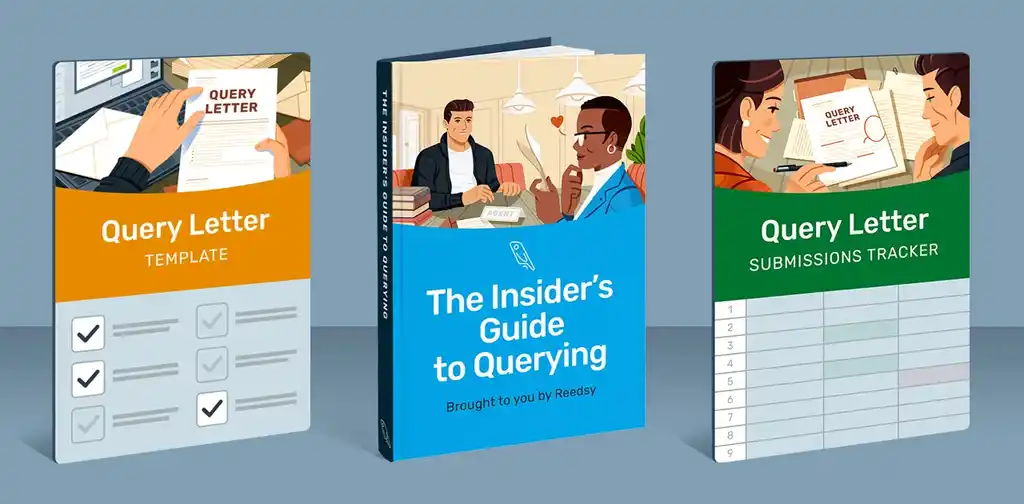
FREE TOOLKIT
Get everything you need to query
Download our agent-approved ebook + submissions tracker + query letter template.
✅ The final checklist
Run through this query letter checklist before sending each query:
Basic details:
-
Agent's name is spelled correctly
-
No [INSERT NAME HERE] placeholders remain
-
Title, word count, and genre are accurate
-
No typos or grammatical errors
Submission compliance:
-
You've followed their specific guidelines
-
Sample pages (if requested) are formatted correctly
-
You're querying the right agent at the agency
-
You haven't queried this agent before with this project
-
You’re not querying two or more agents from the same agency simultaneously
Professional polish:
-
Your contact information is current
-
Email address is professional
-
All links work (if you included any)
-
You've removed any tracked changes or comments
Q: When is it appropriate for authors to follow up on query letters, and how long should they wait before doing so?
Suggested answer

Check with the agency's or agent's guidelines on this; often, there will be something on the website or on the query form that will say something like, "If you don't hear back within X weeks, consider it a pass" or even, "Please wait X weeks before following up." Always follow the guidelines.
Unfortunately, it can take a long time to hear back--there are many more authors out there than there are industry professionals, and there just isn't as much time to dedicate to queries as we would like (it's also unpaid time). Most agents won't mind receiving a nudge, but I recommend waiting at least 3 months/12 weeks before doing so (unless they specify otherwise on their website). Keep it short and friendly and professional as possible. If they specify on their website not to nudge, please be respectful and don't nudge.
An exception would be if you have received an offer of rep or an offer to publish by an indie press. If that's the case, congratulations! Typically, you would contact any agent that still has your query (especially if they have requested pages) and give them a timeframe (usually about 10 days to 2 weeks) to get back to you by. (Please do not nudge with an offer of representation if you have not actually received an offer, though.) That way, they have the chance to prioritize your manuscript and counter with an offer, if they love it enough.
Sadly, if you don't hear back in another few weeks after a nudge, it's likely a pass, and I don't recommend nudging again.
Kathleen is available to hire on Reedsy ⏺
6. Hire a professional editor for a query letter review
Finally, if you want to guarantee that your query letter is firing on all cylinders, you can get a query letter review from a professional editor. This will ensure that every part of your letter is perfectly honed — and that you aren’t getting disqualified for totally avoidable reasons.
Q: How do editors and agents evaluate whether a manuscript has commercial and craft potential?
Suggested answer

Potential is usually obvious in the first few sentences. The quality of the writing, pace and tone particularly, are evident from sentence one. But structure is important too, and if that's not in place, no amount of fine writing is going to fix it. So fine writing + tight structure (whatever these things look like in any given novel) is the clue that the manuscript has potential.
Potential is all about a writer being in control of their material. A writer I feel confident in from page one. The sense that although the manuscript isn't perfect and needs work, the writer fundamentally knows what they are doing. I look for a tone that fits the genre. This is really important, and often it's not working in manuscripts. Good pace is important too, again whatever that looks like in any given novel. This is often determined by the genre. For example, thrillers are pretty much defined by their fast pace, yet I've read many manuscripts described by their writers as thrillers that simply aren't, often due to slow pace.
Potential in a manuscript is always an exciting thing to find as an editor, and it is usually evident where a writer understands their genre, its pace, and its tone. That is a very strong start!
Louise is available to hire on Reedsy ⏺

The first thing I consider in a manuscript is how well the first line caught my attention and made me truly care. Even if is subconscious, readers are passing judgement on a piece immediately. This is why the first line is absolutely vital to setting up a successful manuscript. Unfortunately, most people have a very short attention span, and over 500,000 new fiction books are published each year, leaving no shortage of choices for readers. If a writer is adept at capturing an audience in just one line, it tells me they likely understand storytelling and know how to craft a narrative with a compelling voice.
Beyond this, I see potential in consistency. By this, I mean I always look for consistency in the voice throughout a manuscript and for characters to remain consistent in their choices or motivations. If characters are constantly doing strange and out-of-character things, it tells me the work is not well planned or fully developed. I look for plot consistency as well: is the central problem remaining the central problem, or have things drastically shifted somewhere along the way? If it has shifted, it is a sign that the original plotline/idea may not have been strong enough to carry the story.
I hope this helps! There are quite a few other small things I look for, but these are the two biggest ones I can typically spot right away.
Ciera is available to hire on Reedsy ⏺
Why is getting a query letter review from a professional so much better than, say, having a friend read it over? Well, you’ll be able to work with an editor who’s actually been an acquiring editor for a publisher — or maybe even an agent themselves. This insider industry knowledge can be a game-changer for authors struggling to sell their books.
And compared to most editing costs, the cost of a query letter review is a real bargain — most Reedsy editors charge between $50 and $250 for this service. Since a compelling query letter could be your gateway to a generous advance and lucrative publishing career, it might be the best return on investment you'll ever get.
Get an expert editor to review your query letter

Helen L.
Available to hire
Literary Agent and Developmental Editor. I represent incredible authors at Ki Agency. My editorial focus is on Fantasy, Sci Fi and Romance.

Michael S.
Available to hire
Versatile editor of award-winning fiction and nonfiction with 20+ years' industry experience.

Ian S.
Available to hire
I'm an Australian writer and editor living in Greece. Apart from books, my passions are walking, swimming, wine, and photography.
That concludes our post on how to write a query letter! To see more query letter examples, check out Part 3 in this series. We've posted letters from a range of genres that have been reviewed and improved by our very own Reedsy editors.
16 responses
Cheryl Charlesworth says:
02/11/2017 – 18:19
Best damn post this side of the Altantic....thank you.
↪️ Reedsy replied:
02/11/2017 – 23:23
Aw, thank you! Glad you liked it!
Olga GOA says:
02/11/2017 – 20:22
Hello. But how to find this agent? :D
↪️ Reedsy replied:
02/11/2017 – 23:24
Ah, that's where the research comes in. In the next few weeks we'll be following this post up with another one that will be all about researching agents. Watch this space, as they say :)
Mandy Suhre says:
12/11/2017 – 05:16
I write screenplays and poetry. Can anybody help with that? Please and thank you, Mandy (Suhre) Brown
↪️ Sadie Francis Skyheart replied:
28/08/2019 – 15:57
What Reedsy does for authors, ScreenwritingU does for screenwriters. If you haven't checked it out, I highly recommend!
Aleksandr says:
07/12/2017 – 14:59
At first glance, the recommendations are worth it to be read. You have perfectly divided everything into parts: grab the attention of the agent, write a brief overview. If our experience in such letters is not great, but you really want to get the result from such a letter, then it is better to go to a professional. Of course, is cool when you all know how. But sometimes, some things should be transferred to another, for the sake of result. You can write great articles like Neil https://neilpatel.com/blog/, or books like https://en.wikipedia.org/wiki/Stephen_King. But in attracting the attention of the agent can be much more difficult. After tens of unsuccessful attempts, I went to https://writingpaper.org/. I was perfectly satisfied with the work, and I got several meetings with agents that I needed. So sometimes it is important to distribute your efforts correctly.
Cher says:
31/07/2018 – 20:46
Thank you, thank you! This post is extremely helpful!!
jturkish says:
27/01/2019 – 23:13
Sorry folks, aside from the advice to pander to the audience in the first lines of your query and manuscript (which I don't agree with. If your manuscript is good you don't have to pander, have some respect for yourself and your audience! Besides, Gone Girl and especially Twilight, aren't very good novels,) and that your Synopsis should read like a Query Letter (I was trained that a Synopsis or Outline is just that, your entire novel as distilled as possible, ex: a two hundred page novel described completely in less than five pages, a description.) This is the exact same advice I've had in every other publishing column I've ever read, and what I foolishly spent twenty thousand to learn in college. Unless you are an absolute grass roots beginner, save your eyes, your time, and your sanity, for reading Agent's biographies and expectations instead of reading this column. And if you are a grass roots beginner (looking at you college creative writing class kids out there, of whom this page seems aimed at), do another edit on your book, or write another novel entirely. Get some experience under your belt, enjoy being an artist, join your school's society of uber geeks, drink beer, talk about your favorite books, read and critique each other's manuscripts, talk about your favorite Simpson's episodes, meet some very interesting people and incorporate them in your novels; before spending all your free time trying to break into the subjective rat race that is writing at a professional level. Don't worry, the writing biz will still be here when you graduate.
janis hutchinson says:
25/06/2019 – 20:52
I wish you also had an article describing a nonfiction (mine is Christian) query letter. Is there one somewhere?
Chloe says:
07/08/2019 – 19:29
When should I be worried if the agent doesn't respond back?
↪️ Yvonne replied:
08/08/2019 – 01:43
Hi Chloe, agents are very busy, so it could take a couple of weeks to even two or three months to get a response. Some literary agencies have guidelines posted on their website on when to follow up on an unanswered query — check those, as it could be helpful.
Chloe says:
07/08/2019 – 19:30
When should be get worried if the agent doesn't respond back?
Sadie Francis Skyheart says:
28/08/2019 – 15:58
Excellent advice. :-)
B.L. Alley says:
04/11/2019 – 19:56
As usual, this advice is geared toward those who already have a foot in the door.
↪️ Martin Cavannagh replied:
05/11/2019 – 14:14
Not really, to be fair... most agents will tell you that they will, at various points in the year, be looking through the "slush pile" for new authors to represent. These steps are designed to help totally unknown authors stand out from the countless authors who submit overlong, unfocuses query letters.