Guides • Perfecting your Craft
Posted on Nov 04, 2024
Man vs. Man: The Most Popular Conflict in Literature

Martin Cavannagh
Head of Content at Reedsy, Martin has spent over eight years helping writers turn their ambitions into reality. As a voice in the indie publishing space, he has written for a number of outlets and spoken at conferences, including the 2024 Writers Summit at the London Book Fair.
View profile →It’s Batman and the Joker, Matilda and Miss Trunchbull, Goodies and Baddies! In this article, we’re talking all about “Man vs. Man conflict” and how it forms the basis for a huge chunk of stories across this history of literature. After working through a definition, I’ll show you some of my favorite man-on-man face-offs and give you some tips for writing this type of conflict yourself.
So, who’s up for a fight?
 Click to tweet!
What is man vs. man conflict?
Man vs. man conflict in a story describes the antagonistic dynamic or struggle between two (or more) characters, fuelling many of the stories we enjoy over our lifetimes. Usually it takes place between the protagonist and antagonist, and you'll find it in many different contexts, from a physical face-off to psychological warfare.
At the end of the day, from fairy tales where witches prey on innocent children to superhero blockbusters where Iron Man faces off against a space warlord, this is the most elemental story: one person wants something, and another person wants to stop them from getting it.
Q: Does every story need a clear-cut antagonist?
Suggested answer


Yes or there is nothing for the protagonist to push against or overcome. The story will just drift along on a happy cloud, which is nice for real life but not very interesting to read. However, an antagonist can be any number of things. It can be an aspect of the protagonist's personality. It can be a memory. It can the difficulty of reaching a goal. It can be society. It can be a pandemic. It can be the weather. It can be a whale.
Sophia is available to hire on Reedsy ⏺

It depends on your story. A clear-cut antagonist is one specific, highly effective way to personify opposition. A traditional villain can be a powerful tool for delivering a focused, action-oriented, and emotionally resonant narrative. But … not every story is like that. So, no, not every story needs this, exactly. Yet every compelling story needs an antagonistic force that creates conflict or represents an obstacle, getting in the way of the protagonist's goals.
You can have antagonism in various forms, such as inner demons, addictions or trauma. Nature, the environment, or illness. A corrupt system, prejudice, even machines, time! What about destiny?
They all pose nuanced conflicts without a central 'bad guy,' they're sometimes ambiguous, and they explore moral complexities. They all hold a different kind of mirror to your concept. Your antagonist challenges your protagonist, forcing them to grow, reveal true character and values. Whatever form they take, they ought to be the perfect day to your night, or vice versa. Clear-cut becomes a question of who or what is best suited to the challenge.
Agatha is available to hire on Reedsy ⏺

In some genres, readers may expect a clear antagonist (for instance, mysteries and thrillers generally have a clear antagonist, as does young adult SFF), but not every book will need one.
What's important, instead, is that every story needs to have tension, and that tension has to come from somewhere. Maybe it's a serial killer or a world-class villain, but maybe it's just the nerves of a young girl trying to figure out how to survive in the normal world, or the desire of a teenager to be a professional athlete even though the odds are stacked against them.
Another way to think about this is to consider that a story needs stakes. Why should the reader care about the story you're telling or the character centered on the page? Whether you're writing a plot-driven or character-driven story, or balancing the two drives, your reader needs a reason to keep turning pages. An antagonist--or, rather, the fight against such an antagonist--can serve that purpose, but depending on the type of book you're writing, you may simply not need one.
There are also books where, rather than having a single clear-cut antagonist, you'll have many! I just read a mystery graphic novel, the first in a series, where the young protagonist had many people in her life who served as antagonists. No one person/character was the primary antagonist, but it worked really well because the reader was connected to her thoughts/desires, her goals, and her attempts to unravel the world around her. In this case, having multiple antagonists--and even a few characters who were very definitively in gray territory, maybe on her side and maybe not--was exactly what fit the bill.
Jennifer is available to hire on Reedsy ⏺

Every story needs an antagonist, but I think that every writer's definition of an antagonist will differ a bit. For one character, they are fighting a literal dragon. For another, it's the "dragon" of addiction, a storm while climbing a mountain, or their relationship with their mother. I know that sounds cheesy, but the story has to have stakes for the reader to care. Usually, stakes come with a fight to victory, a pathway of challenges -- a hero's journey. And it's hard to be a hero without an antagonist.
But clear-cut? No, I don't think so.
Grace is available to hire on Reedsy ⏺
Also known as character vs. character conflict, it can co-exist with other types of story conflict. For example, a story about a food cart operator being hounded by a tax auditor could be about interpersonal conflict as well as the fight between an individual and modern society (represented by that government employee).
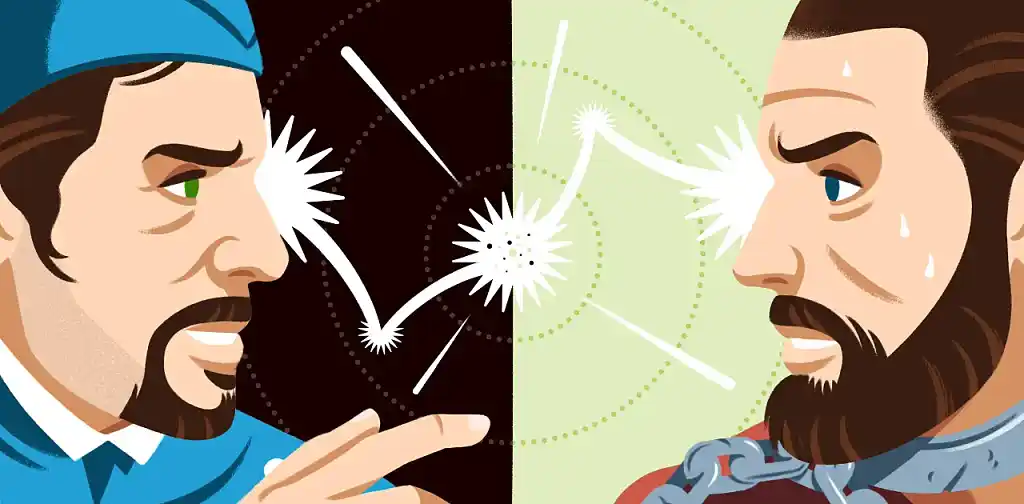
I suspect that the reason why this type of conflict is so common boils down to how well it works in a visual and visceral sense. Just think about a boxing match, a courtroom argument, or a playground battle of wits over who gets to go down the slide first: it’s easier for readers and audiences to relate to those real-world conflicts than to think about abstract conflicts like “man’s unease with technology”.
Most of the stories we’re exposed to these days are about a protagonist who’s up against a nemesis, so it’s understandable that we can reduce this kind of conflict to just “good guys vs. bad guys.” But that doesn’t have to always be the case.
It doesn’t just have to be heroes and villains
Just because an antagonist is trying to stop the ‘hero’ from getting what they want, it doesn’t necessarily mean they’re villains or even in the wrong. The places where you’ll often find man vs. man conflicts that aren’t good-vs.-evil stories can include:
Anti-hero narratives where the protagonist is morally gray and the antagonist is either on the side of ‘good’ or a fellow villain. Example: Walter White vs. Gus Fring or Hank Schrader in Breaking Bad.
Dual narratives where there are effectively two protagonists — and depending on whose story we’re following at any given time, the other character will be the nominal villain. Example: Christopher Priest’s The Prestige (and the film of the same name) is told through the diaries of two feuding magicians in the late 1800s. The reader’s sympathies will change depending on whose perspective you see things through.
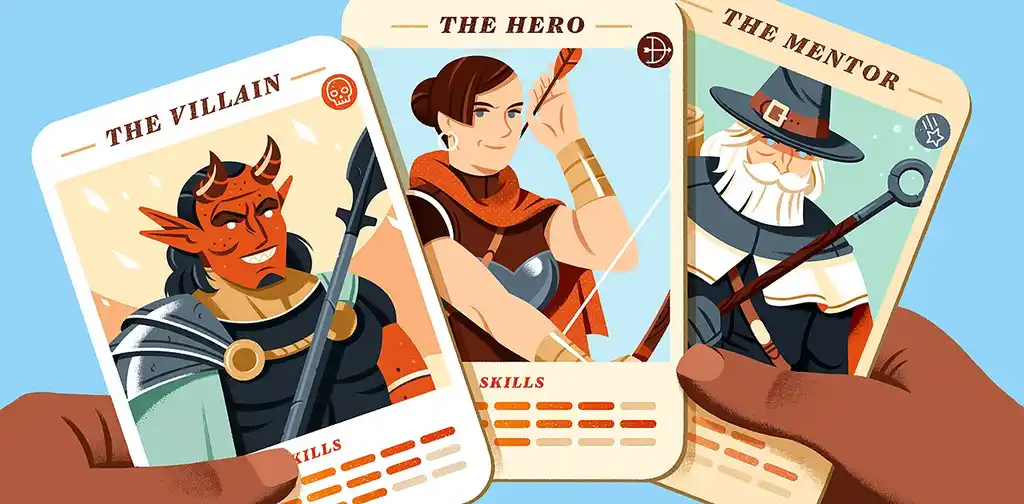
FREE RESOURCE
Reedsy’s Character Development Template
A story is only as strong as its characters. Fill this out to develop yours.
And then you also have stories in which there aren’t necessarily any antagonists — ones where the protagonist might be their own worst enemy. Many romance novels see our hero face a rival who has done absolutely nothing wrong apart from pursuing the same love interest.
So now that we know what we’re looking for in a man vs. man conflict, I want to share some of my favorite examples to show you how diverse this dynamic can be.
Examples of man vs. man conflict
So, let’s start with some classic examples of heroes versus villains before moving to some less popular ones.
Star Wars (Luke Skywalker vs. Darth Vader)
For his 1977 original, writer/director George Lucas took inspiration from Joseph Campbell’s theories on mythology and crafted a story that follows the Hero’s Journey to a tee. Here, we see our hero — a young farmboy dressed in white — venturing out to an unknown world to save a beautiful princess from the villain, an old robot man dressed in black. Only one of them can win the day!
Q: What’s the best way to overcome writer’s block?
Suggested answer
The harsh truth is that there's no one best/true method for overcoming writer's block because writer's block is so unique to each person experiencing it. The effect of it--not being able to write--may be the same for everyone, but the causes are as varied as the writers experiencing it. That said, here are some strategies.
1) Try to figure out what's driving your writer's block. Did it start when you began considering a particular scene/character, or when some new stressor came up in your personal life? If you can figure out the source of your block, that may give you the path toward overcoming it. For instance, I worked with a writer who suddenly hit major writer's block when she was approaching a fight between characters in her Romance novel. What felt like garden-variety writer's block at first didn't resolve after a few days like it normally would for her; after weeks, she still hadn't managed to write another word. Ultimately, we talked it over and she realized it was because she'd based the characters too much off of her own relationship, and approaching the fight was causing her serious anxiety in her personal life. The solution in her case? Tweak one of the characters and the source of the fight so that she no longer felt like she was projecting fiction onto her real future.
2) Sometimes writer's block happens because a writer needs time to think. If you're stuck--especially if this isn't your first project, and the writer's block is worse than usual--take some time out to think about your project. For many writers, daydreaming is a serious part of the writing process. It may be that you need to give your project/next scene some more time to percolate before you're ready to write it. Worse comes to worse, try taking a break and writing something else or reading outside your genre, and that may give your conscious mind to catch up to your project's needs.
3) If you're midway into a project and you suddenly get blocked, consider what's just happened and what's to come. If the block is happening because you're stressed about what's about to happen in the book, your only option may be to force yourself through it (this can especially happen if what's coming up in the plot is personally triggering for you and you're planning to write it anyway). On the other hand, writer's block often happens because a writer has made a misstep in plot or character development--a plot point happened earlier than it should have, a character did something out of character, etc. Sometimes, backing up a few scenes/chapters and rethinking those last few decisions can help you realize where you went wrong, and once you back up, the writer's block will take care of itself.
Jennifer is available to hire on Reedsy ⏺

The best answer here is the most common (and maybe annoying!) one: the best way to overcome writer's block is to write.
If you're struggling to put more words on the page, the only way to truly get through that is to keep writing. Even if you need to open up a separate document to write a completely different scene with the character, the act of writing, the consistency of it is the best way to not only motivate yourself to keep writing, but also to keep the ideas and creativity flowing.
Matt is available to hire on Reedsy ⏺
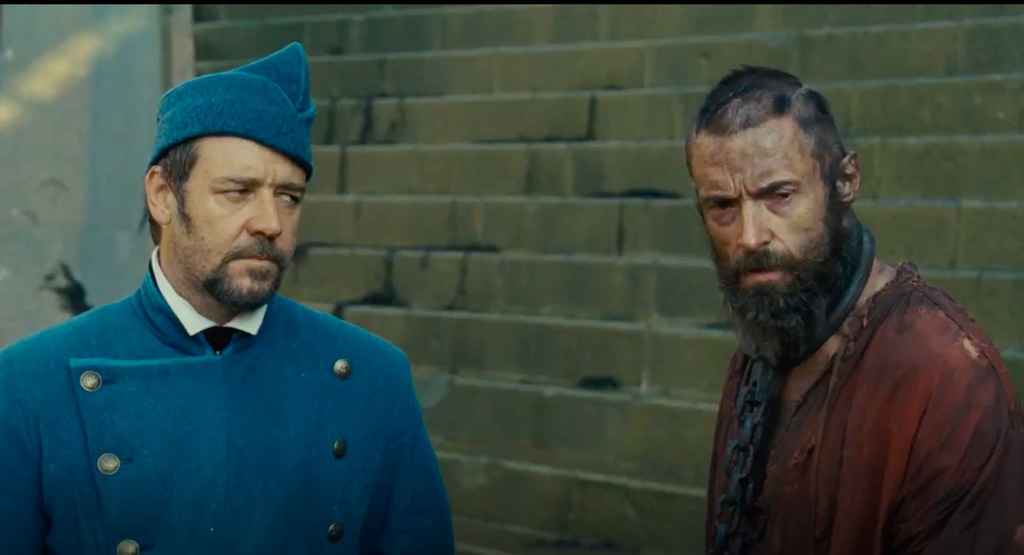
Les Misérables (Jean Valjean vs. Javert)
Former convict Jean Valjean restarts his life with a new identity, seeking to create a more just society for the underclasses. He is discovered and pursued by the dogged Inspector Javert, whose fanatical devotion to the law has blinded him to the actual injustices perpetrated by the system.
Rebecca (The Second Mrs. de Winter vs. Mrs. Danvers)
After a whirlwind romance with an English Aristocrat, a naïve American woman arrives in Cornwall as the new lady of Manderlay, an opulent coastal estate. But no sooner than she drops her bags at the doorstep, she is met by Mrs Danvers, a frosty housekeeper who’s still intensely obsessed with the first Mrs. de Winter, who died on a sailing trip less than a year before. Convinced that her employer’s new wife intends to replace her beloved Rebecca, Mrs Danvers starts a sneaky campaign to undermine the second Mrs. de Winter.
Catch Me If You Can (Frank vs. Carl)
In the film adaptation of con man Frank Abagnale’s spurious memoir, the audience is invited to enjoy the illegal hijinks of young Frank (Leonardo Dicaprio) as he cashes forged checks and fools people into believing he is an airline pilot or a doctor. His main antagonist is FBI Agent Carl Hanratty, with whom he’s engaged in a cross-country cat-and-mouse game. The fact that Hanratty is played by The Nicest Man in Hollywood™️ Tom Hanks helps to humanize the Feds and even out the audience’s loyalty.
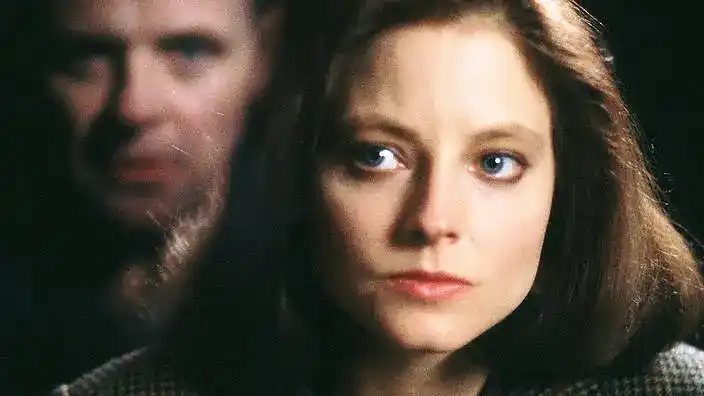
The Silence of the Lambs (Clarice Starling vs. Hannibal Lector)
Sent by her supervisor to interview a genius serial killer behind bars, FBI trainee Clarice Starling is tasked with getting Lector’s help to find an active spree killer. Engaged in a battle of wits where conflict bristles just under the surface, Clarice must figure out what Lector knows — and what he wants from her — before it’s too late.
Animal Farm (Snowball vs. Napoleon)
Tired of how poorly their farm is run, two young pigs stage a coup and seize control of their farm in the name of their fellow animals. But what starts as a utopian idea of equality among animals soon goes awry as one of the pigs, Napoleon, starts hogging all the power and begins a purge of all the animals who he believes to be in support of Snowball, the other piggy hero of the revolution. Written as a retelling of the Russian Revolution, Animal Farm’s Napoleon is an obvious replacement for Joseph Stalin — a leader who had no shortage of enemies (real and perceived) and was embroiled in many man vs. man conflicts!
Q: How do I write dynamic and believable relationships between characters?
Suggested answer

Convincing, alive relationships grow out of the manner in which characters shape each other over the course of time. Rather than relying on labels—friends, enemies, lovers—show how their aspirations, vulnerabilities, and values engender tension or sympathy.
Let them question, misinterpret, encourage, or let each other down. Real relationships aren't initiated; they evolve through conflict, revealed vulnerability, and small gestures toward change. Dialogue must exhibit familiarity, shared background, or tension without words.
Most importantly, every character must be fully fleshed out regardless of the relationship. When each has their own agency and internal stakes, their relationship does not feel contrived, but real. Real relationships are established through action, not explanation.
John is available to hire on Reedsy ⏺
And that’s just the tip of the iceberg. Looking at any novel, playtext, or film, you will find plenty more examples of interpersonal conflict. After all, people dealing with other people is the very core of drama.
So, if you’re a writer, how can you ensure that your man vs. man conflict is firing on all cylinders?
3 tips for writing man vs. man conflict
No matter what medium you’re working in, here are three tips that will help you get the most out of your character conflicts.
1. Make sure your antagonist is believable
Having a villain who just does bad things for the sake of being evil is not very interesting. Even if your bad guy is trying to embezzle money from a care home, give them a believable reason for doing it. (Maybe she needs to provide for her aging parents? Or maybe she believes the care home residents are lizard people from outer space?)
GET ACCOUNTABILITY
Meet writing coaches on Reedsy
Industry insiders can help you hone your craft, finish your draft, and get published.
2. See your antagonist as a reflection of your hero
The best villains often share similar goals to our heroes — they simply have a different way of achieving those goals (Harry and Voldemort are both talented wizards from an early age). By making your antagonist a reflection of your protagonist, you can dramatize what might be going on in your hero’s mind and highlight how they’re more virtuous. Creating this symmetry can also help to humanize the antagonist, which always makes for a more interesting story.
3. Let your characters actually meet each other
This might sound obvious, but if you’re pitting two characters against each other, try putting them together in scenes. There are many examples where protagonists and antagonists don’t meet until the final scene (Rocky, Star Wars). Still, those stories richly benefitted from sequels where these characters interacted a lot more. So, find some way for them to have a conversation, and you’ll be richly rewarded with a strong, tension-filled scene.