Blog • Understanding Publishing
Posted on Dec 22, 2025
The Best Audiobook Production Services of 2026

Savannah Cordova
Savannah is Editor-in-Chief of the Reedsy Blog. She has 8+ years of experience crafting content about how to write, edit, design, and publish your book as an independent author.
View profile →Audiobooks are one of the fastest-growing branches in publishing, projected to be worth $2.2 billion according to the Audio Publishers Association. If you want to get involved by producing your own audiobook in 2026, you’ll find two main paths most audiobook production companies follow: human-narrated production or AI/text-to-speech tools.
The right path for you depends on your budget, how much creative control you’d like, and how widely you want your audiobook to be available. Here are our top 5 picks for audiobook production services at a glance:
|
🎙️Service |
🧰 Type |
🌐 Distribution |
💰Cost |
👑 Best for |
|
Voice123 |
Narrator marketplace |
None (upload to aggregator) |
~$75–$600+ per finished hour (PFH). |
Full casting control and a wide range of options |
|
ACX |
Marketplace, production, distribution |
Audible, Amazon, Apple Books |
Free to publish. Royalty-share: |
Production plus Audible-first visibility |
|
Author’s Republic |
In-house production, distribution |
Audible, Spotify, Apple, Google, Kobo + libraries |
Free distribution. ~$50–$400+ PFH. Author keeps 80% of net. |
One-stop production and wide distribution |
|
Scribe Audiobooks |
Full-service studio |
Files delivered retail-ready; no distribution |
~$300–$600+ PFH. |
Polished, publisher-grade nonfiction |
|
ElevenLabs |
AI narration tool |
None (upload to aggregator) |
Subscription/credits. $5/month (50–60 min). Low-cost PFH. |
Fast, low-cost prototypes and accessibility projects |
Now, let’s look at the different options audiobook production companies offer, starting with human narration.
The best human-narrated audiobook services
Human narration remains the gold standard for most authors, particularly in fiction or nonfiction that leans heavily on tone or emotional nuance. Below are some of the most reliable audiobook production services for finding the right narrator and reaching those listeners.
ACX
💰 Cost: Free to publish; narration costs vary
💸 Royalties: 40% exclusive / 25% non-exclusive; royalty-share available
✅ Pros: Clear workflow, direct pipeline to Audible, minimal upfront cost
❌ Cons: Harder to go wide to non-Amazon retailers, lack of transparency around royalties, inconsistent customer support
👑 Best for: Authors who want an all-in-one production flow + direct Audible visibility
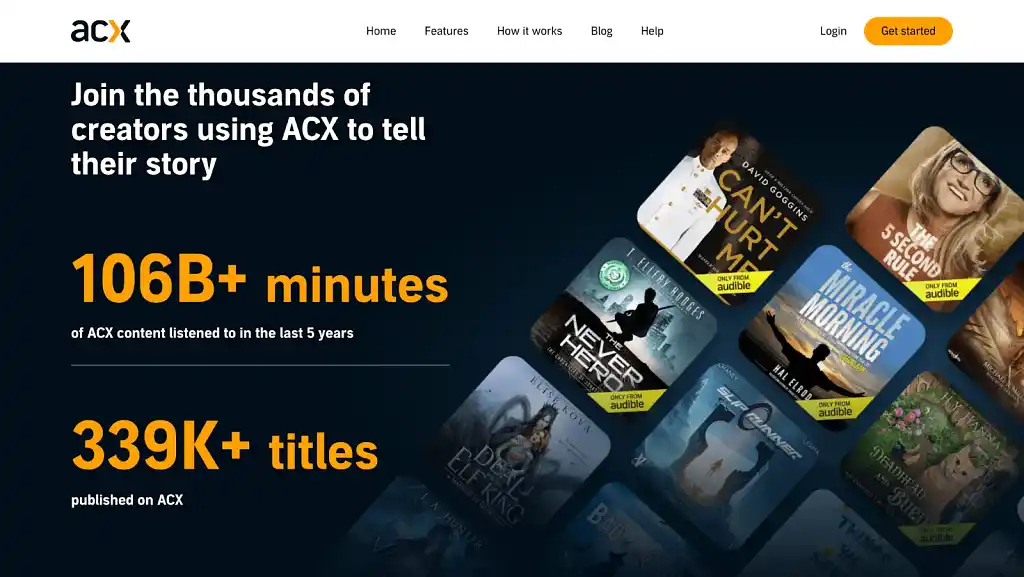
ACX (Audiobook Creation Exchange) is Amazon’s built-in marketplace for audiobook production, connecting authors directly with narrators, producers, and audio engineers. For many authors (especially beginners) ACX’s biggest strength is the end-to-end production workflow. You can audition narrators, negotiate pricing, manage revisions, and approve final masters all within a single platform.
ACX also distributes directly to Audible, Amazon, and Apple Books. While many authors start here for the discoverability boost right within Amazon’s ecosystem (understandable, as they control 90% of the market in the US and UK), it does come with certain trade-offs. Since Audible allows returns, authors don’t always keep every sale, which matters even more if you’re sharing royalties with a narrator. It’s worth carefully weighing the two publishing options AXC offers before committing:
- Exclusive: Your audiobook is sold only on Audible, Amazon, and Apple Books. In return, you earn a higher royalty, up to 40%, but you can’t distribute the audiobook anywhere else.
- Non-exclusive: You’re free to sell your audiobook on other platforms too, but the royalty rate is lower, at 25%
In short, exclusivity means higher earnings per sale while non-exclusive publishing offers more flexibility and wider reach, and you can make a one-time switch between the two after 90 days on sale by contacting support.
Production, distributing & pricing overview
With ACX, you begin by posting your project with details on your budget, tone, and genre, then review auditions from interested narrators. After choosing a narrator, you can either pay a per finished hour (PFH) rate or opt for a royalty-share arrangement (which removes upfront costs but comes with more restrictive contracts).
The narrator then records, edits, and masters the audiobook for your approval, after which ACX publishes it across Audible’s retail network. Keep in mind that experienced narrators are often less willing to accept royalty-share projects, so this option may limit your talent pool.
⭐️ Verdict: ACX makes sense for authors who want a strong Audible presence and are comfortable navigating exclusivity and policy limitations.
Author’s Republic

💰 Cost: Free to distribute; optional paid production
💸 Royalties: 80% of net to authors / 20% to Author’s Republic
✅ Pros: Strong distribution network, beginner-friendly UI, clear royalty structure
❌ Cons: High production fees, fairly basic analytics
👑 Best for: Authors who want a single hub for production and wide distribution
Author’s Republic is a well-established audiobook aggregator that sends your audiobook to a broad network of retailers and library platforms around the world. Its biggest draw is convenience: you can either upload a finished audiobook or use their built-in production service to hire vetted narrators and producers. It’s an appealing setup for authors who want to handle everything in one place with minimal technical work.
Production, distribution & pricing overview
You can either produce an audiobook through their in-house service (typically $50–$400+ per finished hour, depending on narrator experience and project complexity) or upload completed audio for distribution only.
Once approved, the platform manages metadata, quality control, and delivery across a wide network that includes Audible, Apple Books, Google Play, Spotify, Kobo, OverDrive, Hoopla, and other international retail and library partners. Authors keep 80% of net royalties, with Author’s Republic taking 20% (the standard split among major aggregators).
⭐️ Verdict: Ideal for authors who want a hands-off, consolidated workflow and reliable wide distribution without needing to manage multiple retailer accounts.

FREE RESOURCE
Reedsy’s Book Launch Checklist
Launch your book successfully with our tried-and-true strategies.
Voice123

💰 Cost: Free to post; paid membership makes your project more visible
💸 Royalties: Not applicable (direct hiring model)
✅ Pros: High audition volume, broad talent pool, transparent casting process
❌ Cons: Needs hands-on management, editing often outsourced, visibility tied to paid tiers, contracts require careful rights management
👑 Best for: Authors who want maximum audition volume and transparent casting
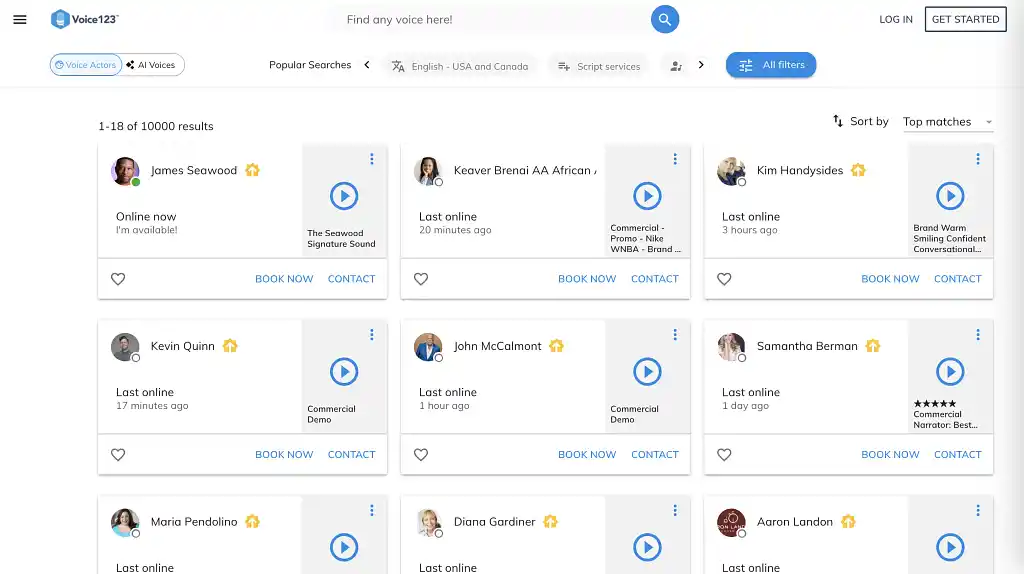
Voice123 is an open narrator marketplace where authors post a brief and receive a large number of auditions — often within hours. It’s one of the best platforms for authors who want to compare a wide range of voices side by side and make casting decisions quickly. Because it caters to commercial and entertainment industries as well as audiobooks, the talent pool is broad.
Production, distribution, and pricing overview
You post a brief outlining your tone, pacing, and budget, then review incoming auditions. Narrators usually quote PFH rates, though some offer flat fees, and editing or mastering may be included. Once approved, you can distribute the final audio via platforms like Voices by INaudio (considered the industry’s leading distributor, though they don’t offer in-house production), Author’s Republic, or ACX.
PFH rates typically range from $75–$150 for newer talent to $300–$600+ for seasoned or union narrators. Note that membership tiers will affect how visible your project is to narrators. Be sure to spell out usage rights, as many narrators prohibit AI training use.
⭐️ Verdict: Voice123 is ideal if you enjoy leading the creative process and want to compare many voices before deciding.
Voices.com
 💰 Cost: Free to post; paid memberships unlock high-quality auditions and all features
💸 Royalties: Not applicable (direct hiring model)
✅ Pros: Guided workflow, experienced narrators, built-in project management tools
❌ Cons: Limited auditions on free tiers, high membership costs, doesn’t handle all production logistics
👑 Best for: Authors who want a more guided casting experience + project management tools
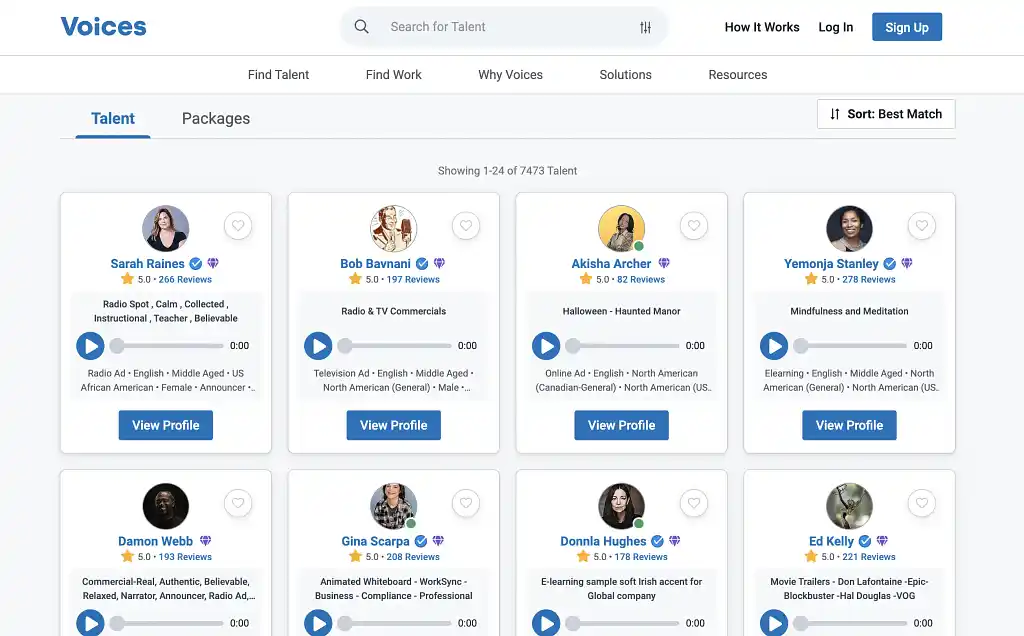
Voices.com operates more like a “managed” narrator marketplace. While you can still post briefs and receive plenty of auditions, there’s more built-in structure and tools to oversee the workflow. This makes it a strong choice for authors who want creative control but prefer a more supported experience compared to the open-style marketplace of Voice123.
Production, distribution and pricing overview
You submit your project details and receive auditions filtered through Voices.com’s proprietary VoiceMatch™ algorithm. Narrators typically quote PFH rates, and editing or mastering may be included. The finished audiobooks can then be distributed via Voices by INaudio, Author’s Republic, or ACX. You must clearly define usage rights, especially regarding AI training (which many narrators prohibit, as on Voice123).
Here, $150–$300 PFH is typical for experienced talent, while premium narrators may charge $400–$600+ PFH. And again, the membership tiers affect how visible your project is to higher-tier talent.
⭐️ Verdict: Voices.com offers a slightly more polished workflow than Voice123 and attracts more mid-level and professional talent — but at a higher cost.
Scribe Audiobooks
![]()
💰 Cost: Premium PFH
💸 Royalties: Not applicable; authors retain all rights
✅ Pros: High-end production quality, strong editorial direction, fully managed workflow
❌ Cons: Premium pricing, less flexibility for stylized fiction, contracts require careful review for rights and AI clauses
👑 Best for: Nonfiction authors and thought leaders who want meticulous, publisher-grade production
Scribe Audiobooks specializes in polished, editorially driven production and is especially well-known among nonfiction authors. Their process is highly structured: you begin with a consultation on tone and audience, receive curated narrator recommendations, and work with a dedicated project manager who oversees the entire recording and editing process.
As a boutique option, Scribe’s emphasis on clarity and authority makes them a strong fit for business, self-help, or expert-driven books.
Production, distribution and pricing overview
Scribe takes care of everything from casting to final mastering, but once production is complete, distribution is up to you. They provide retail-ready files that you can upload to your choice of aggregator (they've partnered with Author’s Republic). Standard productions generally fall in the $300–$600+ PFH range, with higher costs for union talent or complex projects (multiple voices, specialized editing, or documentary-style production).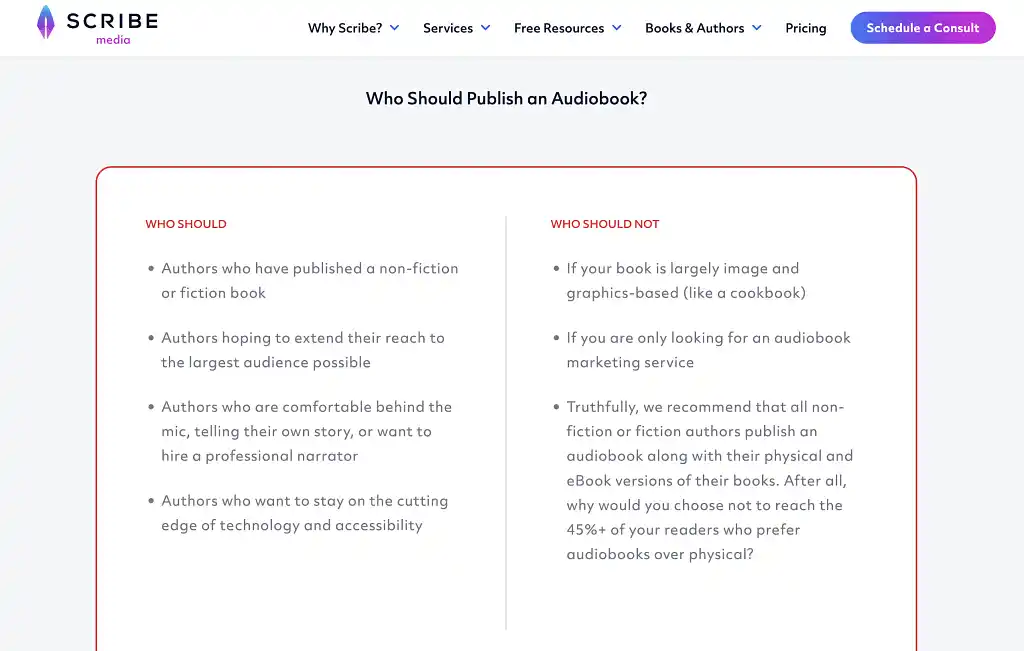
⭐️ Verdict: Ideal for professional nonfiction where quality and authoritativeness matter more than budget.
Jony Studios
💰 Cost: Premium PFH
💸 Royalties: Not applicable; authors retain all rights
✅ Pros: Strong performance direction, expressive narration, fully managed production
❌ Cons: Premium pricing, lighter editorial support, less suited to authors who want full creative control, rights and AI clauses still need careful review
👑 Best for: Fiction authors and creatives who want cinematic, performance-driven audio
Jony Studios is another boutique option that leans more into performance and storytelling, offering high-quality audiobook production suited to fiction and narrative nonfiction. They specialize in expressive reads, character nuance, and immersive sound — making them a nice choice for authors who want something more dynamic than standard single-voice narration. Yet the workflow also isn’t overly complex and authors don’t have to manage too many logistics.
Production, distribution and pricing overview
You begin with a creative consultation, followed by reviewing casting options. Jony manages recording sessions, direction, editing, mastering and proofing, giving you files ready for distribution. Pricing typically ranges from $250–$500+ PFH for single-voice productions, with higher rates for character-driven, multi-voice, or dramatized projects.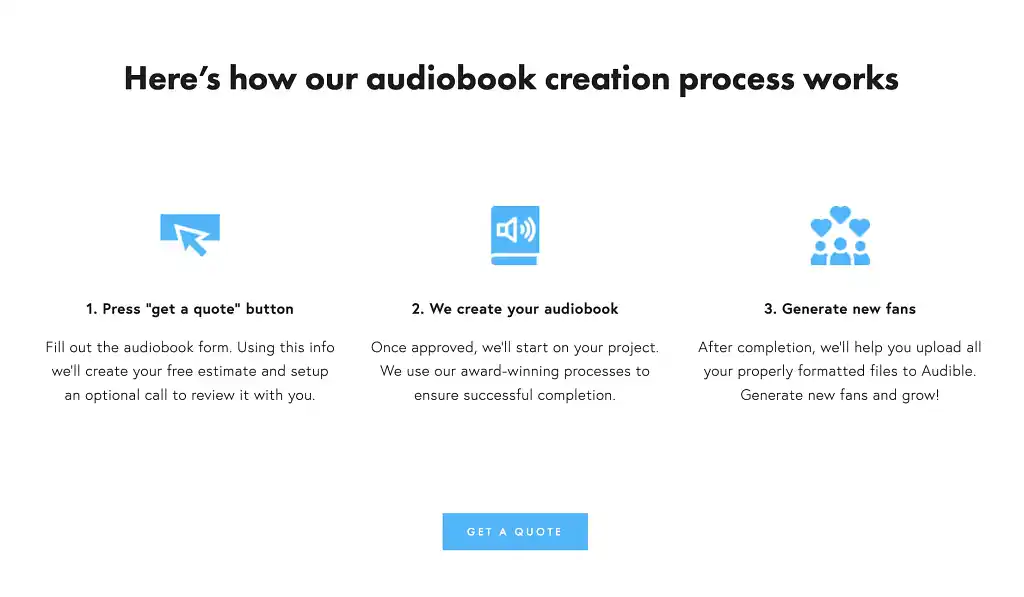 ⭐️ Verdict: A great fit for fiction authors who want more immersive audiobooks, in which character and emotion drive the story.
The best AI & software tools for audiobook creation
AI narration is becoming one of the most practical options for authors working with limited budgets or who require quick turnarounds. Below are the tools that perform best in 2026, along with the key rights and disclosure considerations you’ll want to keep in mind.
ElevenLabs
💰 Cost: Low-cost subscription or credit-based usage
💸 Royalties: Not applicable (tool only)
✅ Pros: Super fast turnaround, low cost, voice quality is improving rapidly, useful for demos
❌ Cons: Not suitable for most fiction, limited emotional nuance, strict consent and disclosure requirements for commercial use
👑 Best for: Fast, affordable AI narration suited to testing, accessibility, or supplemental audio
ElevenLabs is one of the most advanced AI text-to-speech (TTS) platforms available today, offering synthetic yet natural-sounding narration at a very low cost. Plans start at about $5 per month for roughly 50–60 minutes of audio, with creator tiers offering 200–1,000 minutes. Even the higher plans work out to just a few dollars per finished hour.
Now, even ElevenLab’s advanced TTS is no substitute for a human performer, especially for commercial books or upmarket fiction — but it is useful for early testing, educational materials, and low-budget projects.
Note: Voice cloning is available only with documented consent, and most retailers now require clear disclosure when AI narration is used.
Production, distribution and pricing overview
Authors can import a manuscript, select a prebuilt or custom voice (with consent), and generate narration with adjustable pacing and emotion. It also makes it easy to edit or regenerate sections before exporting the final audio. ElevenLabs doesn't distribute audiobooks, so commercial releases must go through an aggregator like Voices by INaudio or Author’s Republic. Although advanced voice cloning features might cost more, ElevenLabs remains a low-cost option for producing long-form audio.
Remember that AI acceptance policies vary across retailers: some allow AI with disclosure, others prohibit it, and many are still updating their guidelines in 2026. So it’s crucial to check current requirements before distributing an AI-narrated audiobook.
Q: How has AI affected you as a professional in the publishing industry?
Suggested answer


At it's most basic, the use of genAI is just another differentiator for me. Do I typically edit erotica? Nope. Do I usually collaborate on AI-drafted novels? No.
In other words, editors all have different personal tastes, professional niches, and areas of expertise. I am not jumping at the chance to content-edit a novel largely written by ChatGPT, but that doesn't mean other editors all feel the same way as I do. Apart from the moral quandaries of AI authorship, I have found that AI-written manuscripts often feel hollow to me: they traffic in tropes, repurpose familiar plotlines, and so on. I'm most excited to work with fresh-feeling manuscripts, and "freshness" is not something a large language model is adept at producing.
Kevin is available to hire on Reedsy ⏺

I see more and more fiction writers coming to Reedsy with outlines for novels that they've created through AI. It's quite easy to detect, especially if you've used AI for research. I've wondered why these writers don't have at least a couple of chapters as well as the outline created by AI. My guess is that they've found out that AI can't write a novel that works. One was sent to me recently, a complete AI novel - 120,000 words of purple prose. The main problem, though, was that there was too much telling, not enough showing. Beyond that, AI didn't know how to create believable characters that the reader could identify with.
At this point, an AI-written novel is a boring novel. Even if the plot is interesting, AI hasn't figured out how to draw the reader into the story. Instead, it's like reading a long outline of a novel. Thankfully, humans are still needed to create a compelling read. Hope it stays that way. I would hate to see an AI novel on the bestseller's list.
Rob is available to hire on Reedsy ⏺

AI truly has become the bane of every editor’s existence. I haven’t seen it here, but at other places I work, I see the same writing, the exact same wording, with no human inflection whatsoever, again and again. AI is boring to edit; it’s always grammatically pretty close to perfect, so I spend a lot of time rewriting and rephrasing words like “tapestry” and “delve into” and overuse of “profound” and “journey” because it screams AI, and no one wants that.
AI is great for many things and has a ton of good, practical uses. Unfortunately, writing is not at the top of that list.
Jenny is available to hire on Reedsy ⏺
⭐️ Verdict: ElevenLabs works well when you need speed and flexibility during the drafting or experimentation phase, but it is not suited for performance-heavy narratives.
Speechify
💰 Cost: Subscription tiers
💸 Royalties: Not applicable (tool only)
✅ Pros: Very easy to use, affordable, well suited for accessibility and demos for internal use
❌ Cons: Not viable for commercial fiction, inconsistent voice quality, requires an external distributor
👑 Best for: Accessibility-focused creators and authors who need quick DIY audio
Finally, we arrive at Speechify; a widely used text-to-speech platform created for accessibility and learning. Similar to ElevenLabs, it can work well for authors who need fast, simple narration rather than full audiobook production. It is especially useful for drafts, classroom materials, companion content, or personal listening, and doesn’t require any prior audio engineering experience.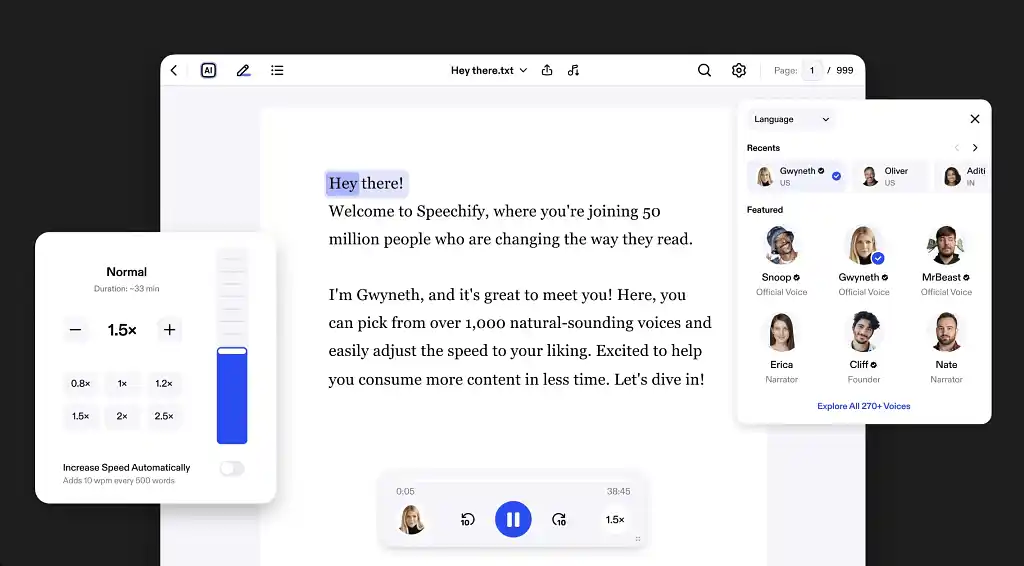
Production, distribution and pricing overview
Authors can import text through uploading, copy/pasting, or cloud syncing, then select from a library of AI voices and adjust speed and clarity before exporting audio files. The quick workflow makes it ideal for accessibility needs or internal review.
However, Speechify also does not distribute audiobooks, so commercial releases must go through an aggregator, and again: retailer policies on AI narration should be checked in advance. Pricing is subscription-based, with higher tiers unlocking better voices and usage limits, but costs remain lower than hiring a human narrator since there’s no PFH model.
⭐️ Verdict: Good for authors or educators who need simple, accessible narration for daily use. Unlike ElevenLabs (which is a bit better for prototypes and early-stage testing) Speechify works best as an everyday tool for low-stakes projects.
Other notable mentions
Beyond the major services, several smaller aggregators, regional distributors, and specialist studios can be a great fit for authors with more specific goals. These options are particularly useful if you publish in multiple languages, want stronger reach in regions like South Asia or Latin America, or are producing formats such as full-cast audio or serialized fiction.
Examples include regional services linked to Audiobook.com or Rakuten Kobo, local-language studios for Spanish, French, German or Hindi markets, and serialized audio platforms such as Pocket FM or Realm. Each service comes with its own pricing model, file requirements and rights considerations. It’s worth comparing factors like distribution reach, royalty terms, language support, licensing clauses, and turnaround times before choosing a partner.
Hire an expert

Kate L.
Available to hire
11 yrs marketing experience in consulting, launching, and promoting books. Specialized in sci-fi, fantasy, gamelit/litrpg, spec fic, LGBTQ+

Tara L.
Available to hire
I am a children's, middle-grade, and YA book marketing expert with 25 years of experience at top publishers. *BEWARE OF SCAMMERS*

Robin S.
Available to hire
11+ years in the industry. Specialist in SF&F. Launch with success, fix your metadata/blurb & identify your competitors to learn from them.
Choosing the right audiobook production service ultimately comes down to what you need most — whether that’s Audible-first visibility, wide distribution across retailers and libraries, a hand-picked narrator or simply an affordable way to experiment with audio.
There’s no single “best” path, only the one that aligns with your budget, preferences, and creative goals. Whatever route you take, it’s safe to say that audiobooks are an effective way to grow your readership and make your work more accessible to them.