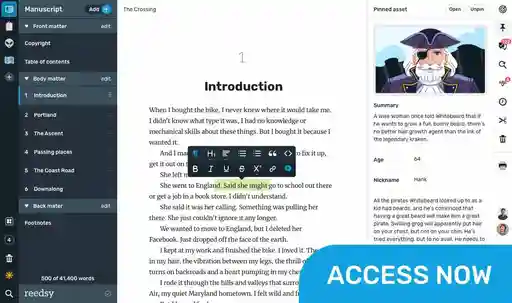
Welcome to Reedsy's contemporary fiction book title generator
A contemporary fiction title has to do something quietly difficult: it has to feel specific enough to belong to one book, and resonant enough to stop a stranger mid-scroll. Too on-the-nose and it reads like a summary. Too abstract and it disappears. The titles that work in this genre tend to carry a second meaning — something that only fully lands once you've read the book, but that tugs at you even before you have.
Our book title generator is AI-powered and built around the specifics of your story. Give it your core conflict or theme, your tone, your setting, and any comparative titles that help locate your book in the market — and it will return ten options, each with a brief note on what it's doing and why.
How to use this title generator
Start with Core conflict or theme — this is the only required field, and it's doing the most work. Don't summarize your plot; distill the tension at the center of your book. "A woman returns to her hometown after twenty years and has to reckon with who she left behind" is a plot summary. "The gap between the life we perform for our families and the one we actually want" is a theme. The second will generate more interesting titles.
The Tone field is where you set the emotional register. Contemporary fiction spans an enormous range — "wry and observational" will pull results in a completely different direction from "quiet and devastating." Be honest about the feeling you want the title to evoke, even if that's different from the feeling of the book as a whole. Titles often work by contrast.
Use Setting if your novel's location carries weight — a specific city, a particular kind of place, a time period with its own texture. A title for a novel set in contemporary rural Appalachia is doing something different from one set in a Manhattan apartment building, even if the themes are similar.
Comparative titles is one of the most useful fields in this generator. If your book sits somewhere between two existing novels — in tone, audience, or subject — naming them here will help the generator calibrate. The Mode dropdown is worth considering carefully: Commercial / Mainstream suits titles with broad, immediate appeal; Literary / Artistic suits titles that prioritize resonance over accessibility; Unconventional / Experimental is for writers who want to break from convention deliberately.
Use Words/themes to avoid to rule out anything that's already saturating your corner of the market — certain words get overused in waves, and this field lets you steer clear.
So you want a good contemporary fiction title?
A title in contemporary fiction is often the first piece of the novel's argument — the initial claim the book makes about what kind of experience it's going to be. The best ones in this genre don't announce their meaning; they hold it in reserve, and the reader only understands what the title was really saying somewhere in the final chapters.
A few things worth knowing as you write:
- The title should belong to this book specifically. Contemporary fiction titles that could apply to dozens of novels in the genre are doing less work than they should. Test any title you're considering against a simple question: does this title say something true about this specific story that wouldn't be true of another novel with a similar premise? If the answer is no, keep looking.
- Ambiguity is a feature, not a problem. The titles with the longest shelf life in contemporary fiction tend to hold multiple meanings simultaneously — a phrase that means one thing at the start and something different, or something more, by the end. This isn't the same as vagueness; it's precision at two levels. Think about what your title might mean in the first chapter and what it might mean in the last, and whether you can find something that earns both readings.
- The rhythm of a title matters as much as its meaning. Read your candidates aloud. A title with good rhythm sits in the mouth differently from one that's technically fine but slightly inert. Some of the most remembered contemporary fiction titles work as much through sound as sense — A Little Life, Normal People, The Corrections. Short, weighted words often outperform longer constructions.
- Consider what the title implies about the narrator's relationship to the story. In contemporary fiction, titles often carry the weight of a narrative voice — ironic distance, earnest directness, oblique grief. A title like Where'd You Go, Bernadette implies a speaker; a title like Olive Kitteridge implies a subject. Those are different relationships to the story, and the title is making the first argument about which one this is.
- The Words/themes to avoid field is worth using seriously. Certain words cycle through contemporary fiction titles in waves — particular color words, particular emotional states, particular domestic images. If you're writing in a space that already has a lot of "the something of somewhere" titles, or titles built around the word "daughter" or "wife," it's worth flagging those as things to avoid and seeing what the generator does when it has to find a different path in.
- Read the literature. Study how Hanya Yanagihara arrived at A Little Life — a title that feels almost ironic given the novel's scale. Look at what Homegoing does in a single word for Yaa Gyasi's multigenerational saga. Consider the double meaning held inside The Kite Runner by Khaled Hosseini. Celeste Ng's Everything I Never Told You is a title that functions as a plot summary, a theme, and an emotional promise simultaneously.
A note on our use of AI
We built this tool for writers, which means we thought carefully about what AI should and shouldn't do here. The generator uses AI to produce contemporary fiction titles that better fit your story's specific context and needs — conflict, theme, tone, setting, and market position — while explaining its reasoning for each one.
Here's what it won't do for you: it won't name your book, make the final call, or tell you which title is right. It simply generates options for you.
More importantly, your inputs are not (and will never be) used to train any AI models. Treat whatever comes out as raw material: a starting point that belongs entirely to you. Every result is yours!