


 2 likes
 0 comments
The Museum of Automata
If it were not for the sudden downpour that interrupted my tour of Provence, I might never have entered The Museum of Automata, in that small sleepy town towards which I was riding on a spring morning, all sun and crisp breezes. Then, within a quarter of an hour, thunderheads gathered and the storm arrives. I lock my bicycle in the rain-shadow of a wall opposite the museum, scurry across the road, and buy my ticket, from a young woman with pale skin and wonky teeth, in a threadbare summer dress, patterned with tiny pastel flowers.
‘You have been here before?’ she says, speaking English. She recognises the gaucherie I share with many of my compatriots when we travel abroad for the first time.
‘Jamais, Mademoiselle,’ I say. My schoolboy French is passable, but ugly, though I do my best. She smiles, nevertheless, and directs me towards the tall doors, elaborately carved, studded with bolts of iron, beyond which I hear music, faint and indeterminate. I push through purple velvet curtains, and the music soars, clearer, more plangent. I look around, enchanted, immediately swallowed by the wonders within. Mademoiselle follows, since there are no other customers. There are life-size figures that stretch and sway, each driven by machinery: gears and sprockets, pinions and racks, powered by electric motors, I surmise, from the sub-liminal purrings that undercut the piped music. They move, slowly, stiffly, like rheumatic paraplegics, creaking their anguishes despite their lubrications of oil and grease. They are, however, beautifully fashioned, and finely detailed, built to endure for years to come.
‘The music is mine,’ she says. I listen, first out of politeness, then with growing fascination, to the fragile sonorities, pre-18th Century pastiches in the Dorian mode, accompanied by tambours and psalteries. The songs of troubadours, perhaps, but modulated and mutated. Her vibrato-less birdlike chirpings, articulated in the French of a bygone age, are curiously moving, yet remote. Their resonant chimes harmonise perfectly with the stately and antique movements of the automata.
‘Singing first, then the instruments, the jingling drums, the flutes, the crumhorns. I play them all,’ she says, looking hard into me, as if to challenge my worth; who am I, after all, to be here, as an equal, with one so accomplished?
The sound of water dripping into buckets provides a counterpoint to the archaic music. ‘The roof leaks,’ she says, looking upwards. ‘Le batiment, c’est cassé.’
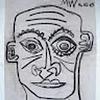
She tells me how she makes the heads. First, in clay, then in peel-off rubber, applied in liquid form with a brush, then finally in builders’ insulating foam pumped in from aerosol cans under pressure. Then she paints them, with the utmost precision, using the finest artists’ oil paints. Most of the heads are of young women with delicate features, crimson lips arched into bows, sensual, even lascivious. Behind the plump lips are teeth like needles of white ivory, wicked and cruel, to lacerate the throats of unlucky suitors. A tableaux of musicians sways gently as the music unwinds. They are pallid and ethereal, the men delicately featured, long haired, transgendered. The women, ginger Pre-Raphaelites all, brandish strung and resonated lutes, citterns and harps. They are clad in robes the colour of buttermilk: creamy, diaphanous.
Mademoiselle smiles, and she tells the story of the figures, her tangled brown hair chasing the vivacious noddings of her neat head, jawbones and cheekbones aligned just so. Her tongue and lips punctuate her deliciously uneven teeth. I am drawn into her, strange as she is, as she explains, in her halting English, the museum’s history. Her eyes are dark amber. They glow, like those of an eagle owl, with an unexpected caged ferocity, belied by the measured nature of her speech: ‘Come and see,’ she says.
She leads me to an annex, an adjoining single storey building with a roof of terracotta tiles, in which stand bulky carboys containing formaldehyde, plugged with discs of cork, sealed with black wax. Inside are preserved freakish outcasts from the town’s abattoir. Within one of these green glass jars, she shows to me an everted foetus, a never-to-be born calf. The pelt, the skin, now bleached to an indeterminate sepia by the action of the preserving liquids, has grown on the inside of the embryo, and the organs - the lungs, heart, liver, intestines, kidneys - are attached, with a vile logic, to the outside. The whole confection floats, moving imperceptibly, within the viscous murky fluids. It is an aborted mutation. There may be many more to come, I think, should current madnesses prevail amongst those who rule.
‘All you can ever possibly imagine, it is here already,’ she says. ‘Don’t you agree?’ She looks into me, weighing me up, for a second time. Now, her gaze cuts harder, like she’s drilling for diamonds.
‘My father was peculiar; an eccentric, seriously so,’ she says. ‘He was fascinated by the unusual, the bizarre. This is what he showed me.’ She pauses, her eyes misting, so I thought. ‘I loved him dearly.’ She reaches out towards me, and wraps her slim spidery fingers around the back of my head, as the rain outside intensifies its poundings upon the ancient leaking roof. ‘Come here,’ she says, to where white furs are spread upon the concrete floor. ‘Come and fuck me, darling boy…’
‘My father,’ she tells me, later, ‘Was a marvel.’ The storm has abated, for the moment, and sporadic showers prevail.
‘He was genius, he made the first automata. And, every day he would drink two bottles of red wine, as he worked, and afterwards, in the evening, a bottle of brandy, to relax. He threw the bottles out the back. Every day of his life. You want to see?’ Outside, a glass mountain of green crystal glistens wet in the drizzle, fit to rebuild the Crystal Palace, once melted down and cast into translucent bricks.
‘Perhaps this is the wonder I should display,’ she says. ‘Not the puppets, but a monument to booze.’ She smiles wryly, inviting a response, and receives one, although the truths she reveals are unsettling.
‘He was a strange man,’ she says. ‘Sometimes really happy. But, sometimes not. Happiness that comes from a bottle can still be happiness,’ she says. ‘That is true. I know myself. Now and again, I drink wine, to be happy for an hour. To be not alone. Or, rather, to dull the ache of solitude. But then I make a face, a mask, from clay. Then I am truly alive.’
‘Were you not truly alive, just now?’ I say.
‘You are a man,’ she says, obliquely. ‘The world becomes better, when love is made.’ She stands, and pulls on the shabby faded dress over her head, down her body, pale and sticky with love. She wants to talk more, about her father.
Outside, the sky gathers up its drizzle, and clenches its loins. Thunder rumbles, then a flicker of lightning. The storm is returning.
‘He made them, he showed me how. From when I was eleven,’ she says. ‘Before then, I was taught to draw, pencil, charcoal and pastels. All this at first from my mother. But then, on the night of my eleventh birthday, my father took me into his workshop, and, together, we made a head. It was a revelation, a wonder. He showed me how a spirit can be conjured from clay. A devil, or an angel. You understand?’ I nod, just to keep up. I’m out of my depth, and she is deepening down inside, deep into her skull. She is putting herself away from me.
‘There is another life,’ she says, ‘Beyond all this stuff we do from day to day.’ She takes a skeletal iron key, and locks the doors of the museum. That lead to the small town outside, to safety, and the world as it is known, by me, at any rate. And to my bicycle, upon which I may ride to freedom. By now, the rain is pounding like Burundi drums, and the thunder rolls on, tolling its bells, filling the void. We are alone in the museum. She shakes white powder from a silver locket, slung upon a chain around her neck, onto the glass of a photograph she pulls down from the wall, and chops it neatly into lines, with a steel blade.
‘Do this,’ she says, snorting through a cardboard tube, one in each nostril. ‘It is MDMA. Ecstasy.’ She hands it over.
It kicks in, pretty soon. We get naked, again. We lie down, and let bliss take over. We pleasure each other, our probing fingers performing gentle caresses of the utmost intimacy. The rain continues to pound, for more than an hour, then gradually slackens, as the storm recedes. We each take another snort, topping up. The hours pass by. The sun sets, then voyages steadily around the other side of the world - for, enslaved to our fancies, astronomy can re-arrange itself willy-nilly. Then, in due course, one night later, after an eternity of paradise, it rises again in radiance, illuminating our bower with roses. Then, at last, we sleep, wrapped around each other, fledglings in a nest. Thus does time pass, when, just now and again, things come together, and perfection prevails.
Later, the following afternoon, still floating, just a bit, we walk hand in hand through the automata, as they crank out their peculiarities, jerking and stuttering. Her songs echo through the high curtained spaces: curious, fey, exuding melancholy.
‘We shall not see each other again,’ she tells me. I know that this is true. The sight of my bicycle steaming in the morning sun that followed the storm brings me back to a different reality. I shall move on, pedalling dutifully from one village to the next, until it is time to return home, to England, to the office job. And she, in her shabby floral-patterned dress, her sandals beat up and broken, will remain here, as years pass by, building her own world of a mechanical paradise, denying the corruptions of government, defying unreality.
And inviting other travellers, now and again, into her dreams…




You must sign up or log in to submit a comment.