


 8 likes
 0 comments
The priest left early that morning—but not before dawn had broken. Even a man of God had his fears, and he would not have ventured out into the night to face such a situation. He took holy water and incense, next to his large nickel-plated iron cross—the one parishioners kissed—and he set off on his mission.
When he reached Sabin's house, one of the church cantors, he stopped by and even though it wasn't planned, took him along.
A light rain had fallen the night before, making the road treacherous. Pafnutie spotted his visitors from his porch half an hour before they reached his gate. Their arrival troubled him; he knew they weren't coming with good news but rather with accusations.
Pafnutie waited for them with hot coffee and scolded them for coming. The conversation did not unfold peacefully, but the priest, with his conciliatory nature, managed to reach a compromise with Pafnutie. He feared that the tensions in the village might turn into violence against the young man, fueled by nothing more than rumors. To defuse the situation, he proposed that Pafnutie go to a nearby monastery, where the abbot was an old friend of his. At first, Pafnutie refused, but after the priest explained further, the young man was persuaded and accepted the offer.
At the monastery, things unfolded just as they had been described by the priest. The monks left him alone—he woke up whenever he wanted and helped only when he deemed it appropriate. Even though no monk ever asked what he was doing there or what had brought him, that didn’t mean Pafnutie was at peace. He constantly ruminated on what had transpired and was tormented by the question of who he truly was. Words and rumors from the villagers often haunted him, stirring his thoughts.
On the fifth night at the monastery, the bell calling the monks to the midnight office woke him from a nightmare that felt all too real. He wasn’t sure if he had dreamed or simply recalled that fateful hunting night. Recently awoken, drenched in sweat, he felt a strong pain in his head and tight muscles. He was deeply frightened and remembered how in the dream—if not in reality—he had awoken on the edge of a thirteen feet ravine, a wolf, not a man. Just as he did now, he felt that his brain was exploding. That abrupt change had overwhelmed him and triggered a panic attack. Desperate, he had started to run. Before taking flight, he'd felt how in his mind different and powerful smells mixed with a multitude of colors and sharp noises. The crickets seemed to sing inside his head, the earth seemed stuck to his snout though he stood raised, and the stars seemed to shine too bright and the moon called to him. He also remembered how he'd felt the black, thick fur undulating over his whole body in the running that had warmed his powerful muscles.
Worried, he rose from bed and requested to see the abbot for an urgent matter. After the service, Abbot Pimen received him in his cell and asked how he could assist. Pafnutie, with a worn look, told him he had something heavy on his soul and absolutely needed to confess. He recounted village rumors, then, trembling, the night he discovered his ability to transform into a wolf.
“Father, I’m afraid of myself and my blasted nature. What should I do? I don’t want to harm anyone but fear my own futility. Can you help me? Am I, as the villagers say, a son of the devil? Am I cursed?” Pafnutie asked the monk desperately.
All this time Father Pimen looked at him horrified and terrified. He tried not to let his gaze show any sign of what he was experiencing inside and it wasn't easy. He thought for good moments about what to say, searching his memory for words that could help the man sitting before him desperately asking for help. He didn't find much, didn't know what he could do here for him, then remembered Avva the Hermit and his face brightened:
“Pafnutie, my son, calm yourself, you've been through much. There's a holy father named Origen who thinks we'll all be restored and saved. He says that eternal hell wouldn't exist. Unfortunately, this was later condemned as heretical. Yet I live with this great hope that universal salvation could be possible. And if the Lord loves us so much, then He wouldn't let you be cursed" the abbot couldn't continue his ideas as Pafnutie's desperation interrupted him.
“How can I not be cursed if I can roll over thrice and become a wolf? You don’t believe me, do you? Do you want me to show you here in your cell? He immediately regretted threatening Abbot Pimen and quickly begged for forgiveness
“My son, that’s alright. You’re going through tough times, but don’t be sad or worried; the Lord is always with you, watching over us. Up in the mountains, there is a hermit living in the wilderness alone with the animals. It is said he speaks to them. Go to him and you will receive the understanding you need. We cannot help you here, but do not worry, Father Avva the Hermit will call upon the Lord and all these beasts for guidance to find the right path for you. Go, pack your things, and head to his hut.”
Pafnutie wasn’t fully satisfied with the abbot’s words, but he found comfort in the news of this hermit who had lived in the mountains for decades, who spoke to the animals and understood their language.
Although he had initially resisted going to the monastery, now, in desperation, he did not flinch when he heard the journey to the hermit would be hard and three days long. He felt he needed to get there; he had to find an answer. He prepared his pack, the monks packed him food for the journey, and at daybreak, he set off.
The road was tough and full of steep slopes. Pafnutie felt more hopeful at the thought of meeting this almost saintly monk, but wasn't at all calm. The abbot’s words had greatly disoriented him instead of calming him. All along the way, the things he mentioned about universal salvation spun in his mind.
“If there is no hell, what is the purpose of suffering? Why have I been cast into this world, only to suffer? Only to be cursed and to struggle my entire life with the fact that I am a monster? Is life the only hell we have?” He marched on for a while, then thought about how he'd find the father and he would teach him how to fight his trials and fallen nature, to understand and overcome it. But always this worm of the mind would turn back and gnaw at him from within: “If there is no hell, everything is possible.”
The next day, traveling toward the hermit, he stopped on a slope where there were blueberry bushes and ate until his hands turned purple. Then he sat down and gazed at the valley stretching at the mountain's foot and the opposite slope: “What is the purpose of this world if we are all saved? What sense is there in all this, and what sense does my life have? Are we merely cast into an absurd vortex?”
After three days, carefully following the monks’ directions, he encountered the hermit’s hut. He still had half an hour to walk to it, but he already felt a warmth in his chest and joy filled him knowing he would soon find answers to all his questions.
“What am I? Am I a monster, a cursed being? How do I fight against violent instincts? What is the purpose of my life?” As he approached, he sensed that something was amiss; everything seemed too still and silent. Next to the hut, just a few steps away, in the remnants of a past fire, the woods were half smoldering, half whole. The hut appeared shabby, but what could one expect from a man who had lived there for years—maybe even decades? He thought, "When you're a hermit and almost holy, you don’t need many worldly things." He reached the hut and went to open the door. But he hesitated, “What if he isn’t here? Maybe he has gone to gather food, moved elsewhere, or perhaps he is inside praying. Should I call out first?” He knocked on the hut and shouted twice, “Father, Father,” but nothing. He braced himself and went in.
When he opened the hut's door, he was surprised by the strong smells emanating from inside. He expected the scent of incense, myrrh, or at worst, sweat, but the smell that greeted him was that of urine and excrement. He looked inside and found the old man lying on the floor on a mat of willow branches. He approached him, but the man didn’t stir at all. He nudged him gently with his hands and realized that the old hermit was more dead than alive. He hurried out of the hut and vomited outside at the door.
“Oh, what am I doing here? I came to seek a saint and found a dying man,” he lamented. He considered leaving him and letting Father Avva pass peacefully into the holy realm, but then he felt pity and thought that no enemy deserves to die alone, suffering and hungry—certainly not someone nearly holy. He planned to make a stretcher and carry him back to the monastery, but he quickly abandoned that idea, realizing the hermit wouldn’t withstand the cold and long journey. He calculated various possibilities, but the outcome was always the same — to take care of him there.
He turned back into the hut and gave him water to drink, and then food. He went to the river for more water and first washed the old man’s feet, then his frail body, dry as a root. Among the provisions given by the monks, he had a small vial of myrrh, which he diluted with a bit of water. He warmed the liquid and anointed the old man from head to toe. He cleaned the hut and removed all the filth and waste. He fashioned a pillow for the hermit in one of his clothes from dry leaves, and now the hut smelled as if a prince lived there and not a hermit.
The old man began to feel better in a few days, but he was still so weak that he could not speak. He could barely open his eyes for a few moments each day and slept most of the time. The food he had brought ran out, and soon Pafnutie had to find more. Until then, he had refused to think about the possibility of transforming into a wolf. He feared that his wolf nature would awaken and would eat the monk one night. But after a day of trials and tribulations in hunting, he began considering the advantages of a predator's nature.
He approached the old man and asked if it was dangerous to become a wolf. He received no answer, not even a gesture, but he saw that the old man looked even weaker and became very frightened.
“Father, I promised to take care of you, and I will. I will become a wolf and bring you food soon. If God truly cares for you, He won’t let me eat you.” He stepped out of the hut, rolled over three times, and turned into a wolf. After thirty minutes, he returned with a large rabbit and fed the sick man.
In the first days of using his powers, he was very scared so slept outside. But over time, he began to enjoy it. He ran freely through the surrounding forests, stalking rabbits, deer, and birds. He loved watching their behavior and seeing how they lived in harmony with nature and other creatures. Day by day, he started to feel better in his own skin and in those places. Besides, hunting was no longer a problem, and the hermit received nourishing meals.
The freedom to just be himself made him feel good and whole. The haunting thoughts about his essence tormented him less and less, and he resolved to remain in the mountains for life if he felt he could not master his wild side.
He spent his time hunting, caring for the hermit, and talking with him. In fact, they were monologues—he asked questions, and most of the time silence responded; sometimes he answered himself or perhaps found an answer on the old man’s face.
Nearly three months passed since he began caring for the hermit. The old man felt well but could not move or speak. Thoughts about what the abbot had said still churned within him, but differently. Something had changed in him since he had fully accepted who he was. He couldn’t completely understand the change, but his perspective had shifted from anger toward Origen’s thoughts to contemplating the world’s reaction to those ideas: “Aren’t we just damned, all of us? Why couldn’t we accept that salvation exists for all? What do you think, Avva? Is our mind unable to conceive such goodness, and so we decided such a pardon is impossible?” But the old man did not respond; his face remained unchanged and unmoving.
One day, coming back from hunting after catching a large and beautiful stag, Pafnutie entered for the first time as a wolf into the hut, left the stag next to the hermit, and transformed back into a man. Then he addressed the sick man, “What do you think, Avva? Did you know I’m a werewolf? I’m not a man, nor a wolf; I am something in between, and I like it. I feel like I was made like this out of love, not out of a curse. I am still afraid I might eat you or any other man who crosses my path, but I stay away from temptations.” Finishing his words, he had the impression that the sick man smiled at him, but he quickly realized that a paralyzed person could only move through a miracle.
“You can’t know how much joy I felt finding you.” He cried and rubbed the sick man’s back where his spine curved from old age. He gazed at his face, marked by wrinkles, with a long gray beard, wondering about the hermit's life: “Who were you before becoming a monk? Were you a saint for most of your life, or were you a thief? What made you become a hermit—the hatred toward people, the fear of their madness, or love for God and His creation? I came to you to save my life, but it seems I am saving yours. Or am I wrong? Are you saving mine by keeping me here bound to you?"
Many more months passed, and young Pafnutie had lost count of how long he had been there. He no longer questioned whether he would take the old man to the monastery. Now he could do so, but he thought a hermit would be sad in a hospital. And if he could take care of the hermit and remain away from people, why not stay there? All this time, he had seen people, but they had never come close to Avva’s hut; they were always miles away from that place. And Pafnutie kept his distance from people; he was still afraid of them, but most of all of his animal instincts.
Before dying, the old man shed a tear and on his face appeared the most serene smile Pafnutie had seen in his life. After a few moments, the old man was already gone. The young man didn’t bury him immediately; he considered taking him to the monastery, but it was too far away. Then he recalled that saints keep the body clean and that it remains incorrupt, free from decay. But after three days, the body began to bloat and emit a terrible smell. Pafnutie dug a grave not far from the hut, buried him with a prayer, and placed a cross made from two branches at his head.
After the hermit's death, he felt alone for some time, with a great emptiness in his soul. He visited Avva’s grave daily, speaking to him as he had when he was alive—asking questions, seeking advice, and receiving answers in silent responses.
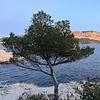
One day, while hunting, he tracked a doe, but it suddenly disappeared into a thicket. As he wandered back toward the hut through the mountains, he stumbled upon a crooked and ugly tree, bent by years of strong winds. He moved closer to look at it. As he admired it, he noticed that near the trunk, beneath branches laid low by relentless winds, a handful of snowdrops had sprung up. The tree had shielded them from all the elements and frost, allowing them to grow and bloom. Pafnutie stayed there for a few hours, contemplating. First, he viewed them as a wolf, then he transformed back into a man. What he saw filled him with great delight, and he felt enormous joy: “Isn't it good how things are made? Perhaps not always. But we ought to strive for an eternity—like this tree tormented by winds—to shelter the miracle of life.”
He returned to the hut, gathered his belongings, and began heading calmly to the monastery, thinking of informing them of the hermit's death and longing to return home. He did not know what awaited him in his village, but he was ready to resume his life or perhaps begin a brand new one.




You must sign up or log in to submit a comment.