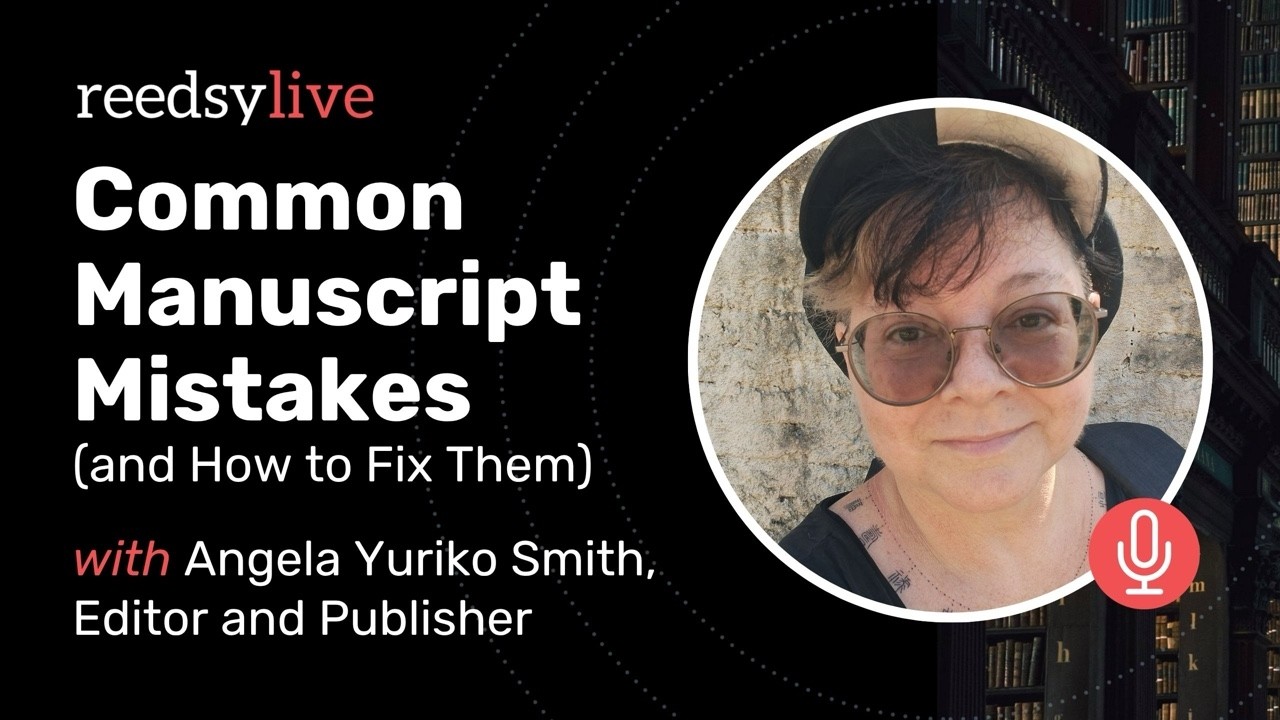
Our speaker for this event is Angela Yuriko Smith: writer, editor, coach, and publisher. To work with her on your manuscript, you can reach out through her Reedsy profile.
As a publisher and an editor-in-chief, it is my job to get good submissions, so I love it when people attend events like this, because it means you're going to get better submissions. Before we talk about manuscript mistakes, let's talk about why these manuscripts even matter.
Sometimes we overlook the value of creating stories, but stories are exactly what survive the test of time.
Empires fall away, but stories survive as history, and I think we need a reminder of that, especially as writers. Sometimes we can think that what we do is play, or that it doesn't matter, that it's not as important as more serious things.
But human beings have always needed stories, and we need them for very practical reasons.
We use them to carry warnings to each other, preserve memories, challenge injustices, imagine different futures, and build empathy. We understand other people through stories. They build connection.
So they're not just decorations we add to our life after the important work is finished. Stories are how we decide what the important work is.
Every story, including yours, changes the available map of the world. It tells someone that something happened, that something is possible, what it might have felt like, and that they are not the only person who has felt it. So thank you for being here.
Stories are not interchangeable. Sometimes people say, "Oh, well, somebody else is doing this, so I'm not going to write this story."
Yes, somebody may have already written about vampire influencers on Mars, but write your own version anyway.
They might have the same subject, the same creatures, the same fears, the same kind of future, the same griefs, but they cannot write it through the precise accumulation of experiences that made you who you are.
They can't write from the same wounds, and they can't write from the same wins that belong to you.
Magazines like Space and Time, which is where I publish stories, need your stories published, because an unpublished story can't reach the readers who need it. That doesn't mean every draft is ready.
It doesn't mean every story belongs in every magazine, which we're going to talk about, but it does mean the work deserves your best attempt to find it the right home.
So thank you for being here. Publication is not what gives a story value — it's what allows our stories to travel. It allows that value to travel.
Now let's get into why you're here: what happens on the other side of that submit button.
Who am I to share my experience?
I'm Angela. I publish Space and Time Magazine, which has actually been around since 1966. I'm also an author and editor, so I understand submissions from both sides of the desk. I've had my rejections, and I've also rejected — it's not my favorite thing to do in the world at all.
I've experienced the same hope and anxiety of sending work out, and I've spent countless hours reading manuscripts and deciding which stories I can confidently put in the magazine.
So today my goal is to help you make that process a little less mysterious, and to help you remove the obstacles that may be standing between you and getting your story an acceptance.
Something people have told me that I want you to not believe is that editors are just waiting to reject manuscripts. This is not true. Even when I've read 500 manuscripts and feel like I can't see straight anymore, what I really want is a yes. I want to give a yes. Depending on how much money I have for yeses and how much paper I have for ink, I want to say yes.
Every time we open a submission, we're hoping that story completes the issue — that it's the story we needed, that it introduces an unforgettable voice, a rising star. That's a huge thing we want to see. Or that it helps us understand a transformation, or see something differently.
So when we're sitting down looking at, say, 500 short stories we need to read, we're usually asking three questions.
The first is: Can I enter this story? Does the opening create curiosity, orientation? Does it have emotional movement?
Second: Can I trust this story? Does the writer appear to be in control of the language? A lot of that is formatting, spell-check — things that are very easy for you to control. Do I feel solid in the viewpoint? Do I trust the viewpoint? Do I trust the pacing and the information coming at me?
And finally: Can I champion this story?
Because that's why we're here doing this — not for the wealth, certainly. It's because we believe in stories so much, and we're looking for stories we want to champion.
We're looking for stories that deliver something distinctive, something meaningful, something satisfying, and also appropriate for the magazine or anthology we're editing.
Now let's go into what I mean by all that.
Helping the Editor Enter Your Story
The first thing is we want to help the editor enter our story, and one of the big mistakes — very easy to fix — is submitting to the wrong room.
Submitting to the right places
What I mean by that: before addressing the manuscript itself — say you've done all the things. You've formatted it, you've spell-checked it, your story is great, you've run it through a beta reader, all the checks and balances fit — but are you submitting to the right place?
A brilliant horror story submitted to a magazine that doesn't publish horror isn't failing as a story when you get that rejection. It's that the story is in the wrong conversation.
Space and Time is speculative, so we publish horror, science fiction, and fantasy. It's amazing how many wonderful, beautiful stories I would love to say yes to, but they don't have any speculative element to them, and that's what our readers are expecting, so I cannot say yes, no matter how much I want to.
So you definitely want to make sure you're in the right room. As a starting point, I see submissions ignoring genre, theme, and length.
We do flash fiction, and I'll get 5,000-word stories. They're beautiful, wonderful stories sometimes. I still can't take them.
The formatting requirements are important to follow.
I've also seen people submit a story without reading the magazine, and I've had people say, "Oh, magazines just say that because they want you to buy a magazine."
And yes, we do want you to buy magazines — I'm not going to gloss over that. But if you can't afford the magazine, a lot of times it's available online for free. You can just ask, and a lot of times editors will send you a copy, or a copy at cost, because we want these stories to be read, and we want you to understand what we need so you can give it to us. It's win-win for everybody.
Sometimes people submit a story that only resembles the publication superficially. What I mean by that: sometimes I have to reject a story because it doesn't have any speculative elements.
I'll say, "It's a really great story, I really loved it, but we're a speculative magazine — I need these elements in the story."
Then I get the same story back, and the romance heroine is now a vampire — which, there's nothing wrong with that — but nothing else, no other motivations follow from that. She's still just going to Starbucks. Not that that's inappropriate for a vampire, but it feels very superficial unless it's treated correctly.
So you want to make sure the story is actually a good fit, not just because you slapped on some new adjectives.
So what I encourage you to do — if you can't afford a copy of the magazine and you want to get in it, ask the editor if they can help you. A lot of times they'll just send you a PDF.
Look through the magazine after you get a copy, and ask: what emotional experiences does the magazine tend to offer? What is the emotional flavor? What is the mood? What risks does it welcome?
We really like experimental work. I have editor friends who, if something is slightly outside the lines, don't want it — but that's because their readers don't want it.
What has the magazine published recently?
I like to look at what my friends — who usually write in the same genres I do — are getting published, and where. That's sometimes how I find a new market I want to submit to.
What does my story contribute that's related to the flavor of this magazine, without being redundant? I don't want to repeat stories I've seen, but like I said, we're all approaching everything from our own individual wounds and wins.
What is my perspective on this that I can add to the conversation?
Ask yourself: when you look at your story and you look at the magazine, can you tell yourself why your story belongs there? That's a really good way to look at it.
So you don't simply ask if the magazine is good enough for your story — you ask whether your story is right for the magazine too.
I hope that puts some perspective on rejections. Sometimes people say, "Oh, my story is just terrible." No — it could have just been the wrong magazine. But if we don't look at the magazine first, we don't know that.
Following the submission guidelines
Treating submission rules or cover letter instructions as optional is never a good idea, because we say things for a reason. There are word limits for a reason. There's specific formatting for a reason. We are not inventing these things to be difficult — though I used to think that too, when I was just submitting as a writer.
The submission rules are there for a reason. They help us process things. They help us format everything for the magazine, and if you're publishing monthly, it's a lot of work and a lot of time, and we need those rules followed.
Another one, a final one, is assuming that the prestige of a publication matters more than compatibility.
I see this a lot, where writers think, "Well, this is an important publication," and send their work anyway, hoping the square peg will fit the round hole, instead of stepping back and trying to create a story that would actually fit that magazine.
You don't want to force your way into a table of contents if your story doesn't truly belong there.
I want to leave you with this: guidelines are not arbitrary hoops editors invent to be difficult, I promise. They tell you, the writer, what conversation we're trying to create, and we want to create that conversation with you together.
Weak Openings
One thing I see that's pretty much a quick rejection is weak openings.
Sometimes people think you have to start with action — I've actually heard people say this. But it can be a quiet opening. It doesn't have to start in the middle of the action.
The opening has to give me, the reader and the editor, a meaningful reason to continue.
Common weak openings might include a lot of background before the movement. I always think of that as: don't give me the what before the why.
Let me know why I should care. In real life, I walk into all kinds of places, and I don't need to know the inventory of the store. I need to know why I'm there. I need this thing — that's what I need, that's what I'm looking for, that's my focus.
I don't want to know too many details, because it will kill that opening for me.
Sometimes it's world-building before there's a consequence. Going back to the store: if I walk in and a shop assistant comes up and starts describing all the various things they have — five different types of combs, whatever their product is — my question, and I'm probably not even listening, is: "But do you have what I need?"
That's the same for a story.
We all have our flavors — the stories we like, why we're reading, from relaxation to transformation. So does this story have what I need? That's what has to come through in the world-building.
A character waking up and preparing for the story to begin — I see this quite a lot. But if there's no reason for the character to be waking up, it's probably not a great place to start, unless it has some integral point to the story.
Action involving people and dangers I haven't had a chance to care about yet — I like to think of this as the guy-who-missed-the-bus example.
I might see a guy miss a bus — I'm walking down the road, and he's running after his bus, and he misses it. As a person, I think, "Okay, I'm probably not even thinking about that in five minutes."
So I need to know the context of why that's a tragedy. If he misses the bus, and then does something — maybe he cries out, or maybe he drops something, like baby shoes — I'm making this up as I go — then I know the importance of him getting on that bus has something to do with this baby.
Now I'm intrigued about what's going on, and I'm feeling some emotional investment in that — trying to set the mood before anything actually happens.
If there's a whole lot of conversation about them washing dishes, then checking the weather, and it has nothing to do with the story, then it probably doesn't need to be there.
When I'm reading a story, that first paragraph has to have a lot in it, because the question I'm asking, and the reader is asking, is: "Why am I here?"
It needs a specific consciousness, or a desire, or expectations, or some combination of these — a disruption, an unanswered question. That's usually a hook for me; I cannot resist an unanswered question.
It's the reason this moment we've entered matters.
When I'm looking at my own manuscript, at my first page, particularly that first paragraph, I ask myself: what changes on this first page that cannot just be unchanged? What matters?
Give me the why of why I should keep reading. As a writer, I want to give my reader the why — the editor the why. Not all the whats — not "this is what it is, what it is, what it is" — but why do I care?
Helping the Editor Trust Your Story
So that's helped the editor enter our story. Now let's help the editor trust our story.
Overwritten Prose
This is one of those things I feel so sad when I see it happen: overwritten prose.
It usually doesn't come from having nothing to say and trying to pad your word count. A lot of times overwritten prose comes from caring so much that you really want to get the message across, and you're not trusting one good image, one clear emotion, or one precise sentence to carry the weight of that message.
Common things I see:
Repeating an emotion after dramatizing it. She starts weeping, but then there's a paragraph about how she's weeping, describing why or explaining it to me.
Too many metaphors — I'd say two metaphors might be too many, competing in one paragraph to communicate the same mood.
Explaining what dialogue has already revealed, or what actions have already revealed. She's weeping — I know she's sad. I don't need the dialogue to then say, "You look really sad," unless it has something to do with the story.
Describing every physical action. She came into the room, she sat down, she adjusted her pants, she looked at the cup, she picked up the cup, she took a sip. It's already a little too slow for me.
Pausing the story — and I'll admit this is a weakness of mine. We're writers; we love words, we love playing with words. But when the words don't help carry the story forward, they're kind of wasted, and we might want to take them out and stick them in a poem instead, which is usually what I do. When I have a perfect paragraph that's so beautiful I can't cut it, it goes in a poem.
We can be going along with the dialogue, then get lost in some beautiful metaphor — it's beautifully written, but it slows down the story. We're there to communicate something that's happening.
So pausing the story to show off prose is one issue. Being too abstract is another.
Replacing a precise image with an explanation — she weeps, she wept, she's crying. It's not about cutting out all the word count; it's about making sure the words that are there are the words that need to be there for this story.
When I'm diagnosing my own manuscript, the question I ask myself is: is the language I'm using deepening the experience? Or am I over-explaining whatever I'm trying to say?
I always think of this in terms of being a teenager, since that's something we've pretty much all experienced. Remember the adults who would over-explain things to us? They'd go on and on, and we wonder why teenagers roll their eyes — this is why. They understand what we're trying to say the first time, but the adult keeps explaining, explaining, explaining, and we stop listening.
That's what we don't want to be — the writer who over-explains what they're trying to communicate to the reader, because in some ways it's writing down to them. It eases the tension so they can jump off our hook and escape our story — and we don't want them to escape our story.
So we want to give the reader the experience, but not over-explain that experience.
Inconsistent Point of View
Another one I see a lot, that pretty much means we can't use the story, is inconsistent point of view.
Sometimes it's called head-hopping, but I like to put it in a realistic scenario: I go into a party with no direction. I know nobody there, and people are kind of pushing me around — "Oh, you're this kind of person, well you're supposed to stand over there, oh, this is upstairs, well the hors d'oeuvres are downstairs."
I'm already a little nervous, and I kind of want to leave the party now, because I don't know where I'm supposed to be.
That can make me very uncomfortable — not knowing where I'm supposed to stand at a party — and that's what POV does in our story.
It's supposed to tell us where we are. It's not just a technical choice — it tells our reader where to stand, what can be known, and whose interpretation of reality in the story matters.
Common problems include:
Head-hopping, which we've talked about — I always think of it as editorial whiplash, because it's this person, that person, this person, that person, and I can't keep the story straight at that point.
Revealing information the POV character cannot know. "His eyes were bloodshot" — well, he's in the next room. How do we know that? That pulls me out of the story.
Moving abruptly between deep and distant narration. Describing characters from the outside when you're supposed to be inside their consciousness.
Giving all the characters the same language of observation, so they all feel exactly the same way about something, with no variety — they could really all be the same person if we're not giving them different observational language, because those different facets help the reader understand the situation better.
Or changing viewpoint because it's an easy way to deliver information you need to deliver. The mom, who wasn't even part of the story, suddenly pops in to tell you something, and it feels stuck on, not an integral part of the story.
As a writer, the manuscript diagnostic question I'd ask myself is: whose nervous system is processing this story, or even this sentence? Would the character notice the detail I'm describing? What meaning would they assign to it? Could they misunderstand it? (Which can actually be good — that can help carry a story.) Would they be emotionally unable to see it — would they avoid it even though it's right in front of them?
Basically: is the viewpoint shift serving the story, or solving a convenient problem for the writer? Our readers can follow us anywhere — that's what fiction is — but they need to know whose eyes they're looking through. They need orientation to stay in the story.
Unclear Stakes
Another one I really hope nobody does: unclear stakes.
You have to give us something to champion as the reader and editor. But stakes are not synonymous with catastrophe.
The destruction of the planet is pretty big — I can't think of anything worse — but as a reader, I might not care.
One child deciding to open a bedroom door, in the right story, the right scenario, can be unbearable tension. You have to give us the emotional stakes of why something matters.
It requires desire. What does the character want? Maybe there's candy on the other side of that door, and that's why the child is going to open it. There's a voice with the candy saying, "Come here, open the door and get candy." And now we don't want that character, that child, to open the door.
The consequence: what happens if they fail? What happens if they open the door?
And then meaning: why is this consequence personal? I think we all love children and don't want them to get eaten by monsters, so that's my example, in a very broad way.
So the internal meaning is what allows the external danger to stand and to land.
Your protagonist could lose their job, a relationship, a battle, the world, their own body. But the deeper question is: what does the loss prove to them? What beliefs does it confirm? What do they become afterward, or what would they become? In the case of the child opening the door, they could become lunch for a monster.
These are the things that give me emotional investment in the stakes.
What line might they have to cross? What do they have to sacrifice for that?
My manuscript diagnosis question, when I'm looking for this in my own writing, is simply: what will the protagonist lose? What will they become? What will they be forced to believe if they fail?
Stakes are not about the size of the danger. It doesn't matter if the planet is blowing up if we don't emotionally feel a stake in it. The stakes are about how personally the danger lands.
Endings That Don't Deliver
Another big one — please, please don't do this, because it always makes me want to cry — is endings that don't deliver.
I recently had one of these stories where I loved it, I was so into it, best story ever, I'm taking this story — except then it just ended.
Our word count limit is 1,000, and they ended at 500 — so it wasn't a word count issue — and I was so disappointed.
The ending is where the editor and the reader decide if the story worked, if it's going to be unforgettable to us. When a story doesn't deliver that, it's very frustrating. That's your mic-drop moment at the end of your story.
This might look like stopping at the climax without showing the meaning of it, the emotional value of the climax.
It might be resolving the external problem but not the emotional question behind it.
It could be introducing a twist that invalidates my investment as the reader or editor. I always think of that as the "and then they woke up" ending — please don't do that, unless you can break that convention and make it matter.
Relying on coincidence — somebody just happens to come through with the right thing to save the day.
Explaining the theme after it's already been dramatized — after the whole thing happens, you start explaining, "Well, this meant such-and-such."
Ending ambiguously because you actually don't know how you want to end it, or you're pulling your punches. We don't want to pull our punches as writers, because we want to follow through with the impact.
Or returning the protagonist to the same internal position, without making the failure or success meaningful to them.
The point of the story is the transformation. We want to know there was a transformation, and we live vicariously through it. If there's no transformation, it feels very empty, and it's hard to connect with.
So when I'm looking at my manuscript, my diagnostic question is: what can the protagonist understand, or choose, or do at the end that they could not do, understand, or choose at the beginning?
If I can't name the transformation, I go back and keep working on it.
The plot ends when the problem is resolved — that's the plot. The story ends when the resolution means something, when there's some sort of meaning.
The Underlying Problem
So those are the biggest mistakes I see, besides simply not following instructions, which I already talked about with formatting and so on.
But these aren't five separate mistakes — they're usually very connected.
Weak openings, overwritten prose, unstable viewpoint, vague stakes, and unsatisfying endings often come from one underlying problem: the writer knows what is happening, but the reader doesn't. The reader hasn't yet been able to experience it.
The writer knows why the first scene matters. They know what that beautiful description symbolizes. They know who's thinking, and why the failure would be devastating.
All of these things are things we know as we're creating the story — we know what the ending is intended to mean — but the editor and the reader don't.
It's like that joke where everybody gets mad because everyone else should have known what they were thinking. That's what we cannot be as writers, because our editors and readers cannot evaluate our intention.
Our editors only evaluate what reaches the page. Our readers can only know what we've inked on that paper.
But this is really good news, because it means rejections are not some mysterious verdict on your talent, or something you need to go consult the Ouija board about.
Most manuscript problems are really just communication problems, and communication problems can be fixed with better communication.
That's how I like to think of it: your job is not to force the editor to recognize your brilliance. Your job is to make the story's brilliance available to them, and to the reader.
I started by telling you that we need your story published, and I really mean that. Facts are great, reasoning is great, but stories create emotion, and emotion inspires motion.
We need stories that disturb familiar assumptions, and stories that preserve what might otherwise disappear.
We need you to write stories that imagine futures beyond the ones we may have been handed, and stories that reach even just one reader and help transform their ideas and beliefs.
We need all of these things.
But editors cannot publish stories that only exist in your mind. We can only publish the stories that reach us on the page — that communicate what you're trying to say, and how it fits in the conversation we're creating with readers.
So we want to say yes, and I want you to help us say yes — and you are that person, because you're here right now.
So thank you. Read the magazines. Respect the guidelines. Begin where something changes. Trust your strongest language. Give us a clear place to stand in your story with the POV. Make the consequences matter. Repay the investment of our time as readers and editors with that emotional payoff.
Give us the payoff at the end.
You can't control every acceptance — nobody can — but you can make your manuscript easier to enter, easier to trust, and easier to champion. That's what we want. We want to champion you.