Guides • Understanding Publishing
Last updated on Oct 14, 2025
How to Publish a Poetry Book: Immortalizing Your Verse

Dario Villirilli
Managing Editor of the Reedsy blog, Dario is a graduate of Mälardalen University. As a freelance writer, he has written for many esteemed outlets aimed at writers. A traveler at heart, he can be found roaming the world and working from his laptop.
View profile →When putting together a poetry book (also commonly called a poetry collection), you’ll need to exercise your powers of curation, edit your material, and figure out some sort of publishing plan. Drawing on Reedsy’s experience helping poets publish their work, we’ve put together a roadmap to help you on your way.
Here’s how you can publish a poetry book in 7 steps:
- 1. Arrange your poems with a reading experience in mind
- 2. Edit to achieve clarity and concision
- 3. Start getting your name out there
- 4. Determine whether you’ll self- or traditionally publish
- 5. Attract the right readers with the right presentation
- 6. Release your poetry book into the world
- 7. Stay present and continue leading people to your work
 Click to tweet!
1. Arrange your poems with a reading experience in mind
Imagine you’re the director of a museum. You need to decide which works of art will be displayed in your galleries, how they’ll be grouped together in each room, and what order they’ll be presented in. Mapping out your poetry book is a similar process — with several considerations to bear in mind.
Thematic or stylistic patterns can organize your work
Read through the poems you’ve amassed and look for any apparent patterns or motifs. Chances are you’ll already know which themes run through your work, so this should be an intuitive process.
But if your work deals with more abstract concepts, it’s useful to note down a few words you associate with each poem. You can then refer to your notes for an at-a-glance impression of how the different pieces of this collection can fit together when you piece the collection together.
If you’ve written much-loved darlings that simply don't fit in with the rest of your poems, there’s no need to kill them — hold on to them for a future collection, or try to submit individual poems to magazines or contests.
Poem order creates a narrative or thematic journey
You don’t know whether people will read your book in order from start to finish, but you should aim to delight those disciplined readers who do.

Poetry is deeply personal and incredibly wide-ranging, so there’s never a ‘right’ way to organize a poetry book. Still, unless your collection is a meditation on the theme of haphazardness, it is generally kinder to your reader to organize the poems with some sense of intentionality.
For example, you may have written a bunch of confessional poems loosely dealing with the manifestations of trauma. What would you like your reader to feel as they read through your work?
If you want them to emerge with hope, then cluster more optimistic poems toward the end of the collection. Are you arguing that the world will continue to remain hopeless? Do the opposite. Alternatively, should you wish to show that joy and trauma coexist in everyday life, you could switch between emotions with each successive poem, to show this instability.
2. Edit to achieve clarity and concision
Poems are famously economical in expression — a great poem gives the reader the sense that language is exact and intentional. So put aside any romantic notions of composing a final draft in a frenzy, and edit every aspect of your draft diligently.
Lazy titles damage your poems
Titles will shape a reader’s expectations, so don’t flatten your work with an overly literal, obvious, or random title without considering how it will affect the reading experience. A good rule of thumb is to stay away from abstract nouns: no ‘Redemption,’ ‘Solitude,’ or ‘Heartbreak,’ please!
Here are some popular title approaches you can always fall back on:
- A particularly meaningful, strange, or suggestive phrase from your poem;
- e.g. ‘Still I Rise’;
- An explanation of the poem’s form,
- e.g. ‘Notes I Left for Myself Around the House’;
- A phrase that gives a sense of setting or direction,
- e.g. ‘From the Riverside’;
- The first line of the poem,
- e.g. ‘That Morning, I Didn’t Say Goodbye’.
Needless to say, you need to think just as hard about how you’re going to title your book as a whole. Also, double-check you're putting it in the correct title case.
Need some inspiration? Check out this reading list of poetry books to get a sense of how other poets title their work. 📚
Reading aloud streamlines rhythm and rhyme
Poetry is not a silent art form, so read your poems aloud when editing them. Hearing your words shows you what works and what falls flat in terms of rhythm — and it ensures that any rhyme scheme is on point and effective.
So find somewhere private (if you’re shy) or perform your poem from the steps of town hall: do whatever you need to do to hear your poetry’s aural effects most clearly.

Friends and family aren’t qualified advisors
By all means share your work with the people you’re closest to — most writers do. Often, constructive criticism comes from unlikely places, so the thoughts of your nearest and dearest are far from unimportant.
That said, remember that friends and family are not usually the best people to counsel you in publication. Unless you’re acquainted with a renowned poetry professor or your aunt is Louise Glück, your best option may be to seek feedback from professional poetry editors.
The best poetry editors are on Reedsy.

Aaron L.
Available to hire
I am Editor in Chief of a literary publication and former English professor who loves all forms of creative writing—both poetry and prose.

Agnes C.
Available to hire
Publisher & Editor. Devoted to emerging poets who want to submit to literary magazines, complete their debut collections, or self-publish.

Michael M.
Available to hire
Editor and consultant. Theology, spirituality, philosophy, and literary works (poetry, fiction, sci-fi/fantasy). Worked with Angelico Press.
Readings allow you to road-test your material

Readings are always a great method to help build some “brand awareness” for yourself (apologies if the term makes you cringe) by introducing your name to literary circles. But beyond that, reading in front of an audience gives you a real sense of feedback: when you’re on stage, you can always tell if an audience is engaging, even without audible cues. You may also meet fellow poets or audience members who would be willing to give you suggestions on improving your work or the way you deliver it.
3. Start getting your name out there
The vast majority of published poets do not become bestsellers — even those with the backing of major presses. The books that do become commercially successful often involve their creator’s online presence or author platform. Take Rupi Kaur, whose Instagram following helped her sell 8 million copies of her self-published debut collection. Though she started off self-publishing, she soon received offers from publishers, and ultimately decided to transition to traditional publishing.
So, how can you get yourself on readers’ radars?
Social media helps your work get shared
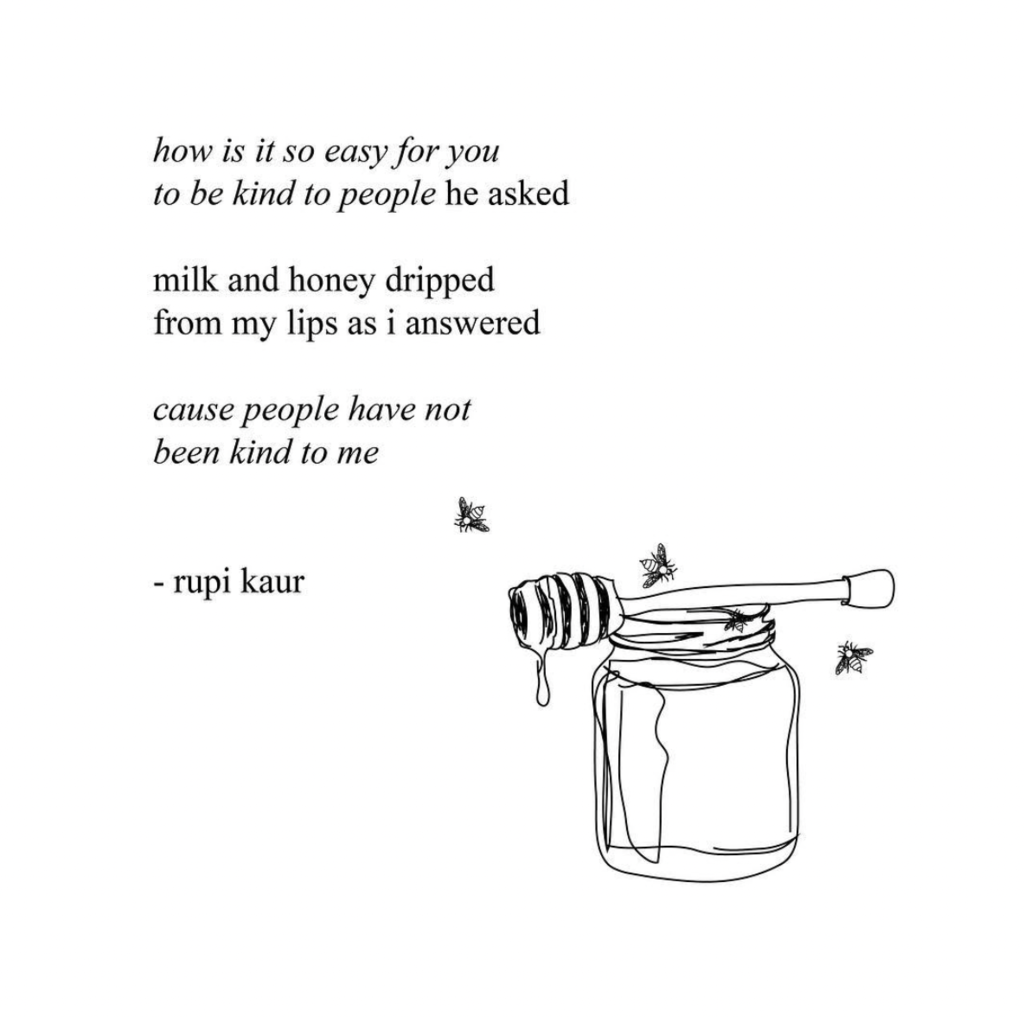
Social media isn’t for everyone, but if it’s something you're comfortable with, start sharing your work and interacting with other poets, authors, or readers of poetry. For sharing extracts or entire poems, Instagram is ideal because of its image focus — allowing you to post images containing poetry. For longer work or participating in poetry discussions, Twitter’s images and public conversations are a great place to be.
Contest wins make your author bio more persuasive
If you manage to win a contest, that’s a gem to feature in your writer bio, as prizes and achievements help validate your work in the eyes of other people. Don’t worry, people don’t outright dismiss writers who have no fancy-sounding accolades — but the least you can offer yourself is the chance to win one, and for that to happen, you need to be entering contests.
🚨You’ll need to watch out for dodgy contests trying to scam writers. To help you identify reputable ones, we’ve compiled this directory of poetry contests you can refer to anytime.
4. Determine whether you’ll self- or traditionally publish
Two roads diverged in a yellow wood…
Will you be self-publishing your poetry book or seeking a book deal with a publisher? The road ahead depends on this decision.
If you publish traditionally
Traditional publishing follows a well-known model: with or without the help of a literary agent, you are offered a book deal by a publisher willing to take a gamble on your book. You’ll work with an in-house editor to polish your manuscript, and will be provided with a cover and some publicity (the extent of which varies from book to book) by the publisher.
💡 Note: Not all book genres require a literary agent. In poetry, they are not essential — but if you’d still like to find an agent to represent you, head to our post on how to write a query letter.
There isn’t a lot of money in poetry publishing…
The good news is that poetry readers are not particularly obsessed with writers’ pedigrees — which means that poetry publishers generally care less about who you are, and more about how good your writing is than they would if you were penning a memoir or even a novel.
The bad news is that because poetry doesn’t sell as well as other genres (e.g. crime thrillers or cozy romances), publishers are often less eager to invest in poetry books. Add to that the various biases at play in the gatekeeping process, you may find that securing a book deal is tough. To improve your chances, a respectable author platform is desired: in other words, it’d be great to have had a few of your individual poems published already.
Head to our directory of literary magazines, and don’t forget to review submissions guidelines and follow them to a T!
But there is more prestige in trad pub
Like literary fiction, poetry is quite heavily tied into legacy bookselling. Being published traditionally gives you more direct access to activities denoting prestige in the book industry: hardback editions, prize consideration, editorial reviews in magazines or newspapers, you name it. Still, only a small minority of poetic works receive this kind of recognition, so it is by no means guaranteed to any traditionally published poet.
If you choose to self-publish
Self-publishing a poetry book is becoming increasingly popular for both the creative control and ease of access it offers — anyone with talent, a computer, and passion can now see their work in print. It is a larger undertaking than having someone else publish it for you, but it offers you complete control, and requires no one else’s approval.
Self-publishing a poetry book is similar to self-publishing a novel — and you can check out this thorough guide for the step-by-step process. But let’s run through the fundamentals now.
Like any self-published title, a poetry book is going to have its best chance at success if you have:
- A compelling, genre-specific cover;
- Targeted keywords and categories on Amazon;
- An enticing Amazon book description that uses your keywords;
- An author website and newsletter to promote your book;
- A solid understanding of your paid advertising options.
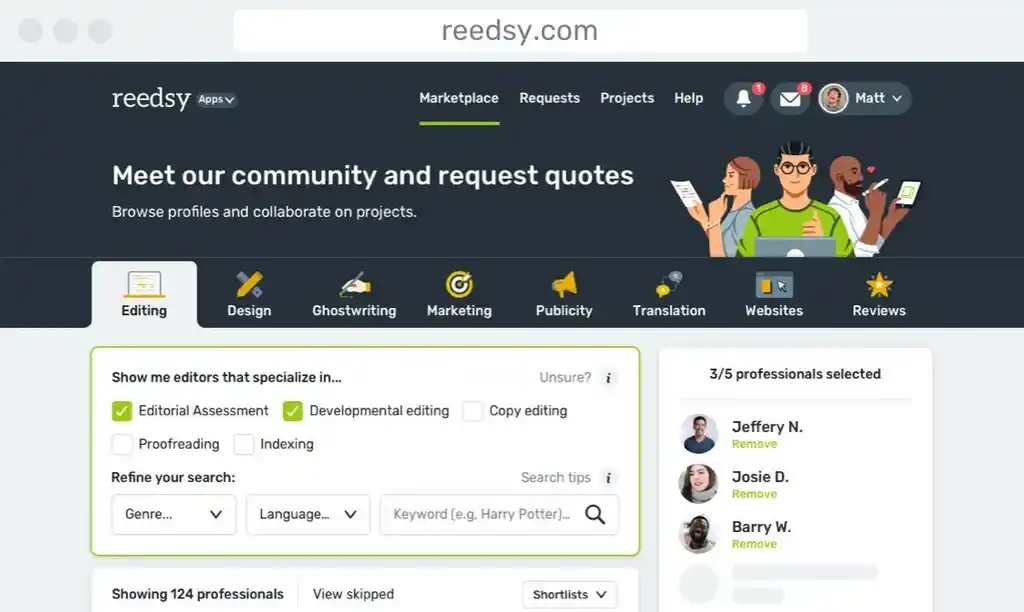
If you need help with any of the above, we’ve linked to some helpful resources on our blog — or you can always hire a professional editor, designer, marketer, or publicist from Reedsy’s marketplace:
Give your book the help it deserves
The best editors, designers, and book marketers are on Reedsy. Sign up for free and meet them.
Learn how Reedsy can help you craft a beautiful book.
5. Attract the right readers with the right presentation
For the rest of this post, we’ll assume you’re self-publishing — so you’ll be responsible for the presentation of your poetry book, inside and out.
Cover design

Cover designs are more than just a pretty façade. They contain coded information about the book’s tone and content that readers’ brains are trained to interpret, even though they may not consciously realize it. A poetry cover, then, needs to look like a poetry cover to attract the attention of poetry readers — whether that’s in bookstores or digitally.
There aren’t particularly strict conventions for poetry covers, though a degree of abstraction is common. Unlike the designs of genre fiction, which gravitate towards a particular palette or type of font, poetry allows a lot of freedom, but that also means it can be tricky to get right — which is why we always advise that you work with a professional cover designer.
Interior design

Interior design by Reedsy designer Rachel Kelli
Poetry really allows you to be visually creative, so if your work is laid out in an unusual way, it may well be worth your time to hire an interior formatter who’ll be able to handle any challenges your unique format presents. If your poetry doesn’t require special formatting, you can typeset it yourself using Reedsy Studio — our free tool that allows you to easily import your work and export to ebook or PDF files.
🎨 Can't visualize your poetry collection's interior yet? Check out our post on poetry book layout for insights from designers and inspiration!
6. Release your poetry book into the world
You’ve got a polished manuscript typeset for publication and a great cover to boot — the next thing on your to-do list is choosing a self-publishing company to distribute your book with.
In the US and UK, releasing your work on Amazon generally helps you reach the biggest audience — but should you go Amazon-exclusive, or sell “wide” to other retailers as well? And do you want to exclusively sell ebooks, or create a print version? These are all important marketing decisions that you’ll want to consider as you prepare to launch your book, so do check out our in-depth guides to these topics:
- The 17 BEST Self-Publishing Companies of 2022 (Read here)
- READ THIS Before You Enroll in KDP Select! (Read here)
- Print on Demand Books: The Best Services in 2022 (Read here)
Every book requires active book marketing efforts
You can’t just release a book and let it wilt away from the eyes of readers: you owe it to yourself to maximize the number of people who read it.
Book marketing starts long before you actually publish, so the earlier you have a plan in place, the better. During your launch stage, it also helps if you run a preorder for a while, so that you can build hype, gather early reviews, and boost your sales rank before release day. One way to secure book reviews is to submit your book to Reedsy Discovery, the platform we built to champion independent authors and their work. If you can launch your book along with some praise from reviewers, you’ll have much better chances of intriguing the people who hear about it — everyone values social validation!
Free course: How to get book reviews
Learn how to get the book reviews you need to turn browsers into buyers. Get started now.
Consider a gentle advertising push
Digital advertising can be quite scary to get into, but it doesn’t have to be. This includes Facebook, Amazon, as well as BookBub advertising (providing you sell your poetry book in ebook format). All you need is some patience and willingness to learn. With advertising in place, your book can build some sales momentum at any point — but it’s especially important to give it a boost during its initial launch.
Ready to do some learning? Sign up for our free introductory course below!
Free course: Amazon Advertising for Authors
Advertise directly on Amazon and reach your target readers where they buy most of their books. Start this 10-day online course today!
In advertising, you can easily waste money if you try things at random, but it’s possible to test audiences without spending a fortune if you make careful decisions and evaluate their impact. Start slow, test the waters, and if you feel like you need their help, get a professional book marketer to help you with your campaigns. Once you’ve figured out what works well, you can then scale up your efforts and invest more money in proven methods you’re confident will work.
Top tip: Check out these case studies of Amazon ads getting it right for some more inspiration!
7. Stay present and continue leading people to your work
Marketing your book never really ends, as anything you do post-publication is an opportunity to bring up your book. But two active strategies you can choose are giving readings and publishing essays or articles in hopes of leading people to your book.
Give readings (and bring some copies)
 You might not be able to match Amanda Gorman’s poetry reading gig, but any reading, no matter how small, could bring new readers to you. So look up local book festivals, open mic nights, or even virtual open mic sessions, and get your work heard by as many people as possible. You’d be surprised by how far word of mouth can take you. The number of attendees may be small, but if they’ve chosen to attend a poetry event, you can bet these people are passionate about literature — so you better take some signed copies along to sell to anyone interested.
Get published (and mention your book)
Another way you can lead readers to your work is to write for print or digital publications. You could pitch a personal essay, a reading list, or submit poetry, as long as it’s something related to your book’s themes or the act of writing itself — a political op-ed won’t necessarily bring readers to your poetry book. But if your published writing is relevant, and you can ensure that your new book is mentioned, a new byline can result in people looking up your book and buying it to check out more of your work.
Alternatively, you can give a publication the right to print an exclusive extract of your book — an example of this might be Kat Lister’s extract of her memoir The Elements, published in The Guardian. As you can see, the extract is followed by a short note stating that her book is available for sale.
As you can see, publishing a poetry book is a long-term commitment: if you’re serious about your writing career, your efforts don’t simply end when the book is published, but continue so that a steady stream of new readers can reach your work. Don’t expect immediate pay off, but remember that every little thing you do to improve or promote your book counts. Best of luck!